Citicoline vs Alpha-GPC
Citicoline vs Alpha-GPC — At a Glance
Citicoline (CDP-Choline)
Mechanism: Raises acetylcholine + donates uridine for membrane phospholipid synthesis
Evidence quality: Moderate — positive RCTs exist, mixed results in healthy adults
Standard dose: 250–500 mg/day
Onset: Effects may accumulate over 4–12 weeks
Best role: Daily foundation supplement; long-term membrane support
Alpha-GPC
Mechanism: Direct, high-bioavailability choline delivery → acetylcholine synthesis
Evidence quality: Moderate — strong in clinical populations; emerging in healthy users
Standard dose: 300–600 mg/day
Onset: Acute effects possible within 60 minutes
Best role: Pre-task cognitive boost; stack pairing with racetams
Key contraindications: Alpha-GPC — cardiovascular risk factors warrant caution; important 2021 stroke-risk data covered below. Citicoline — generally well-tolerated; mild GI effects possible. Neither replaces healthcare provider guidance.
Disclaimer: This article is for educational purposes only and does not constitute medical advice. Citicoline and alpha-GPC interact with cholinergic neurotransmission and may not be appropriate for everyone. Consult a qualified healthcare provider before beginning any supplementation, particularly if you have cardiovascular risk factors, take anticholinergic medications, or have a pre-existing neurological condition.
Here is the question I get asked more consistently than almost any other in the choline category: citicoline or alpha-GPC, which one should I take? The answer I give surprises most people. I tell them the question is usually wrong — not because both are equivalent, but because they operate through genuinely different pathways and serve different purposes. Choosing between them based solely on “which raises acetylcholine more” is a bit like choosing between a hammer and a screwdriver based on which one hits harder. The right tool depends entirely on what you are building.
I spent the better part of four years running systematic personal trials on choline sources before I reached a position I was confident enough to write about. My early experience with choline supplementation — like most people’s — started with standard choline bitartrate, which did essentially nothing useful beyond making me smell faintly of fish at higher doses. Alpha-GPC came next, and the difference was immediate and noticeable: sharper working memory, noticeably better word retrieval during demanding cognitive sessions, and a motivation quality that was distinct from caffeine. Then I spent twelve weeks on citicoline in isolation. The effects were subtler and slower, but what I noticed over those weeks was less about acute performance and more about a kind of cognitive resilience — less mental fatigue accumulation across long work sessions, better recovery of baseline function after sleep deprivation. These are different profiles, and recognising that distinction changed how I recommend both. You can explore the broader context in our Nootropics & Supplements Guide, which covers the full landscape of evidence-backed compounds I’ve tested.
What Choline Supplements Actually Do — and Why Most Fall Short
Choline is an essential nutrient the body cannot synthesise in sufficient quantities on its own. According to the NIH Office of Dietary Supplements, adequate intake is set at 550 mg/day for adult men and 425 mg/day for adult women, yet most people in the United States fall short of these targets through diet alone. The brain depends on choline for two interlocking purposes: as the direct precursor to acetylcholine, the neurotransmitter governing memory formation, attention, and learning, and as the building material for phosphatidylcholine, the dominant phospholipid in neuronal cell membranes.
The Acetylcholine Pathway — and the Blood-Brain Barrier Problem
The cholinergic system is central to cognitive function. Acetylcholine neurons in the basal forebrain project widely to the cortex and hippocampus, facilitating attention switching, memory encoding, and cortical arousal. The challenge for supplementation is not whether choline matters — it clearly does — but whether ingested choline compounds can actually cross the blood-brain barrier in meaningful concentrations and reach the neurons that need them.
Basic choline salts — choline bitartrate and choline chloride — have poor central bioavailability. They raise plasma choline reasonably well but cross the blood-brain barrier inefficiently at standard doses. This explains why many people experimenting with these forms report little cognitive effect despite technically meeting their daily choline requirement. Both citicoline and alpha-GPC were developed specifically to solve this bioavailability problem, and they do so via entirely different structural mechanisms.
Harvard Health and the Foundational Choline Evidence
The Harvard T.H. Chan School of Public Health notes that observational data from the Framingham Offspring Study — involving 1,391 adults followed across a decade — found higher dietary choline intake associated with better verbal and visual memory, as well as smaller white matter hyperintensity volume, a marker of small-vessel brain disease. The research picture is more complicated than “take more choline and think better,” but the foundational relationship between choline status and cognitive function is well-established.
How Citicoline Works — The Double Mechanism
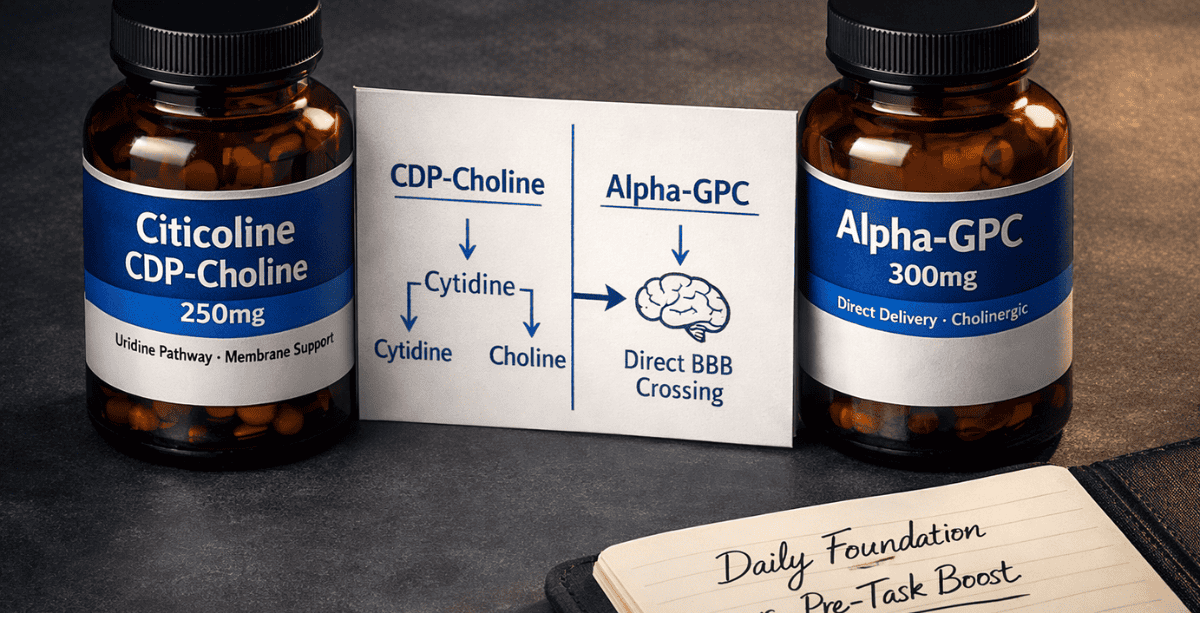
Citicoline — also written as CDP-choline or cytidine-5′-diphosphocholine — is a naturally occurring molecule in human cells. When ingested, it is hydrolysed in the gut into two components: choline and cytidine. The choline crosses the blood-brain barrier to support acetylcholine synthesis. The cytidine converts to uridine in the blood, which then crosses independently into the brain and participates in phosphatidylcholine synthesis — the process of building and repairing neuronal cell membrane phospholipids.
The Uridine Angle — Why This Matters for Long-Term Cognition
The uridine pathway is what makes citicoline genuinely distinct from every other choline source and explains why its cognitive effects accumulate over weeks rather than appearing acutely. Phosphatidylcholine is the primary structural phospholipid of neuronal membranes. As cells age, membrane phospholipid turnover accelerates, and the brain’s capacity for repair and new synapse formation depends in part on having adequate precursor availability. Citicoline provides both the choline for neurotransmitter synthesis and the cytidine-uridine for membrane maintenance simultaneously — a dual contribution no other mainstream choline source replicates.
This mechanism also explains why citicoline research shows particular strength in populations with compromised baseline cognition — aging individuals, those with vascular risk factors, post-stroke patients — where membrane repair capacity matters more than in young, healthy brains. For younger users, the acute cholinergic effects are real but modest; the long-term membrane support is the more compelling rationale.
Frontal Lobe Bioenergetics and the Attention Connection
Clinical research has demonstrated that citicoline improves frontal lobe bioenergetics and alters phospholipid membrane turnover in human subjects. The frontal cortex governs sustained attention, executive function, and working memory — the cognitive functions most relevant to professional performance. This suggests a plausible mechanism by which citicoline supplementation may support exactly the cognitive domains that degrade first under chronic stress, sleep deprivation, or ageing. For more on how this connects to daily performance, our article on working memory and its cognitive role provides useful background.
How Alpha-GPC Works — Direct Delivery and a Broader Reach
Alpha-GPC (L-alpha-glycerylphosphorylcholine) takes a more direct route. As a glycerophosphocholine compound, it is absorbed in the gut and crosses the blood-brain barrier intact, where it releases choline directly at neuronal sites. By weight, alpha-GPC contains approximately 40% choline — significantly higher than citicoline — which contributes to its reputation for more pronounced acute cholinergic effects. You can explore the full mechanistic detail in our dedicated Alpha-GPC benefits and research review.
The Dopaminergic and Serotonergic Dimensions
Alpha-GPC does not stop at acetylcholine. Research in animal models and preliminary human studies indicates that alpha-GPC influences dopamine and serotonin transmission in the frontal cortex and striatum — systems governing motivation, reward processing, and mood. A 2021 randomised placebo-controlled trial by Tamura et al. found that alpha-GPC supplementation increased self-reported motivation in healthy volunteers across a two-week administration period, an effect the authors attributed to its modulatory influence on dopaminergic transmission. This broader neurotransmitter reach may explain why users subjectively describe alpha-GPC’s effects in terms of both clarity and drive, rather than clarity alone.
Growth Hormone and the Athletic Performance Angle
Alpha-GPC is notable for a secondary property that citicoline does not share: evidence of growth hormone stimulation. Multiple studies have found that alpha-GPC increases growth hormone secretion, particularly when taken pre-exercise. This contributes to its popularity among athletes and biohackers combining cognitive enhancement with physical performance goals. For purely cognitive purposes, this additional mechanism is interesting but less directly relevant than its central cholinergic effects.
The Evidence Compared — What the Research Actually Shows
Citicoline: The RCT Landscape
The strongest citicoline trial in healthy adults is the 2021 double-blind, placebo-controlled study by Nakazaki et al., which enrolled 100 men and women aged 50–85 with age-associated memory impairment. Participants receiving 500 mg/day of citicoline for 12 weeks showed significant improvement in episodic memory performance compared to placebo, with particular gains on paired-associates tasks correlating with frontal lobe function. Notably, the same improvement was not replicated in a separate RCT using 1,000 mg/day, suggesting a dose-response relationship that is not simply linear — a finding worth keeping in mind when calibrating protocol design.
A 2023 systematic review and meta-analysis by Bonvicini et al. pooled data from seven RCTs in patients with mild cognitive impairment, Alzheimer’s disease, and post-stroke dementia. All seven studies showed a positive effect of citicoline on cognitive function, with pooled standardised mean differences ranging from 0.56 to 1.57 across sensitivity analyses. The authors were appropriately cautious about the overall quality of available studies — risk of bias is a legitimate concern in this literature — but the directional consistency across independent trials is meaningful.
The honest assessment for healthy younger adults: the acute cognitive enhancement evidence in non-impaired populations is limited. Citicoline’s evidence base is stronger in individuals with some degree of cognitive compromise, making the long-term neuroprotective and membrane support rationale more relevant for healthy users than expectation of immediate performance gains.
Alpha-GPC: The Research Picture in Healthy Individuals
A 2024 randomised, double-blind, placebo-controlled crossover trial by Gorji and Khalilpour tested acute alpha-GPC supplementation in 20 resistance-trained men. Both 315 mg and 630 mg doses significantly improved performance on the Stroop test — a measure of cognitive control and attention — compared to placebo, with effects appearing within 60 minutes. This is one of the cleaner recent trials in a healthy population, though the sample is small and all-male.
A 2023 systematic review and meta-analysis by Sagaro et al. reviewed seven RCTs and one prospective cohort study in adults with cognitive dysfunction. Patients receiving alpha-GPC showed significantly better cognition as measured by the MMSE compared to those receiving placebo or other medications (mean difference 3.50 points; 95% CI: 0.36 to 6.63). The overall effect is clinically meaningful in impaired populations, though generalisability to healthy young adults remains limited by the available evidence base.
An important caveat from the Alzheimer’s Drug Discovery Foundation’s cognitive vitality review: evidence for alpha-GPC improving cognition in healthy individuals without cognitive impairment remains limited. The acute effects in performance-relevant tasks like the Stroop and N-Back appear real but individual variability is substantial. As with citicoline, results tend to be stronger in those who start with lower baseline cognitive function.
Safety Considerations — The Conversation Nobody Has Fully
I want to address the alpha-GPC safety data directly here, because it is routinely underreported in nootropics content and I think that is a disservice to anyone making an informed decision. This is also why reviewing the broader nootropic safety evidence before starting any cholinergic supplement is genuinely worthwhile.
Citicoline — A Reassuring Profile
Citicoline has a well-established safety record. Long-term administration has not been associated with serious adverse events in clinical trials, and it has been used as a prescription medication in parts of Europe and Japan for decades. Mild side effects — occasional headache, nausea, or gastrointestinal discomfort — have been reported in a small percentage of participants, typically at higher doses. The compound is generally considered one of the better-tolerated options in the choline category.
Alpha-GPC — The 2021 Stroke Data and What It Means
In 2021, a large-scale retrospective cohort study by Lee et al. in JAMA Network Open analysed data from over 12 million South Korean adults aged 50 and over. Those prescribed alpha-GPC had a 46% higher adjusted hazard ratio for total stroke compared to non-users, with risk increasing in a dose-responsive manner. Ischemic stroke risk was elevated by 36% and haemorrhagic stroke by 37%.
There are legitimate methodological caveats. In South Korea, alpha-GPC is a prescription drug used predominantly in older adults with existing cognitive impairment or vascular risk factors — populations with elevated baseline stroke risk regardless of supplementation. The retrospective design cannot establish causation, and confounding by indication is a real concern. That said, the proposed biological mechanism — alpha-GPC raises plasma choline, which gut bacteria convert to TMAO (trimethylamine N-oxide), a metabolite associated with cardiovascular disease — is biologically plausible and supported by independent animal research.
My position: for healthy adults under 50 without cardiovascular risk factors using alpha-GPC intermittently at standard doses, this data should not create panic. For adults over 50, or those with hypertension, dyslipidaemia, or family history of stroke, the risk-benefit calculation changes meaningfully. In those groups, citicoline becomes the considerably more defensible choice. This is a situation where the conversation with a healthcare provider is not boilerplate advice — it is genuinely important.
Stack Integration — How Each Fits Into a Broader Protocol
Citicoline fits naturally as a daily foundation compound. Its slow-build mechanism, excellent tolerability, and membrane support properties make it well-suited to continuous use at 250–500 mg/day. It pairs well with compounds that complement but do not duplicate its mechanism — lion’s mane mushroom (for NGF and neuroplasticity), omega-3 DHA (additional membrane support), and adaptogenic compounds like Bacopa monnieri (for memory consolidation via separate mechanisms).
Alpha-GPC, by contrast, is particularly valuable as a targeted pre-performance supplement — taken 30–60 minutes before a cognitively demanding session, a high-stakes meeting, or intensive study. Its better-established acute effect profile makes it the more logical choice when timing and immediacy matter. Within the nootropic stacking framework, alpha-GPC is also the conventional choline source paired with racetam-class compounds like aniracetam, which increase acetylcholine turnover and can deplete available choline without supplementation. For this racetam-pairing purpose, alpha-GPC’s higher choline content per dose is a genuine advantage over citicoline.
Practical Protocol — Dosing, Timing, and Who Should Choose What
Citicoline Protocol
Dose: 250–500 mg/day
Timing: Morning with or without food
Duration: Minimum 8–12 weeks to assess
Best for: Foundation supplement; older adults; anyone prioritising long-term brain health
Alpha-GPC Protocol
Dose: 300–400 mg acutely; 300 mg/day sustained use
Timing: 30–60 min pre-task for acute use; morning for daily use
Duration: Assess after 4 weeks sustained; or acute as-needed
Best for: Acute performance boosts; racetam pairing; under-50 healthy adults
One approach I have used personally and find well-grounded in the evidence is running citicoline as a continuous daily foundation at 250 mg, then adding alpha-GPC situationally at 300 mg pre-task during periods of high cognitive demand. This preserves the long-term membrane and cholinergic support from citicoline while allowing the more acute cholinergic potency of alpha-GPC when it is actually needed, without the theoretical cardiovascular concern of daily high-dose alpha-GPC exposure accumulating indefinitely.
What This Research Review Confirms
- Citicoline and alpha-GPC raise acetylcholine through different structural routes — citicoline also provides uridine for neuronal membrane repair, a benefit alpha-GPC does not replicate.
- Evidence in cognitively impaired populations is stronger for both compounds than in healthy adults; realistic expectations for young, healthy users should reflect this distinction.
- Alpha-GPC’s 2021 stroke-risk cohort data warrants genuine attention, particularly for adults over 50 or those with cardiovascular risk factors — citicoline is the safer choice for these groups.
- Citicoline suits daily long-term use; alpha-GPC suits acute cognitive loading and racetam stack pairing.
- The most defensible protocol for most users is citicoline as a daily foundation, with situational alpha-GPC supplementation for high-demand sessions rather than continuous daily use.
Frequently Asked Questions
Can I take citicoline and alpha-GPC together?
Combining them is possible but requires some caution around total choline load. High cumulative choline intake can cause cholinergic side effects — headaches, brain fog, lethargy, and in some people a low mood that paradoxically resembles depression. If you combine them, keep the total choline equivalent conservative: 250 mg citicoline plus 150–200 mg alpha-GPC daily is a reasonable starting point. Taking alpha-GPC situationally rather than daily is a safer approach when stacking.
Which is better for pairing with racetam nootropics?
Alpha-GPC is the conventional choice for racetam pairing because of its higher choline content by weight and its direct, high-efficiency delivery mechanism. Racetams accelerate acetylcholine turnover in the brain, which increases choline demand. Alpha-GPC’s more concentrated choline delivery addresses this demand more directly than citicoline at comparable doses. That said, citicoline is used successfully by many people alongside racetams — it just typically requires a slightly higher dose to meet the increased cholinergic demand.
How long before I notice effects from citicoline?
Research suggests citicoline effects on memory and cognition accumulate over 8–12 weeks of consistent supplementation. This is a genuine characteristic of the compound, not a marketing narrative — the membrane phospholipid synthesis pathway citicoline supports through its uridine component takes time to influence neuronal structure. Do not assess citicoline after two or three weeks and conclude it does not work. Commit to a minimum 8-week trial at 250–500 mg/day before drawing any conclusions.
Should I be concerned about the alpha-GPC stroke data if I am young and healthy?
For healthy adults under 40 without cardiovascular risk factors using standard doses intermittently, the 2021 cohort study should inform rather than alarm. The study population was predominantly older adults with existing health conditions in a country where alpha-GPC is a prescription drug — not young nootropics users. The risk calculus changes significantly with age, and the TMAO mechanism means that continuous daily high-dose use over years represents a different exposure profile than occasional supplementation. Use the data as a reason to be thoughtful rather than dismissive.
What is choline bitartrate and why is it not recommended over these options?
Choline bitartrate is an inexpensive choline salt that raises plasma choline effectively but crosses the blood-brain barrier poorly at standard doses. This means most of the choline stays in peripheral circulation rather than reaching the neurons where it is needed. At high doses sufficient to produce central effects, choline bitartrate also tends to cause a fishy body odour due to TMAO production — an unpleasant side effect that disappears with better-tolerated forms. For cognitive purposes, both citicoline and alpha-GPC offer meaningfully superior central bioavailability and are worth the modest price premium.
Free Download
Get the 7-Day Brain Optimization Protocol
The evidence-based diet, sleep, and supplement framework for your first week of cognitive enhancement — completely free.
Join 2,000+ readers optimising their cognitive performance. Unsubscribe anytime.
Scientific References
- Nakazaki, E., et al. (2021). Citicoline and Memory Function in Healthy Older Adults: A Randomized, Double-Blind, Placebo-Controlled Clinical Trial. The Journal of Nutrition, 151(8), 2153–2160. https://pubmed.ncbi.nlm.nih.gov/33978188/
- Bonvicini, M., et al. (2023). Is Citicoline Effective in Preventing and Slowing Down Dementia? A Systematic Review and a Meta-Analysis. Nutrients, 15(2), 386. https://pmc.ncbi.nlm.nih.gov/articles/PMC9866349/
- Sagaro, G.G., Traini, E., & Amenta, F. (2023). Activity of Choline Alphoscerate on Adult-Onset Cognitive Dysfunctions: A Systematic Review and Meta-Analysis. Journal of Alzheimer’s Disease, 92(1), 59–70. https://pmc.ncbi.nlm.nih.gov/articles/PMC10041421/
- Gorji, A., & Khalilpour, S. (2024). Acute Alpha-Glycerylphosphorylcholine Supplementation Enhances Cognitive Performance in Healthy Men. Nutrients, 16(23), 4240. https://pubmed.ncbi.nlm.nih.gov/39683633/
- Tamura, Y., et al. (2021). Alpha-Glycerylphosphorylcholine Increases Motivation in Healthy Volunteers: A Single-Blind, Randomized, Placebo-Controlled Human Study. Nutrients, 13(6), 2091. https://pubmed.ncbi.nlm.nih.gov/34207484/
- Lee, G., et al. (2021). Association of L-α Glycerylphosphorylcholine With Subsequent Stroke Risk After 10 Years. JAMA Network Open, 4(11), e2136008. https://pubmed.ncbi.nlm.nih.gov/34817582/
- Parker, A.G., et al. (2015). The effects of alpha-glycerylphosphorylcholine, caffeine or placebo on markers of mood, cognitive function, power, speed, and agility. Journal of the International Society of Sports Nutrition, 12(Suppl 1), P41. https://pmc.ncbi.nlm.nih.gov/articles/PMC4595381/
- NIH Office of Dietary Supplements. (2024). Choline — Health Professional Fact Sheet. National Institutes of Health. https://ods.od.nih.gov/factsheets/Choline-HealthProfessional/
- Harvard T.H. Chan School of Public Health. (2024). Choline — The Nutrition Source. Harvard University. https://nutritionsource.hsph.harvard.edu/choline/