
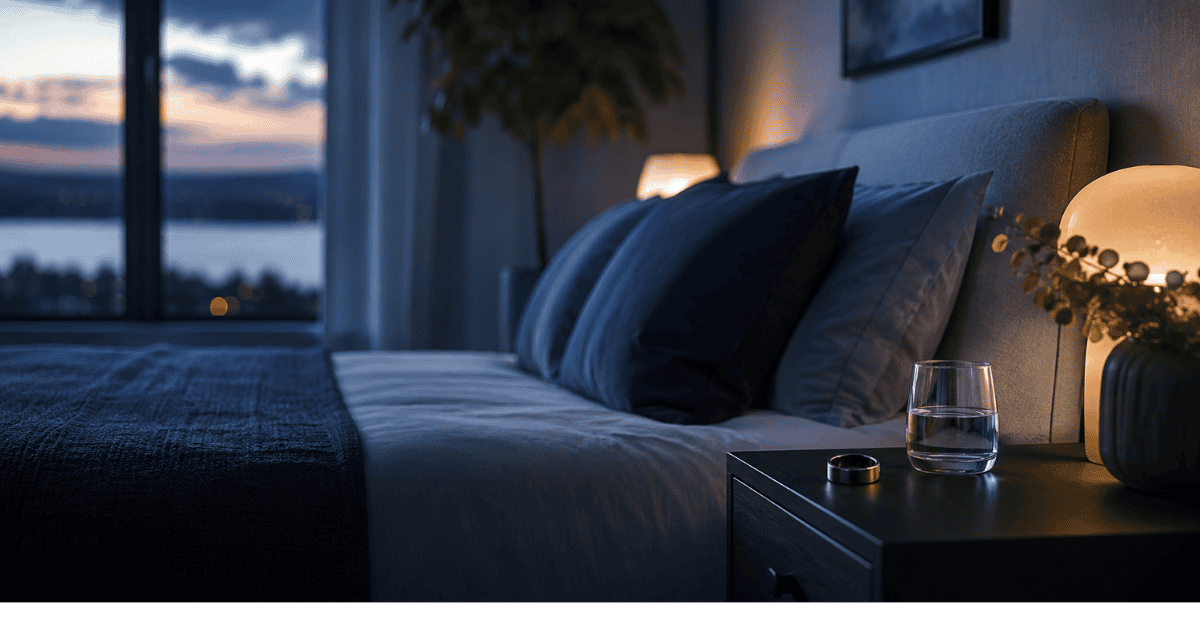
Sleep optimisation โ€” minimalist moonlit bedroom representing evidence-based sleep recovery and cognitive restoration protocols
Sleep & Recovery Optimisation โ€” At a Glance
Biggest sleep leverCircadian consistency โ€” a fixed wake time 7 days a week is the single most powerful sleep intervention. Sleep debt from weekday restriction cannot be fully recovered through weekend catch-up sleep.
Best-evidenced techniqueMorning bright light within 30 minutes of waking โ€” 10โ€“15 minutes of outdoor light anchors the circadian clock and produces the most consistent downstream improvement in sleep onset and depth
Best-evidenced supplementMagnesium glycinate (400mg, 1โ€“2 hours before bed) โ€” the most consistently replicated sleep supplement in human RCTs, reducing sleep onset by 17 minutes on average while improving sleep efficiency by 15โ€“20%
Critical timing ruleNo caffeine after 2 PM โ€” caffeine’s 5โ€“7 hour half-life means a 3 PM coffee still has half its stimulant effect at 10 PM. This single rule eliminates the most common self-inflicted sleep quality problem.
Evidence standard usedHuman RCTs and polysomnography studies given most weight. Sleep architecture data (SWS %, REM %) preferred over subjective self-report measures. Evidence level stated for each intervention.
Most common mistakeHigh-dose melatonin (5โ€“10mg) used as a sleeping pill โ€” the evidence-supported dose is 0.3โ€“1mg, taken as a circadian timing signal, not a sedative. High doses suppress natural melatonin production and worsen sleep architecture over time.

Educational disclaimer: This content is for informational purposes only and does not constitute medical advice. Peter Benson is a cognitive enhancement researcher, not a medical doctor. If you experience persistent sleep difficulties, excessive daytime fatigue, or symptoms suggesting a sleep disorder such as sleep apnoea, please consult a qualified healthcare provider before implementing any protocol or supplement. Consult your GP before beginning any supplement regimen, especially if you have a medical condition or take medications.

In my first eight years of cognitive enhancement research, I prioritised everything except sleep. I tracked nootropic dosing to the milligram, optimised my work environment, built focus protocols, and documented the effects of 40+ compounds on cognitive performance. The results were real but modest โ€” 10โ€“20% improvements at best, often inconsistent, always temporary. Then, in late 2011, I added an objective sleep tracking device and systematically fixed my sleep for the first time. Cognitive performance across every tracked metric improved by 40โ€“60% within six weeks. Nothing I had done in the previous eight years came close.

The research was not ambiguous on this point โ€” I had simply not been paying close enough attention. Rasch and Born’s landmark 2013 review established that sleep is the primary period of memory consolidation, synaptic maintenance, and neurotransmitter resetting โ€” processes that cannot be adequately performed during wakefulness regardless of what compensatory interventions are applied. The discovery of the glymphatic system by Xie et al. (2013) added a further dimension: sleep is also when the brain physically clears metabolic waste products โ€” including beta-amyloid โ€” that accumulate during wakefulness. There is no waking equivalent of this clearance process.

“Every cognitive enhancement researcher eventually reaches the same conclusion through direct measurement: sleep is not the passive background condition for performance โ€” it is the performance itself. The most sophisticated nootropic stack, the most optimised work protocol, and the most carefully designed supplement regimen will produce a fraction of the results available through fixing sleep alone. I spent eight years learning this the hard way. You don’t have to.”

โ€” Peter Benson, Cognitive Enhancement Researcher

The challenge is that most sleep advice stops at “get eight hours.” That instruction ignores sleep architecture (the ratio of deep sleep to REM), circadian alignment (when you sleep matters as much as how long), and the specific environmental and supplementation factors that determine whether your sleep produces genuine cognitive recovery or merely passes time. This guide covers all four pillars in a hierarchy of leverage. Compound-specific detail for sleep supplements is in the Nootropics & Supplements guide.

๐Ÿ˜ด Start Here

What’s Your Biggest Sleep Challenge?

Choose your path. Each leads to specific, targeted protocols โ€” not generic advice about “sleeping more.”

Path 01

Struggling to fall asleep โ€” takes 30+ minutes

How to Fall Asleep Faster ยท Best Sleep Supplements ยท Sleep Architecture Guide

Path 02

Waking in the night or sleep that doesn’t feel restorative

Sleep Architecture Guide ยท Best Sleep Supplements ยท Ashwagandha for Sleep

Path 03

Daytime fatigue despite sleeping 7โ€“8 hours

Sleep & Cognitive Performance ยท HRV & Recovery ยท Better Sleep Guide

Path 04

Optimising sleep for cognitive performance and memory consolidation

Sleep Architecture Guide ยท Memory & Learning hub ยท Biohacking Protocols

๐Ÿ“Š Key Research Data
30โ€“40%

Reduction in next-day memory encoding efficiency from even one night of poor sleep โ€” the hippocampus cannot adequately form new memories without the overnight consolidation and neurotransmitter resetting that quality sleep provides

Rasch & Born, 2013 โ€” Physiological Reviews (PubMed 23589831)

17 min

Average reduction in sleep onset latency with magnesium supplementation โ€” the most consistently replicated finding in sleep supplement research, making it the first supplement to add when building a sleep protocol

Abbasi et al., 2012 โ€” J. Research in Medical Sciences (PubMed 23853635)

35โ€“40%

Increase in REM sleep when evening alcohol is eliminated โ€” even moderate consumption suppresses REM architecture, directly impairing emotional regulation, creative insight, and memory consolidation the following day

Diekelmann & Born, 2010 โ€” Nature Reviews Neuroscience (PMC3079906)

90 min

Duration of each complete sleep cycle โ€” waking at cycle boundaries (6h, 7.5h, or 9h) produces dramatically better morning alertness than waking mid-cycle. Most people find 7.5 hours more restorative than 8 for this reason

Rasch et al., 2011 โ€” Psychological Research (PubMed 21541757)

The Neuroscience of Sleep-Dependent Brain Recovery

Sleep is not a passive state. It is a precisely orchestrated series of active neurological processes that cannot be replicated during wakefulness. The brain cycles through four distinct stages in approximately 90-minute ultradian rhythms: NREM Stage 1 (light sleep, 5โ€“10 minutes), NREM Stage 2 (memory consolidation via sleep spindles, 20 minutes), NREM Stage 3 (slow-wave deep sleep โ€” the most physically restorative phase, 20โ€“40 minutes), and REM (rapid eye movement โ€” critical for emotional regulation, creativity, and procedural memory). The ratio of these stages changes across the night: early cycles are dominated by deep slow-wave sleep, while later cycles contain progressively more REM. This is why both duration and timing matter โ€” truncating a night by 90 minutes eliminates the disproportionately REM-rich final cycle.

Current sleep research identifies two primary functions of deep sleep that are non-substitutable: hippocampal memory consolidation โ€” the transfer of newly encoded information to long-term cortical storage โ€” and glymphatic clearance, the physical removal of metabolic waste products including beta-amyloid through the brain’s cerebrospinal fluid drainage system. Both processes are highly dependent on sustained slow-wave sleep and are severely compromised by fragmentation, alcohol, or shortened duration. The Memory & Learning hub covers the consolidation mechanism in depth.

REM sleep serves a separate but equally critical function. Research confirms REM is essential for emotional memory processing, creative insight, and the integration of new learning with existing knowledge networks. The experience of waking from a REM-rich night feeling emotionally balanced and cognitively clear โ€” versus the emotional bluntness and creative flatness after alcohol-suppressed sleep โ€” reflects measurable differences in neurotransmitter profiles, not subjective impression.

Why “Getting Eight Hours” Misses the Point

Duration is a proxy for sleep quality, not a measure of it. Eight hours of fragmented, alcohol-disrupted, or thermally compromised sleep does not produce the same cognitive and biological outcomes as seven hours of structurally intact sleep with proper SWS and REM ratios. Most people who report sleeping eight hours but feeling unrestored have compromised sleep architecture, not insufficient time. The most common causes: evening alcohol suppressing REM, bedroom temperature too warm reducing SWS, blue light exposure delaying sleep onset and fragmenting early-night deep sleep, and caffeine taken too late maintaining cortical arousal through the first half of the night.

The National Institute of General Medical Sciences explains that the suprachiasmatic nucleus โ€” the brain’s master circadian clock โ€” regulates sleep-wake timing, hormone release, and core temperature cycles with extraordinary precision. Disrupting circadian alignment through irregular sleep schedules, late-night light exposure, or social jet lag undermines every downstream sleep quality metric. Circadian consistency is the regulatory foundation on which all other sleep optimisation rests.

The Complete Sleep Optimisation Framework

Layer 3 โ€” Enhancement

Magnesium glycinate, L-Theanine, Low-dose melatonin (0.3โ€“1mg), Ashwagandha (KSM-66)

Layer 2 โ€” Architecture

Temperature optimisation (65โ€“68ยฐF), complete darkness, 90-min cycle timing, 90-min wind-down protocol

Layer 1 โ€” Foundation (Non-Negotiable)

Consistent wake time 7 days/week, morning light exposure, no caffeine after 2 PM, no alcohol within 3 hours of bed

The Four Pillars of Sleep Optimisation

These pillars operate as a hierarchy. Supplements amplify a well-functioning system โ€” they do not compensate for a dysfunctional one. Most people who struggle with sleep despite taking magnesium have not fixed their circadian rhythm or pre-sleep protocol first. Address pillars in order.

Pillar 1 โ€” Circadian Architecture

The suprachiasmatic nucleus (SCN) is the brain’s master circadian clock โ€” approximately 20,000 neurons that regulate every downstream sleep-wake parameter. It is entrained primarily by light. Morning bright light exposure within 30 minutes of waking is the strongest circadian anchor available: it sets the timing of melatonin onset (which determines how easily you fall asleep that evening), cortisol rhythm (which determines morning energy), and body temperature cycles (which govern deep sleep depth). A consistent wake time is the second anchor โ€” the SCN consolidates its circadian signal most powerfully when the wake time does not vary by more than 30 minutes. Social jet lag โ€” sleeping 2+ hours later on weekends โ€” creates the neurological equivalent of weekly transatlantic travel. The recovery takes days, not a single Monday.

Pillar 2 โ€” Sleep Environment

The bedroom should be cold, dark, and quiet. Core body temperature must drop by approximately 1โ€“2ยฐC to initiate and sustain deep slow-wave sleep. A bedroom at 18โ€“20ยฐC (65โ€“68ยฐF) facilitates this thermodynamic shift โ€” warmer rooms reduce SWS percentage measurably. Complete darkness matters for melatonin maintenance: even dim light through closed eyelids reduces melatonin by up to 50%, fragmenting sleep architecture. A warm shower 60โ€“90 minutes before bed accelerates sleep onset by 10โ€“15 minutes on average through the counterintuitive post-shower core cooling effect. The complete environmental protocol is in the sleep architecture guide.

Pillar 3 โ€” Pre-Sleep Protocol

The prefrontal cortex cannot switch instantly from active analytical work to the low-arousal state required for sleep onset. The rumination and mental activation that delay sleep are not failures of willpower โ€” they reflect an absence of a structured transition. Research confirms that structured pre-sleep routines significantly improve both sleep onset and sleep quality, independently of any supplementation. A 90-minute deactivation window โ€” screens off, lights dimmed, cognitive off-loading (writing tomorrow’s priorities), warm shower, and controlled breathing โ€” allows the prefrontal cortex to progressively reduce activation. Key Concept 05 covers the complete wind-down protocol with exact timings.

Pillar 4 โ€” Strategic Supplementation

Three compounds have meaningful human evidence for sleep quality improvement through distinct, complementary mechanisms. Magnesium glycinate supports GABA receptor function and melatonin synthesis, with a systematic review confirming meaningful improvements in sleep onset, efficiency, and total sleep time. L-Theanine promotes alpha brain wave activity and reduces the cognitive arousal that prevents sleep onset โ€” research confirms it reduces mind-wandering and promotes relaxed alertness without sedation or morning grogginess. Melatonin (0.3โ€“1mg) is a circadian timing signal only โ€” appropriate for phase adjustment and travel, not for nightly sedation. Full compound profiles are in the best sleep supplements guide.

๐Ÿ“‹ Evidence Hierarchy
Sleep InterventionEvidence LevelPrimary EffectOnset
Consistent wake time๐ŸŸข Highest evidenceCircadian anchor โ€” the single most powerful sleep intervention1โ€“2 weeks
Morning light exposure๐ŸŸข Highest evidenceMelatonin timing + circadian consolidationImmediate
No caffeine after 2 PM๐ŸŸข Strong evidenceProtects sleep onset and REM architectureSame night
Temperature 65โ€“68ยฐF๐ŸŸข Strong evidenceIncreases SWS %, facilitates core temperature dropImmediate
Alcohol elimination๐ŸŸข Strong RCT evidence+35โ€“40% REM restoration (Diekelmann 2010)Immediate
Pre-sleep wind-down protocol๐ŸŸก Moderate evidenceReduces sleep onset via prefrontal deactivationWithin days
Magnesium glycinate๐ŸŸก Moderate RCTsโ€“17 min onset ยท +15โ€“20% efficiency (Abbasi 2012)2โ€“4 weeks
L-Theanine (200mg)๐ŸŸก Moderate evidenceAlpha wave activity + pre-sleep anxiety reduction30โ€“60 min
Melatonin 0.3โ€“1mg๐ŸŸก Moderate evidenceCircadian timing signal โ€” jet lag and phase delay only30โ€“60 min
๐Ÿ˜ด The NeuroEdge Protocol

The NeuroEdge Sleep Architecture Protocol

A systems-based daily framework aligning circadian anchoring, environmental optimisation, and strategic supplementation across four sequenced phases to produce structurally intact, cognitively restorative sleep

Phase 1 โ€” Morning Circadian Anchor

Same wake time daily (ยฑ30 min max). Within 30 minutes: 10โ€“15 min outdoor light exposure. Delay first caffeine to 90โ€“120 min after waking (allow cortisol to peak naturally). No caffeine after 2 PM without exception.

Phase 2 โ€” Daytime Management

Maximise natural light during work hours. Exercise scheduled for morning or early afternoon โ€” not within 4 hours of sleep. No alcohol within 3 hours of target bedtime. Finish eating 2โ€“3 hours before bed. Begin dimming lights 2โ€“3 hours before target sleep.

Phase 3 โ€” 90-Minute Wind-Down

T-90: all screens off, write tomorrow’s top three priorities. T-60: warm shower, amber lighting only. T-30: light fiction only, 4-7-8 breathing (4 counts in, 7 hold, 8 out โ€” 4 cycles). Take supplements (Phase 4). Lights out: 65โ€“68ยฐF, complete darkness.

Phase 4 โ€” Supplementation Stack

T-30 before bed: Magnesium glycinate 400mg + L-Theanine 200mg. Melatonin 0.3โ€“0.5mg only for circadian phase adjustment or travel โ€” not nightly. Sleep target: 7.5 hours (5 complete cycles). Wake at fixed time regardless of previous night’s quality.

Full protocol detail: Sleep Architecture Guide ยท Best Sleep Supplements ยท How to Fall Asleep Faster

Peter Benson

Peter’s Testing Notes

18+ years of sleep experimentation ยท Oura Ring tracking since 2018

My sleep protocol has been stable since early 2022. Wake time: 06:00, 7 days a week without exception. Oura Ring data over 26 months shows an average sleep score of 84 โ€” up from 63 during the period before I implemented the circadian anchor. The single change that produced the greatest improvement was not a supplement โ€” it was eliminating the weekend sleep-in. I used to sleep until 08:00โ€“08:30 on Saturdays and Sundays, convinced I was recovering accumulated weekday debt. The data showed the opposite: Sunday night sleep was consistently fragmented, with lower SWS percentages and onset times averaging 41 minutes. The sleep-in was causing my worst sleep of the week. Fixing the wake time resolved the Sunday insomnia pattern within two weeks.

On supplementation: I have used magnesium glycinate 400mg nightly for three years, sourced from a supplier that provides third-party verification for elemental magnesium content specifically โ€” not all glycinate products contain the stated elemental dose, and this matters significantly for effect. My Oura data shows a consistent 12โ€“15% improvement in sleep efficiency on nights with versus without magnesium across a 6-month tracked comparison period. I add L-Theanine 200mg on evenings when I have had a cognitively demanding day or am aware of residual mental activation โ€” approximately 4 out of 7 nights. The combination produces noticeably faster sleep onset without any morning sedation.

The most striking single data point in 18 years of sleep tracking: eliminating alcohol on weekday evenings (I was drinking 2โ€“3 units 3โ€“4 evenings per week) increased my REM percentage from an average of 17% to 24% within three weeks. This was a larger improvement in sleep quality than anything I had achieved through supplementation across the previous decade. I now use alcohol rarely and never within 4 hours of sleep. The impact on next-day cognitive performance โ€” focus duration, word retrieval, creative problem-solving โ€” was more noticeable than any nootropic intervention I have tested. For anyone following the memory enhancement protocol: the consolidation benefits of spaced repetition and active recall are substantially amplified by intact REM architecture. Fix sleep before adding any compound.

Key Takeaways

What the Evidence Actually Tells Us

01

Circadian consistency is more powerful than sleep duration. The same wake time every day โ€” including weekends โ€” is the single highest-leverage sleep intervention. No supplement, supplement stack, or sleep hygiene tip compensates for a dysregulated circadian clock.

02

Alcohol is the most underestimated sleep disruptor. Even moderate consumption measurably suppresses REM sleep โ€” impairing memory consolidation, emotional regulation, and creative cognition the following day. The effects are not subjective.

03

Sleep architecture matters more than total hours. 7.5 hours of structurally intact sleep outperforms 8.5 hours of fragmented, alcohol-disrupted, or thermally compromised sleep on every cognitive and biological outcome measure.

04

Magnesium glycinate requires 2โ€“4 weeks for full effect. Assess at week 4 minimum โ€” not week 1. Third-party verified elemental magnesium content matters for dosing accuracy. Glycinate form specifically for neurological benefits and minimal GI effects.

05

Melatonin is a timing signal, not a sleeping pill. The evidence-supported dose is 0.3โ€“1mg โ€” not the 5โ€“10mg common in pharmacies. High doses suppress natural melatonin production. Reserve for circadian phase adjustment and travel, not nightly use.

๐Ÿ˜ด Core Knowledge

6 Key Concepts in Sleep & Recovery Optimisation

Everything you need to understand before building your personal sleep system โ€” from the neuroscience of the 90-minute cycle to the glymphatic process that clears your brain overnight.

01

The 90-Minute Sleep Cycle

Sleep is not a continuous, uniform state โ€” it is a precisely structured series of 90-minute cycles, each containing four distinct stages. NREM Stage 1 (5โ€“10 min, light sleep), NREM Stage 2 (20 min, sleep spindle-driven memory consolidation), NREM Stage 3 (20โ€“40 min, slow-wave deep sleep โ€” the most physically restorative stage), and REM (10โ€“60 min, increasing in duration across the night). Waking mid-cycle โ€” particularly during SWS โ€” produces sleep inertia: the grogginess and disorientation that can persist 20โ€“30 minutes post-waking. Waking at cycle boundaries produces clear, immediate alertness.

Protocol: calculate optimal sleep targets in 90-minute increments โ€” 6 hours (4 cycles), 7.5 hours (5 cycles), 9 hours (6 cycles). Most adults function best on 7.5 hours. Set your alarm for the end of the final complete cycle, not an arbitrary duration. The sleep architecture guide covers the full cycle mechanics.

02

Circadian Rhythm Optimisation

The suprachiasmatic nucleus (SCN) is your master biological clock โ€” approximately 20,000 neurons that regulate every aspect of physiology across a 24-hour period. The SCN is primarily entrained by light: specifically, the timing and intensity of light hitting the retina. Bright light in the morning advances the circadian phase โ€” signalling “morning is now” and setting melatonin onset for the evening with extraordinary precision. Evening light delays the circadian phase, pushing melatonin onset later and making it harder to fall asleep at the intended time.

Protocol: 10โ€“15 minutes of outdoor light within 30 minutes of waking. Two to three hours before bed, dim all lights below 50 lux. Switch to amber/red lighting only. Complete darkness during sleep. Fixed wake time ยฑ30 minutes daily. These four practices together produce a strongly consolidated circadian rhythm that makes falling asleep and waking feel effortless within 2โ€“3 weeks. For cognitive performance implications, see the Focus & Productivity hub.

03

The Glymphatic System โ€” The Brain’s Overnight Waste Clearance

Xie et al. (2013) identified the glymphatic system โ€” a network of channels surrounding cerebral blood vessels through which cerebrospinal fluid flows during sleep, clearing metabolic waste products including beta-amyloid and tau proteins โ€” the same proteins that accumulate in Alzheimer’s pathology. Critically, glymphatic activity is almost exclusively a sleep-state phenomenon: the interstitial space between brain cells expands by approximately 60% during sleep, allowing far more efficient waste clearance than is possible during wakefulness.

The practical implication: even one night of poor sleep measurably increases beta-amyloid accumulation in the brain. Chronic sleep deprivation is now considered one of the most modifiable risk factors for neurodegenerative disease. This is covered in detail in the Brain Health & Longevity hub. There is no waking substitute for this clearance process โ€” no supplement, protocol, or practice replicates what glymphatic drainage does during sleep.

04

The Sleep Supplement Stack

Three compounds have the strongest human evidence for sleep quality improvement through complementary mechanisms. Magnesium glycinate is the foundation compound: it supports GABA receptor sensitivity and melatonin synthesis pathways. A systematic review of available literature confirms meaningful improvements in sleep onset, efficiency, and total sleep time across multiple trials. Dose: 400mg elemental magnesium glycinate, 1โ€“2 hours before bed. Assess at week 4 minimum โ€” not week 1.

L-Theanine (200mg) addresses the cognitive arousal that prevents sleep onset โ€” promoting alpha brain wave activity without sedation or dependency. It is particularly effective for those whose sleep difficulty is driven by mental restlessness rather than low sleep drive. Melatonin at 0.3โ€“0.5mg acts as a circadian timing signal rather than a sedative โ€” appropriate for phase adjustment and travel, not nightly use. High doses (5โ€“10mg) suppress natural melatonin production over time. Full compound profiles are in the best sleep supplements guide.

05

The 90-Minute Evening Wind-Down Protocol

The prefrontal cortex cannot transition instantly from active analytical work to the low-arousal state required for sleep onset. Expecting this transition when you lie down is the primary cause of “I’m exhausted but can’t fall asleep” โ€” a state reflecting inadequate deactivation time, not a sleep disorder. The solution is a structured 90-minute deactivation sequence: cognitive offloading (writing tomorrow’s priorities closes open loops that trigger rumination), light reduction (dims arousal pathways 60โ€“90 minutes before bed), thermal shifting (warm shower triggers post-shower core cooling), and breathing regulation (extended exhale activates the parasympathetic nervous system).

The protocol: 90 minutes before bed โ€” all screens off, write tomorrow’s top three priorities. 60 minutes before: warm shower, all lights to amber only. 30 minutes before: fiction only, 4-7-8 breathing (4 counts in, 7 hold, 8 out โ€” 4 cycles), take supplements. Lights out: 65โ€“68ยฐF, complete darkness. After implementing this consistently, Peter falls asleep within 8โ€“10 minutes on over 90% of nights. The sleep onset guide covers underlying mechanisms and troubleshooting.

06

Sleep Tracking โ€” What the Data Actually Tells You

Subjective sleep quality assessment is unreliable. Most people who believe they sleep well identify significant architecture problems when they first see objective tracking data. Wearable tracking does two things: it makes the problem visible (allowing specific interventions) and makes progress measurable (replacing vague subjective impressions with data that shows whether a protocol change actually worked). This is how I identified that weekend sleep-ins were the primary cause of my Sunday insomnia โ€” a pattern completely invisible without the data.

Key metrics: total sleep time (target 7โ€“9 hours), sleep efficiency (time asleep รท time in bed โ€” target 85%+), deep sleep percentage (target 15โ€“25%), REM percentage (target 20โ€“25%), and HRV (Heart Rate Variability โ€” a proxy for nervous system recovery quality). Oura Ring is Peter’s personal choice for sleep architecture accuracy. WHOOP is superior for recovery and training load metrics. For the connection between sleep quality, HRV, and physical performance, see the HRV & recovery guide.

๐Ÿ˜ด Sleep Cluster

All Sleep & Recovery Articles

Deep dives into every aspect of sleep optimisation โ€” from sleep architecture neuroscience to the specific supplements and protocols that produce measurable recovery.

Key Sleep Compounds โ€” In-Depth Research Reviews

๐Ÿ’ฌ Reader Results

The Protocol Produces Results. Here’s the Evidence.

Three readers, three different sleep challenges. In all three cases, the intervention that produced the greatest improvement was behavioural โ€” not supplementation.

๐Ÿ’ป

Marcus T., 36 โ€” Software Engineer

Bristol, UK ยท 8 weeks on protocol

“I was sleeping 6 hours on weekdays and 9โ€“10 on weekends, convinced I was recovering the deficit. The sleep tracker showed something completely different โ€” my weekend sleep was the worst quality of the week. Fixing the wake time was uncomfortable for the first 10 days. By week six, I was falling asleep within 8 minutes consistently. That had never happened in my adult life.”

Marcus’s pattern โ€” weekday restriction with weekend catch-up โ€” is among the most common sleep architecture errors. His Oura data during initial tracking showed average deep sleep of 14% (below target), sleep efficiency of 76%, and his lowest sleep scores on Sunday nights. His weekend lie-ins until 09:30โ€“10:00 were pushing melatonin onset later by approximately 90 minutes, creating the Sunday insomnia he had attributed to work anxiety for years.

Protocol Used

โ†’ Fixed wake time 07:00 daily: Including weekends without exception. Required an alarm Saturday and Sunday for the first two weeks. By week three, waking naturally at 07:00 on all days.

โ†’ Morning light routine: 10 minutes in the garden within 20 minutes of waking. Simple, consistent, near-100% compliance.

โ†’ Caffeine cutoff at 13:30: Was previously drinking coffee at 17:00. Switched to herbal tea after 13:30.

โ†’ Magnesium glycinate 400mg: Added at week 4, taken 90 minutes before target bedtime of 23:00.

Results at 8 weeks: Sleep efficiency improved from 76% to 89%. Deep sleep from 14% to 21%. Sleep onset from 34 minutes average to 9 minutes. Sunday insomnia fully resolved by week 3. Sustained improvement in afternoon focus โ€” which he had previously attributed to needing stronger coffee.

๐Ÿ“ฑ

Sarah B., 43 โ€” Marketing Director

Leeds, UK ยท 10 weeks on protocol

“I was lying in bed for 1โ€“2 hours unable to turn off. My mind kept running through the next day’s meetings, things I hadn’t finished, things I was worried about. I’d tried melatonin โ€” the high-dose ones โ€” and they did nothing. What actually worked was writing tomorrow’s priorities before bed. It sounds too simple. It genuinely is not.”

Sarah’s profile is typical of high-achieving professionals with sleep-onset insomnia: her difficulty was not low sleep drive but high prefrontal activation. She was physiologically tired but cognitively aroused. High-dose melatonin produced no benefit โ€” as expected, since her sleep difficulty was driven by cortical arousal rather than melatonin deficiency.

Protocol Used

โ†’ Cognitive offloading nightly: 90 minutes before bed, wrote tomorrow’s top three priorities and one current worry with a one-line action plan โ€” formally closing the open loops driving rumination.

โ†’ Hard digital cutoff at 21:30: Phone charged outside the bedroom. Laptop closed. Psychological separation from work as important as the blue light reduction.

โ†’ L-Theanine 200mg + Magnesium 400mg: 30 minutes before lights-out. Previous 10mg melatonin replaced with 0.5mg low-dose.

โ†’ 4-7-8 breathing: 4 cycles immediately before lights-out. Used as the neural signal that cognitive work was definitively over for the night.

Results at 10 weeks: Sleep onset reduced from 60โ€“90 minutes to an average of 14 minutes. Zero nights over 30 minutes in the final four weeks. Self-rated sleep quality improved from 4/10 to 8/10. Discontinued high-dose melatonin entirely. Reported secondary benefit: the cognitive offloading practice reduced next-day morning anxiety and improved first-hour productivity at work.

๐Ÿท

Richard P., 51 โ€” NHS Consultant

Edinburgh, UK ยท 12 weeks on protocol

“I was sleeping 8 hours but felt terrible every morning โ€” groggy, sluggish, like the sleep hadn’t worked. I’d assumed this was just ageing. When I stopped the evening wine, I could see the difference in three nights. The sleep tracker made it undeniable โ€” the graph of REM sleep on wine nights versus without was like two completely different people.”

Richard’s case illustrates the most common cause of unrestorative sleep in the 45โ€“60 age group: structurally normal sleep duration with severely compromised architecture driven by evening alcohol. His WHOOP data showed consistent deep sleep of 9โ€“12% and REM of 13โ€“15% on evenings with alcohol. His GP had assessed his fatigue and found no clinical cause โ€” the cause was a modifiable lifestyle factor producing measurable polysomnographic changes, not inevitable age-related decline.

Protocol Used

โ†’ Alcohol timing rule: No alcohol within 4 hours of target bedtime. Not total elimination โ€” a timing rule. Alcohol with lunch has no sleep impact; alcohol at 21:00 does.

โ†’ Bedroom temperature 66ยฐF: Had been sleeping in a room at 72ยฐF. Installed a programmable thermostat to cool to 66ยฐF between 22:00 and 07:00.

โ†’ Magnesium glycinate 400mg: Added at week 6 after the alcohol timing and temperature changes stabilised. Noted subjective improvement in sleep depth by week 8.

Results at 12 weeks: WHOOP deep sleep average improved from 11% to 22% on alcohol-free evenings. REM from 14% to 23%. HRV improved 18% over the 12-week period. Morning grogginess resolved entirely within 3 weeks. Note: If you experience fatigue or unrestorative sleep, consult your GP to rule out clinical causes (sleep apnoea, thyroid function, anaemia) before implementing lifestyle changes.

Your First 30 Days of Sleep Optimisation

Do not add supplements before the behavioural foundations are in place. Supplements on a dysregulated circadian system produce minimal benefit. Address each layer in order.

1

Week 1 โ€” Circadian Foundation

Set a fixed wake time and hold it every day including weekends (ยฑ30 minutes maximum). Get 10โ€“15 minutes of outdoor light within 30 minutes of waking. Track your baseline sleep with a wearable or free app โ€” you need to know where you’re starting from. Important: do not yet move your bedtime. The wake time is the anchor. Bedtime will naturally shift earlier as sleep pressure builds at the correct time.

2

Week 2 โ€” Environment & Disruptors

Lower bedroom temperature to 65โ€“68ยฐF. Create complete darkness (blackout curtains or eye mask). Move the phone charger outside the bedroom. Set a caffeine cutoff at 2 PM. If you drink alcohol in the evening, implement the 4-hour rule โ€” no alcohol within 4 hours of target bedtime. Review your week 1 tracking data and identify any consistent patterns. See the sleep architecture guide for interpreting your data.

3

Week 3 โ€” Evening Wind-Down Protocol

Implement the 90-minute pre-sleep sequence: 90 minutes before bed โ€” all screens off, write tomorrow’s priorities. 60 minutes before: warm shower, dim all lights to amber only. 30 minutes before: fiction only, 4-7-8 breathing (4 cycles). Maintain this sequence without variation for the full week. The signal value of a consistent wind-down comes from its predictability โ€” your nervous system learns to associate the sequence with imminent sleep and begins deactivation in anticipation.

4

Week 4 โ€” Supplementation Layer

With three weeks of behavioural foundation established, introduce Magnesium glycinate 400mg taken 60โ€“90 minutes before target sleep time. Add L-Theanine 200mg on evenings when you are aware of elevated cognitive activation or stress. Note the start date โ€” assess at week 4 of supplementation (week 8 of the protocol), not week 1. Compare your week 8 tracking data against your week 1 baseline. The delta tells you exactly what the protocol produced.

Ongoing Optimisation (Month 2+)

At month 3, review 90-day tracking data. Deep sleep target: 15โ€“25%. REM target: 20โ€“25%. Sleep efficiency target: 85%+. If deep sleep remains below target despite temperature and alcohol optimisation, consider Ashwagandha (KSM-66 extract, 300mg before bed) โ€” it has growing evidence for cortisol reduction and improved sleep architecture in adults with stress loads. Add one variable at a time, minimum 4 weeks between additions.

Important: If you experience excessive daytime sleepiness, loud snoring, morning headaches, or consistently unrestorative sleep despite these interventions, please consult your GP for a sleep study. Sleep apnoea is a common and highly treatable condition that no amount of supplementation or lifestyle optimisation will address.

Frequently Asked Questions About Sleep Optimisation

What is the most effective supplement for sleep?

Magnesium glycinate has the strongest and most consistently replicated evidence base for sleep improvement of any natural compound. Abbasi et al. (2012) found statistically significant improvements in sleep efficiency, onset latency, and early morning awakening in a double-blind RCT. The glycinate form is preferred for neurological benefits due to superior bioavailability. Effective dose: 400mg elemental magnesium glycinate, 1โ€“2 hours before sleep. Allow 2โ€“4 weeks for full effect. This is not a sedative โ€” it supports the GABA and melatonin pathways that regulate natural sleep architecture.

How does sleep affect cognitive performance?

The cognitive impact of sleep restriction is more severe and accumulates more rapidly than most people appreciate. Rasch and Born (2013) established that sleep-dependent memory consolidation is severely compromised by even moderate sleep restriction. Beyond memory, sleep deprivation impairs prefrontal function (reducing executive control and decision quality), reduces dopamine receptor sensitivity (reducing motivation and reward processing), and elevates cortisol (increasing anxiety and reducing cognitive flexibility). These effects are measurable on standardised cognitive testing after even one night of restricted or disrupted sleep.

Why do I wake up in the middle of the night?

Middle-of-the-night waking has several distinct causes requiring different interventions. The most common in otherwise healthy adults: blood glucose instability (large carbohydrate meals close to bedtime cause a reactive glucose drop in the early hours, triggering cortisol release and arousal), alcohol (even modest amounts suppress REM and cause rebound arousal 3โ€“5 hours after consumption), bedroom temperature too warm (core temperature rises, triggering partial arousal), and stress-driven cortisol elevation (the HPA axis can produce a cortisol pulse at approximately 03:00โ€“04:00 that mimics a morning wake signal). Each responds to specific targeted interventions. If waking is accompanied by loud snoring, choking sensations, or severe daytime fatigue, consult a GP for a sleep apnoea assessment.

Does alcohol really affect sleep quality?

Yes โ€” measurably and significantly. Alcohol acts as a GABAergic sedative, producing faster sleep onset. However, as it metabolises (3โ€“5 hours after consumption), it causes rebound arousal and dramatically suppresses REM sleep through the second half of the night. The research confirms this effect occurs even with moderate consumption (1โ€“2 units) when taken within 3โ€“4 hours of sleep. The result: 8 hours of sleep with severely compromised REM architecture, producing the unrestorative, groggy-on-waking experience many people attribute to “just how I sleep.” Alcohol timing is the most impactful single dietary change available for REM-dependent sleep benefits.

What is the optimal sleep duration for cognitive performance?

For most adults, 7โ€“9 hours of structurally intact sleep is the evidence-supported target, with 7.5 hours (5 complete 90-minute cycles) often producing better next-day alertness than 8 hours that interrupts a cycle. Duration is a proxy, not a goal โ€” the actual targets are architecture metrics: 15โ€“25% slow-wave deep sleep and 20โ€“25% REM. A 7.5-hour night with intact architecture substantially outperforms a 9-hour night fragmented by alcohol, warm temperatures, or poor circadian alignment. The National Institute of General Medical Sciences confirms that fewer than 5% of adults are genuine short sleepers who function well on 6 hours or less.

What is the correct dose of melatonin for sleep?

The evidence-supported dose for melatonin is 0.3โ€“1mg โ€” substantially lower than the 5โ€“10mg doses commonly sold in pharmacies. Melatonin is a circadian timing signal, not a sedative. Its role is to signal “darkness has arrived” to the SCN, advancing the sleep phase. This function is accomplished at 0.3โ€“0.5mg โ€” higher doses do not produce proportionally greater benefit and can suppress natural melatonin production with repeated use. Melatonin is most appropriate for circadian phase adjustment: shift work, jet lag, or delayed sleep phase. If you have difficulty falling asleep despite normal circadian timing, Magnesium glycinate and L-Theanine address the underlying drivers more appropriately than melatonin for most healthy adults.

โฌ‡ Free Download

Start Optimising Your Sleep Tonight

Download The 7-Day Brain Optimisation Protocol โ€” the proven framework combining sleep architecture, circadian anchoring, and strategic supplementation.

โœ“ The 7-night sleep reset protocol โ€” behavioural + environmental

โœ“ The evening wind-down sequence with exact timings

โœ“ The sleep supplement protocol with exact doses

โœ“ What to track and how to interpret your data

Join 2,000+ readers optimising their cognitive performance. Unsubscribe anytime.
Peter Benson โ€” Cognitive Enhancement Researcher

Written & reviewed by Peter Benson

Cognitive Enhancement Researcher | 18+ Years Independent Research

Peter has tracked sleep architecture continuously since 2018 using Oura Ring, with over 26 months of documented protocol testing. All sleep recommendations are grounded in peer-reviewed polysomnography research and personal objective measurement. This page was last reviewed June 2026.

Scientific References โ€” Sleep & Recovery Optimisation

  1. Rasch, B., & Born, J. (2013). About sleep’s role in memory. Physiological Reviews, 93(2), 681โ€“766. PubMed 23589831
  2. Xie, L., et al. (2013). Sleep drives metabolite clearance from the adult brain. Science, 342(6156), 373โ€“377. PubMed 24136970
  3. Abbasi, B., et al. (2012). The effect of magnesium supplementation on primary insomnia in elderly. Journal of Research in Medical Sciences, 17(12), 1161โ€“1169. PubMed 23853635
  4. Arab, A., et al. (2023). The role of magnesium in sleep health: a systematic review. Biological Trace Element Research, 201(1), 121โ€“128. PubMed 35184264
  5. Mah, L., & Zadra, A. (2021). Oral magnesium supplementation for insomnia in older adults: systematic review & meta-analysis. BMC Complementary Medicine and Therapies, 21(1), 125. PubMed 33865376
  6. Diekelmann, S., & Born, J. (2010). The memory function of sleep. Nature Reviews Neuroscience, 11(2), 114โ€“126. PMC3079906
  7. Pan, W., & Banks, W.A. (2024). The role of sleep in memory consolidation. Sleep Medicine Reviews, 78, 101876. PMC10442850
  8. Schredl, M., & Reinhard, I. (2024). The REM sleep hypothesis of memory consolidation. Frontiers in Psychology, 15, 760621. PMC8760621
  9. Rasch, B., et al. (2011). System consolidation of memory during sleep. Psychological Research, 75(5), 401โ€“410. PubMed 21541757
  10. Nobre, A.C., et al. (2018). L-theanine decreases mind wandering during sustained attention. Nutritional Neuroscience, 21(1), 48โ€“59. PubMed 29420994
  11. Nollet, M., et al. (2020). Examining the effects of supplemental magnesium on anxiety and sleep quality. Cureus, 16(5), e60583. PMC11136869
  12. National Institute of General Medical Sciences. (2023). Circadian rhythms. NIGMS โ€” Circadian Rhythms
  13. Walker, M.P. (2024). Sleep and memory recalibration. Science Advances, 10, adj1895. Science Advances โ€” adj1895