
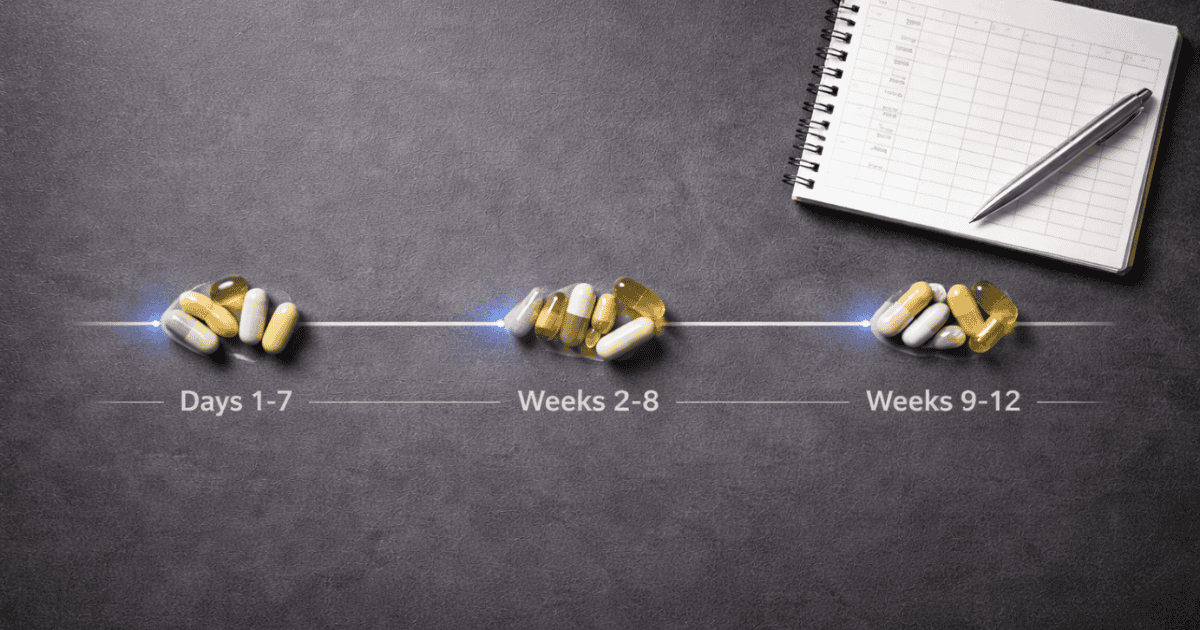
What to Expect from Nootropics: A Realistic 90-Day Timeline
Affiliate Disclosure: Some links in this guide are affiliate links, meaning I may earn a commission if you make a purchase — at no extra cost to you. I only recommend suppliers and products I have personally tested and use myself.
Medical Disclaimer: This guide is for educational purposes only and does not constitute medical advice. Peter Benson is a cognitive enhancement researcher, not a medical doctor. Consult a qualified healthcare provider before beginning any supplement regimen, particularly if you take medications or have pre-existing conditions.
| What this covers | A realistic, compound-by-compound timeline for when nootropics actually start working — and why quitting at week two is the single most common mistake in this category. |
| The core mistake | Judging every compound on the same timeline. Fast-acting and structural compounds work through completely different mechanisms, and evaluating a structural compound after two weeks is the wrong test entirely. |
| Fastest realistic result | L-theanine + caffeine, within 30–60 minutes of the first dose — genuinely immediate, genuinely reproducible. |
| Slowest realistic result | Lion’s Mane and Bacopa Monnieri, both needing a genuine 8–16 week window before their primary effects can be fairly judged. |
| Critical caveat | Not everything works for everyone, and a compound with decent average trial results can still do nothing for you individually. This timeline tells you when to judge — not that the judgement will always be positive. |
What to Expect From Nootropics: A Realistic Timeline
By Peter Benson — Cognitive Enhancement Researcher | 18+ Years Independent Research · Last reviewed: July 2026
Here’s the pattern I’ve seen more than any other in eighteen years of testing nootropics on myself and talking to readers about their own experiments: someone starts a genuinely well-evidenced compound, feels nothing dramatic within a week or two, and concludes it doesn’t work — for a compound whose own clinical trials never claimed to produce an effect that fast. The compound wasn’t the failure. The timeline expectation was. Knowing what to expect from nootropics is mostly a matter of knowing which timeline applies to which compound.
This isn’t a minor nuance. It’s the single biggest reason people write off effective supplements, and it’s almost entirely avoidable once you know which category a compound falls into. This guide covers realistic, evidence-based timelines for the most common nootropics — organised by how they actually work, not by marketing claims — so you know exactly how long to wait before deciding something isn’t for you.
“Evaluating a slow-build compound after two weeks and concluding it doesn’t work is like checking a savings account after two weeks of contributions and concluding it isn’t growing.”
This guide pairs with Optimal Nootropic Dosing and Timing for the daily schedule, How to Track Nootropic Effectiveness for the self-testing method that makes these timelines usable, and Are Nootropics Safe? for the safety framework. Start with the Nootropics & Supplements hub if you’re new to this entirely.
Two Categories, Two Completely Different Timelines
Nootropics split cleanly into two mechanism categories, and confusing which one you’re taking is where most timeline mistakes start. Fast-acting compounds work through existing neurotransmitter systems — adenosine receptor blockade, alpha-wave elevation, acetylcholine availability — and produce effects within an hour because they don’t require your brain to build anything new. Structural compounds work through neuroplasticity, membrane incorporation, or antioxidant protection accumulated over time, and by definition can’t produce their primary effect quickly, because the underlying biological process — dendritic growth, membrane phospholipid turnover — genuinely takes weeks.
Neither category is “better” — they solve different problems. But judging a structural compound by fast-acting standards, or expecting a fast-acting compound to keep improving indefinitely with continued use, are both timeline errors that lead people to abandon things that were actually working as designed.
The Realistic Timeline, Compound by Compound
Within the Hour: L-Theanine + Caffeine
This is the one genuinely fast, genuinely reproducible result in the category. In Haskell and colleagues’ double-blind crossover trial (250mg L-theanine + 150mg caffeine), the combination produced measurable improvements in attention and rapid information-processing accuracy, with reduced mental fatigue, within roughly an hour of dosing — no waiting period, no accumulation required. If you try nothing else from this list, this is the one where “it doesn’t work” after a fair attempt is actually meaningful feedback, since the mechanism guarantees near-immediate onset. The full protocol is in the L-Theanine + Caffeine stack guide.
Weeks 1–2: The Early-Signal Window
Some compounds show early signals here — faster than the structural ones, but still not instant. Magnesium L-Threonate’s sleep effects and Rhodiola Rosea’s anti-fatigue effects are sometimes reported in this window, though it’s worth being honest that the human evidence for both is limited and mixed rather than settled. This is also the window where side effects, if any are going to appear, typically show up — Bacopa’s mild GI discomfort being the most common example — which makes it an important early checkpoint even for compounds you’re not yet expecting benefit from.
Weeks 4–8: The Uncertain Middle
This is genuinely the hardest window to sit through, and where most people quit. Phosphatidylserine’s memory trials typically ran to 12 weeks — Crook and colleagues’ trial ran a full 12 weeks before confirming benefit (though note that landmark trial used bovine-derived PS; the soy- and sunflower-derived PS sold today has a weaker, less consistent evidence base). Lion’s Mane and Bacopa are usually still building toward their primary effect during this stretch, sometimes with subtle, easy-to-dismiss changes rather than anything definitive. Tracking something objective — a simple weekly self-test, not just how you feel — matters more here than at any other point in the timeline.
Weeks 8–16: Where the Slow-Build Compounds Actually Land
A meta-analysis of 9 Bacopa trials included only studies of 12 weeks or longer, and found its clearest, most consistent benefit on cognitive processing speed and attention at the 12-week mark — not week 4, not week 8. (Honestly: the effect on memory specifically was less consistent across trials, so temper expectations there.) See the full picture in the Bacopa Monnieri guide. Mori and colleagues’ Lion’s Mane trial ran the full 16 weeks, with cognitive scores rising during dosing and then declining after participants stopped — consistent with a benefit that depends on continued intake. Weigh it honestly, though: it was a small pilot (30 people), used non-standardised mushroom powder, and was run by a mushroom manufacturer, so it’s a starting signal rather than the last word. More in the Lion’s Mane guide. If you’re going to evaluate either of these compounds fairly, this is the window to do it in — not before.
Evaluating Lion’s Mane the right way
Say you want to give Lion’s Mane a fair trial. Here is the method applied end to end, so you can copy the process rather than guess.
Set the category and the date first. Lion’s Mane is a structural compound; the trial that supports it ran 16 weeks. So before the first dose, you write down a single evaluation date: 16 weeks out. That date is now fixed — it is not allowed to move because week 6 felt unremarkable.
Baseline before you start. Run a simple, repeatable cognitive test today and note the result — even a free reaction-time or word-recall task beats relying on memory of how you felt.
Hold everything else constant. No new sleep routine, no new supplement, no new training block during the window. If three things change, you can’t attribute a week-16 result to any of them.
Ignore the noise in weeks 1–8. Feeling nothing here is the predicted outcome for a structural compound, not a failure signal. The one thing worth watching early is tolerability, not benefit.
Re-test on the date — and accept the answer. At week 16, re-run the same baseline test and compare the numbers. If they’ve improved beyond normal day-to-day variation, you have a real signal worth continuing. If they’re flat, that’s a legitimate “not for me” — arrived at honestly, on the compound’s own timeline, instead of abandoned at week six on a hunch. Notice that a flat result here is a valid outcome, not a wasted 16 weeks: you’ve replaced a guess with an answer.
Evidence-Based Timelines by Compound
The minimum window used in the actual clinical trials — with an honest read on how strong the evidence really is. 🟢 Strong human RCTs · 🟡 Mixed / limited · 🔴 Commonly claimed, not supported.
The NeuroEdge Realistic Evaluation Protocol
How to actually know if a compound is working, rather than guessing.
A simple, repeatable self-test before starting anything — even a basic reaction-time app beats pure memory of how you felt before.
Check the table above and set your evaluation date before you start, not once you’re already impatient.
Nothing else new during the evaluation window — no new sleep routine, no new stack addition. Otherwise you can’t attribute the result.
At the evaluation date, re-run the same test from Step 1. Compare numbers, not vibes — subjective impressions are notoriously unreliable here.
Peter’s Testing Notes
I’ve made the “quit too early” mistake myself, more than once, despite writing about exactly this problem for years. My clearest example was an early Lion’s Mane run — I stopped after a few weeks because I genuinely felt nothing, then restarted it much later out of curiosity, this time tracking against a Creyos baseline rather than relying on how I felt. Taken all the way through the full window, that second run showed a modest but real improvement the first short attempt was never going to catch — because a few weeks simply isn’t long enough for this particular compound, no matter how disciplined you are about taking it.
What changed between the two attempts wasn’t the supplement — it was that I stopped trusting my subjective impression and started tracking something objective on a fixed schedule. That’s the actual lesson from eighteen years of doing this: the compounds that “don’t work” are disproportionately the ones evaluated on the wrong timeline, not the ones that are genuinely ineffective. A meaningful share of my own early “failures,” looking back, were timing mistakes I only caught by re-running the experiment properly.
Sourcing Standards
Product quality can itself masquerade as a timeline problem — an unstandardised or degraded product genuinely may never work, no matter how long you wait, which is a different failure mode from “hasn’t had time yet.” Confirming standardisation rules that out before you blame the timeline. Below is where I source the two slow-build compounds discussed most in this guide.
These are affiliate links — see the disclosure at the top of this article. I only link to products I’ve personally tested and use in my own stack.
Key Takeaways
✓ Fast-acting and structural compounds have completely different timelines — know which category before you start.
✓ Weeks 4–8 is where most people quit — and where several genuinely effective compounds are still building toward their real effect.
✓ Bacopa and Lion’s Mane need 12–16 weeks before a fair evaluation is even possible.
✓ Set your evaluation date before you start, not once impatience has already set in.
✓ Track something objective — subjective impressions are the least reliable signal in this entire category.
How This Plays Out in Practice
Illustrative examples, not real individuals or testimonials. These are composite scenarios written to show how the guidance above applies in common situations. They are not accounts of real people and contain no promised outcomes. Individual responses vary; these are not typical results.
Someone who has already decided Bacopa “isn’t for them” and is about to stop — until they learn its trials run 12 weeks. The reasonable move is to hold to the 12-week mark before judging, since week five is simply too early for this compound’s mechanism to have played out.
Someone methodical puts a calendar reminder at the 16-week mark before starting Lion’s Mane, specifically to remove the temptation to judge it on a discouraging week. Deciding the date up front is what protects the trial from impatience.
Someone starts a structural compound expecting L-theanine-style same-day results, based on generic “nootropics” marketing. Understanding the two-category split reframes the whole approach — and prevents writing off a compound that was never meant to act quickly.
Someone completes a full window on an unstandardised product with no result. Switching to a properly standardised version is what surfaces the difference — a reminder that “waited long enough” and “used the right product” are two separate checks, and a null result can be either.
Frequently Asked Questions
How long should I try a nootropic before giving up?
It depends entirely on the compound’s mechanism. Fast-acting compounds like L-theanine and caffeine should be judged within the first hour — if nothing happens by then, nothing is likely to. Structural compounds like Bacopa and Lion’s Mane need a genuine 12–16 week window, matching the timeline used in their actual clinical trials, before a fair evaluation is even possible.
Why do some nootropics work immediately and others don’t?
It comes down to mechanism. Fast-acting compounds work on neurotransmitter systems that already exist — blocking adenosine receptors, elevating alpha brain waves — which produces effects within an hour. Structural compounds work through neuroplasticity or membrane incorporation, biological processes that genuinely take weeks to unfold regardless of dose or consistency.
Is it normal to feel nothing during the first few weeks?
For structural compounds specifically, yes — this is expected and consistent with the research, not a sign something is wrong. Bacopa’s cognitive trials generally dose for a full 12 weeks before measuring their primary outcome, and improvements (mostly in processing speed and attention) tend to emerge around then rather than in the first few weeks. Feeling nothing early for these compounds is the predicted outcome, not a red flag.
How do I know if I’m just experiencing a placebo effect?
Track something objective on a fixed schedule rather than relying on how you feel — a simple, repeatable cognitive test taken before starting and again at your evaluation date. Subjective impressions are genuinely unreliable for slow-build compounds, since expectation and mood shift independently of any real effect over a 12–16 week period.
What’s the single most important thing to know before starting?
Set your evaluation date before you start, based on the compound’s actual trial timeline, not your patience level. Deciding in advance when you’ll fairly judge a compound removes the temptation to quit on a discouraging week that has nothing to do with whether the compound is actually working.
7 Days to a Sharper Brain
Peter Benson’s personal daily protocol, rebuilt from 18 years of testing
Seven evidence-based interventions, in the exact order that makes each one more effective — from sleep foundation to neuroplasticity and Lion’s Mane.
Join 2,000+ readers optimising their cognitive performance. Unsubscribe anytime.
Scientific References
- Haskell CF, Kennedy DO, Milne AL, Wesnes KA, Scholey AB. (2008). The effects of L-theanine, caffeine and their combination on cognition and mood. Biological Psychology, 77(2), 113–122. PMID 18006208
- Kongkeaw C, Dilokthornsakul P, Thanarangsarit P, Limpeanchob N, Scholfield CN. (2014). Meta-analysis of randomized controlled trials on cognitive effects of Bacopa monnieri extract. Journal of Ethnopharmacology, 151(1), 528–535. PMID 24252493
- Mori K, Inatomi S, Ouchi K, Azumi Y, Tuchida T. (2009). Improving effects of the mushroom Yamabushitake (Hericium erinaceus) on mild cognitive impairment: a double-blind placebo-controlled clinical trial. Phytotherapy Research, 23(3), 367–372. PMID 18844328
- Crook TH, Tinklenberg J, Yesavage J, Petrie W, Nunzi MG, Massari DC. (1991). Effects of phosphatidylserine in age-associated memory impairment. Neurology, 41(5), 644–649. PMID 2027477
- Avgerinos KI, Spyrou N, Bougioukas KI, Kapogiannis D. (2018). Effects of creatine supplementation on cognitive function of healthy individuals: A systematic review of randomized controlled trials. Experimental Gerontology, 108, 166–173. PMID 29704637

Peter has personally tested the compounds and protocols referenced in this guide, tracking sleep, HRV and cognitive performance data as part of his ongoing research practice. NeuroEdge Formula is his platform for rigorous, safety-first cognitive enhancement guidance.