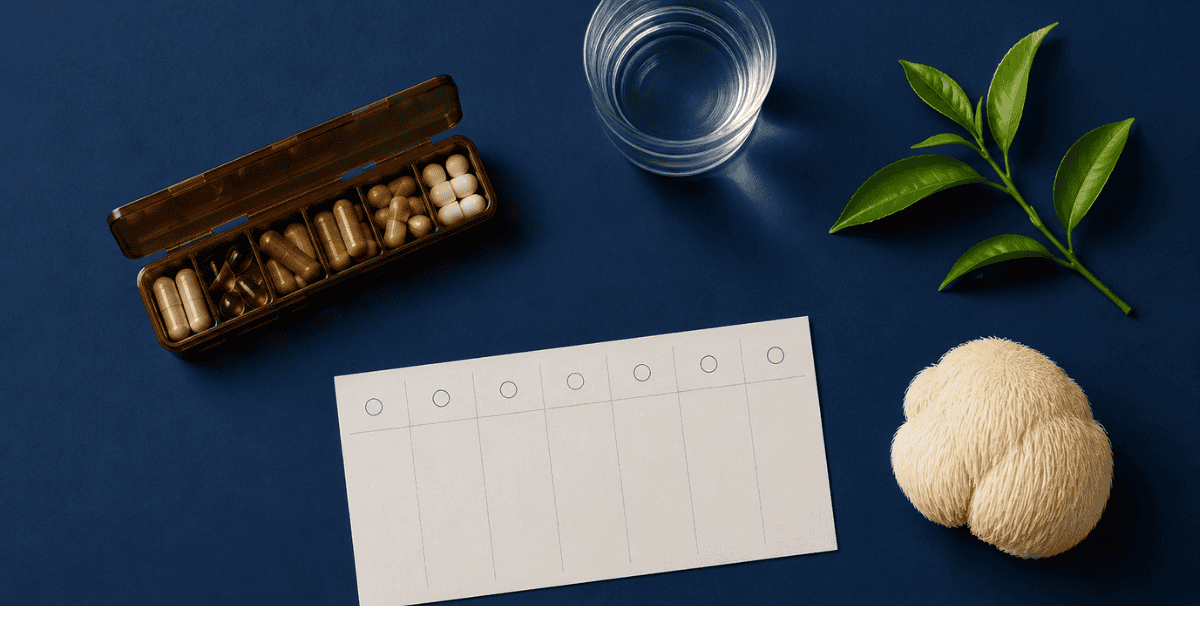
The 7 Days to a Sharper Brain Protocol is a seven-day plan that layers one evidence-based habit and one nootropic per day — magnesium for sleep, L-theanine for focus, nutrition timing, creatine, sleep-environment mastery, stress resilience, then Lion’s Mane. Compounds are introduced one at a time so you can identify what genuinely works for you before stacking further.
The 7-Day Sharper Brain Protocol
A behavioural and nootropic integration plan for peak cognitive performance — introduced one layer at a time.
By Peter Benson, Cognitive Enhancement Researcher | 18+ Years Independent Research · Published July 2026 · Last updated August 2026
Educational information, not medical advice. Peter Benson is a cognitive enhancement researcher, not a medical doctor. Consult a qualified healthcare provider before starting any supplement regimen — especially if you take medications, have a pre-existing condition, or are pregnant or nursing. Introduce compounds one at a time and stop immediately if you experience adverse effects.
Most cognitive-enhancement advice treats behaviour and supplements as separate conversations. In my 18+ years of research and personal testing, I’ve found the opposite is true: the brain responds best to a synergistic approach, where behavioural optimisation and strategic supplementation reinforce each other — introduced progressively so you can actually tell what’s working.
This is the full, public version of the plan I deliver as the free 7 Days to a Sharper Brain email course. Each day adds one habit and, where relevant, one compound. By Day 7 you have an integrated routine — and, more importantly, a personal read on which pieces matter most for you. For the compound science behind each choice, the Nootropics & Supplements Guide is the companion reference.
The named frameworks in this protocol
Five repeatable methods recur across the seven days. Each is defined here so it stands alone:
The 90-60-30 Wind-Down is a three-stage evening routine: at 90 minutes before bed all screens go off; at 60 minutes you take magnesium and write tomorrow’s top three priorities; at 30 minutes you do light stretching and ensure complete darkness.
The 25-Minute Focus Sprint is a single-task work block: one task, a 25-minute timer, no multitasking, then a 5-minute break before the next sprint.
The 90-Second Attention Reset is a mid-session recovery: 30 seconds looking 20+ feet away, 30 seconds of slow breathing, 30 seconds re-setting your next micro-goal.
The STOP Technique is a stress interrupt: Stop, Take a breath, Observe thoughts and sensations, Proceed with intention.
One-Compound-at-a-Time is the safety spine of the whole protocol: never begin two supplements together, so any effect — good or bad — is attributable to a single variable.
Day 1 — Sleep foundation + magnesium glycinate
The intervention: optimise sleep first, and add magnesium glycinate as your baseline supplement before anything stimulatory.
Why it works: during sleep the glymphatic system clears metabolic waste and consolidates memory. Magnesium supports the pathways governing sleep and stress, and the glycinate form is well absorbed and gentle on the stomach, with glycine adding a calming effect. In a 2025 placebo-controlled trial in 155 adults reporting poor sleep, 250mg of elemental magnesium (as bisglycinate) modestly improved insomnia symptoms — a small effect size, in a study whose senior author discloses nutraceutical-industry research funding, so treat it as supportive rather than decisive.
The protocol: magnesium glycinate, 300–400mg elemental magnesium, taken 1–2 hours before bed, starting tonight and continuing daily (the trial above tested ~250mg; 300–400mg is a common practical range — stay within the tolerable upper intake and reduce if you notice loose stools). Look for “elemental magnesium” on the label and a third-party certification (USP, NSF or ConsumerLab); avoid magnesium oxide, which is poorly absorbed. Pair it with the 90-60-30 Wind-Down. There’s a deeper breakdown in the Sleep & Recovery guide.
What to expect: possible mild relaxation 60–90 minutes after your first dose; easier sleep onset over Days 2–3; clearer mornings by Days 4–7. Rate sleep quality 1–10 on waking and note how long it takes to fall asleep — that’s your baseline.
Day 2 — Strategic focus + L-theanine
The intervention: add attention training plus the calm-focus stack — L-theanine, with or without caffeine.
Why it works: L-theanine promotes alpha brain-wave activity linked to relaxed alertness. Paired with caffeine, the combination improves accuracy on attention-switching tasks and self-reported alertness, and neuroimaging work shows it reduces mind-wandering by lowering default-mode-network activity. A systematic review supports it as the best-evidenced beginner focus stack.
The protocol: 200mg L-theanine with 100mg caffeine (a 2:1 ratio) in the morning or 30 minutes before focus work; or L-theanine alone at 100–200mg if you’d rather skip the stimulant. Start at the lower end to assess tolerance. Full dosing and timing detail is in the L-theanine + caffeine guide. Work in 25-Minute Focus Sprints and use the 90-Second Attention Reset when focus breaks down.
What to expect: a subtle sense of calm focus within 30–60 minutes, easier sustained attention, and — unlike caffeine alone — no jitter or crash. Continue your evening magnesium.
Day 3 — Precision nutrition + brain-fuel timing
The intervention: no new supplement today — instead, time your meals to stabilise the glucose your prefrontal cortex runs on.
Why it works: blood-glucose instability impairs prefrontal function within minutes, and when you eat matters as much as what you eat. Hydration counts too: a meta-analysis of 33 studies found dehydration degrades attention and executive function, with the clearest effects once fluid loss exceeds about 2% of body mass.
The protocol: a protein-dominant breakfast (25–30g protein, 15–20g healthy fats, minimal refined carbs); a moderate lunch of lean protein, complex carbs and vegetables, ideally after your most demanding work; a 15g protein snack at 3–4 PM if needed. Apply the 4-Hour Rule — eat your largest meal 4+ hours before your most important cognitive work — and front-load water across the morning.
What to expect: steadier energy and fewer afternoon dips. Track energy every two hours on a 1–10 scale and note where meal timing and clarity line up.
Day 4 — Movement integration + creatine
The intervention: add strategic movement breaks and creatine monohydrate as your third supplement.
Why it works: beyond muscle, creatine supports brain ATP production. A 2024 double-blind study found that a single high dose of creatine reduced cognitive deterioration during sleep deprivation alongside changes in cerebral high-energy phosphates. Short movement breaks also reset attention between sprints.
The protocol: creatine monohydrate 5g daily with food (consistency matters more than timing), or a 20g/day loading phase for 5–7 days then 5g. Choose a third-party-tested product (Informed-Sport or NSF Certified for Sport), add 16–20oz of water daily, and take a 3-minute reset every 45–60 minutes plus a 5-minute walk every 90–120. More depth in the creatine and cognition article.
What to expect: subtle gains in mental stamina in week one, clearer working-memory and processing benefits over 2–4 weeks as brain stores saturate, and a possible 1–2 lb of water retention early on.
Day 5 — Sleep-environment mastery
The intervention: engineer the bedroom, and decide whether to keep magnesium glycinate or upgrade to magnesium L-threonate.
Why it works: sleep onset depends on a 2–3°F drop in core temperature and darkness that protects melatonin. On the supplement side, a 2024 randomised trial found magnesium L-threonate improved subjective and objective sleep and daytime functioning — though it was a small (n=80), 21-day study funded by the maker of the branded ingredient (Magtein), so weigh it accordingly — and it is notably brain-bioavailable.
The protocol: room at 65–68°F, blackout darkness, consistent low background sound, 40–60% humidity. Then choose one — stay on 400mg magnesium glycinate (cost-effective and effective), or switch to magnesium L-threonate (Magtein, ~144mg elemental, split morning/evening). Don’t run both. The trade-offs are covered in the magnesium L-threonate article.
What to expect: faster sleep onset and fewer awakenings. Time bedtime around full 90-minute cycles (6, 7.5 or 9 hours) to avoid waking mid-cycle groggy.
Day 6 — Stress resilience + mindfulness
The intervention: add a brief daily mindfulness practice and in-the-moment stress interrupts. No new supplement — your body is adapting to five days of progressive stacking.
Why it works: chronic stress impairs prefrontal function and working memory while heightening amygdala reactivity. Regular mindfulness practice is associated with greater grey matter in attention and emotion-regulation regions and reduced amygdala reactivity — it functions as cognitive training, not just relaxation.
The protocol: a 5-minute breath-focused meditation each morning; a 3-breath reset between tasks; and the STOP Technique whenever stress spikes. When a task feels overwhelming, run the priority filter: “If I could complete only one thing in the next hour, what creates the most impact?” — then work solely on that for 15 minutes.
What to expect: you’ll notice stress earlier and interrupt it faster. Track how quickly you catch and defuse a stress response.
Day 7 — Neuroplasticity + Lion’s Mane
The intervention: introduce novelty to drive neuroplasticity, and add Lion’s Mane as your final compound.
Why it works: Lion’s Mane (Hericium erinaceus) contains compounds that support nerve-growth-factor pathways. University of Queensland researchers found that active compounds from the mushroom promoted neurite outgrowth and enhanced memory in preclinical models — strong mechanistic and animal evidence, with human trials still emerging.
The protocol: Lion’s Mane extract 500–1,000mg in the morning, standardised to at least 30% polysaccharides, ideally a dual extract of fruiting body and mycelium; give it a minimum of four weeks. Sourcing standards are in the Lion’s Mane review. Pair it with one small novelty daily — a new route, a new skill, a non-dominant-hand task.
What to expect: subtle clarity in week one, with neuroplastic benefits accruing over 4–8 weeks. This is a long-game compound, not an acute one.
The NeuroEdge 7-Day Sharper Brain Protocol
Your complete integrated daily routine after all seven layers.
Morning (with breakfast)
L-theanine 200mg + caffeine 100mg (2:1)
Creatine monohydrate 5g
Lion’s Mane extract 500–1,000mg
Evening (1–2h before bed)
Magnesium glycinate 400mg (or magnesium L-threonate per label)
90-60-30 Wind-Down
Daily behaviours
Morning activation (5 min) · 25-Minute Focus Sprints · movement breaks every 45–90 min · 5–10 min mindfulness · one novelty · 90-60-30 Wind-Down
Introduce compounds one at a time. Consult a healthcare provider before starting any supplement.
How the week tends to unfold
Illustrative example, not a real individual or testimonial. This is a composite of a typical experience, described in direction only — no promised outcomes or specific figures. Individual responses vary and are not typical.
Picture a mid-thirties knowledge worker — long focus blocks, an afternoon slump, and inconsistent sleep — running the protocol as written. Days 1–2 usually feel the most tangible: the evening magnesium and 90-60-30 Wind-Down tend to make sleep onset easier within a couple of nights, and the L-theanine + caffeine stack on Day 2 is the change most people register first, felt as calmer focus without the usual caffeine edge.
Day 3’s nutrition timing often does quiet, underrated work — steadier late-morning energy once the largest meal moves earlier and water is front-loaded. Creatine on Day 4 typically produces nothing dramatic at first; its contribution, if any, tends to show up as steadier working memory a few weeks in, not that afternoon. By the end of the week the pieces are stacked, but the more useful outcome is diagnostic: because each layer went in alone, our composite reader can now say which ones actually moved their focus, sleep, or energy — and quietly drop the ones that didn’t. That personal read, not the stack itself, is the point.
Peter’s testing notes
I’ve run some version of this sequence on myself for years, and the ordering isn’t arbitrary — it’s what stopped me misattributing effects. When I first started, I added three compounds in a week and had no idea which one gave me a headache. Now I hold each new variable for several days minimum.
The magnesium-first rule earns its place. Across 26+ months of Oura Ring data, my deep-sleep numbers are visibly more consistent on nights I take 400mg glycinate 1–2 hours before bed than on nights I skip it. L-theanine with my morning coffee is the change most people feel fastest — the absence of the caffeine jitter is obvious within the first few days. Creatine was the opposite: nothing dramatic acutely, but by week three my afternoon working memory held up better on demanding days. Lion’s Mane I treat as a months-long commitment, not a week-one win — I’m honest that the strongest evidence there is still preclinical.
If you only do one thing from this protocol, make it Day 1. Everything downstream works better on a foundation of good sleep, and no compound compensates for the lack of it.
Key takeaways
| → | Sleep is the foundation. Optimise it and add magnesium before any stimulatory compound. |
| → | L-theanine + caffeine (2:1) is the best-evidenced acute focus stack and the one most people feel first. |
| → | Nutrition timing and hydration often deliver more focus than supplements do. |
| → | Creatine and Lion’s Mane are cumulative — judge them over weeks, not days. |
| → | Add one compound at a time. Consistency beats perfection — 70% adherence still works. |
Frequently asked questions
Do I need to buy supplements to start the 7-day protocol?
No. Days 1, 3, 5 and 6 are largely behavioural — sleep, nutrition timing, sleep-environment design and stress resilience — and require no purchase. Magnesium, L-theanine, creatine and Lion’s Mane are introduced as optional layers, one at a time, so you can begin with behaviour alone and add compounds only if you choose to.
Is the protocol safe to combine with medication?
Each compound here is introduced one at a time at a standard dose, but several supplements can interact with prescription medication. This is educational information, not medical advice — consult your healthcare provider before combining any supplement with medication, and especially if you are pregnant, nursing, or managing a health condition. Stop immediately if you notice adverse effects.
How quickly will I notice results?
It varies by element. L-theanine with caffeine is usually felt within 30–60 minutes on Day 2, and better sleep from magnesium often appears within a few days. Creatine’s cognitive benefits build over 2–4 weeks as brain stores saturate, and Lion’s Mane is a multi-week to multi-month compound. Behavioural changes to sleep and nutrition timing can improve focus within the first week.
Why add only one supplement at a time?
Because it’s the only way to know what’s actually working. If you start several compounds together and feel a benefit — or a side effect — you can’t attribute it to any single one. Introducing one compound every few days makes each effect traceable to a single variable, which is the core of the One-Compound-at-a-Time method.
Should I take magnesium glycinate or magnesium L-threonate?
Start with glycinate at 400mg — it’s well absorbed, gentle, cost-effective and supported for sleep. Magnesium L-threonate is more brain-bioavailable and has trial evidence for sleep and daytime functioning, but it’s more expensive. Choose one, not both, since excess magnesium can cause gastrointestinal upset. Many people begin on glycinate and only trial L-threonate later.
What happens after the seven days?
Days 8 onward are a consolidation phase: keep the integrated stack consistent and fine-tune dosing and timing to your own response. From month two you can consider adding one further compound at a time — Bacopa monnieri or phosphatidylserine for memory, Rhodiola for stress — always one variable, tracked, and with a healthcare provider’s input.
Get “7 Days to a Sharper Brain” — Free
The complete printable protocol and daily tracker, delivered as a free 7-day email course. One habit and one compound at a time:
✓ Day 1 — Sleep foundation + magnesium
✓ Day 2 — Calm focus: L-theanine + caffeine
✓ Day 3 — Nutrition timing + hydration
✓ Day 4 — Creatine + movement
✓ Day 5 — Sleep-environment mastery
✓ Day 6 — Stress resilience + mindfulness
✓ Day 7 — Neuroplasticity, Lion’s Mane + your complete assembled daily stack
Join 2,000+ readers optimising their cognitive performance. Unsubscribe anytime.

Peter Benson
Cognitive Enhancement Researcher | 18+ Years Independent Research
Peter has spent 18+ years systematically testing behavioural protocols and nootropic compounds on himself, tracking outcomes with tools including 26+ months of continuous Oura Ring data. He is a researcher, not a medical doctor, and writes to make cognitive-enhancement evidence honest and practical.
Last reviewed August 2026
Scientific references
- Schuster, J., Cycelskij, I., Lopresti, A., & Hahn, A. (2025). Magnesium bisglycinate supplementation in healthy adults reporting poor sleep: a randomized, placebo-controlled trial. Nature and Science of Sleep, 17, 2027–2040. PMC12412596
- Hausenblas, H.A., et al. (2024). Magnesium-L-threonate improves sleep quality and daytime functioning in adults with self-reported sleep problems: a randomised controlled trial. Sleep Medicine: X, 8, 100121. doi:10.1016/j.sleepx.2024.100121
- Haskell, C.F., et al. (2008). The effects of L-theanine, caffeine and their combination on cognition and mood. Biological Psychology, 77(2), 113–122. PubMed 18006208
- Kahathuduwa, C.N., et al. (2018). L-theanine and caffeine improve target-specific attention to visual stimuli by decreasing mind wandering: a human fMRI study. Nutrition Research, 49, 67–78. PubMed 29420994
- Sohail, A.A., Ortiz, F., Varghese, T., et al. (2021). The cognitive-enhancing outcomes of caffeine and L-theanine: a systematic review. Cureus, 13(12), e20828. PMC8794723
- Gordji-Nejad, A., et al. (2024). Single-dose creatine improves cognitive performance and induces changes in cerebral high-energy phosphates during sleep deprivation. Scientific Reports, 14, 4937. PMC10902318
- Martínez-Mármol, R., et al. (2023). Hericerin derivatives activate a pan-neurotrophic pathway in central hippocampal neurons converging to ERK1/2 signalling enhancing spatial memory. Journal of Neurochemistry, 165, 791–808. doi:10.1111/jnc.15767
- Wittbrodt, M.T., & Millard-Stafford, M. (2018). Dehydration impairs cognitive performance: a meta-analysis. Medicine & Science in Sports & Exercise, 50(11). PubMed 29933347
© 2026 NeuroEdge Formula. Educational information only — not medical advice. Consult a qualified healthcare provider before starting any supplement protocol.