Sleep Architecture: Understanding Sleep Stages and Cycles
Affiliate disclosure: This article contains one affiliate link to a product I personally use. If you buy through it, NeuroEdge Formula may earn a commission at no extra cost to you. This is primarily an educational article about sleep physiology — no supplement meaningfully changes sleep architecture, and I say so plainly below.
⚕️ Educational Information, Not Medical Advice
This article reflects independent research and personal experimentation, not clinical guidance. I’m a cognitive enhancement researcher, not a medical doctor. Persistent sleep problems, loud snoring with pauses in breathing, or severe daytime sleepiness warrant medical assessment — conditions like sleep apnoea are common, treatable, and cannot be fixed by anything in this article. Please see a healthcare provider rather than self-managing.
Sleep Architecture: The Structure of a Night, and Why Its Shape Matters
Almost every conversation about sleep is a conversation about duration. Seven hours, eight hours, did you get enough. But duration is only half the story, and the half that’s easier to measure. Sleep has an internal structure — a repeating architecture of distinct stages, arranged in a specific order, with different functions concentrated at different points in the night. Understanding that shape explains things raw hours can’t: why a full eight hours can leave you flat, why cutting an hour off the end of the night costs more than it seems, and why the 3am wake-up is more damaging than the same amount of lost sleep at the start.
This guide covers what actually happens across a night, what each stage appears to do, and — importantly — where the popular science gets ahead of the evidence. It’s part of our Sleep & Recovery Optimisation guide. If your problem is getting to sleep in the first place, our guide to falling asleep faster is the more practical starting point.
The stages, and what actually happens in each
Sleep divides into two fundamentally different states: non-REM and REM. Non-REM is further split into three stages, and each is defined by a characteristic pattern of brain-wave activity rather than by how asleep you feel. Roughly 75% of the night is spent in non-REM sleep, with the largest share in stage N2 (StatPearls).
Stage N1 is the brief handover from wakefulness — heartbeat, breathing and eye movements slow, muscles relax with the occasional twitch, and it typically lasts only minutes. Stage N2 is light sleep, marked by brief bursts of electrical activity known as sleep spindles, and you spend more of the night here than anywhere else. Stage N3 is deep or slow-wave sleep, when heartbeat and breathing fall to their lowest levels and it becomes genuinely difficult to wake you — this is the stage most responsible for feeling physically restored (NINDS). REM sleep is different in kind: brain activity moves closer to waking patterns, eyes move rapidly, most dreaming occurs, and the limb muscles are temporarily paralysed so you don’t act out dreams.
The shape of the night — and why it isn’t symmetrical
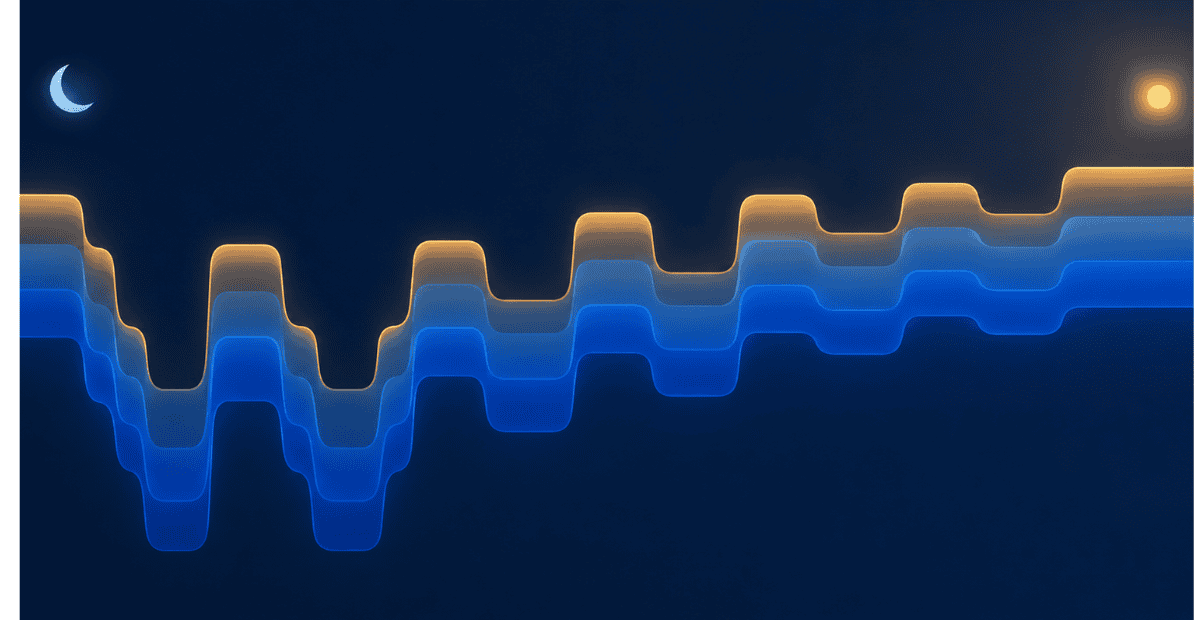
You move through these stages in cycles, not once but repeatedly. A complete cycle runs roughly 90 to 110 minutes, and a typical night contains four to six of them (StatPearls). But here’s the part that changes how you should think about sleep: the cycles are not identical copies of each other. Their composition shifts systematically across the night.
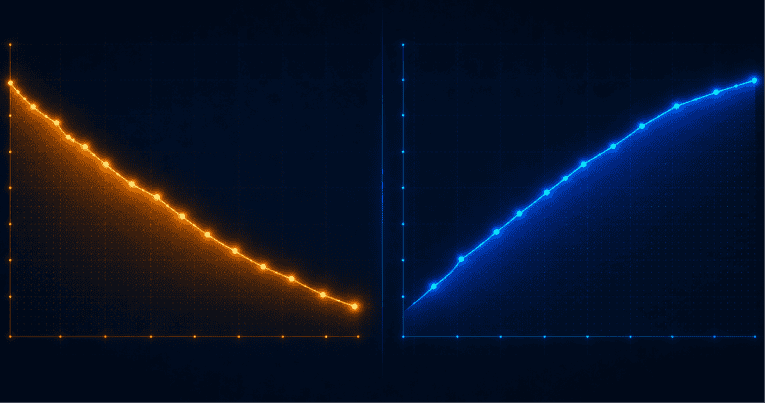
Deep slow-wave sleep is front-loaded — it occurs in longer periods during the first half of the night. REM is back-loaded — the first REM period arrives about 90 minutes after falling asleep, and REM periods get progressively longer as the night goes on (NINDS). By the final hours, you’re spending most of your time in lighter stages and REM, with little deep sleep remaining.
That asymmetry has a practical consequence people rarely appreciate. Cutting an hour off the end of your night doesn’t remove a representative slice of sleep — it removes disproportionately REM-rich sleep. Waking two hours early costs you far more REM than deep sleep. Conversely, going to bed an hour late and rising at the same time preserves deep sleep reasonably well while cutting REM. Neither is good, but they’re not the same deficit, and they don’t feel the same either.
What the stages are actually doing
The best-supported functional story concerns memory. Older thinking treated sleep as passively protective — memories survived because nothing interfered with them. Current evidence describes something far more active. In a comprehensive review of the field, researchers describe how memories undergo system consolidation during sleep, with slow-wave sleep proving more important than REM for this process (Rasch & Born, 2013).
The mechanism is elegant. During slow-wave sleep, recently encoded memories held temporarily in the hippocampus are repeatedly reactivated and gradually integrated into long-term storage in the neocortex — a dialogue orchestrated by the slow oscillations that define the stage. REM sleep, which follows, appears to stabilise those transformed memories (Rasch & Born, 2013). In other words, the sleeping brain isn’t idling. It’s running a consolidation process that the waking brain, optimised for taking new information in, cannot perform simultaneously. This is why sleep is a learning tool as much as a recovery one, a link explored further in our guide to sleep and cognitive performance.
The “brain washing itself” claim, honestly
You’ll have encountered the claim that sleep flushes waste products, including amyloid-beta, out of the brain — often stated as settled fact with an implied link to Alzheimer’s prevention. The underlying study is genuinely striking: researchers found that natural sleep was associated with a 60% increase in the interstitial space of the brain, producing a marked increase in the exchange of cerebrospinal fluid with interstitial fluid and raising the rate of amyloid-beta clearance (Xie et al., 2013).
Now the part usually left out: that was measured in mice, using two-photon imaging of live rodent brains. It’s excellent science and a plausible mechanism, and human work in this area continues — but extrapolating a rodent finding directly to “your brain detoxifies while you sleep, so sleep prevents dementia” goes well beyond what that study established. I include it because the mechanism is genuinely interesting and may well hold in humans. I flag the species because you deserve to know which claims rest on human evidence and which don’t.
What your wearable is — and isn’t — telling you
Sleep stages are defined by brain-wave patterns measured with electrodes on the scalp. Your ring or watch has no electrodes on your scalp. It infers stages from movement, heart rate and heart rate variability, using algorithms trained against laboratory data. That inference is reasonable at the level of “asleep versus awake” and considerably shakier at the level of “you had 47 minutes of deep sleep.”
This matters because chasing a deep-sleep number is one of the more common ways people make their sleep worse. Anxiety about a metric is itself arousing, and there’s no reliable way to consciously increase slow-wave sleep on demand anyway. My recommendation after 26+ months of tracking: use wearable stage data as a rough trend line across weeks, never as a nightly verdict. The signals worth acting on — consistent timing, total duration, how you feel at 3pm — are cruder and far more reliable.
What actually influences your architecture
The honest answer is: less than the supplement market implies. Alcohol is the clearest example of something that reliably distorts architecture — it can help you fall asleep while suppressing REM and fragmenting the second half of the night, which is why alcohol-assisted sleep feels unrefreshing. Consistent timing is the other major lever, because circadian regulation determines when your body expects each stage; natural light exposure meaningfully shifts circadian timing (Wright et al., 2013). Age matters too — time spent in REM declines as you get older (NINDS), which is normal rather than a problem to solve.
Supplements, by contrast, mostly affect how easily you fall asleep rather than restructuring the night. Magnesium is the clearest case: a 2025 randomised trial of magnesium bisglycinate found a small but significant improvement in insomnia severity, with the largest effects in people low in dietary magnesium (Schuster et al., 2025), while a meta-analysis found roughly 17 minutes faster sleep onset on low-quality evidence (Mah & Pitre, 2021). Useful, modest, and not a redesign of your architecture. Full detail sits in our magnesium glycinate guide.
Evidence hierarchy: sleep architecture claims
This field mixes very solid physiology with some widely repeated overreach. Here’s which is which.
The NeuroEdge Protocol
The NeuroEdge Architecture-Protection Protocol
You can’t engineer more deep sleep directly. You can stop damaging the structure you’d otherwise get.
Protect the whole span
Allow 7–9 hours in bed so you complete 4–6 full cycles. Truncating the end removes REM-rich sleep specifically, not a representative slice.
Fix the wake time first
A constant rise time anchors circadian timing more effectively than a constant bedtime. Get outdoor light shortly after waking (Wright 2013).
Guard the first half
Deep sleep is concentrated early. Late alcohol, late heavy meals and a late bedtime all attack the most restorative portion of the night.
Track trends, not nights
Read wearable stage data weekly, never nightly. Chasing a deep-sleep percentage creates the arousal that degrades sleep.

Peter’s Testing Notes
First-person, n=1 — reported honestly
I’ve worn an Oura Ring for 26+ months and I want to be candid about what that data has and hasn’t taught me, because I spent the first several months using it badly. I checked my deep sleep figure every morning and let it colour my expectations for the day. On low-deep-sleep mornings I’d feel worse — and I’ve no way of knowing whether that was the sleep or the number. That’s not tracking; that’s a nocebo delivered at breakfast.
What the data has genuinely been useful for is trends across weeks, where the signal outruns the noise. Two patterns hold up consistently in my own record: alcohol in the evening, even a single glass, shows up clearly in a worse second half of the night; and a variable wake time degrades things more than an occasional late bedtime does. Both are consistent with the physiology in this article, which is part of why I trust them.
Where I’ve stopped drawing conclusions is anything about a single night’s stage breakdown. I don’t know how accurate my ring’s deep-sleep estimate is on any given night, because it isn’t measuring brain waves, and neither do you. I’d rather admit that than build recommendations on a number I can’t validate. My 06:00 wake time, held consistently, has done more for my sleep than any metric I’ve ever optimised.
Sourcing standards
To repeat the point above: no supplement redesigns your sleep architecture, and anything marketed as boosting deep sleep is overselling. Magnesium glycinate is the one I keep in my own routine, for modest help settling rather than any structural change.
Nootropics Depot — Magnesium Glycinate
Transparent elemental magnesium content and published third-party testing. Around 200mg elemental in the evening — a modest aid to settling, not a structural intervention.
Key takeaways
| → | Sleep runs in 4–6 cycles of roughly 90–110 minutes, with about 75% of the night in NREM and most of that in stage N2 (StatPearls). |
| → | The night isn’t symmetrical: deep sleep is front-loaded, REM back-loaded (NINDS). Cutting the end of your night removes REM disproportionately. |
| → | Slow-wave sleep drives active memory consolidation — reactivating memories and transferring them from hippocampus to neocortex (Rasch & Born, 2013). |
| → | The brain-waste-clearance finding is real but was measured in mice — treat human extrapolations with appropriate caution (Xie et al., 2013). |
| → | Wearables estimate stages from movement and heart rate, not brain waves. Read the trend across weeks; ignore the nightly deep-sleep number. |
Frequently asked questions
How long is one sleep cycle?
A complete sleep cycle runs roughly 90 to 110 minutes, and a typical night contains four to six of them (StatPearls). Each cycle moves through the non-REM stages and then into REM, with the first REM period arriving about 90 minutes after falling asleep (NINDS). Importantly, cycles are not identical — early cycles contain more deep slow-wave sleep, while later cycles contain progressively longer REM periods. This is why the popular advice to time your alarm to a 90-minute multiple is oversimplified: cycle length varies between people and between nights.
How much deep sleep do I actually need?
There’s no validated personal target you should be chasing, which is why the question is harder to answer than wearable apps imply. Around 75% of the night is non-REM sleep, with the largest portion in the lighter N2 stage rather than deep N3 (StatPearls), and deep sleep concentrates in the first half of the night (NINDS). The practical approach is to protect total sleep opportunity and consistent timing, which allows your body to take the deep sleep it needs, rather than trying to manipulate a percentage directly. Deep sleep also declines naturally with age, which is normal rather than a deficiency.
Is my smartwatch or ring accurate for sleep stages?
Not in the way it presents itself. Sleep stages are formally defined by brain-wave patterns recorded with scalp electrodes. Consumer wearables have no access to that, so they infer stages from movement, heart rate and heart rate variability using algorithms trained against laboratory data. That inference is reasonably good at distinguishing sleep from wakefulness and considerably less reliable at specific stage durations. Use the data as a trend line across weeks, not a nightly verdict — and be aware that anxiety about a poor score is itself arousing and can worsen the sleep you’re trying to improve.
Why do I feel worse after waking early than after going to bed late?
Because sleep architecture isn’t symmetrical, so the two losses aren’t equivalent. Deep slow-wave sleep occurs in longer periods during the first half of the night, while REM periods lengthen progressively toward morning (NINDS). Waking two hours early therefore removes disproportionately REM-rich sleep, whereas a late bedtime with a fixed wake time preserves more of that REM but compresses deep sleep. Neither is desirable, but they produce different deficits and genuinely feel different. It’s one reason a consistent wake time is usually the more valuable habit to protect.
Does sleep really clean waste out of the brain?
There’s a real finding behind this claim, but it deserves an honest qualifier. Researchers found that sleep was associated with a 60% increase in the brain’s interstitial space, markedly increasing the exchange of cerebrospinal fluid with interstitial fluid and raising the rate of amyloid-beta clearance (Xie et al., 2013). That study was conducted in mice using two-photon imaging, not in humans. The mechanism is plausible and human research continues, but claims that sleep detoxifies your brain and thereby prevents dementia extend well beyond what that evidence established.
Get “7 Days to a Sharper Brain” — Free
The exact daily protocol I use — biohacking stack sequence, HRV tracking, cold exposure, and a 4-week testing methodology to measure what actually works for you.
Join 2,000+ readers optimising their cognitive performance. Unsubscribe anytime.
Scientific references
1. Rasch, B., & Born, J. (2013). About sleep’s role in memory. Physiological Reviews, 93(2), 681–766. Link
2. Xie, L., Kang, H., Xu, Q., et al. (2013). Sleep drives metabolite clearance from the adult brain. Science, 342(6156), 373–377. Link
3. National Institute of Neurological Disorders and Stroke. Brain Basics: Understanding Sleep. Link
4. Patel, A. K., Reddy, V., Shumway, K. R., & Araujo, J. F. Physiology, Sleep Stages. StatPearls. NCBI Bookshelf. Link
5. Wright, K. P., McHill, A. W., Birks, B. R., et al. (2013). Entrainment of the human circadian clock to the natural light-dark cycle. Current Biology, 23(16), 1554–1558. Link
6. Schuster, J., Cycelskij, I., Lopresti, A., & Hahn, A. (2025). Magnesium bisglycinate supplementation in healthy adults reporting poor sleep: A randomized, placebo-controlled trial. Nature and Science of Sleep, 17, 2027–2040. PMID: 40918053. Link
7. Mah, J., & Pitre, T. (2021). Oral magnesium supplementation for insomnia in older adults: A systematic review & meta-analysis. BMC Complementary Medicine and Therapies, 21, 125. PMID: 33865376. Link
Peter Benson
Cognitive Enhancement Researcher | 18+ Years Independent Research
Peter has personally tested every protocol in this guide over 18+ years of systematic self-experimentation, tracking sleep, HRV and cognitive performance data as part of his ongoing research practice. NeuroEdge Formula is his platform for sharing rigorous, safety-first cognitive enhancement guidance.
Last reviewed: July 2026