How to Get Better Sleep Tonight
Affiliate disclosure: This article contains affiliate links to products I personally use. If you buy through them, NeuroEdge Formula may earn a commission at no extra cost to you. I only link to things I’ve tested and would recommend regardless — and the honest thrust of this article is that the free changes matter more than anything you can buy.
⚕️ Educational Information, Not Medical Advice
This guide on how to get better sleep tonight is educational, not medical advice. I’m a cognitive enhancement researcher, not a medical doctor. Chronic insomnia, sleep apnoea and restless legs need professional evaluation — if persistent sleep problems are affecting your daytime function, see a qualified provider. Magnesium can interact with medications and is a genuine risk in kidney impairment; check with a clinician before supplementing if either applies to you.
How to Get Better Sleep Tonight: The Evidence-Ranked Protocol
By Peter Benson, Cognitive Enhancement Researcher | 18+ Years Independent Research · Last Updated: August 2026
Poor sleep is the most reliably documented drag on cognitive performance there is — and the most commonly ignored. A single night of disrupted sleep impairs working memory and prefrontal executive function and raises next-day cortisol, quietly undermining every other cognitive effort you’re making. If you want to get better sleep tonight, the good news is that the highest-leverage changes are free and work within hours, not weeks.
After 18+ years researching cognitive enhancement and tracking my own sleep with an Oura Ring, the hierarchy in the evidence is clear and consistent: environmental changes produce the largest effects, cutting alcohol produces the fastest measurable improvement, and supplementation — while genuine — works best as the last layer, not the first. This article gives you the sequence for tonight, ranked by evidence. For the underlying science of sleep stages, see the Sleep & Recovery hub and the sleep architecture guide.
One framing before the protocol: if you change only one thing tonight, make it bedroom temperature. If you add a second, add light. The environmental changes cost nothing, act the same night, and in my own tracking produce larger and more consistent effects than any supplement combination I’ve tested. If falling asleep is your specific struggle, pair this with our guide to how to fall asleep faster; for the wider menu of evening options, see our best supplements for sleep guide.
Why your sleep is poor — find your root cause
Which interventions help most depends on what’s driving your specific problem. Most people have a mix of all three, but identifying the primary driver tells you what to prioritise.
Root cause 1 — an environment keeping you aroused
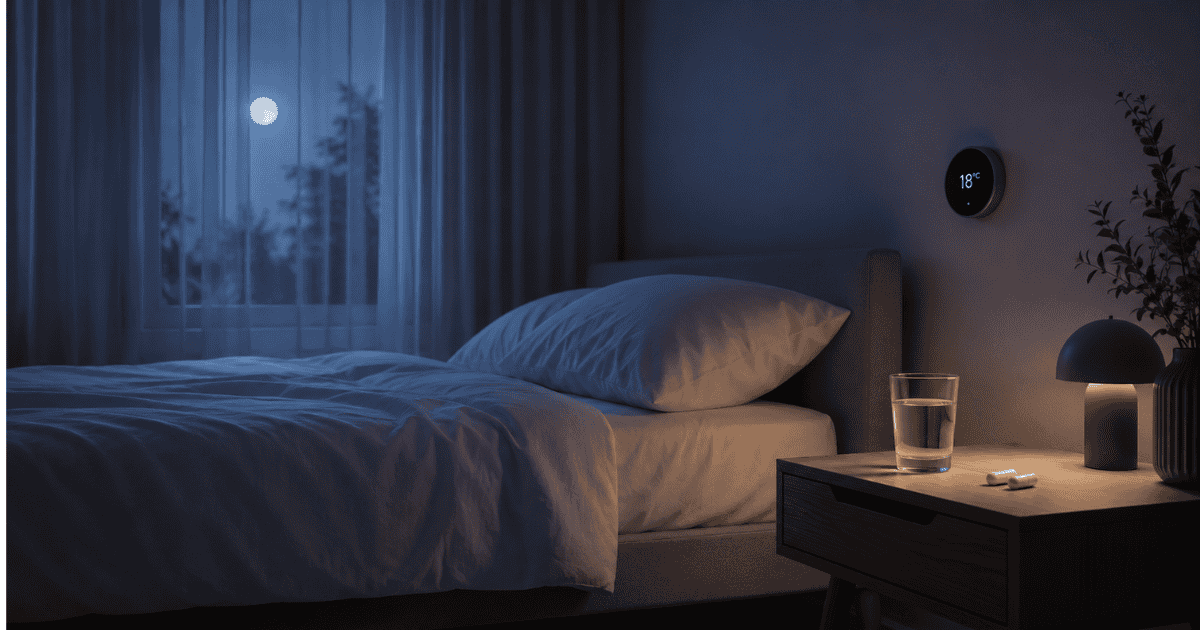
Signs: hard to fall asleep despite feeling tired, light and fragmented sleep, waking to small noises, unrestored despite enough hours. Two culprits dominate. First, a room above ~19°C: your core temperature needs to fall roughly 1–2°C to enter deep sleep, and a warm room blocks that drop. Second, bright light within about 90 minutes of bed suppresses the natural melatonin rise. Both are solvable tonight at zero cost.
Root cause 2 — elevated cortisol at bedtime
Signs: mind alert while the body is tired, waking at 2–3am and struggling to return, early-morning waking before the alarm. Cortisol — which should be near its low point in the hours before sleep — is elevated. The two most common causes are afternoon caffeine (a 5–7 hour half-life means a 3pm coffee is still active near midnight) and unresolved stress. Magnesium may act on this pathway: the Abbasi et al. (2012) trial found reduced serum cortisol alongside its sleep improvements.
Root cause 3 — a mind that won’t switch off
Signs: thoughts keep arriving, replaying the day or pre-living tomorrow, frustration at not being able to disengage. The pre-sleep window is full of unresolved cognitive load the brain keeps processing because it hasn’t been written down. A polysomnographic RCT by Scullin et al. (2018) found that spending five minutes writing tomorrow’s specific to-do list helped people fall asleep faster — externalising pending tasks takes them out of the active mental queue.
Tonight’s interventions — ranked by evidence
🟢 Strong | 🟡 Moderate | 🔴 Actively harmful. The environmental levers sit at the top for a reason.
The evidence — what the key trials actually show
Landmark magnesium RCT
Abbasi et al. (2012) — magnesium and primary insomnia
A double-blind, placebo-controlled trial in 46 elderly adults with primary insomnia, given 500mg elemental magnesium daily (delivered as magnesium oxide) or placebo for 8 weeks. The magnesium group showed significant improvements in insomnia severity, sleep efficiency and sleep onset latency, with reduced serum cortisol and increased serum melatonin — mechanistic support for the HPA-axis pathway. Early-morning-awakening improvement was only marginal, and the population was elderly, so it doesn’t automatically transfer to healthy younger adults. It also used oxide, not the glycinate form I’d choose today. Still, it’s the cornerstone of the magnesium-sleep evidence base.
Abbasi B, et al. J Res Med Sci. 2012;17(12):1161–1169. PMID 23853635
Bisglycinate form, 2025
Schuster et al. (2025) — magnesium bisglycinate and poor sleep
A randomised, double-blind, placebo-controlled trial in 155 adults with poor sleep, using 250mg elemental magnesium as bisglycinate for four weeks. The magnesium group showed a significantly greater improvement in insomnia severity than placebo — but the effect size was small (Cohen’s d = 0.2), and the benefit was notably larger in those who started with lower dietary magnesium. That’s the honest shape of it: a modest, real effect, concentrated in people most likely to have been short. It also matters because it tested the well-tolerated bisglycinate form specifically, in younger adults, at a sensible dose.
Schuster J, et al. Nature & Science of Sleep. 2025;17:2027–2040. PMID 40918053
Glycine PSG RCT
Yamadera et al. (2007) — glycine and sleep quality
A small polysomnography study in which 3g of glycine before bed shortened the time to fall asleep (and to reach slow-wave sleep) and improved subjective sleep quality — importantly, without altering overall sleep architecture. The mechanism is distinct from magnesium’s: glycine lowers core body temperature via peripheral vasodilation, which is why the two are complementary rather than redundant. The honest catch worth stating: this is the studied 3g dose of glycine taken on its own — far more than the roughly 1–1.5g of glycine a typical magnesium glycinate serving delivers.
Yamadera W, et al. Sleep and Biological Rhythms. 2007;5(2):126–131.
Warm-bath meta-analysis
Haghayegh et al. (2019) — timing the warm bath
A systematic review pooling 13 trials of water-based passive body heating found that a warm bath or shower (40–42.5°C) shortened sleep onset latency and improved sleep quality and efficiency — but timing is everything. The effect appears when the bath is scheduled roughly 1–2 hours before bed (optimally around 90 minutes), which is why a shower right before lights-out is too late to help: you need time for the post-bath cooling to pull your core temperature down. Note the authors couldn’t pin down precise effect sizes across the varied studies, so treat this as a well-grounded ritual rather than a guaranteed number of extra minutes.
Haghayegh S, et al. Sleep Medicine Reviews. 2019;46:124–135.
Cognitive-unload RCT
Scullin et al. (2018) — the to-do list
A polysomnographic RCT in 57 healthy young adults compared two five-minute bedtime writing tasks: tomorrow’s to-do list versus today’s completed tasks. The to-do list group fell asleep faster — and the more specific and detailed the list, the faster the onset. Externalising pending tasks removes them from the rumination queue. It’s the most under-appreciated intervention here: zero cost, zero side effects. One honest limit — the sample was healthy young adults, so we can’t assume it transfers unchanged to clinical insomnia.
Scullin MK, et al. J Exp Psychol Gen. 2018;147(1):139–146. PMID 29058942
Honest evidence assessment
The best synthesis of the magnesium-sleep evidence, Mah & Pitre (2021), pooled just three RCTs in 151 older adults. It found sleep onset latency about 17 minutes faster with magnesium, but rated the overall evidence “low to very low” quality because the trials were small and at risk of bias. The direction is consistently positive and the safety profile is reasonable — but these are well-evidenced options, not proven treatments. Environmental changes have stronger, faster effects. Fix the room before you buy supplements.
Worked example — building tonight’s sequence for a 2am waker
Take the most common pattern — you fall asleep fine but wake at 2–3am and can’t get back down. That points at root cause 2 (cortisol). Here’s how to build tonight’s plan around it, in the evidence order, so you’re not guessing.
Step 1 — Remove the biggest cortisol provoker first (free). No alcohol tonight. A nightcap eases you down but drives the exact 2am rebound you’re trying to fix — it’s the single most impactful change and it costs nothing. If you had coffee after early afternoon, that’s the second suspect; move tomorrow’s cut-off earlier.
Step 2 — Set the environment (free). Thermostat to 18–19°C and lights down ~90 minutes out. This is the foundation every later step depends on, so it goes in before anything you swallow.
Step 3 — Add the temperature push (free). A 10-minute warm shower or bath about 90 minutes before bed — not right before — so the post-bath cooling drops your core temperature into deep-sleep range as you get in bed.
Step 4 — Only now, the supplement layer. Because the driver is cortisol, magnesium is the sensible pick — 200–350mg elemental as glycinate, roughly an hour before bed, kept at or under the 350mg/day supplemental ceiling. Not because it’s powerful, but because it targets your specific root cause and it’s the fourth layer, not the first.
The point: notice the order. Three free, higher-leverage changes went in before the one you buy — and each was chosen because it matches the 2am-cortisol pattern rather than because it’s popular. Diagnose the root cause, then spend your effort top-down. That’s the entire method; the protocol below is just this applied on a clock.
The NeuroEdge Protocol
The NeuroEdge 90-60-30 Sleep Tonight Protocol
Environment first (largest effect, free), then supplementation, then cognitive unload. Peter Benson’s nightly sequence.
T-90 — Environment + bath
Dim the lights, drop the thermostat to 18–19°C, phone charging outside the room, no more caffeine. Take a 10-minute warm shower or bath now — the ~90-minute lead lets the cooling do its work by lights-out.
T-60 — Supplements (optional)
If you use them: magnesium glycinate 200–350mg elemental, optionally with glycine and L-theanine. Three non-overlapping mechanisms — GABA/NMDA, core-temperature drop, alpha-wave calm. Stay at or under the 350mg/day magnesium ceiling.
T-30 — Wind down
Screens off or on warm/dim. Something low-stimulation — reading on paper, light stretching. You’re protecting the melatonin rise you set up at T-90, not undoing it with a bright screen.
T-5 — Cognitive unload
Write tomorrow’s specific to-do list — five minutes, concrete tasks, forward-looking (Scullin et al., 2018). The more specific the list, the faster you tend to drop off. The most under-rated step here.

Peter’s Testing Notes
First-person, n=1 — reported honestly
Across a few years of Oura tracking, the hierarchy in my own data matches the trials: the environmental changes move my sleep metrics the most, and supplements add a real but smaller amount on top of a correct foundation. On nights when I run the full 90-60-30 sequence — cool room, dim from mid-evening, a warm shower well before bed, and the to-do list last — my deep-sleep readings tend to sit clearly higher than on unmanaged nights. When I strip out the environment and lean on the supplement alone, the signal gets smaller and less reliable.
On magnesium specifically: I take a glycinate dose in the evening as part of my stack, and what I notice most is a gentler wind-down rather than a knockout effect — consistent with what the modest evidence would predict. I hold all of this loosely; it’s an n=1 observation with a consumer ring, not a controlled result, and the placebo of doing something deliberate about sleep is real.
The intervention that still surprises me most is the to-do list. I initially dismissed the Scullin trial as too simple to matter, and I was wrong — on nights I actually write a specific list, I fall asleep more easily than on nights I skip it, and it’s free. The specificity is the part that matters: vague notes do far less than concrete, actionable tasks.
Sourcing standards
If you decide to add magnesium, three criteria matter: the form should specify glycinate or bisglycinate; the label should declare elemental magnesium (not just compound weight); and it should be third-party tested with a certificate of analysis available. Our full magnesium glycinate for sleep guide goes deeper on form, dose and the evidence.
Nootropics Depot — Magnesium Glycinate
A clean, well-labelled magnesium bisglycinate with transparent elemental content and third-party testing — the form and brand I keep in my own evening routine.
Performance Lab Sleep — pre-formulated option
A ready-made evening formula that covers the magnesium mechanism and adds Montmorency cherry as a natural melatonin source — the one I reach for on travel weeks when I can’t control the room.
Glycine (bulk powder) and L-theanine are inexpensive standalone additions if you want the full three-mechanism stack. But remember the order of this whole article: the room comes first, and no supplement rescues a warm, bright bedroom where you drank wine.
⚠️ Before you supplement magnesium
Keep total supplemental magnesium at or under 350mg/day (the NIH tolerable upper limit); going over mainly causes loose stools in healthy people. Two cautions matter more: magnesium is cleared by the kidneys, so anyone with impaired kidney function can accumulate it dangerously and shouldn’t supplement without medical supervision; and magnesium can bind some antibiotics and bisphosphonates (space them by a few hours). This isn’t a complete list — if you take regular medication or have a health condition, check with your doctor or pharmacist first.
Key takeaways
| → | Environment produces the largest, fastest effects — and costs nothing. Room at 18–19°C and dim light ~90 minutes before bed are the two highest-leverage changes, and they act the same night. |
| → | A warm bath helps — but ~90 minutes before bed, not right before. The post-bath cooling is what drops your core temperature (Haghayegh et al., 2019). |
| → | Writing tomorrow’s specific to-do list reduces sleep latency — PSG-confirmed (Scullin et al., 2018). Five minutes, concrete tasks, zero cost. |
| → | Alcohol is the highest-priority thing to cut tonight — it eases onset but suppresses REM and causes the cortisol rebound behind 2am waking. |
| → | Magnesium is the best-evidenced supplement but a modest one, on low-quality evidence — a fourth layer, 200–350mg elemental, not a substitute for the room. Melatonin is for timing, not quality. |
Frequently asked questions
What’s the single best thing I can do to sleep better tonight?
Cool your bedroom to 18–19°C. Your core temperature has to fall to enter and hold deep sleep, and a warm room blocks that — so temperature is the highest-leverage single change, it’s free, and it works the same night. If you can do a second thing, dim the lights about 90 minutes before bed to let melatonin rise. And if you’d otherwise have a drink, skip it: alcohol is the most common “sleep aid” that actively fragments sleep. These three cost nothing and beat any supplement.
Why do I wake at 3am and can’t get back to sleep?
The classic cause is a cortisol rebound as alcohol or caffeine clears, pushing arousal above the sleep threshold. If you drink, that’s the most likely trigger — alcohol eases you down early then rebounds in the second half of the night. If you don’t, late-afternoon caffeine (a 5–7 hour half-life is still active at 3am) or unresolved stress are common. Magnesium acts on the cortisol pathway most directly. If the pattern persists despite addressing these, see a healthcare provider — persistent middle-of-the-night waking can indicate a sleep disorder.
Does melatonin actually improve sleep quality?
Not really — melatonin at physiological doses (0.5–1mg) is a timing signal, not a quality supplement. It advances your internal clock by roughly 30–60 minutes, which is genuinely useful for jet lag, shift work or a delayed sleep phase where the problem is when you sleep — the levers our circadian rhythm optimisation guide covers in depth. It doesn’t meaningfully deepen sleep or improve sleep efficiency. Common 5–10mg doses are far above physiological levels and offer no added benefit over 1mg. If your problem is quality — light, unrefreshing sleep — magnesium and good sleep habits are the better targets.
How long does magnesium take to help sleep?
Allow a few weeks for a fair trial. Only about 1% of body magnesium circulates in serum — the rest is in bone and tissue — and roughly half of adults consume less than recommended (NIH ODS), so if you’re low, rebuilding stores takes time. The Abbasi et al. (2012) trial ran over 8 weeks. If you also take glycine, its core-temperature effect can be felt within the first few nights, but judge the magnesium itself over 3–4 weeks rather than a single night. Start at the lower end (around 200mg elemental) and stay under the 350mg/day supplemental ceiling.
What bedroom temperature is best for sleep?
Around 18–19°C (65–67°F) is the consistently supported range. Your core temperature needs to fall roughly 1–2°C below its daytime peak to initiate and hold deep sleep, and a room above ~19°C works against that, tending toward lighter, more fragmented sleep. If you’re used to a warmer room, 18–19°C can feel slightly cool at first, but most people adapt within a few nights. Use bedding for warmth — the goal is cool room air for the thermoregulatory pathway, not being cold under the covers. A warm bath ~90 minutes earlier helps the same mechanism.
Get “7 Days to a Sharper Brain” — Free
Peter Benson’s personal daily protocol, rebuilt from 18 years of testing.
✓ Day 1 — Sleep foundation + Magnesium Glycinate
✓ Day 2 — L-Theanine + Caffeine focus stack
✓ Day 3 — Brain nutrition timing for stable energy
✓ Day 4 — BDNF movement protocol
✓ Day 5 — 90-60-30 sleep environment sequence
✓ Day 6 — Stress resilience + cognitive load framework
✓ Day 7 — Neuroplasticity, Lion’s Mane + your complete assembled daily stack
Join 2,000+ readers optimising their cognitive performance. Unsubscribe anytime.
Scientific references
1. Abbasi, B., et al. (2012). The effect of magnesium supplementation on primary insomnia in elderly: A double-blind placebo-controlled clinical trial. Journal of Research in Medical Sciences, 17(12), 1161–1169. PMID 23853635 · PMC3703169
2. Schuster, J., et al. (2025). Magnesium bisglycinate supplementation in healthy adults reporting poor sleep: A randomized, placebo-controlled trial. Nature and Science of Sleep, 17, 2027–2040. PMID 40918053 · PMC12412596
3. Yamadera, W., et al. (2007). Glycine ingestion improves subjective sleep quality in human volunteers, correlating with polysomnographic changes. Sleep and Biological Rhythms, 5(2), 126–131. DOI: 10.1111/j.1479-8425.2007.00262.x
4. Scullin, M. K., et al. (2018). The effects of bedtime writing on difficulty falling asleep: A polysomnographic study comparing to-do lists and completed activity lists. Journal of Experimental Psychology: General, 147(1), 139–146. PMID 29058942
5. Haghayegh, S., et al. (2019). Before-bedtime passive body heating by warm shower or bath to improve sleep: A systematic review and meta-analysis. Sleep Medicine Reviews, 46, 124–135. DOI: 10.1016/j.smrv.2019.04.008
6. Mah, J., & Pitre, T. (2021). Oral magnesium supplementation for insomnia in older adults: A systematic review & meta-analysis. BMC Complementary Medicine and Therapies, 21, 125. PMID 33865376
7. National Institutes of Health, Office of Dietary Supplements. Magnesium: Fact Sheet for Health Professionals. ods.od.nih.gov
Peter Benson
Cognitive Enhancement Researcher | 18+ Years Independent Research
Peter has tested every protocol in this guide over 18+ years of systematic self-experimentation, tracking sleep, HRV and cognitive performance data with an Oura Ring across hundreds of nights. NeuroEdge Formula is his platform for sharing rigorous, safety-first cognitive enhancement guidance.
Last reviewed: August 2026