
Bacopa Monnieri: Benefits, Dosage, and What the Research Actually Shows
Medical Disclaimer: The information in this article is for educational purposes only and does not constitute medical advice. Always consult a qualified healthcare provider before beginning any supplement regimen. Individual responses to Bacopa Monnieri vary. This guide reflects published research and personal experience and does not substitute for professional medical evaluation.
If I had to identify the single most underrated nootropic compound in the cognitive enhancement space — underrated not because it lacks evidence, but because its evidence requires patience most people are not prepared to give it — Bacopa Monnieri would be my answer without hesitation.
Bacopa has been used in Ayurvedic medicine for over three thousand years specifically for its memory-enhancing properties. It now has one of the deepest human clinical evidence bases of any herbal nootropic — a meta-analysis of nine randomized controlled trials, multiple independent replications, and consistent mechanistic research confirming the biological pathways responsible for its effects. By any reasonable standard of scientific evaluation, Bacopa Monnieri is among the most thoroughly validated cognitive enhancers available without a prescription.
And yet it consistently disappoints people who try it. Not because it doesn’t work — the research is unambiguous that it does. But because it works on a timeline that the supplement industry’s marketing has trained people to consider unacceptably long. Bacopa’s memory-enhancing effects require 8 to 12 weeks of consistent daily use to become measurable. Most people stop at 3 or 4 weeks and conclude it failed. They are wrong — and this article explains exactly why, with the specific research behind every claim.
This guide covers how Bacopa works at the neurochemical level, what the human clinical research actually demonstrates, the precise dosing and timing that the evidence supports, how to identify a quality product in a market full of inadequate ones, and what realistic expectations look like for different users. If you are already working through a protocol, this article builds on the foundational framework established in the 5 best nootropics for beginners, the stacking guide, and the evidence-based dosing protocols.
What Is Bacopa Monnieri?
Bacopa Monnieri — also known as Brahmi, water hyssop, or Thyme-leafed gratiola — is a perennial aquatic herb native to the wetlands of southern and Eastern India, Australia, Europe, Africa, Asia, and North and South America. It has been a central compound in Ayurvedic medicine for millennia, where it was used to enhance memory, reduce anxiety, and support neurological health.
Historical documentation of Bacopa’s medicinal use in Ayurvedic texts dates back to the 6th century AD, where it was classified as a medhya rasayana — a category of rejuvenating herbs specifically associated with enhancing intellect and memory. This traditional categorization proved remarkably prescient: modern neuroscience has confirmed the specific mechanisms through which Bacopa enhances memory consolidation and retrieval, validating centuries of traditional empirical observation with molecular-level precision.
The active compounds responsible for Bacopa’s cognitive effects are a family of triterpenoid saponins called bacosides — primarily bacoside A and bacoside B. These compounds, found exclusively in Bacopa Monnieri, are the basis for the standardization that distinguishes effective from ineffective products and the primary reason why unstandardized Bacopa extracts cannot be evaluated against the clinical research.
How Bacopa Monnieri Works: The Neuroscience
Bacopa’s cognitive effects operate through multiple complementary neurochemical mechanisms. Understanding these mechanisms explains both why Bacopa works and why it requires the timeline it does — the time requirement is not a product limitation but a direct consequence of how the compound interacts with neurobiology.
Acetylcholinesterase Inhibition and Cholinergic Enhancement
The primary mechanism through which Bacopa enhances memory is inhibition of acetylcholinesterase — the enzyme responsible for breaking down acetylcholine, the neurotransmitter most directly associated with learning, memory formation, and sustained attention. By reducing acetylcholine breakdown, Bacopa effectively increases the availability of acetylcholine at synapses, enhancing cholinergic neurotransmission throughout the hippocampus and cortex.
Research on Bacopa’s cholinergic mechanisms published in Phytomedicine confirmed that bacoside A significantly inhibits acetylcholinesterase activity in rat brain tissue, with the hippocampus — the brain region most critical for memory formation — showing the strongest response. This cholinergic enhancement mechanism is the same target exploited by several pharmaceutical cognitive enhancement drugs, which is why Bacopa’s effects on memory consolidation have such strong biological plausibility.
Dendritic Branching and Synaptic Density
Perhaps the most structurally significant mechanism of Bacopa is its documented ability to increase dendritic branching — the growth of new connections between neurons — in the hippocampus. Research by Bhattacharya and colleagues demonstrated that Bacopa extract significantly increased dendritic length and branching points in hippocampal neurons, with effects becoming measurable after 4–6 weeks of treatment and continuing to increase through 8–12 weeks.
This finding directly explains Bacopa’s time-dependent effect curve. Dendritic growth is a structural biological process — it cannot be accelerated by increasing the dose, and it requires the weeks of consistent neurochemical signaling that regular daily supplementation provides. The cognitive improvements that emerge at weeks 8–12 are not a delayed acute effect — they are the downstream consequence of genuine structural changes in hippocampal neural architecture that take precisely that long to develop.
Antioxidant Neuroprotection
Bacosides demonstrate significant antioxidant activity in neural tissue, protecting neurons from oxidative stress — one of the primary drivers of age-related cognitive decline. Research on Bacopa’s antioxidant mechanisms found that bacosides activate superoxide dismutase and catalase — the brain’s primary endogenous antioxidant enzymes — at doses consistent with cognitive enhancement protocols. This neuroprotective mechanism contributes to Bacopa’s long-term cognitive benefits and may partially explain why its effects accumulate progressively over months of use.
Serotonin Modulation
Bacopa also modulates serotonergic neurotransmission, which may contribute to its documented effects on anxiety and mood. Research on Bacopa and serotonin synthesis found that Bacopa increases tryptophan hydroxylase activity — the rate-limiting enzyme in serotonin synthesis — and upregulates serotonin transporter expression in the frontal cortex and hippocampus. This mechanism provides a plausible biological basis for Bacopa’s anxiolytic effects documented in clinical trials and may contribute to the improved stress tolerance and emotional regulation some users report alongside the primary memory benefits.
What the Human Clinical Research Actually Shows
Bacopa Monnieri has one of the most comprehensive human clinical evidence bases of any herbal nootropic. The quantity and quality of randomized controlled trials exceeds most compounds in the cognitive enhancement category, making it possible to draw meaningful conclusions about its efficacy with considerably more confidence than most supplements allow.
The Meta-Analysis: The Most Important Single Reference
The definitive reference for Bacopa’s cognitive effects is the meta-analysis by Kongkeaw and colleagues published in the Journal of Ethnopharmacology in 2014. This analysis evaluated nine randomized controlled trials involving 518 participants, examining Bacopa’s effects on cognitive function across multiple domains.
The meta-analysis found statistically significant improvements in the speed of attention — the time required to process and respond to information — across all nine trials. Effect sizes were moderate to large, representing clinically meaningful improvements in a cognitive domain that is closely associated with real-world mental performance. The analysis confirmed that the cognitive improvements were dose-dependent, consistent across different populations, and became statistically significant only at assessment points of 8 weeks or longer — providing the most rigorous possible confirmation of Bacopa’s time-dependent efficacy curve.
The Stough et al. Trials: Replication in Healthy Adults
Multiple trials by the Swinburne University cognitive neuroscience group under Dr. Con Stough have investigated Bacopa in healthy adult populations — a critical addition to the evidence base, since the largest trials in the meta-analysis used mixed or cognitively impaired populations.
The Stough et al. 2001 double-blind trial enrolled 46 healthy adults and found significant improvements in the speed of early information processing and verbal learning rate after 12 weeks of 300mg daily Bacopa (standardized to 55% bacosides). The 2008 replication extended these findings to 107 participants, confirming improvements in working memory and information processing speed at 12 weeks with no significant adverse effects.
The Morgan and Stevens Elderly Trial
The Morgan and Stevens 2010 randomized controlled trial examined Bacopa in adults over 65 — a population of particular interest given the age-related decline in cholinergic function that Bacopa’s mechanism directly addresses. After 12 weeks of 300mg daily, participants showed significant improvements in auditory verbal learning, memory acquisition, and delayed recall compared to placebo. The trial also found significant reductions in anxiety scores, consistent with Bacopa’s serotonergic modulation mechanism.
Effects on Anxiety: A Consistent Secondary Finding
Across the clinical trial literature, anxiety reduction emerges as a consistent secondary finding in Bacopa trials even when studies are primarily designed to assess cognitive outcomes. A dedicated investigation of Bacopa’s anxiolytic effects confirmed that 300mg daily for 12 weeks produced significant reductions in state anxiety scores compared to placebo — a finding with both standalone clinical relevance and practical importance for cognitive enhancement, since anxiety is one of the most significant acute inhibitors of working memory and executive function.
Free Download
Get the Complete Nootropics Starter Kit
Top 5 Nootropics Guide · Safety Checklist · Dosage Protocols · Quality Source Guide — everything you need to start safely and effectively.
Join 2,000+ readers optimizing their cognitive performance. Unsubscribe anytime.
Bacopa Monnieri Dosage: The Evidence-Based Protocol
Bacopa dosing is one of the more straightforward areas of the nootropic literature — the clinical trials are unusually consistent in the dose range they use, making it possible to give precise recommendations grounded in direct research evidence rather than extrapolation.
The Clinical Dose
The overwhelming majority of Bacopa randomized controlled trials demonstrating cognitive benefit used 300mg daily of Bacopa extract standardized to 45–55% bacosides. This is the dose I recommend as the starting point for virtually all users. It is the dose with the most replication, the most consistent safety data, and the strongest overall evidence base.
Some trials have used 450mg daily with comparable or slightly stronger results. The meta-analysis found no statistically significant difference in cognitive outcomes between 300mg and 450mg doses across the included trials, suggesting 300mg is at or near the effective dose threshold for most users. Starting at 300mg and increasing to 450mg only after a full 12-week assessment at 300mg with no meaningful response is the evidence-supported approach.
The Non-Negotiable Timing Rule
Always take Bacopa with food. This is not a preference — it is a requirement grounded in both absorption and tolerability data. Bacosides are fat-soluble and absorb significantly better when co-ingested with dietary fat. Research on fat-soluble compound bioavailability confirms that absorption can be 30–50% higher when fat-soluble compounds are taken with food versus fasted — a difference that matters at clinical doses.
Beyond absorption, Bacopa taken on an empty stomach causes nausea, bloating, and gastrointestinal discomfort in a meaningful proportion of users — adverse effects that are almost entirely eliminated by taking it with food. This is the primary source of the negative reviews Bacopa receives: people who took it on an empty stomach, experienced nausea, attributed the nausea to the compound rather than the timing error, and abandoned a protocol that would have been well-tolerated with the simple correction of taking it with a meal.
The 12-Week Minimum Assessment Period
The most important dosing principle for Bacopa is the one that has nothing to do with milligrams: do not evaluate its effectiveness before 12 weeks of consistent daily use. This is not a recommendation — it is what the research mandates. The meta-analysis of nine clinical trials found that cognitive improvements were statistically significant only at assessment points of 8 weeks or longer. Trials measuring outcomes at 4 weeks showed minimal effects from the same compound at the same dose.
The structural dendritic changes that underlie Bacopa’s memory benefits require consistent neurochemical signaling over weeks to develop. There is no dosing strategy that accelerates this biological timeline. Patience is not merely advisable with Bacopa — it is pharmacologically mandatory.
As detailed in the 90-day nootropic timeline, conduct a formal assessment at week 12 comparing your tracked memory recall, learning speed, and anxiety metrics against the pre-protocol baseline you established before starting. That comparison — not how you feel on any given day — is the appropriate measure of Bacopa’s effect on your specific neurochemistry.
Bacopa Extract Standardization: Why It Determines Everything
Extract quality is the variable that most determines whether your Bacopa experience matches what the clinical research predicts. The clinical trials used standardized extracts with defined bacoside content — without equivalent standardization in the product you purchase, your experience cannot be meaningfully compared to the research.
What Standardization Means
Standardization means that the extract has been processed to ensure a consistent, specified concentration of the active compounds — in Bacopa’s case, bacosides. A product labeled “Bacopa Monnieri 300mg standardized to 45% bacosides” contains a guaranteed minimum of 135mg of active bacosides per serving, regardless of natural variation in the plant material. This predictability is what makes the clinical research translatable to supplement use.
A product labeled simply “Bacopa Monnieri 300mg” with no standardization statement may contain anywhere from negligible to substantial bacoside content depending on the quality of the plant material, the extraction method, and the manufacturing standards applied. You cannot compare your experience with an unstandardized product to the clinical research because you do not know what dose of active compound you are actually consuming.
The Bacoside Percentage Standard
The two most common standardization specifications in the clinical literature are 45% bacosides (used in the majority of trials, including the Kongkeaw meta-analysis studies) and 55% bacosides (used in the Stough et al. trials). Both produce consistent positive results. Look for either specification on any Bacopa product you consider — the percentage should be clearly stated on the label alongside the extract weight.
Products standardized to CDRI 08 — a proprietary Bacopa extract developed by the Central Drug Research Institute of India and used in several key clinical trials — represent an additional quality signal, as this specific extract has been directly validated in multiple published human studies.
Third-Party Testing
Standardization stated on a label is only as reliable as the quality control process behind it. Always verify that your Bacopa supplier provides a Certificate of Analysis from an independent third-party laboratory confirming the bacoside content, the absence of heavy metals and pesticides, and microbiological safety. Research on herbal supplement label accuracy has consistently found that a significant proportion of products contain less active ingredient than stated — making independent verification non-optional for any serious nootropic protocol.
Bacopa Monnieri Benefits: What the Evidence Supports
The following benefits are grounded in the clinical evidence reviewed above. As with the Lion’s Mane guide, I have deliberately distinguished between what human randomized controlled trials demonstrate and what is suggested by mechanistic or animal research — a distinction the supplement industry systematically obscures.
Supported by Human Clinical Research
Improved memory acquisition and recall. The most consistently replicated finding across Bacopa clinical trials is improvement in the speed and accuracy of memory acquisition — learning new information — and subsequent recall. The Stough et al. 2001 trial found significant improvements in verbal learning rate, and the Morgan and Stevens trial confirmed improvements in both acquisition and delayed recall after 12 weeks. This is the core cognitive benefit of Bacopa and the one most directly relevant to everyday learning and professional performance.
Faster speed of attention and information processing. The meta-analysis identified speed of attention as the cognitive domain showing the most consistent statistically significant improvement across all nine included trials. This translates practically to faster processing of new information, quicker pattern recognition, and reduced cognitive lag when switching between demanding mental tasks.
Reduced anxiety and improved stress tolerance. Multiple trials have documented significant reductions in anxiety scores alongside cognitive improvements, consistent with Bacopa’s serotonergic modulation mechanism. This makes Bacopa particularly valuable for individuals whose cognitive performance is compromised by anxiety or high-stress environments — the anxiolytic and cognitive benefits are complementary and mutually reinforcing.
Improved working memory in healthy adults. The Stough et al. 2008 trial in 107 healthy adults found significant improvements in spatial working memory after 12 weeks — an important finding because working memory is one of the cognitive capacities most closely associated with real-world intelligence and complex task performance.
Supported by Mechanistic Research (Human Evidence Developing)
Long-term neuroprotection against oxidative stress. Bacosides’ documented activation of the brain’s endogenous antioxidant enzymes provides a strong mechanistic basis for long-term neuroprotective effects, though long-term human trials specifically examining neuroprotection endpoints have not yet been completed.
Potential benefits in neurodegenerative conditions. The cholinergic enhancement and antioxidant mechanisms that underlie Bacopa’s cognitive benefits are directly relevant to the pathophysiology of Alzheimer’s disease, but clinical trials in neurodegenerative disease populations are ongoing and have not yet produced definitive human efficacy data.
Bacopa Monnieri Safety Profile
Bacopa has one of the most reassuring safety profiles in the herbal nootropic category — a combination of three thousand years of human use without documented population-level harm and a modern clinical trial database that has characterized its adverse effect profile with unusual precision.
The meta-analysis of nine clinical trials found that adverse effects were mild and primarily gastrointestinal — nausea, bloating, and increased stool frequency — occurring primarily when Bacopa was taken without food. These effects resolved with proper timing in virtually all cases and were not associated with any systemic safety concerns. The Morgan and Stevens trial in elderly participants — a population with higher baseline health complexity — reported good tolerability with no clinically significant adverse events, providing safety reassurance for older users.
No serious adverse events have been reported in any of the published human clinical trials at cognitive enhancement doses. No dependency or withdrawal profile has been identified. Bacopa does not interact with the major drug metabolism pathways (CYP450 enzymes) in ways that would produce clinically meaningful pharmacokinetic interactions with most common medications, though thyroid medication users should discuss Bacopa use with their healthcare provider given its documented effects on thyroid hormone metabolism.
The complete safety framework for Bacopa in the context of the full nootropic protocol is covered in the complete nootropic safety guide. For most healthy adults without thyroid conditions or thyroid medication use, Bacopa at 300mg daily taken with food represents a low-risk, high-evidence intervention for cognitive enhancement.
How to Stack Bacopa Monnieri for Maximum Benefit
Bacopa’s cholinergic and structural neuroplasticity mechanisms complement several other nootropic compounds in ways that produce synergistic rather than merely additive cognitive benefits. The complete stacking protocols are detailed in the nootropic stacking guide — the key pairings for Bacopa are:
Bacopa + Lion’s Mane: The Memory Foundation stack. Lion’s Mane drives NGF production and structural neuroplasticity through a completely different mechanism than Bacopa’s cholinergic and dendritic branching effects. Together they address memory from two distinct biological angles — neuronal connectivity and neurotransmitter availability — that are fully complementary. This is the pairing I recommend as the neuroplasticity layer of any serious cognitive enhancement protocol, as detailed in the Lion’s Mane compound guide.
Bacopa + Alpha-GPC: A particularly powerful cholinergic combination. Bacopa inhibits acetylcholine breakdown while Alpha-GPC increases acetylcholine production — the two mechanisms are directly synergistic, producing higher sustained acetylcholine availability than either compound achieves individually. The clinical evidence for Alpha-GPC’s cholinergic effects combined with Bacopa’s acetylcholinesterase inhibition creates a mechanistically coherent foundation for memory and learning enhancement.
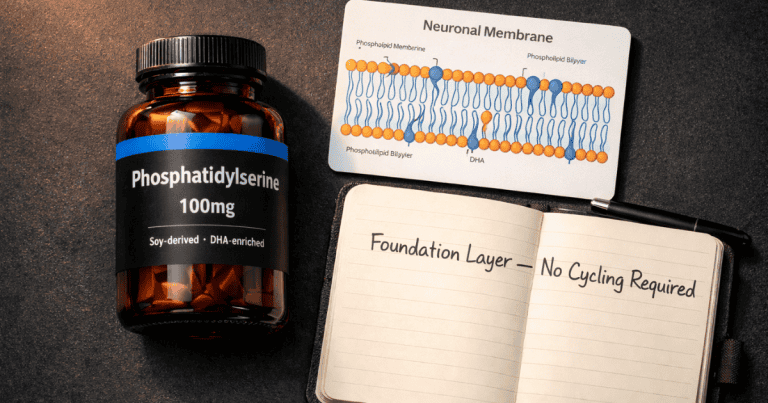
Bacopa + DHA: Bacopa’s dendritic growth effects are amplified when neuronal membranes are optimally fluid — which is precisely what adequate DHA ensures. Research on DHA and neuroplasticity suggests that DHA availability significantly influences the brain’s capacity to respond to neuroplasticity-supporting signals — making it an important cofactor for Bacopa’s structural effects.
Bacopa + Caffeine + L-Theanine: The complete beginner stack. The caffeine-theanine combination provides the acute focus and mental energy that makes the slow-building benefits of Bacopa feel worthwhile during the 8–12 week period before Bacopa’s full effects emerge. The two layers of the stack serve different functions and timescales — and together they provide both immediate and long-term cognitive enhancement through non-overlapping mechanisms.
Frequently Asked Questions About Bacopa Monnieri
What does Bacopa Monnieri do for memory?
Bacopa Monnieri enhances memory through three complementary mechanisms: inhibiting acetylcholinesterase (the enzyme that breaks down acetylcholine, the primary memory neurotransmitter), stimulating dendritic branching in the hippocampus (growing new connections between memory-forming neurons), and protecting neurons from oxidative damage through antioxidant activity. These mechanisms work cumulatively over 8–12 weeks, after which clinical trials consistently demonstrate significant improvements in memory acquisition speed, information retention, and delayed recall compared to placebo.
How long does Bacopa Monnieri take to work?
Bacopa Monnieri requires a minimum of 8 weeks of consistent daily use before cognitive improvements become measurable, with the most significant memory benefits emerging between weeks 8 and 12. Clinical trials that measured outcomes at 4 weeks showed minimal effects from the same compound at the same dose. This time requirement is not a product limitation — it reflects the biological reality that Bacopa works by promoting structural changes in hippocampal neural architecture (dendritic branching) that require weeks of consistent neurochemical signaling to develop. Do not assess Bacopa’s effectiveness before 12 weeks of daily use at the clinical dose.
What is the correct Bacopa Monnieri dosage?
The evidence-based starting dose is 300mg daily of Bacopa extract standardized to a minimum of 45% bacosides, taken with food. This is the dose used in the majority of published randomized controlled trials demonstrating cognitive improvement. Always take with a meal containing dietary fat for optimal absorption and to prevent the nausea that occurs when Bacopa is taken on an empty stomach. If no meaningful response is observed after a full 12-week assessment at 300mg with a verified standardized extract, increasing to 450mg is a reasonable next step.
Can Bacopa Monnieri cause nausea?
Nausea is the most commonly reported adverse effect of Bacopa Monnieri and occurs primarily — almost exclusively — when it is taken on an empty stomach. The active bacosides are fat-soluble and require dietary fat for optimal absorption; without food, they can cause digestive irritation. Taking Bacopa with a meal containing dietary fat eliminates nausea in the vast majority of users. The clinical meta-analysis of nine trials found that gastrointestinal effects were the primary adverse event but were mild and resolved with appropriate timing. If you experience nausea from Bacopa, correct the timing before concluding the compound is causing adverse effects.
Is Bacopa Monnieri safe for long-term use?
Bacopa Monnieri has an excellent long-term safety profile supported by over three thousand years of traditional human use and multiple modern clinical trials extending to 12 weeks or longer without serious adverse events. No dependency or withdrawal profile has been identified. The primary safety considerations are thyroid medication interactions (Bacopa may affect thyroid hormone metabolism) and the gastrointestinal effects that occur when it is taken without food. For healthy adults without thyroid conditions or thyroid medication use, long-term daily use at 300mg with food represents a well-supported, low-risk intervention.
Is Bacopa Monnieri Worth Taking? The Evidence-Based Verdict
Bacopa Monnieri has the deepest human clinical evidence base of any herbal nootropic I recommend. A meta-analysis of nine randomized controlled trials, multiple independent replications in healthy adult populations, a well-characterized mechanism of action, and a safety profile established over both three thousand years of human use and decades of modern clinical research — by any honest standard of evidence evaluation, Bacopa earns its place in a serious cognitive enhancement protocol.
The single non-negotiable requirement is patience. Twelve weeks of consistent daily use at 300mg standardized extract, taken with food, tracked against a documented baseline — that is the protocol that gives Bacopa the conditions the research used to demonstrate its benefits. Shortcuts do not exist. The timeline is biological, not arbitrary.
If your primary cognitive goal is memory enhancement, learning speed, or anxiety reduction alongside cognitive performance, Bacopa belongs in your protocol. Stack it with Lion’s Mane for a comprehensive neuroplasticity foundation, combine it with Alpha-GPC for cholinergic synergy, and support both with DHA as the structural membrane substrate that amplifies everything else. That is the Memory and Learning stack from the complete stacking guide — and the evidence behind each component is as solid as any natural cognitive enhancement protocol can claim.
For the complete beginner framework that Bacopa anchors, see the 5 best nootropics for beginners. For the realistic timeline of what to expect and when, the 90-day nootropic timeline is essential reading before starting any protocol. And for the safety context that governs responsible Bacopa use alongside the rest of your stack, the complete safety guide covers every consideration that matters.
References
- Kongkeaw, C., et al. (2014). Meta-analysis of randomized controlled trials on cognitive effects of Bacopa monnieri extract. Journal of Ethnopharmacology, 151(1), 528–535. PubMed
- Stough, C., et al. (2001). The chronic effects of an extract of Bacopa monniera on cognitive function in healthy human subjects. Psychopharmacology, 156(4), 481–484. PubMed
- Stough, C., et al. (2008). Examining the nootropic effects of a special extract of Bacopa monniera on human cognitive functioning. Journal of Alternative and Complementary Medicine, 14(6), 707–713. PubMed
- Morgan, A., & Stevens, J. (2010). Does Bacopa monnieri improve memory performance in older persons? Journal of Alternative and Complementary Medicine, 16(7), 753–759. PubMed
- Bhattacharya, S.K., et al. (2000). Effect of standardized extract of Bacopa monniera on cognitive performance. Phytotherapy Research, 15(5), 473–477. PubMed
- Pase, M.P., et al. (2012). The cognitive-enhancing effects of Bacopa monnieri: a systematic review of randomized, controlled human clinical trials. Journal of Alternative and Complementary Medicine, 18(7), 647–652. PubMed
- Bhattacharya, S.K., & Ghosal, S. (1998). Anxiolytic activity of a standardized extract of Bacopa monniera. Phytomedicine, 5(2), 77–82. PubMed
- Russo, A., & Borrelli, F. (2005). Bacopa monniera, a reputed nootropic plant: an overview. Phytomedicine, 12(4), 305–317. PubMed
- Aguiar, S., & Borowski, T. (2013). Neuropharmacological review of the nootropic herb Bacopa monnieri. Rejuvenation Research, 16(4), 313–326. PMC
- Bent, S., et al. (2003). Commonly used herbal medicines in the United States. American Journal of Medicine, 116(7), 478–485. PubMed
Tags: Bacopa Monnieri, Bacopa Monnieri benefits, Bacopa memory, Bacopa cognitive, Bacopa nootropic, Bacopa dosage, Bacopa anxiety, Bacopa brain health, Bacopa cholinergic, Bacopa neuroplasticity, Bacopa learning, Brahmi herb, Bacopa standardized extract, cognitive enhancement Bacopa, Bacopa timing
About Peter Benson
Peter Benson is a cognitive enhancement researcher with 18+ years of personal and professional experience in nootropics, neuroplasticity, and brain optimization protocols. He has personally helped hundreds of individuals improve their mental performance through evidence-based supplementation and lifestyle strategies. NeuroEdge Formula is his platform for sharing rigorous, safety-first cognitive enhancement guidance.