
Lion’s Mane Mushroom: Benefits, Evidence and Safety
By Peter Benson, Cognitive Enhancement Researcher · Updated October 2026 · Citations re-verified
Short answer: Lion’s Mane has an interesting mechanism, nerve-growth-factor activity in cells and animals, but thin human evidence. Its best-known trial had 30 people with mild cognitive impairment, and results in healthy adults are small and inconsistent. It appears safe for most people; allergy is the main risk.
⚕️ Educational information, not medical advice — full disclaimer. This page contains one affiliate link, in the buying section.
Lion’s Mane is one of the most heavily marketed nootropics, usually as a mushroom that “grows new brain cells”. The laboratory work behind that is genuine. The human evidence is much thinner than the marketing suggests, and I take it daily myself, so I have tried to keep both of those facts in view.
This guide covers the mechanism, the human trials, the fruiting-body and mycelium question, safety, and my own decade of use. Lion’s Mane is not in our beginners list, because compounds with better human data come first. The wider context is in the Nootropics & Supplements guide.
Lion’s Mane Dosage & Timing
The doses used in the human trials, as a reference point rather than a prescription. Read the side effects section first.
| Mild cognitive impairment trial | 3,000mg a day of dry powder: four 250mg tablets, three times a day, for 16 weeks (Mori et al., 2009). |
| Healthy young adults | 1,800mg a day (three 600mg capsules) of a mushroom complex for 28 days (Docherty et al., 2023). |
| Mild Alzheimer’s pilot | Three 350mg capsules a day of mycelium enriched with erinacine A, for 49 weeks (Li et al., 2020). |
| Comparing products | Dry powder, extracts and dual extracts are not equivalent by weight, so a milligram figure on one label can’t be compared directly with a trial. |
| How long to judge | 8–12 weeks. In the 16-week trial, differences from placebo appeared from week 8. |
The mechanism is real, but it is in cells and animals
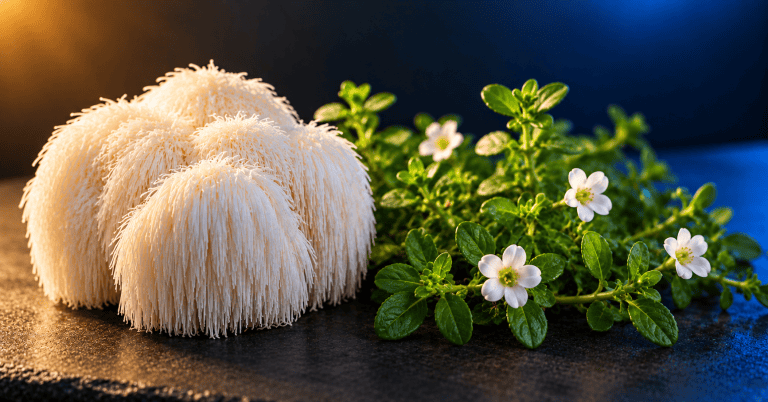
Lion’s Mane contains two families of compounds of interest: hericenones, found mainly in the fruiting body (the visible mushroom), and erinacines, found in the mycelium (the root-like network). In cultured nerve cells, compounds from the mushroom promoted cell survival and boosted nerve-fibre growth triggered by nerve growth factor (Zhang et al., 2017). In rats, erinacine A is the compound with the clearest evidence of acting on the central nervous system (Li et al., 2018).
A compound that works in a dish still has to survive digestion, reach the brain in useful amounts and change how people think. Most promising compounds fail somewhere along that path. Reviews of the field describe it as still some distance from clinical use, as one title puts it: “how far from the shoreline?” (Brandalise et al., 2023).
What the human trials show
Mild cognitive impairment. In the most-cited trial, 30 Japanese adults aged 50 to 80 with mild cognitive impairment took 3,000mg a day of dry powder or placebo for 16 weeks. Scores on a dementia screening scale improved compared with placebo at weeks 8, 12 and 16, then fell significantly four weeks after stopping. There were 15 people per group, and the lead author worked for a mushroom company (Mori et al., 2009).
Mild Alzheimer’s disease. In a pilot trial, 49 people took erinacine A-enriched mycelium or placebo for 49 weeks. Most between-group differences in cognitive scores were not significant; one daily-living score differed at week 49. The mycelium maker employed five of the authors (Li et al., 2020).
Healthy young adults. In a pilot trial of 43 adults aged 18 to 45 (41 analysed at 28 days), a single dose sped up performance on a Stroop attention test, but immediate word recall was worse an hour later. After 28 days, the placebo group improved more on delayed word recall, and a reduction in stress was only a trend. The authors called the findings tentative (Docherty et al., 2023).
The pooled picture. A 2025 systematic review of 26 studies, ten of them in people, found a small average rise in a dementia screening score across two trials, and described the evidence as “heterogeneous and limited in size” (Menon et al., 2025).
In practice: a modest benefit in people with cognitive impairment is possible, on small, partly industry-linked trials. For healthy adults, there is no reliable evidence of better memory or focus.
Fruiting body or mycelium?
It matters which part you buy. Hericenones come mainly from the fruiting body; erinacines from the mycelium. Many cheaper products are mycelium grown on grain, and the grain is not always separated out, so part of what you pay for can be starch. Reviews have called for standardisation of Lion’s Mane supplements to ensure effectiveness and safety (Szućko-Kociuba et al., 2023), because products vary widely.
Look for a label that states the part used (fruiting body, mycelium, or a dual extract of both), the extraction method and ratio, and third-party testing.
Lion’s Mane claims ranked by evidence
🟢 Stronger or replicated human evidence · 🟡 Limited, mixed or preliminary human evidence · 🔴 Not established
Worked example — checking a bottle and testing it fairly
Step 1: read the back label. Does it name the part (fruiting body, mycelium or dual extract), the extract ratio and the testing? “Full spectrum mycelium” with no mention of the grain tells you little.
Step 2: compare the dose sensibly. The MCI trial used 3,000mg of dry powder a day. An extract is more concentrated than dry powder, so a smaller number of milligrams is not necessarily a smaller dose, and a larger one is not necessarily better.
Step 3: test it on its own. Record a baseline, then take it alone for 8–12 weeks with nothing else new. Use a simple measure: a focus rating, or a recall test with a different word list each time.
Step 4: try a pause. In the trial, scores fell four weeks after stopping. A few weeks off is a fair test of whether anything was there. If you can’t tell the difference, that is a result too.
The NeuroEdge Formula Lion’s Mane Self-Testing Framework
A way to test a low-risk compound with a promising mechanism and thin human evidence. It is not a prescription.
1. Check safety first
Mushroom or mould allergy: avoid it. On regular medication: ask a pharmacist first.
2. Know your product
Fruiting body, mycelium or dual extract, with the ratio and third-party testing stated.
3. One change, 8–12 weeks
Take it on its own and judge against a baseline.
4. Test a pause
A few weeks off shows whether the effect you think you notice is there.
For how to set a baseline and read your own results, see our self-testing method.
Peter’s Testing Notes
A personal impression, not tracked data
About ten years of use. For the first couple of years I was inconsistent: 500mg some days, 1,000mg others, and skipped days. By year three I settled on 1,000mg of a dual-extract fruiting-body product twice a day, morning and early afternoon. I avoid taking it after 4pm, because late doses occasionally left me restless. Around year five I tried four weeks on and one week off; the week off felt noticeably worse, so I dropped the idea and now take it every day.
What I notice. The low-grade brain fog I had in my thirties rarely returns. Names and details come back with fewer tip-of-the-tongue moments, and I can do deep work without leaning on coffee. Bad days don’t linger the way they used to, I’m less irritable (people around me noticed before I did) and my mood is steadier. My digestion has been calm for years, and I haven’t had the tingling or numbness some people my age describe.
The caveats. None of this was measured. Ten years is long enough for age, sleep, work and everything else in my life to change, so I can’t separate the mushroom from the rest. The week-off dip could be expectation. And none of it is evidence that Lion’s Mane protects nerves; the research hasn’t shown that in people.
I keep taking it because it is cheap, easy and low-risk for me, and because I notice when I stop. That is a personal choice on thin evidence, not a recommendation.
Choosing a product
Because products vary so much, the label matters more than the brand. Look for the part used, the extract ratio, how it was extracted, and published third-party testing. Be wary of a large milligram figure that doesn’t say what it is a figure of.
Nootropics Depot Lion’s Mane — fruiting-body and dual-extract options
Nootropics Depot sells Lion’s Mane as an 8:1 dual extract, a 1:1 whole fruiting body product and an erinacine-A mycelium product, with certificates of analysis. Check which one you are buying; they are not interchangeable.
This is an affiliate link. If you buy through it, NeuroEdge Formula may earn a commission at no extra cost to you. The human evidence is thin, and many readers will not need this product.
Side Effects & Interactions
Allergy. This is the most serious concern. A 2025 review describes a case of acute respiratory distress after long-term use, linked to an allergic reaction. If you are allergic to mushrooms or moulds, avoid it, and stop if you develop a rash, breathing problems or swelling.
Common side effects. Stomach discomfort, nausea, diarrhoea and skin rash have been reported in trials, and some participants withdrew because of them. Headache was reported in one trial.
Medicines. Interactions have not been well studied in people. If you take regular medication, including diabetes or blood-thinning medicines, ask a pharmacist before starting.
Pregnancy and breastfeeding. There is no safety data. Avoid it unless a doctor advises otherwise.
This is not a complete list. Sources: Menon et al. (2025) and Li et al. (2020). See also our nootropic safety guide.
Key takeaways
| → | The nerve-growth-factor mechanism is shown in cells and animals, not in people. |
| → | The best-known trial had 30 people with mild cognitive impairment; the benefit faded after they stopped. |
| → | In healthy adults, results are small and mixed, including worse delayed recall than placebo in one trial. |
| → | Products vary widely. Check the part used, extract ratio and testing. |
| → | Allergy is the main risk; otherwise it appears safe for most people in short trials. |
Frequently asked questions
Does Lion’s Mane grow new brain cells?
In cultured cells and animals, its compounds support nerve growth factor activity. That has not been shown in the human brain, and no trial has measured it.
Should I cycle Lion’s Mane?
No trial has tested cycling. In the main trial, scores fell four weeks after stopping, which suggests any benefit depends on continued use. A pause is still a useful way to check whether you notice a difference.
Can I take Lion’s Mane with Bacopa or other supplements?
No interaction has been reported, but the combinations haven’t been studied. Add one compound at a time so you can tell what is doing what. See the Bacopa guide and the stacking guide.
Is it safe to take long term?
Most trials lasted 4 to 16 weeks; one pilot ran 49 weeks. Side effects were uncommon and mostly digestive or skin-related, but allergic reactions can be serious. Long-term data in healthy adults are limited.
Get “7 Days to a Sharper Brain” — Free
Peter Benson’s evidence-first starting framework
The habits with the strongest evidence first — sleep, movement, stress and learning — then how to add a single supplement and test whether it actually works for you.
No spam. Unsubscribe anytime.
⚕️ Educational Information, Not Medical Advice
This article is educational and is not medical advice. I’m a cognitive enhancement researcher, not a medical doctor. Lion’s Mane is a mushroom and can cause allergic reactions, occasionally severe. Nothing here treats or prevents cognitive decline or dementia. Consult a qualified healthcare provider before use, particularly if you have allergies, take any medication, or are pregnant or breastfeeding.
Scientific references
1. Mori, K., Inatomi, S., Ouchi, K., Azumi, Y., & Tuchida, T. (2009). Improving effects of the mushroom Yamabushitake (Hericium erinaceus) on mild cognitive impairment: a double-blind placebo-controlled clinical trial. Phytotherapy Research, 23(3), 367–372. PMID: 18844328
2. Li, I.-C., et al. (2020). Prevention of early Alzheimer’s disease by erinacine A-enriched Hericium erinaceus mycelia: pilot double-blind placebo-controlled study. Frontiers in Aging Neuroscience, 12, 155. Link (Five authors employed by the mycelium maker.)
3. Docherty, S., Doughty, F. L., & Smith, E. F. (2023). The acute and chronic effects of Lion’s Mane mushroom supplementation on cognitive function, stress and mood in young adults: a double-blind, parallel groups, pilot study. Nutrients, 15(22), 4842. Link
4. Menon et al. (2025). Benefits, side effects, and uses of Hericium erinaceus as a supplement: a systematic review. Frontiers in Nutrition. Link
5. Zhang, C.-C., Cao, C.-Y., Kubo, M., et al. (2017). Chemical constituents from Hericium erinaceus promote neuronal survival and potentiate neurite outgrowth via the TrkA/Erk1/2 pathway. International Journal of Molecular Sciences, 18(8), 1659. Link
6. Li, I.-C., Lee, L.-Y., Tzeng, T.-T., et al. (2018). Neurohealth properties of Hericium erinaceus mycelia enriched with erinacines. Behavioural Neurology, 2018, 5802634. Link
7. Brandalise, F., Roda, E., Ratto, D., et al. (2023). Hericium erinaceus in neurodegenerative diseases: from bench to bedside and beyond, how far from the shoreline? Journal of Fungi, 9(5), 551. Link
8. Szućko-Kociuba, I., Trzeciak-Ryczek, A., Kupnicka, P., & Chlubek, D. (2023). Neurotrophic and neuroprotective effects of Hericium erinaceus. International Journal of Molecular Sciences, 24(21), 15960. PMID: 37958943
Cognitive Enhancement Researcher | 18+ Years Independent Research
Peter is not a clinician; this guide is educational, not medical advice. It was rewritten in October 2026 to add trials in healthy adults and mild Alzheimer’s disease, a 2025 systematic review and updated safety information. Read about how NeuroEdge Formula evaluates research.
Last reviewed: October 2026 | Educational content only. Not medical advice.