Lion’s Mane vs Bacopa Monnieri
Best for: Long-term brain building, neurological resilience, age-related cognitive decline prevention
Time to effect: 4–12 weeks consistent use
Evidence base: Strong preclinical, growing human RCT data
Best for: Memory consolidation, recall speed, stress-impaired cognition, anxiety reduction
Time to effect: 8–12 weeks minimum
Evidence base: Strongest human RCT base of any nootropic herb
If you’ve spent any time researching nootropic supplements, you’ve almost certainly encountered the same question framed the same way: Lion’s Mane or Bacopa — which one should I take? It’s an understandable question, and I asked a version of it myself when I first encountered both compounds nearly two decades ago. But after eighteen years of personal testing and studying the mechanisms behind these two herbs, I can tell you with confidence that it’s the wrong question. These compounds don’t compete. They don’t even really overlap.
Lion’s Mane and Bacopa monnieri work through fundamentally different biological pathways, produce different types of cognitive benefits on different timescales, and sit in entirely different categories of cognitive enhancement. Comparing them head-to-head is a bit like asking whether you should use a foundation or a roof when building a house. The honest answer is: both, at the right time, for the right purpose.
In my experience, most people who struggle to choose between these two compounds do so because they’re unclear on what each one actually does at a mechanistic level. Once that’s understood, the decision usually becomes straightforward. This article covers both mechanisms in honest detail, walks through the human clinical evidence as it currently stands, and gives you a practical framework for deciding whether one or both belong in your protocol. If you’re building a comprehensive nootropic approach, I’d also recommend reading through my Nootropics & Supplements guide for broader context on how these compounds fit into a full cognitive optimisation stack.
What Makes These Two Compounds So Different
The confusion around Lion’s Mane and Bacopa stems from the fact that both are frequently marketed under the same broad umbrella of “natural memory supplements.” That categorisation is superficially true but mechanistically misleading.
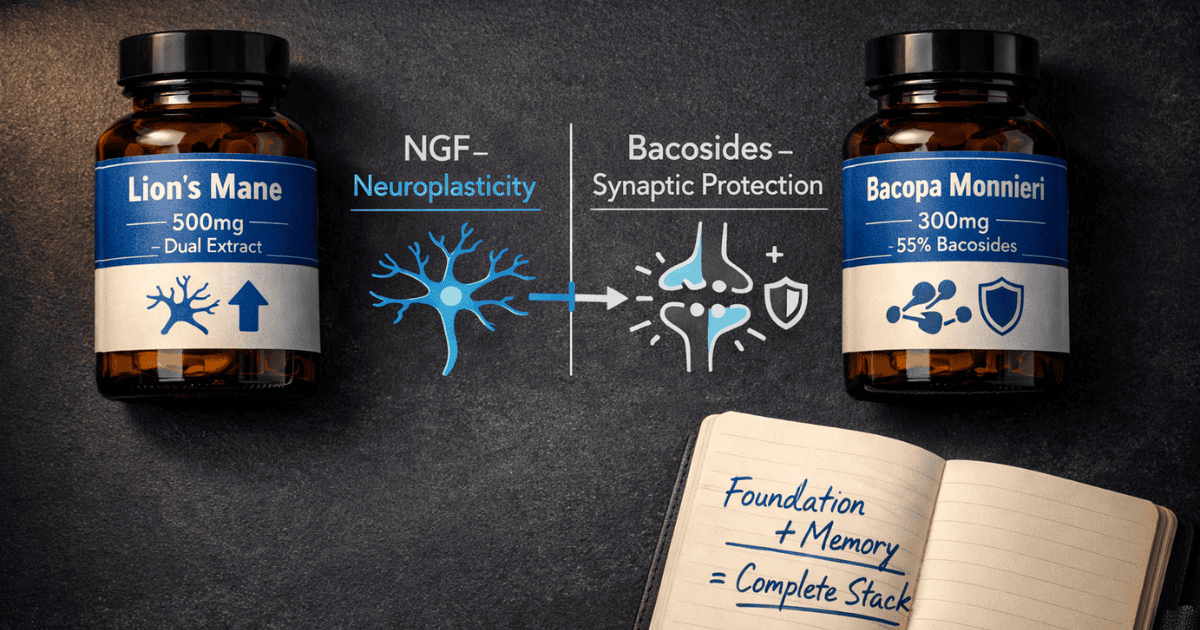
Lion’s Mane (Hericium erinaceus) is fundamentally a neuroplasticity and neuroprotection compound. Its primary value comes from bioactive molecules — hericenones in the fruiting body and erinacines in the mycelium — that stimulate the synthesis of nerve growth factor (NGF) and brain-derived neurotrophic factor (BDNF). These neurotrophins govern neuronal survival, the formation of new synaptic connections, and the brain’s capacity to adapt and rewire. Lion’s Mane isn’t primarily making you sharper today. It’s helping maintain and build the biological infrastructure that makes cognition possible.
Bacopa monnieri is, by contrast, a memory consolidation and synaptic protection compound. Its active compounds — the bacosides, particularly bacosides A and B — work primarily through a different set of mechanisms: repairing and protecting synaptic junctions, modulating the cholinergic system (the neurotransmitter network most directly linked to memory encoding), reducing oxidative stress at neural synapses, and demonstrating meaningful anxiolytic effects that support cognition under stress. Bacopa doesn’t build new neural infrastructure the way Lion’s Mane does. It maintains, protects, and optimises what’s already there, with a particular emphasis on the memory formation process.
Once you understand this distinction — neuroplasticity and neural growth versus synaptic maintenance and memory encoding — the “which one” question essentially answers itself based on your goals.
Lion’s Mane: The Neuroplasticity Compound
The mechanism behind Lion’s Mane is, in my view, one of the most compelling stories in the nootropics world — not because of hype, but because of what NGF actually does and why its support matters. NGF is not simply a “growth” molecule in a generic sense. It is specifically essential for the maintenance and survival of cholinergic neurons in the basal forebrain — the very neurons most vulnerable to early Alzheimer’s-related degeneration, and the same neurons responsible for attention, learning, and memory encoding.
The Fruiting Body vs. Mycelium Distinction
Before covering the research, there’s an important sourcing nuance that most articles skip over. The bioactive compounds that drive Lion’s Mane’s neurological effects are found in different parts of the mushroom. Hericenones — which stimulate NGF from outside neurons — are concentrated in the fruiting body. Erinacines — small enough to cross the blood-brain barrier and stimulate NGF synthesis from within the central nervous system — are found exclusively in the mycelium. Research from Li et al. (2018) established that erinacine A can increase NGF levels in the hippocampus and locus coeruleus — critical regions for memory and stress regulation. This makes mycelium-derived or dual-extract Lion’s Mane products the more neurologically potent choice, though fruiting body products still offer value through the hericenone pathway.
What the Human Evidence Actually Shows
I want to be direct about something that most Lion’s Mane content glosses over: the human RCT evidence, while growing and genuinely promising, is more limited than the preclinical picture might suggest. A 2024 systematic review covering five RCTs found that Mini-Mental State Examination scores showed a combined weighted mean increase of 1.17 in the intervention group — a meaningful signal, but one that comes predominantly from studies in cognitively impaired or older populations. The results in young, healthy adults are more modest.
A 2023 double-blind randomised controlled trial at Northumbria University — one of the better-designed human studies to date — tested 1.8g of Lion’s Mane daily in 41 healthy adults aged 18–45. Participants showed faster performance on the Stroop task at 60 minutes post-dose, and a trend toward reduced subjective stress after 28 days, though the latter did not reach statistical significance. The researchers appropriately cautioned against overinterpreting results given the small sample size. This is an honest representation of where the science currently sits: encouraging but not definitive for healthy young adults.
In my own experience, the subjective effects of Lion’s Mane are subtle and cumulative in a way that doesn’t lend itself to easy self-assessment. You don’t feel it acutely the way you feel caffeine or even L-theanine. What I’ve noticed over extended periods of use — and what seems consistent with the mechanistic picture — is a gradual improvement in mental clarity and learning efficiency, and a sense of cognitive resilience: the brain feeling more capable of handling complex work over longer periods. These are difficult effects to measure and easy to attribute to other variables, which is precisely why the long-form RCT data matters so much for this compound. For more detail on the standalone evidence for Lion’s Mane, I’ve covered it in depth in my dedicated Lion’s Mane research review.
Bacopa Monnieri: The Memory Consolidation Compound
Bacopa monnieri — known in Ayurvedic medicine as Brahmi — has been used for over 3,000 years as a cognitive tonic. It occupies a different position to Lion’s Mane in the nootropic landscape: it has the strongest human RCT evidence base of any single nootropic herb, it targets memory processes more directly, and its effects are meaningfully different depending on when and how you take it.
The Bacoside Mechanism
Bacopa’s active compounds — the triterpenoid saponins collectively known as bacosides — operate through several complementary mechanisms. They enhance the kinase activity necessary for synaptic remodelling, increase the synthesis of key proteins involved in neural transmission, modulate acetylcholine availability (directly supporting memory encoding), and reduce lipid peroxidation at synaptic membranes. This last mechanism is particularly relevant: oxidative stress at synaptic junctions is one of the primary drivers of age-related memory decline, and bacosides appear to provide meaningful protection against it. Bacopa also has documented effects on the serotonin system, which contributes to its well-replicated anxiolytic properties — a secondary benefit that turns out to be cognitively significant, because anxiety is one of the most reliable disruptors of memory consolidation.
What the Human Evidence Actually Shows
Bacopa has a considerably deeper human RCT record than Lion’s Mane. A 2014 meta-analysis by Kongkeaw et al. reviewed multiple randomised controlled trials and concluded that Bacopa has meaningful potential to improve cognitive performance, particularly attention speed. A well-designed 12-week RCT by Morgan and Stevens (2010) found that 300mg daily of a standardised Bacopa extract significantly improved verbal learning, memory acquisition, and delayed recall in healthy adults over 55 — one of the cleaner trials in the Bacopa literature. A 2012 systematic review by Pase et al. found that across six trials, Bacopa improved performance on 9 of 17 memory free recall tests — a meaningful, if not overwhelming, signal.
There’s an important nuance worth highlighting here. A rigorous 2025 RCT published by McPhee et al. enrolled 101 adults aged 40–70 with self-reported memory concerns and found no significant between-group differences in primary cognitive measures (verbal learning, attention, working memory) after 12 weeks of 300mg daily. However — and this is the clinically interesting part — the Bacopa group showed significantly greater reductions in stress reactivity and fatigue after cognitively demanding tasks. This finding is actually consistent with what I’ve observed personally and what the mechanistic picture predicts: Bacopa’s most reliable and repeatable effects may sit at the intersection of stress resilience and memory, rather than raw cognitive enhancement in an unstressed state. For those whose cognitive performance is impaired primarily by anxiety or chronic stress, this is not a minor effect — it’s often the central one.
I’ve written a detailed standalone review of the Bacopa evidence if you want to go deeper: Bacopa Monnieri: Complete Research Review.
The Honest Limitations of Both Compounds
Before discussing protocols, it’s worth being direct about what neither of these compounds is.
Neither Lion’s Mane nor Bacopa produces acute, noticeable cognitive enhancement the way caffeine or even L-theanine does. If you’re expecting to take either compound and feel a clear difference within days, you will likely be disappointed — and then conclude the compound doesn’t work for you, which may not be accurate. Both require extended consistent use. For Lion’s Mane, the neuroplasticity mechanisms operate on timescales of weeks to months. For Bacopa, the memory consolidation effects in clinical trials consistently require a minimum of 8–12 weeks before reaching significance. This patience requirement is not a weakness — it reflects the nature of structural and synaptic changes in the brain — but it does mean these compounds demand a different kind of commitment than fast-acting stimulants.
For Bacopa specifically, gastrointestinal side effects — nausea, cramping, loose stools — are the most consistently reported adverse effects across trials, particularly at higher doses or when taken on an empty stomach. The 2025 McPhee et al. trial noted a significantly higher frequency of digestive complaints in the Bacopa group. This is well-managed by taking Bacopa with a meal containing healthy fats, but it’s worth knowing in advance. Some individuals also report that Bacopa reduces mental sharpness during the first 1–2 weeks of use — a temporary adaptation effect that typically resolves.
For Lion’s Mane, the side effect profile is remarkably clean. Adverse events in clinical trials have been minimal. The main quality concern is product variation — Lion’s Mane supplements vary dramatically in their actual bioactive content, and starch-heavy mycelium products diluted with grain substrate are common in the supplement market. For both compounds, third-party testing and standardised extracts are non-negotiable. This connects to the broader quality framework I cover in my nootropic safety guide.
Side-by-Side: Choosing Based on Your Goals
The most useful framework for choosing between these two compounds is to identify which category of cognitive outcome matters most to you right now.
There’s a third option that I use personally and consider the most effective long-term approach: combine them. These compounds are not only compatible — their complementary mechanisms make them genuinely synergistic. Lion’s Mane builds and maintains the neural infrastructure; Bacopa optimises how that infrastructure is used for memory. For anyone serious about long-term cognitive health, using both in a thoughtfully structured protocol is the approach I consistently return to. The evidence for combined nootropic stacking is explored in my nootropic stacking guide.
Practical Protocol: Dosing, Timing, and Sourcing
These are the protocols I use and recommend based on the clinical literature and personal testing across both compounds individually and in combination.
Timing: Morning with breakfast — consistent daily dosing is more important than timing
Form preference: Dual-extract (fruiting body + mycelium) or erinacine-enriched mycelium for full bioactive spectrum
Minimum trial period: 8–12 weeks before evaluating effectiveness
Cycling: Not strictly necessary; some researchers use 5 days on, 2 days off to maintain sensitivity
Quality marker: Look for products specifying beta-glucan content (>20%) and third-party testing
Timing: Take with a fat-containing meal — fats significantly improve bacoside absorption and dramatically reduce GI side effects
Split dosing option: 150mg morning / 150mg evening if GI sensitivity is an issue
Minimum trial period: 12 weeks minimum — effects are cumulative and gradual
Cycling: Many practitioners recommend 5 days on, 2 days off to prevent tolerance; also helps manage GI adaptation
Quality marker: Specify bacoside A+B content, avoid products without standardisation information
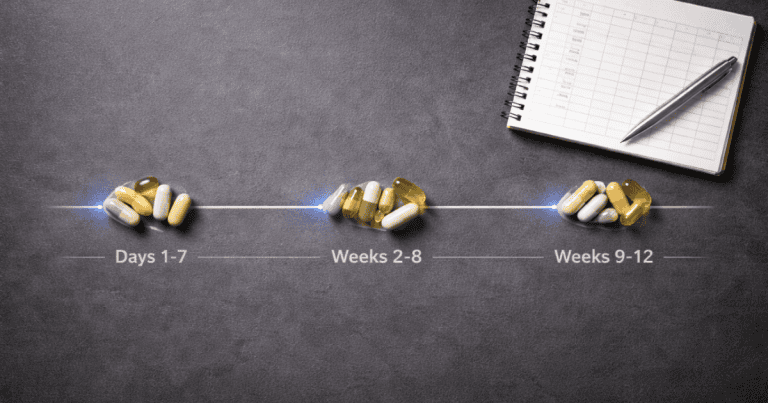
When combining both, I typically recommend beginning with Lion’s Mane alone for the first 4 weeks to establish a baseline and ensure no unexpected responses. Then introduce Bacopa in week 5. This staged introduction also allows you to attribute any effects or side effects to the correct compound. For memory optimisation strategies that complement both compounds, see my Memory & Learning Enhancement hub.
Key Takeaways
Frequently Asked Questions
The exact daily system I use combining Lion’s Mane, Bacopa, and foundational nootropic principles — with a 7-day implementation guide to get you started properly.
Join 2,000+ readers optimising their cognitive performance. Unsubscribe anytime.
- Docherty, S., et al. (2023). The acute and chronic effects of Lion’s Mane mushroom supplementation on cognitive function, stress and mood in young adults: a double-blind, parallel groups, pilot study. Nutrients, 15(22), 4842. PMC10675414
- Sagaro, G.G., et al. (2024). Benefits, side effects, and uses of Hericium erinaceus as a supplement: a systematic review. Frontiers in Neuroscience. PMC12434001
- Li, I.C., et al. (2018). Neurohealth properties of Hericium erinaceus mycelia enriched with erinacines. Behavioural Neurology, 2018, 1–11. PMC5987239
- Kushairi, N., et al. (2023). Neurotrophic and neuroprotective effects of Hericium erinaceus. International Journal of Molecular Sciences, 24(21), 15960. PMC10650066
- Kongkeaw, C., et al. (2014). Meta-analysis of randomized controlled trials on cognitive effects of Bacopa monnieri extract. Journal of Ethnopharmacology, 151(1), 528–535. PubMed 24252493
- Morgan, A., & Stevens, J. (2010). Does Bacopa monnieri improve memory performance in older persons? Results of a randomized, placebo-controlled, double-blind trial. Journal of Alternative and Complementary Medicine, 16(7), 753–759. PubMed 20590480
- Pase, M.P., et al. (2012). The cognitive-enhancing effects of Bacopa monnieri: a systematic review of randomized, controlled human clinical trials. Journal of Alternative and Complementary Medicine, 18(7), 647–652. PubMed 22747190
- McPhee, G.M., et al. (2025). The effects of a Bacopa monnieri extract on cognition, stress, and fatigue in healthy adults: a randomized, double-blind, placebo-controlled trial. International Journal of Sport Nutrition and Exercise Metabolism. PubMed 41091332
- Surendran, S., et al. (2025). Acute effects of a standardised extract of Hericium erinaceus on cognition and mood in healthy younger adults. Frontiers in Nutrition. PMC12018234