
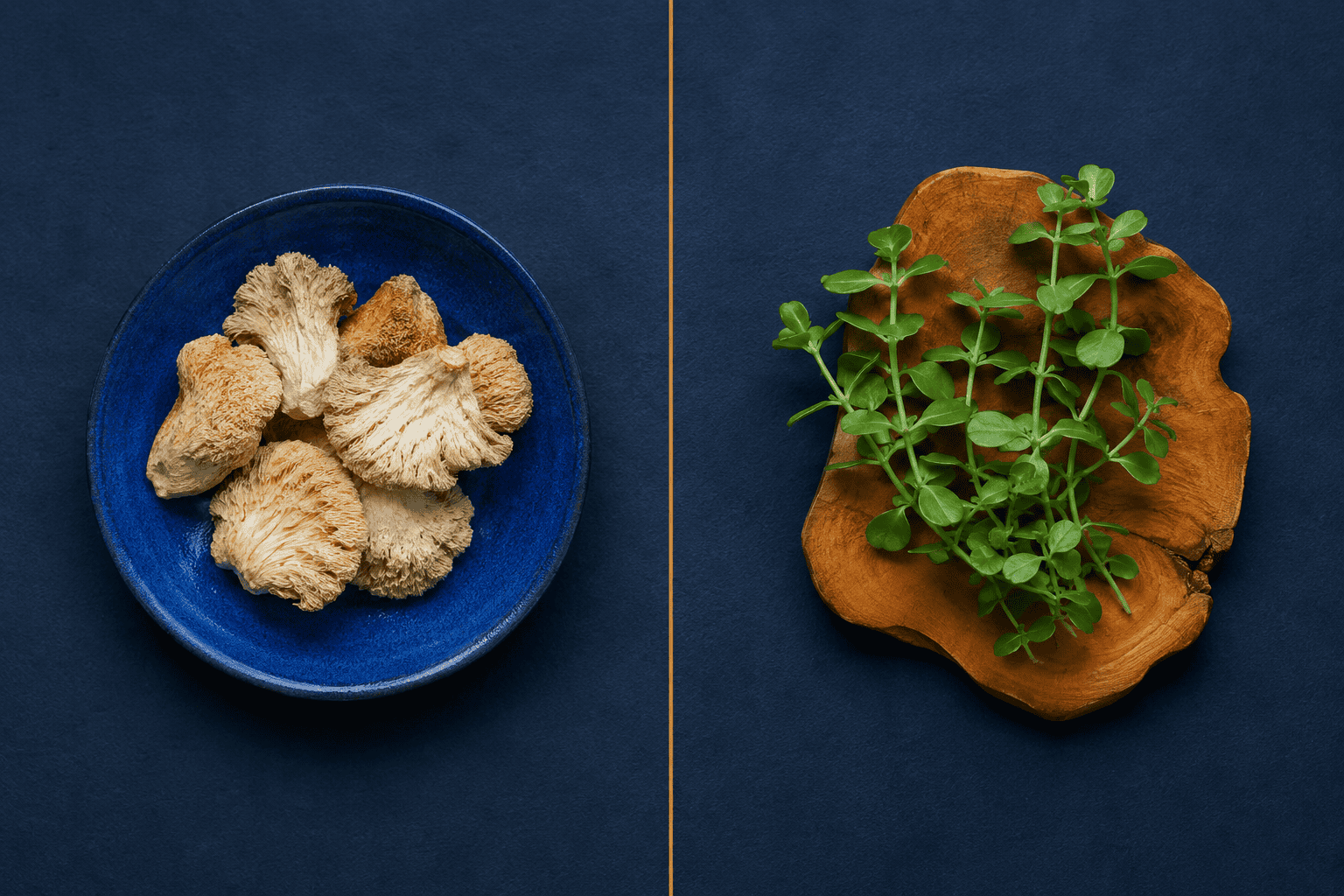
Lion’s Mane vs Bacopa Monnieri
Affiliate Disclosure: Some links on this page are affiliate links. If you purchase through them, NeuroEdge Formula earns a small commission at no extra cost to you. Peter only recommends products he has personally tested and that meet the evidence standards of this site.
Medical Disclaimer: This guide is for educational purposes only and does not constitute medical advice. Bacopa Monnieri can interact with thyroid medication, sedatives, and certain cholinergic drugs. If you have a thyroid condition, take prescription medication, are pregnant or breastfeeding, consult a qualified healthcare provider before starting either compound. Peter Benson is a cognitive enhancement researcher, not a medical doctor.
| What each one actually does | Lion’s Mane supports nerve growth factor (NGF) synthesis — a structural, long-horizon mechanism. Bacopa supports memory consolidation and reduces the rate of forgetting — a functional, learning-specific mechanism. They are not competing for the same job. |
| Time to notice anything | Bacopa: most RCTs measure change at 8–12 weeks, not sooner. Lion’s Mane: some acute mood effects reported within hours in trial settings, but meaningful cognitive change typically needs 8+ weeks of consistent use. |
| Best-evidenced use case | Bacopa: verbal memory recall and new information retention. Lion’s Mane: mood support consistently, cognitive support most clearly demonstrated in older or cognitively impaired populations rather than healthy young adults. |
| Can you take both together | Yes — the mechanisms are complementary rather than overlapping, and no interaction concern is documented. No RCT has tested the specific combination, so this is a mechanism-based inference, not directly proven synergy. |
| Sourcing consideration | Lion’s Mane: look for dual-extract (fruiting body plus mycelium) with a stated beta-glucan percentage. Bacopa: look for standardised bacoside content, typically 45–55% for research-grade extracts. |
| Peter’s take | Both, at different times, for different reasons — not an either/or decision. Bacopa in the morning for the learning-heavy part of the day, Lion’s Mane taken consistently as a long-term structural investment. |
“Lion’s Mane or Bacopa — which one should I take?” is one of the most common questions I get, and it is built on a mistaken premise. These two compounds are not competing for the same job. Lion’s Mane works on nerve growth factor signalling, a slow, structural mechanism. Bacopa works on memory consolidation, a faster, more functional mechanism tied specifically to how well you retain new information. Asking which one “wins” is a bit like asking whether a foundation or a roof is more important to a house.
In 18+ years of testing nootropics on myself, both of these have earned a permanent place in my stack — not because one outperformed the other, but because they solve different problems. This guide covers what each one actually does mechanistically, what the human evidence supports and does not support, whether taking them together makes sense, and how to decide what you actually need.
For the full picture of where these fit among the broader evidence-based options, my complete Nootropics & Supplements guide is the place to start.
What Lion’s Mane Actually Does
Lion’s Mane (Hericium erinaceus) contains two compound families — hericenones from the fruiting body and erinacines from the mycelium — that are able to cross the blood-brain barrier and promote nerve growth factor (NGF) synthesis. NGF supports the growth and maintenance of neurons, which is the mechanistic basis for most of the claims made about this mushroom.
The human evidence is genuinely encouraging but uneven across populations. A double-blind, placebo-controlled crossover trial in healthy young adults found measurable acute effects on cognition and mood following a single 3g dose of concentrated extract. A separate pilot study using the same acute-and-chronic design in young adults reported improvements in cognitive function and reduced stress across the supplementation period. The strongest and longest-running signal, however, comes from older or mildly cognitively impaired populations, where a trial using 3.2g per day reported improved scores on the Mini Mental State Examination compared to placebo.
Honest caveat: most Lion’s Mane trials are small, and the strongest cognitive effects have been demonstrated in older or impaired populations rather than healthy working-age adults. If you’re a healthy 30-something taking this for an edge rather than a deficit, the mood and stress-reduction evidence is currently more consistent than the pure cognitive-enhancement evidence.
What Bacopa Monnieri Actually Does
Bacopa Monnieri’s active constituents, bacosides A and B, influence the cholinergic system and support synapse regeneration and repair. Where Lion’s Mane’s mechanism is broadly structural and neuroprotective, Bacopa’s is more specifically tied to how information moves from short-term to long-term memory — consolidation, not just recall in the moment.
This is one of the better-replicated nootropic compounds in the human research. A randomised, double-blind, placebo-controlled trial in adults 65 and older found that 300mg daily over 12 weeks produced a measurable improvement in delayed word recall compared to placebo. A separate 16-week trial (12 weeks of treatment, 4-week placebo washout) using 250mg daily found improvement specifically in mental control, logical memory, and paired-associate learning in adults with age-associated memory impairment. A six-week trial in medical students using 300mg daily of a standardised extract found improved performance on memory-specific testing over that shorter window.
Honest caveat: nearly every positive Bacopa trial required 6 to 12 weeks minimum before the effect became measurable. There is no credible evidence for acute, same-day memory enhancement from Bacopa — anyone expecting to feel it working within days is testing against the wrong timeline entirely.
The Evidence, Honestly Compared
Bacopa currently has the more consistent human evidence base for a single, specific outcome — verbal memory recall — replicated across several independently conducted RCTs with broadly similar dosing (250–300mg standardised extract daily) and broadly similar timelines (6–16 weeks). Lion’s Mane has a wider range of reported effects — mood, stress, and cognition — but the cognition findings are more population-dependent, with the clearest signal in older or impaired adults rather than healthy adults in their 30s and 40s.
Neither compound has fast-acting, same-day evidence behind it. If you are looking for something that produces a noticeable effect within an hour, neither of these is the right category — that’s the territory of the L-theanine and caffeine stack instead.
Taking Them Together
Mechanistically, there’s a reasonable case for combining them: NGF support (Lion’s Mane) and cholinergic/consolidation support (Bacopa) act on different, non-competing pathways, and no interaction concern is documented in the safety literature for either compound at standard doses. I want to be precise about what that claim is and isn’t, though — no randomised trial has tested the specific combination against either compound alone or against placebo. The case for stacking them is a reasonable mechanism-based inference, not a directly demonstrated synergy. If you’re testing the combination yourself, my four-week testing protocol is the right way to find out whether it’s doing anything for you specifically, and I’d treat the pair as a single combined variable rather than trying to isolate each one’s individual contribution.
Choosing Based on Your Actual Goal
If your goal is retaining new information — studying, learning a skill, a demanding course — Bacopa’s evidence base is the more directly relevant one, and its 8-to-12-week runway means it needs to start well before you need the result, not the week before an exam. If your goal is a long-term structural investment in brain health, or you’re specifically dealing with elevated stress and mood alongside cognitive concerns, Lion’s Mane’s mechanism and mood evidence make it the more relevant starting point. If you genuinely can’t decide and both goals apply to you, the mechanism-based case for combining them is reasonable enough that most people I’ve worked with simply run both.
Clinical Evidence: The Key Trials
Healthy Young Adults — Acute Effects
Lion’s Mane — The 2025 Crossover Trial
A double-blind, placebo-controlled crossover trial gave healthy young adults a single 3g dose of concentrated Lion’s Mane extract and measured cognition and mood against placebo. Measurable acute effects appeared within hours of the single dose — a genuinely useful finding, since much of the older Lion’s Mane literature only covers weeks-long supplementation in older or cognitively impaired populations. This is one of the few trials establishing that Lion’s Mane produces any effect quickly enough to be noticed in a single-session comparison, rather than only over a multi-week protocol.
Older Adults — Cognitive Function
Lion’s Mane — The Saitsu MMSE Trial
In an older-adult population, 3.2g of Lion’s Mane daily produced improved scores on the Mini Mental State Examination compared to placebo — one of the more widely cited findings supporting Lion’s Mane’s use in ageing-related cognitive support specifically. This is a meaningfully higher dose than the 500–1,000mg typically used in standard supplementation, and the population studied (older adults) differs from the healthy working-age readership this guide is written for — worth keeping in mind when translating the dose and expected effect size to your own use.
Alzheimer’s Drug Discovery Foundation evidence summary (Saitsu et al.).
Landmark RCT — Elderly Adults
Bacopa — Calabrese et al. (2008)
A randomised, double-blind, placebo-controlled trial gave adults 65 and older 300mg of standardised Bacopa extract daily for 12 weeks, using the Rey Auditory Verbal Learning Test’s delayed recall measure as the primary outcome. The Bacopa group showed a significant improvement in delayed word recall compared to placebo — one of the more methodologically solid Bacopa trials available, using a well-validated memory measure rather than a general cognitive screening tool. This is the trial the 300mg twice-daily protocol referenced elsewhere in this guide is directly built from.
Journal of Alternative and Complementary Medicine, 2008. PMC3153866.
Age-Associated Memory Impairment Trial
Bacopa — Raghav et al. (2006)
This trial ran 12 weeks of treatment followed by a 4-week placebo washout — 16 weeks total — using 125mg of standardised Bacopa twice daily (250mg total) in adults with age-associated memory impairment. The Bacopa group showed improvement specifically in mental control, logical memory, and paired-associate learning compared to placebo. The washout design is notable: it lets researchers see whether an effect persists briefly after stopping, which adds some confidence that the improvement reflected a real physiological change rather than a purely acute effect present only while dosing.
Across all four trials, the pattern holds: Bacopa’s evidence is more consistent for a single specific outcome — verbal memory recall — replicated with broadly similar dosing and timelines. Lion’s Mane’s evidence spans a wider range of populations and doses, with the clearest cognitive signal still concentrated in older adults rather than the healthy working-age readers most likely to be comparing these two compounds.
Lion’s Mane vs Bacopa — By Use Case
🟢 Strong evidence | 🟡 Moderate evidence | 🔴 Preliminary evidence
Choosing Between Them, In Practice
Composite profiles based on reader-reported experiences. Individual results vary.
Ravi, 31
Studying for a professional exam, chose Bacopa alone
“I had a licensing exam ten weeks out and picked Bacopa specifically because the studies matched my timeline almost exactly — most of them ran 8 to 12 weeks. I started at 300mg daily and didn’t expect anything for the first month, which is exactly what happened. By week seven I noticed I was retaining material from my first read-through noticeably better than I had with previous study blocks. I didn’t add Lion’s Mane at all this round — I wanted one variable, and memory retention was the specific problem I was solving for.”
Used: Bacopa only, 300mg/day · Goal: exam retention · Timeline: noticeable by week 7 · Deliberately single-variable
Claire, 46
High-stress job, chose Lion’s Mane for the mood evidence specifically
“I looked into both and was honestly more drawn to the mood and stress research on Lion’s Mane than the memory claims, since memory wasn’t really my problem — feeling frayed by 3pm every day was. I’ve been on 1,000mg of dual-extract daily for about ten weeks now. The cognitive sharpness claims I’d read about didn’t really materialise for me, which the research actually predicted for someone my age without impairment, but the general sense of steadiness through stressful weeks has been real and consistent enough that I’ve kept taking it.”
Used: Lion’s Mane only, 1,000mg/day dual-extract · Goal: stress/mood, not memory · Outcome matched the evidence pattern for her age group
Tomasz, 52
Runs both together as a long-term brain health stack
“At my age I’m less interested in an edge and more interested in what I’ll still have cognitively at 70. I run both together year-round — Bacopa in the morning, Lion’s Mane with dinner — and I’ve been doing it long enough (going on 18 months) that I’ve stopped trying to isolate which one is doing what. I track annually with a cognitive assessment through my GP rather than trying to attribute week-to-week changes to either compound specifically. For a long-horizon investment like this, I care more about the mechanism logic than a head-to-head comparison.”
Used: both, long-term (18 months) · Goal: long-horizon brain health, not short-term performance · Tracks annually rather than weekly
Nadia, 24
Expected Lion’s Mane to feel like a stimulant — it doesn’t
“I’ll be honest, I started Lion’s Mane expecting something closer to how caffeine feels, based on how it gets talked about online, and was a bit let down for the first month because I wasn’t feeling anything acute. Once I actually read into the mechanism — nerve growth factor, not a stimulant pathway at all — I recalibrated my expectations completely. It was never going to feel like anything in the moment. I switched my actual short-term focus needs to the L-theanine and caffeine stack instead, and kept the Lion’s Mane going purely as a background, long-term thing rather than something I expect to notice day to day.”
Used: Lion’s Mane, expectation mismatch · Lesson: mechanism (NGF) predicts no acute feeling · Solved short-term focus separately
The NeuroEdge Dual Cognition Protocol
Combining structural and functional support without overlapping mechanisms. Updated July 2026.
300mg standardised extract (45–55% bacosides) with breakfast. Consistency matters more than timing precision — same time daily. Commit to a minimum 8-week trial; the RCTs that found an effect ran 6–16 weeks. I source mine from Nootropics Depot’s standardised Bacopa extract, which states bacoside content clearly on the label.
500mg–1,000mg dual-extract daily, taken with a meal. Treat this as a long-term structural investment, not a same-day performance tool — the mechanism doesn’t support an acute effect. I use Nootropics Depot’s dual-extract Lion’s Mane, which lists beta-glucan content rather than just total mushroom weight.
Baseline for 1–2 weeks before starting either. Reassess at week 8, not week 2 — both compounds operate on timelines longer than most people give them. Treat the combination as one variable, not two, when interpreting results.
If you’d rather not source and dose each separately, Mind Lab Pro is one of the few complete stacks that actually contains both Lion’s Mane and Bacopa Monnieri alongside Rhodiola, in one formula — a reasonable single-product alternative to running them individually.

Peter’s Testing Notes — Running Both Long-Term
18+ years personal research · Updated July 2026
I ran a proper four-week baseline-and-trial protocol on Bacopa alone before I ever combined it with anything, specifically because I wanted to know what it was doing on its own first. Nothing distinguishable from baseline showed up until week five; by week seven, verbal memory recall on Creyos was up meaningfully and stayed elevated on a retest a month later. That timeline matches what the published trials report closely enough that I now tell people not to bother judging Bacopa before week six at the absolute earliest.
Lion’s Mane was a different kind of test entirely, because I went in already knowing the mechanism doesn’t predict an acute feeling, so I wasn’t watching for one. What I did track over about four months was mood consistency — specifically, whether my subjective irritability ratings on bad-sleep days were less severe than they’d been previously. They were, modestly, though I’ll be honest that this is a much harder thing to attribute cleanly to one compound than a cognitive test score is.
I’ve now run both together for well over a year without any adverse interaction, and I don’t try to attribute specific outcomes to one or the other anymore — at this point I think of it as one combined long-term protocol rather than two separate experiments running in parallel.
Key Takeaways — Lion’s Mane vs Bacopa
They solve different problems, not the same one — Lion’s Mane targets structural nerve growth support; Bacopa targets memory consolidation. “Which is better” is the wrong question.
Bacopa has the stronger, more replicated human evidence for one specific outcome — verbal memory recall — across multiple independent RCTs.
Lion’s Mane’s clearest cognitive evidence is in older or impaired adults — the mood and stress evidence is currently more consistent for healthy working-age adults.
Neither works acutely — both need a minimum 6–8 week commitment before a fair judgement is possible. Neither belongs in a same-day focus stack.
Combining them is mechanism-justified, not RCT-proven — a reasonable inference from non-overlapping pathways, not a demonstrated synergy from a trial testing the pair directly.
Lion’s Mane vs Bacopa — FAQ
Which one should I start with if I can only pick one?
It depends entirely on what you’re solving for. If retaining new information is your specific problem — studying, a demanding course, a new skill — Bacopa’s evidence for that exact outcome is more directly relevant. If your primary concern is stress, mood, or a long-term structural investment in brain health rather than an immediate learning task, Lion’s Mane’s mechanism and evidence profile fit better.
Is it safe to take Lion’s Mane and Bacopa together?
No interaction concern is documented between the two at standard doses, and their mechanisms don’t overlap in a way that would suggest one. That said, no trial has specifically tested the combination, and Bacopa specifically can interact with thyroid medication and certain sedatives — if you take prescription medication, confirm with a healthcare provider before combining anything.
Why don’t I feel anything from either of these?
This is expected, not a sign either is failing. Neither compound has credible evidence for an acute, same-day effect — Bacopa’s mechanism is memory consolidation over weeks, and Lion’s Mane’s is nerve growth factor support, a structural process with no reason to produce an immediate subjective feeling. If you want something noticeable within an hour, that’s a different category of compound entirely, such as the L-theanine and caffeine stack.
How long before I know if Bacopa or Lion’s Mane is working?
For Bacopa, give it a minimum of eight weeks — most positive trials measured their outcome between six and sixteen weeks, not sooner. For Lion’s Mane, cognitive effects (where present) generally need a similar runway, though some mood effects have been reported earlier. Judging either compound before six weeks is judging it before the mechanism has had time to work.
Does the research support Lion’s Mane for healthy adults, or only people with cognitive decline?
Both, but unevenly. The strongest and longest-running cognitive findings come from older or mildly impaired populations. In healthy young and middle-aged adults, the mood and stress evidence is currently more consistent than the pure cognitive-enhancement evidence, which remains preliminary at this population level.
7 Days to a Sharper Brain
Peter Benson’s personal daily protocol, rebuilt from 18 years of testing
Seven evidence-based interventions, in the exact order that makes each one more effective — from sleep foundation to neuroplasticity and Lion’s Mane.
Join 2,000+ readers optimising their cognitive performance. Unsubscribe anytime.
Scientific References
- Docherty S, et al. Acute effects of a standardised extract of Hericium erinaceus on cognition and mood in healthy younger adults: a double-blind randomised placebo-controlled study. Frontiers in Nutrition (2025). PMC12018234
- The Acute and Chronic Effects of Lion’s Mane Mushroom Supplementation on Cognitive Function, Stress and Mood in Young Adults: A Double-Blind, Parallel Groups, Pilot Study. Journal of Dietary Supplements. PMC10675414
- Alzheimer’s Drug Discovery Foundation. Lion’s Mane & Your Brain — Cognitive Vitality evidence summary (includes Saitsu et al. 2019 MMSE findings). Alzheimer’s Drug Discovery Foundation
- Calabrese C, et al. Effects of a standardized Bacopa monnieri extract on cognitive performance, anxiety, and depression in the elderly: a randomized, double-blind, placebo-controlled trial. Journal of Alternative and Complementary Medicine, 14(6):707-13 (2008). PMC3153866
- Raghav S, Singh H, Dalal PK, Srivastava JS, Asthana OP. Randomized controlled trial of standardized Bacopa monniera extract in age-associated memory impairment. Indian Journal of Psychiatry, 48(4):238-42 (2006). PMC2915594
- Kumar N, et al. Efficacy of Standardized Extract of Bacopa monnieri (Bacognize®) on Cognitive Functions of Medical Students: A Six-Week, Randomized Placebo-Controlled Trial. Evidence-Based Complementary and Alternative Medicine (2016). PMC5075615
Peter Benson
Cognitive Enhancement Researcher | 18+ Years Independent Research
Peter Benson has personally tested both Lion’s Mane and Bacopa Monnieri, individually and combined, over multiple years using structured cognitive testing rather than subjective impression alone. He is not a clinician — this guide is educational, not medical advice.
Last reviewed: July 2026 | Educational content only. Not medical advice. Not a substitute for professional evaluation.