Optimal Nootropic Dosing and Timing Protocols: Evidence-Based Guide
Medical Disclaimer: The information in this article is for educational purposes only and does not constitute medical advice. Always consult a qualified healthcare provider before beginning any supplement regimen. Individual responses to nootropics vary significantly. Dosage recommendations in this guide are based on published research and personal experience and should not replace professional medical guidance.
Getting your nootropic dosing and timing right is the difference between a protocol that works and one that wastes your money, disrupts your sleep, or produces no measurable effect at all.
In nearly two decades of researching cognitive enhancement, I’ve seen intelligent, well-intentioned people make the same dosing mistakes repeatedly. They take the right compounds at the wrong time. They under-dose and conclude the nootropic doesn’t work. They over-dose and experience side effects that put them off an otherwise effective compound. They ignore the relationship between timing and their body’s natural hormonal rhythms — and then wonder why their results are inconsistent.
Dosing and timing are not secondary considerations. They are as important as compound selection itself. A Lion’s Mane supplement taken at the wrong dose will underdeliver. A Rhodiola taken too late in the day will disrupt sleep. Bacopa taken without food will cause nausea and reduce absorption. These are not minor nuances — they are the variables that determine whether your nootropic investment pays off.
This guide covers the evidence-based dosing and timing protocols for the most widely used and research-supported nootropics. If you are new to cognitive enhancement, I recommend reading my guide on the 5 best nootropics for beginners and the nootropic stacking guide before diving into this one — understanding which compounds to take and how to combine them creates the foundation that proper dosing and timing then optimizes.
Why Nootropic Dosing and Timing Matter More Than Most People Realize
The supplement industry has a packaging problem: most products list a single daily dose with no guidance on when to take it, how to adjust based on body weight or sensitivity, or how the timing interacts with your biology. This one-size-fits-all approach is convenient for manufacturers and inadequate for anyone serious about results.
Research consistently demonstrates that timing dramatically affects nootropic efficacy. Studies on the cortisol awakening response confirm that cortisol peaks within 30 to 45 minutes of waking and then declines — a biological window that should inform when stimulatory nootropics are introduced. Taking caffeine during the cortisol peak blunts its effect and increases tolerance buildup. Waiting 90 minutes produces a cleaner, more sustained response.
Similarly, circadian rhythm research published in the journal Sleep Medicine Reviews demonstrates that many cognitive processes — including memory consolidation — follow predictable daily patterns that smart nootropic timing can work with rather than against. Understanding these patterns is what separates a thoughtfully designed protocol from guesswork.
Dosing precision matters equally. Clinical trials on Bacopa Monnieri consistently use 300mg of extract standardized to 45% bacosides — not 150mg, not 500mg. The research dose is the research dose for a reason, and deviating significantly from it means your experience will differ from what the science predicts. This guide grounds every recommendation in the dosing ranges used in published clinical research.
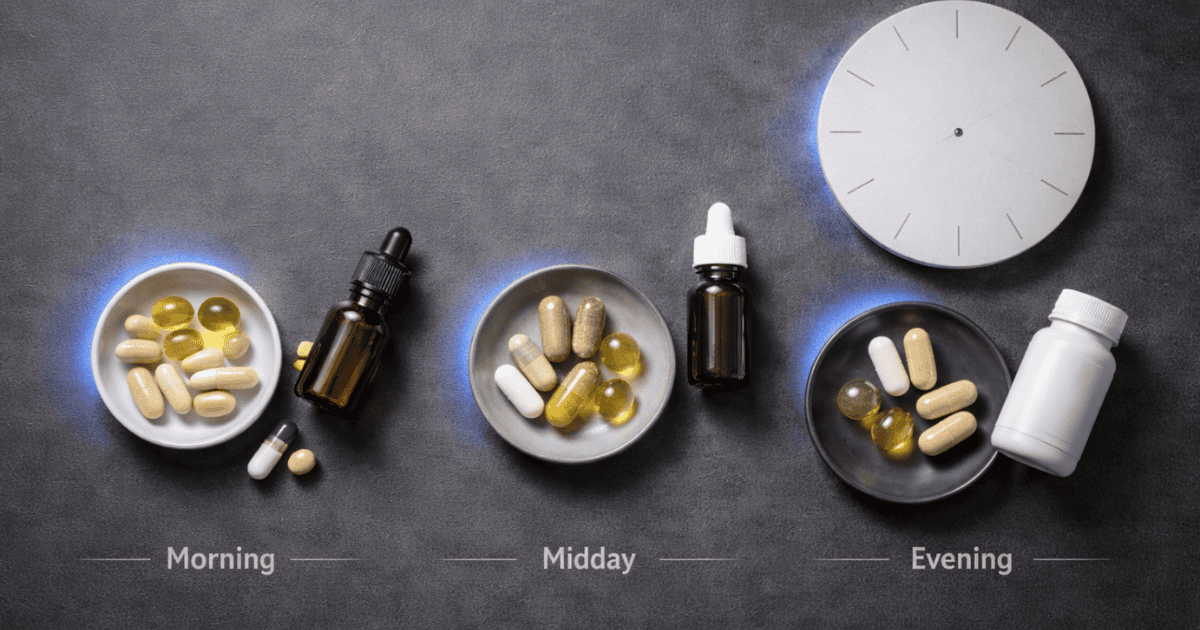
The Evidence-Based Timing Framework
Before we address individual compounds, understanding the broader timing framework that governs effective nootropic protocols is essential. Your body operates on predictable hormonal and neurochemical rhythms throughout the day. Working with those rhythms — not against them — maximizes what any nootropic can deliver.
The Morning Window (90–180 Minutes After Waking)
This is the optimal window for stimulatory and focus-oriented nootropics. By 90 minutes post-waking, cortisol has begun its natural decline from the morning peak, adenosine has started accumulating, and the brain is primed for the alertness-enhancing effects of compounds like caffeine, L-theanine, and Rhodiola Rosea.
Taking stimulatory nootropics during this window — rather than immediately upon waking — produces cleaner, more sustained cognitive enhancement with less tolerance buildup over time. Research on caffeine pharmacokinetics confirms that adenosine receptor sensitivity is highest in the 90–180 minute post-waking window, meaning the same dose of caffeine produces a stronger and more sustained effect when taken during this period compared to immediately upon waking.
The Midday Window (With Lunch)
This is the optimal window for fat-soluble nootropics that require dietary fat for absorption — including Bacopa Monnieri, Lion’s Mane, Phosphatidylserine, and DHA. Taking these compounds with your largest meal of the day maximizes bioavailability and minimizes the digestive discomfort that some users experience when taking them on an empty stomach.
Research on fat-soluble supplement absorption demonstrates that co-ingestion with dietary fat can increase bioavailability by 30–50% for certain compounds — a meaningful difference when you are working with precise clinical doses.
The Afternoon Window (1–3 PM, Sparingly)
The early afternoon is a legitimate second window for non-stimulatory compounds — a small additional dose of Alpha-GPC for extended cognitive work, for example. However, this window requires discipline. Anything with stimulatory properties taken after 2pm risks interfering with sleep, which is the single most important variable in long-term cognitive performance. Research published in Nature and Science of Sleep confirms that even modest caffeine doses taken six hours before bedtime measurably reduce sleep quality — an outcome that negates the cognitive benefits of the nootropic itself.
The Evening Window (With Dinner or Before Bed)
This window is reserved for compounds that support sleep quality, stress recovery, and overnight neurological repair. Magnesium glycinate, ashwagandha, and certain adaptogenic compounds fit here. No stimulatory nootropics belong in the evening window under any circumstances.
Evidence-Based Dosing Protocols: Compound by Compound
The following protocols are grounded in the dosing ranges used in published clinical research. They represent the starting points I recommend to readers — individual adjustment based on personal response and sensitivity should always follow the principle of starting at the lower end of the range and titrating up only after assessing tolerance.
Caffeine
Evidence-based dose range: 100–200mg per serving
Optimal timing: 90–120 minutes after waking, before 2pm
Frequency: Daily use acceptable; 1–2 caffeine-free days per week recommended
Caffeine is the world’s most widely consumed psychoactive compound and one of the most thoroughly researched cognitive enhancers in existence. A comprehensive review in Nutritional Neuroscience confirmed dose-dependent improvements in alertness, reaction time, and sustained attention at doses between 100–300mg. For most people, 100–150mg produces optimal cognitive enhancement with minimal side effects — doses above 200mg increase anxiety and jitteriness in many individuals without proportionally greater cognitive benefit.
The 2:1 L-theanine to caffeine ratio — 200mg L-theanine per 100mg caffeine — is the evidence-backed combination for smooth, sustained focus without jitteriness. This ratio was established in the landmark Haskell et al. study in Biological Psychology and has been replicated in multiple subsequent trials.
Beginner starting protocol: 100mg caffeine + 200mg L-theanine, taken 90 minutes after waking with water. Assess for 2 weeks before adjusting.
L-Theanine
Evidence-based dose range: 100–400mg per serving
Optimal timing: With caffeine in the morning, or alone in the evening for relaxation
Frequency: Daily use, no cycling required
L-theanine is one of the safest nootropics available, with an excellent tolerability profile across a wide dose range. The foundational research on L-theanine’s alpha wave activity used doses of 50–200mg, with 200mg producing the most consistent and measurable effects on relaxed alertness. Higher doses (300–400mg) are used in some anxiety reduction protocols and are well-tolerated, though cognitive enhancement benefits plateau at approximately 200mg for most users.
Unlike most nootropics, L-theanine has a secondary evening application: 200–400mg taken 60 minutes before bed has been shown in research published in Nutritional Neuroscience to improve sleep quality and reduce sleep latency — making it one of the rare compounds that contributes to cognitive performance both during the day and overnight.
Beginner starting protocol: 200mg with morning caffeine. No adjustment needed for most users at this dose.
Free Download
Get the Free 7-Day Optimize Your Brain in 7 Days
The evidence-based diet, sleep, and supplement framework for your first week of cognitive enhancement — completely free.
Join 2,000+ readers optimizing their cognitive performance. Unsubscribe anytime.
Lion’s Mane Mushroom
Evidence-based dose range: 500–3,000mg per day
Optimal timing: With breakfast (fat-soluble, requires dietary fat for absorption)
Frequency: Daily use, no cycling required; minimum 8-week assessment period
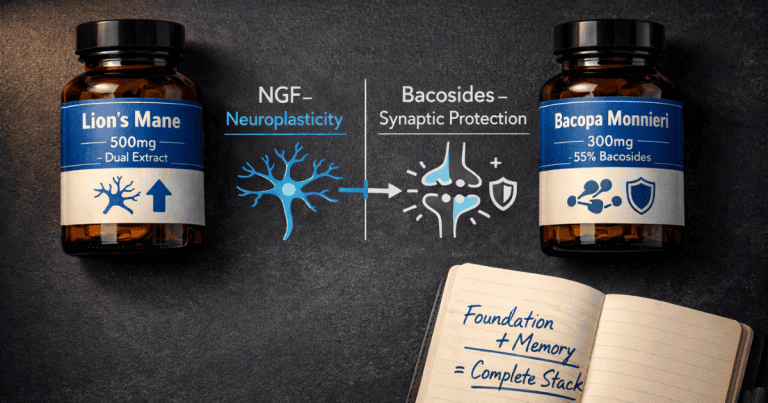
Lion’s Mane dosing is complicated by the significant variation in extract quality across products. The landmark clinical trial demonstrating cognitive improvement in adults with mild cognitive impairment used 1,000mg daily of a standardized extract (three 250mg tablets, three times daily). This is the most commonly referenced human efficacy dose and the one I recommend as a starting point.
Critical quality note: Lion’s Mane products vary enormously in active compound concentration. Look for extracts standardized to beta-glucan content (minimum 25–30%) from the fruiting body — not mycelium on grain, which contains significantly lower concentrations of the active compounds responsible for NGF stimulation. Research comparing fruiting body versus mycelium extracts confirms meaningful differences in bioactive compound concentration between these two sources.
Beginner starting protocol: 1,000mg daily with breakfast. Maintain for minimum 8 weeks before assessing response. Increase to 2,000mg if no noticeable effect after 12 weeks with a verified high-quality extract.
Bacopa Monnieri
Evidence-based dose range: 300–450mg per day
Optimal timing: With largest meal (fat-soluble; always taken with food)
Frequency: Daily use; minimum 12-week assessment period
Bacopa is one of the most consistently dosed nootropics in the clinical literature. The meta-analysis of nine Bacopa randomized controlled trials — the most comprehensive analysis of Bacopa’s cognitive effects — used doses ranging from 300–450mg of standardized extract (45% bacosides). The 300mg dose is the most studied and the appropriate starting point for most users.
Bacopa has a well-documented onset timeline: research by Morgan and Stevens found that statistically significant memory improvements emerge at 12 weeks of consistent use, not 2–4 weeks as some sources suggest. This is not a compound where patience is optional — it is where patience is the protocol.
Always take Bacopa with food. The active bacosides are fat-soluble, and absorption is significantly reduced without dietary fat co-ingestion. Some users experience mild nausea when taking Bacopa on an empty stomach — this is not an adverse reaction to the compound, it is a timing error.
Beginner starting protocol: 300mg with breakfast or lunch. Do not assess efficacy before 8 weeks. Full assessment at 12 weeks.
Alpha-GPC
Evidence-based dose range: 300–600mg per day
Optimal timing: Morning, with or without food
Frequency: Daily use; some users cycle 5 days on, 2 days off
Alpha-GPC is one of the most bioavailable choline sources available and the preferred cholinergic compound in most serious cognitive enhancement protocols. Clinical research published in Dementia used doses of 1,200mg daily in cognitive impairment populations — for healthy adults optimizing performance, 300–400mg in the morning is the standard starting point, with some users adding a second 150–200mg dose early afternoon for extended demanding work sessions.
Alpha-GPC is water-soluble and highly hygroscopic — it absorbs moisture from the air, which causes powder forms to clump. Capsule forms from reputable suppliers are more stable. Examine.com’s comprehensive Alpha-GPC analysis notes that the 50% alpha-GPC form is more stable and equally effective at equivalent active doses — a useful consideration when evaluating product quality.
Beginner starting protocol: 300mg in the morning. If no response after 3 weeks, increase to 400mg. A small subset of users experience headaches at higher doses — this typically resolves by reducing dose or ensuring adequate hydration.
Rhodiola Rosea
Evidence-based dose range: 200–600mg per day
Optimal timing: Morning, 30 minutes before or with breakfast; never after 2pm
Frequency: 5 days on, 2 days off; or 8 weeks on, 2 weeks off
Rhodiola dosing is highly dependent on extract standardization. Effective Rhodiola extracts must be standardized to a minimum of 3% rosavins and 1% salidroside — these are the active compounds responsible for its adaptogenic and anti-fatigue effects. Products without stated standardization are not worth purchasing regardless of price.
The Darbinyan physician night-duty study used 170mg of SHR-5 extract (standardized to 3% rosavins). The student examination study used 200mg. These are the lowest doses with confirmed efficacy — start here before increasing. Doses above 400mg can paradoxically produce sedation in some individuals, a phenomenon documented in the adaptogen literature and attributed to dose-dependent shifts in the compound’s mechanism of action.
Rhodiola should never be taken in the afternoon or evening. Its mild stimulatory and cortisol-modulating effects extend for 4–6 hours post-ingestion and will disrupt sleep quality if taken after 2pm. Research on adaptogen timing protocols supports consistent morning-only administration for stress resilience and anti-fatigue applications.
Beginner starting protocol: 200mg standardized extract (3% rosavins, 1% salidroside) taken with or 30 minutes before breakfast. Do not take after 2pm. Cycle 5 days on, 2 days off to maintain sensitivity.
Phosphatidylserine (PS)
Evidence-based dose range: 100–300mg per day
Optimal timing: With meals (fat-soluble; best absorbed with dietary fat)
Frequency: Daily use, no cycling required
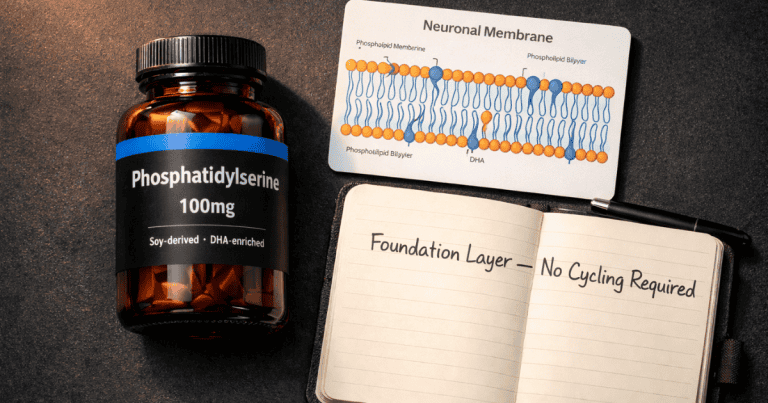
Phosphatidylserine has one of the most consistent dosing protocols in the nootropic literature. The majority of clinical research demonstrating cognitive benefits — including the trials cited in the FDA’s qualified health claim — used 300mg daily divided into three 100mg doses with meals. For cognitive enhancement in healthy adults, 100–200mg daily is the standard starting point, with the full 300mg dose appropriate for those with higher cognitive demands or those over 50.
PS is fat-soluble and should always be taken with food for optimal absorption. It is also one of the safer nootropics for extended daily use — clinical trials have used PS for periods of 12 weeks or longer without adverse effects, and long-term use is associated with progressive rather than plateauing benefits as neuronal membrane health improves over time.
Beginner starting protocol: 100mg with breakfast. Increase to 200mg after 4 weeks if desired. Always take with food containing fat.
DHA (Omega-3 Fatty Acids)
Evidence-based dose range: 1,000–2,000mg DHA per day
Optimal timing: With largest meal of the day
Frequency: Daily use, indefinitely; no cycling required or recommended
DHA is not a nootropic in the traditional sense — it is a fundamental structural nutrient for brain tissue. Research on DHA and brain health confirms it comprises approximately 97% of all omega-3 fatty acids in neural tissue, and its role in neuronal membrane fluidity, synaptic transmission, and neuroprotection makes adequate intake a prerequisite for optimal cognitive performance at any age.
Most omega-3 supplements list combined EPA+DHA. For cognitive purposes, DHA is the primary active compound — look for products where DHA content specifically is listed at 500–1,000mg per serving, and take two servings daily with food. Research on omega-3 bioavailability confirms that triglyceride-form fish oil is significantly better absorbed than ethyl ester form — a quality distinction worth paying attention to when selecting a product.
The NIH Office of Dietary Supplements confirms that fish oil is generally safe at doses up to 3,000mg daily, though doses above this range may have blood-thinning effects relevant for those on anticoagulant medications.
Beginner starting protocol: 1,000mg DHA daily with your largest meal. This is a long-term foundational supplement — take it daily as a permanent component of your cognitive health protocol.
Building Your Complete Daily Dosing Schedule
With individual compound protocols established, here is how an integrated daily schedule looks for each level of the stacking framework. These schedules reflect the timing principles discussed above applied to the complete protocols from my nootropic stacking guide.
Beginner Daily Schedule
Upon Waking: Water, 10 minutes light movement or sunlight exposure — no supplements yet.
90 Minutes After Waking: Caffeine 100mg + L-Theanine 200mg — taken together with water.
With Breakfast: Lion’s Mane 1,000mg + Bacopa Monnieri 300mg + DHA 1,000mg.
Afternoon: No stimulatory compounds. Water. Movement if possible.
Evening (Optional): L-Theanine 200mg 60 minutes before bed for improved sleep quality.
Intermediate Daily Schedule
Upon Waking: Water, movement, sunlight.
90 Minutes After Waking: Caffeine 100mg + L-Theanine 200mg + Alpha-GPC 300mg.
With Breakfast: Lion’s Mane 1,000mg + Bacopa Monnieri 300mg + Phosphatidylserine 100mg + DHA 1,000mg.
Early Afternoon (Demanding Work Days Only): Alpha-GPC 150mg — no later than 1pm.
Evening (Optional): L-Theanine 200mg before bed.
Advanced Daily Schedule
Upon Waking: Water, movement, sunlight.
90 Minutes After Waking: Caffeine 100mg + L-Theanine 200mg + Alpha-GPC 300mg + Rhodiola Rosea 200mg.
With Breakfast: Lion’s Mane 1,000mg + Bacopa Monnieri 300mg + Phosphatidylserine 100mg + DHA 1,000mg.
Early Afternoon (Demanding Work Days Only): Alpha-GPC 150mg — no later than 1pm.
Evening: L-Theanine 200–400mg before bed.
The Five Most Common Nootropic Dosing Mistakes
After nearly two decades of research and working with hundreds of people on cognitive enhancement protocols, these are the dosing errors I see most consistently — and the ones most responsible for failed nootropic experiments.
Mistake 1: Under-Dosing and Concluding the Compound Doesn’t Work
This is the most common error. Someone reads about Lion’s Mane, buys a product, takes 250mg daily (one capsule from a standard product), feels nothing after three weeks, and concludes Lion’s Mane is ineffective. The research dose is 1,000mg daily minimum. At 250mg they were running a quarter of the protocol — and then judging the full protocol by it. Always verify that your dose matches the dose used in clinical research before concluding a compound is ineffective for you.
Mistake 2: Ignoring Extract Standardization
A product labeled “Bacopa Monnieri 500mg” with no standardization statement is meaningless. Without knowing the bacoside content of the extract, you have no idea what you are actually taking relative to the research dose. Always look for standardized extracts with the active compound percentage stated on the label. If it isn’t there, don’t buy it.
Mistake 3: Taking Stimulatory Nootropics Too Early
Caffeine and Rhodiola taken immediately upon waking — during the cortisol peak — produce blunted effects, accelerate tolerance buildup, and often cause the mid-morning crash that people mistakenly attribute to the compound itself. The 90-minute post-waking window is not a minor optimization — it is a fundamental timing principle supported by cortisol awakening response research.
Mistake 4: Not Taking Fat-Soluble Compounds With Food
Bacopa, Lion’s Mane, Phosphatidylserine, and DHA are all fat-soluble. Taking them on an empty stomach reduces absorption, can cause nausea, and means you are getting significantly less of the active compound than the label dose suggests. Always take fat-soluble nootropics with a meal containing some dietary fat.
Mistake 5: Assessing Slow-Acting Compounds Too Early
Bacopa and Lion’s Mane require 8–12 weeks of consistent daily use before their full effects are measurable. Assessing them at 2–3 weeks and concluding they don’t work is like stopping a strength training program after two weeks because you haven’t built muscle yet. The mechanism requires time. The timeline is not optional.
Frequently Asked Questions About Nootropic Dosing and Timing
What is the best time of day to take nootropics?
The optimal timing depends on the compound. Stimulatory nootropics like caffeine, L-theanine, and Rhodiola Rosea are best taken 90–120 minutes after waking — after the cortisol morning peak has begun declining. Fat-soluble neuroplasticity compounds like Lion’s Mane, Bacopa Monnieri, and DHA are best taken with breakfast or your largest meal. No stimulatory nootropics should be taken after 2pm as they can disrupt sleep quality, which negates their cognitive benefits.
How long does it take for nootropics to work?
Acute nootropics like caffeine and L-theanine produce noticeable effects within 30–60 minutes of ingestion. Adaptogenic compounds like Rhodiola Rosea act within 1–2 hours. Neuroplasticity-supporting compounds like Lion’s Mane and Bacopa Monnieri require 8–12 weeks of consistent daily use before their full cognitive benefits are measurable. Most effective protocols include both acute and cumulative compounds to deliver both immediate and long-term cognitive improvements.
Should I take nootropics with or without food?
It depends on the compound. Water-soluble nootropics like caffeine and L-theanine can be taken with or without food. Fat-soluble compounds — including Bacopa Monnieri, Lion’s Mane, Phosphatidylserine, and DHA — must be taken with food containing dietary fat for optimal absorption. Taking fat-soluble nootropics without food reduces bioavailability by up to 50% and can cause digestive discomfort.
How do I know if my nootropic dose is too high?
Signs that a dose may be too high include persistent headaches, increased anxiety or jitteriness, difficulty sleeping, digestive discomfort, irritability, or any symptom that consistently appears after taking a compound. If you experience any of these, reduce the dose by 25–50% and reassess. Always start at the lower end of the clinical dose range and titrate up only after assessing tolerance at a lower dose for at least two weeks.
Do I need to cycle nootropics to prevent tolerance?
Cycling is necessary for stimulatory compounds like caffeine and Rhodiola Rosea, where adenosine receptor adaptation and tolerance develop with continuous daily use. A typical cycling protocol is 5 days on, 2 days off, or 8 weeks on, 2 weeks off. Neuroplasticity compounds like Lion’s Mane, Bacopa Monnieri, Phosphatidylserine, and DHA do not require cycling and actually produce better results with consistent uninterrupted long-term use.
Putting It All Together
Optimal nootropic dosing and timing is not complicated — but it requires that you pay attention to the details that most people skip. Use the clinical dose, not the label minimum. Take fat-soluble compounds with food. Wait 90 minutes after waking before your first stimulatory compound. Never take stimulatory nootropics after 2pm. Give slow-acting compounds 8–12 weeks before assessing them.
These principles apply universally. What varies is your individual response — and the only way to understand that is through systematic self-tracking over time. A two-week baseline followed by consistent metric tracking throughout each new protocol will give you real data about what works for your specific neurochemistry. That data is more valuable than any general guideline, including the ones in this article.
For the complete compound selection guide that this dosing protocol builds on, see the 5 best nootropics for beginners. For the stacking protocols these individual doses integrate into, see the nootropic stacking guide. And for the foundational lifestyle strategies that amplify everything any nootropic can deliver, my overview of sleep and recovery optimization is the place to start.
References
- Haskell, C.F., et al. (2008). The effects of L-theanine, caffeine and their combination on cognition and mood. Biological Psychology, 77(2), 113–122. PubMed
- Nobre, A.C., et al. (2008). L-theanine, a natural constituent in tea, and its effect on mental state. Asia Pacific Journal of Clinical Nutrition, 17(S1), 167–168. PMC
- Mori, K., et al. (2009). Improving effects of the mushroom Yamabushitake on mild cognitive impairment. Phytotherapy Research, 23(3), 367–372. PubMed
- Kongkeaw, C., et al. (2014). Meta-analysis of randomized controlled trials on cognitive effects of Bacopa monnieri extract. Journal of Ethnopharmacology, 151(1), 528–535. PubMed
- Darbinyan, V., et al. (2000). Rhodiola rosea in stress induced fatigue. Phytomedicine, 7(5), 365–371. PubMed
- FDA. (2023). Qualified health claim: Phosphatidylserine and cognitive dysfunction. FDA.gov
- NIH Office of Dietary Supplements. Omega-3 Fatty Acids Fact Sheet for Health Professionals. NIH ODS
- Drake, C., et al. (2013). Caffeine effects on sleep taken 0, 3, or 6 hours before going to bed. Journal of Clinical Sleep Medicine, 9(11), 1195–1200. PubMed
- Examine.com. Alpha-GPC comprehensive analysis. Examine.com
About Peter Benson
Peter Benson is a cognitive enhancement researcher with 18+ years of personal and professional experience in nootropics, neuroplasticity, and brain optimization protocols. He has personally helped hundreds of individuals improve their mental performance through evidence-based supplementation and lifestyle strategies. NeuroEdge Formula is his platform for sharing rigorous, safety-first cognitive enhancement guidance.