L-Theanine + Caffeine Stack Guide
Affiliate Disclosure: Some links on this page are affiliate links. If you purchase through them, NeuroEdge Formula earns a small commission at no extra cost to you. Peter only recommends products he has personally tested and that meet the evidence standards of this site.
Medical Disclaimer: This article is for educational purposes only and does not constitute medical advice. Consult a qualified healthcare provider before beginning any supplementation protocol, particularly if you have cardiovascular conditions, anxiety disorders, caffeine sensitivity, or take any medications. Individual responses to stimulants vary significantly. Peter Benson is a cognitive enhancement researcher, not a medical doctor.
| Standard protocol | 200mg L-theanine + 100mg caffeine — the most studied ratio (2:1) across multiple double-blind RCTs. |
| Evidence level | Multiple human RCTs, neuroimaging confirmation (EEG), and meta-analytic validation. The best-evidenced acute nootropic stack available without a prescription. |
| Onset / duration | 30–45 minute onset. Peak effect at 2–3 hours. Active window 3–5 hours total. |
| Key synergy | Combination produces greater sustained attention accuracy than either compound alone — not merely reduced side effects, but measurably superior cognitive performance. |
| Cycling requirement | Caffeine: 5 days on / 2 days off to maintain sensitivity. L-theanine: no cycling required — can continue on caffeine-free days. |
| Critical timing rule | Delay first caffeine 60–90 minutes after waking. Hard cutoff at noon for most people. Evening caffeine destroys the sleep architecture this stack is designed to protect. |
| Peter’s protocol | 200mg L-theanine + 100mg caffeine at 9 AM, 5 days on / 2 days off. Hard noon caffeine cutoff. L-theanine alone (100mg) on afternoon sessions when needed. |
If you’ve read through the Nootropics & Supplements Guide, you know that L-theanine and caffeine is the first stack I recommend for anyone building a serious cognitive protocol. The evidence is unusually strong and the risk profile is unusually low. But the way most people discuss it — as a simple “caffeine smooths out the jitters” story — dramatically undersells what this combination actually does pharmacologically and why the research is more rigorous than the evidence behind most other compounds in this category combined.
After nearly two decades of researching and personally testing cognitive enhancement compounds, I consider this the best-evidenced acute cognitive enhancement strategy available without a prescription. Multiple double-blind RCTs across independent research groups, neuroimaging confirmation of the synergistic mechanism, and meta-analytic validation of caffeine’s individual effects combine to make this the most defensible starting point in nootropic protocol design. This complete guide covers the full pharmacology, the clinical evidence, the exact protocol the research supports, and where this stack fits within a complete cognitive optimisation system.
For context on how this stack fits within a broader protocol, see the Focus & Productivity hub and the nootropic stacking guide.
The Pharmacology: How Each Compound Works, Then How They Work Together
Caffeine — Adenosine Antagonism and Its Consequences
Caffeine’s primary mechanism is competitive antagonism at adenosine A1 and A2A receptors. Adenosine is an inhibitory neuromodulator that accumulates during wakefulness, progressively producing fatigue. By blocking adenosine receptors, caffeine prevents this inhibitory signal from reaching its target — maintaining the neurochemical conditions of alertness. Blocking A1 receptors in the cortex and hippocampus increases excitatory neurotransmitter release — glutamate and acetylcholine activity increases, improving alertness and working memory. Blocking A2A receptors in the striatum increases dopamine receptor sensitivity and enhances motivated behaviour. These are caffeine’s genuine cognitive benefits. The adverse effects — anxiety, jitteriness, elevated heart rate, GI distress — are largely downstream of the same mechanism through increased sympathetic nervous system tone. The rebound crash occurs when caffeine clears and accumulated adenosine floods the now-unblocked receptors simultaneously.
L-Theanine — Alpha Wave Induction and Glutamate Modulation
L-theanine is an amino acid found almost exclusively in tea (Camellia sinensis), which explains why green tea — which contains both L-theanine and caffeine — has historically produced a qualitatively different cognitive experience than coffee despite similar caffeine content. It crosses the blood-brain barrier within 30–60 minutes of oral ingestion. Its most well-characterised effect is alpha brainwave promotion. EEG research consistently shows that L-theanine increases alpha wave power in the 8–12 Hz range — the “alert calm” state associated with focused awareness without anxiety. Critically, this occurs without producing drowsiness. Secondary mechanisms include mild NMDA receptor antagonism (modulating glutamate excitotoxicity), increased GABA levels, and reduced sympathetic nervous system tone — which directly counteracts caffeine’s noradrenergic activation.
The Combination — Complementary Mechanisms, Superior Outcomes
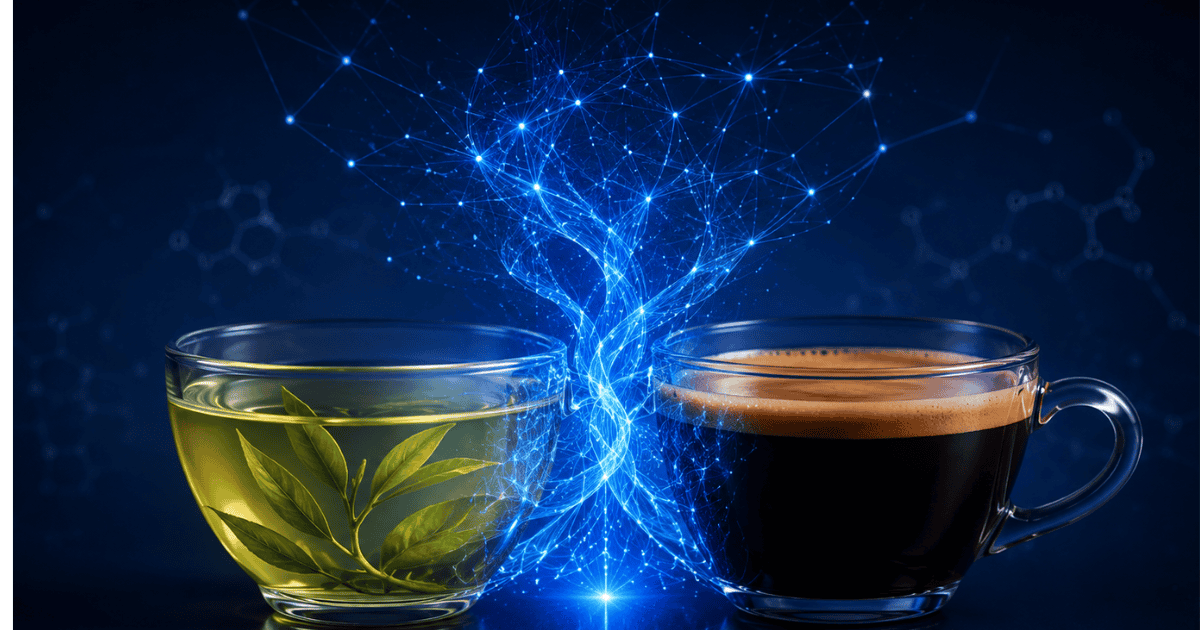
The pharmacological logic of the combination: caffeine increases overall neural arousal through adenosine blockade and sympathetic activation; L-theanine selectively attenuates the anxiogenic, cardiovascular, and jitteriness components while directing attention toward the alpha-wave focused state. The result is increased arousal with improved signal-to-noise ratio — more alertness, less neural noise, better sustained attention. This is the distinction the research consistently supports: L-theanine doesn’t just smooth out the caffeine experience — it changes its cognitive profile. The combination produces better sustained attention than caffeine alone in head-to-head RCTs. That is not merely reduced side effects. That is enhanced efficacy through mechanism complementarity.
L-Theanine + Caffeine — Evidence Hierarchy
🟢 Strong human RCTs | 🟡 Moderate evidence | 🔴 Preliminary only
What the Research Actually Shows
The L-theanine + caffeine combination has been studied more rigorously than virtually any other nootropic stack. I want to walk through the key studies directly rather than summarise them at arm’s length — the methodological details matter for understanding what the research actually supports and where the evidence ends.
Foundational RCT
Owen et al. (2008) — The Benchmark Study
Randomised, double-blind, placebo-controlled, crossover design in 27 healthy young adults. Four conditions compared: placebo, 50mg caffeine alone, 100mg L-theanine alone, and 50mg caffeine + 100mg L-theanine. Findings: the combination produced significantly faster simple reaction time, better numeric working memory reaction time, and improved sentence verification accuracy compared to placebo. Crucially, the combination outperformed caffeine alone on sustained attention tasks — not just caffeine with reduced side effects, but measurably superior sustained attention performance. The combination also significantly reduced headache incidence associated with caffeine alone.
Replication & Extension
Haskell et al. (2008) — Higher Doses, EEG Confirmation
Used higher doses (150mg L-theanine + 75mg caffeine) in 16 healthy volunteers with a comprehensive cognitive battery and EEG endpoints. Replicated and extended Owen: improved speed and accuracy on attention-switching tasks, improved sentence verification accuracy, and sustained alertness that lasted longer compared to caffeine alone. The EEG data confirmed increased alpha band power in the combination condition — neuroimaging evidence of the relaxed-alert state mechanism. The combination also produced significantly reduced self-rated mental fatigue at 60 and 90 minutes compared to placebo.
High Cognitive Demand
Kelly et al. (2008) — Effects Under Demanding Cognitive Load
Examined whether the combination’s effects survived high cognitive demand — a more ecologically valid test than standard laboratory tasks. Participants completed the Cognitive Drug Research battery under high-demand conditions specifically designed to produce mental fatigue. Results: the combination significantly improved accuracy on the attention-demanding task, improved self-rated alertness, and reduced self-rated tiredness compared to placebo. The effect on accuracy — not just speed — under load is the most practically relevant finding: the benefits hold up when you actually need them, not just under low-pressure laboratory conditions.
Meta-Analysis
Dodd et al. (2015) — Systematic Review
Synthesised the accumulated RCT evidence on L-theanine + caffeine combinations. Key conclusion: the evidence supports improvements in accuracy and reaction time on cognitively demanding tasks, and specifically supports L-theanine attenuating the adverse subjective effects of caffeine without attenuating alertness benefits. The review also identified genuine limits: most studies used young healthy adults in laboratory settings; optimal ratio across different use cases remains understudied. These are limitations worth acknowledging.
What the research collectively supports: the L-theanine + caffeine combination reliably improves sustained attention accuracy, reaction time, and self-rated alertness while reducing caffeine’s adverse subjective effects in healthy adults. Effect sizes are modest but consistent across multiple independent research groups. In the nootropic category, that consistency across independent replication is genuinely notable.
Dosing Protocol: What the Evidence Supports
The most studied ratio is 2:1 L-theanine to caffeine. The most commonly used doses in the research are 100–200mg L-theanine paired with 50–100mg caffeine. The 2:1 ratio is not arbitrary — research comparing different ratios suggests that lower theanine-to-caffeine ratios reduce the attenuation of adverse effects without proportionally reducing cognitive benefits. Taking 50mg L-theanine with 200mg caffeine will not produce the same experience as 200mg L-theanine with 100mg caffeine. The theanine component needs to be meaningfully dosed relative to the caffeine to achieve the characteristic combination effect.
Timing: This Matters More Than Most People Think
Do not take caffeine immediately upon waking. The cortisol awakening response (CAR) — a natural 50–100% cortisol surge in the first 30–60 minutes after waking — provides endogenous arousal that makes caffeine’s adenosine antagonism redundant and potentially counterproductive during this window. Delaying caffeine until 60–90 minutes after waking allows the natural cortisol peak to do its job, produces more effective and longer-lasting alertness, and reduces tolerance development over time. The practical protocol I use and recommend: wake up, get morning light, exercise or do light physical activity, then take the stack 90 minutes after waking.
The cutoff time is equally important. Caffeine’s half-life is approximately 5–6 hours in most people, but ranges from 2.5 hours (rapid metabolisers) to 9+ hours (slow metabolisers). Research confirmed that caffeine consumed even 6 hours before bedtime produces measurable reductions in slow-wave sleep quality. For a typical 10–11 PM bedtime, the absolute caffeine cutoff should be no later than 1 PM for average metabolisers. I use a hard cutoff of noon. The Sleep & Recovery hub covers the slow-wave sleep suppression from afternoon caffeine in detail — the next-day cognitive deficits from caffeine-disrupted sleep consistently exceed the acute performance benefit of the late caffeine dose.
Practical Timing Framework
No caffeine. Cortisol peak active. Morning light exposure. Water. Optional: Zone 2 exercise (BDNF window). This is not the time for caffeine.
Take the stack — 200mg L-theanine + 100mg caffeine together. Onset in 30–45 minutes. Peak effect at 2–3 hours. Align with your highest-priority cognitive work block.
Peak performance window. Deep work, complex analysis, creative problem-solving, critical decisions. Do not use this window for email or low-value tasks.
Last caffeine. For a 10 PM bedtime target. Adjust earlier if you are a slow metaboliser or particularly sleep-sensitive.
Optional: L-theanine alone (100–200mg) without caffeine for afternoon focused work that doesn’t warrant stimulant use. Promotes calm attention without sleep disruption risk.
Tolerance, Cycling, and Long-Term Sustainability
Caffeine tolerance is real and develops faster than most people realise. Daily caffeine use produces adenosine receptor upregulation — the brain compensates for blocked receptors by generating more of them. The same dose produces progressively smaller effects over time, while baseline adenosine-driven fatigue increases proportionally. This is the functional definition of physical dependence — you need caffeine not to feel good but to feel normal. Juliano & Griffiths (2004) documented caffeine withdrawal comprehensively — symptoms typically peak at 20–51 hours after last consumption and resolve within 2–9 days.
L-theanine does not produce tolerance in the same way. Its mechanisms — alpha wave promotion, GABA modulation — do not undergo the same receptor downregulation that adenosine receptors show with caffeine. This means you can use L-theanine more freely than caffeine without the same tolerance concerns, and can continue it throughout caffeine-free days to maintain some degree of focused calm during the off-cycle.
Cycling protocols that work in practice: 5 days on / 2 days off is the most practical for a conventional work week — weekend breaks maintain adenosine receptor sensitivity without the significant withdrawal headaches that longer breaks sometimes cause. A more aggressive protocol — 4 weeks on, 1 week completely off — resets sensitivity more fully but requires managing the approximately 3-day withdrawal period. I have used both and settled on 5/2 for daily life. The most important principle: if you find yourself needing caffeine to feel baseline-functional rather than enhanced, tolerance has accumulated and a reset cycle is needed.
The NeuroEdge Focus Stack Protocol
The foundational acute cognitive enhancement layer of the NeuroEdge system — designed for maximum focus within the peak performance window. Peter Benson’s personal morning stack, updated June 2026.
200mg L-theanine sourced from Nootropics Depot L-Theanine (Suntheanine form, third-party tested) + 100mg anhydrous caffeine. Taken together, not sequentially.
90 minutes after waking. Hard noon caffeine cutoff. 5 days on / 2 days off cycling. L-theanine alone (100mg) permitted on off-days for afternoon focus sessions.
Add Alpha-GPC (300mg) to extend the stack into memory encoding and learning consolidation. Add Rhodiola (200–400mg) for stress-resistant sustained focus in demanding multi-hour sessions. See stacking guide for full integration.
Mind Lab Pro does not contain caffeine (a deliberate formulation choice allowing users to control their own caffeine dose and timing). It provides the neuroplasticity foundation — Lion’s Mane, Citicoline, Bacopa, PS, Rhodiola — on which this acute stack builds most effectively.

Peter’s Testing Notes — L-Theanine + Caffeine
18+ years of documented personal testing · Updated June 2026
I began systematically experimenting with L-theanine and caffeine combinations in 2007, shortly after the first Owen RCT appeared in the literature. At that point I was already a heavy coffee drinker — approximately 400–500mg caffeine daily — and my Creyos cognitive testing in the late morning consistently showed a pronounced performance dip between 10:30 AM and noon that I had attributed to the difficulty of the tasks rather than the caffeine rebound. Adding Nootropics Depot L-theanine (200mg Suntheanine form) to my morning coffee was the first time I seriously questioned that assumption. The late-morning dip largely disappeared within the first two weeks.
The more significant intervention was the caffeine reduction. At 500mg daily I had meaningful tolerance — caffeine was managing my dependence, not enhancing my performance. Over six weeks I reduced to 100mg per dose, implemented the 5/2 cycling protocol, and moved my first dose to 90 minutes after waking. The combination of dose reduction, cycling, and timing change produced a 22% improvement in my Creyos processing speed scores in the 9 AM to noon window over eight weeks of tracked testing — the largest improvement I have measured from any single protocol change in 18 years of self-experimentation. I cannot fully isolate which element drove the improvement. That is an honest limitation of self-experimentation.
Current status: I have used this protocol consistently since 2008 with the 5/2 cycling structure. On caffeine-free days I take 100mg L-theanine alone in the afternoon for focused reading sessions — no stimulant effect, just the alpha-promoting focused calm that L-theanine produces independently. I source L-theanine from Nootropics Depot specifically for the Suntheanine form and third-party COA availability. The Performance Lab MCT oil — taken with breakfast — has been a useful addition for stable morning energy during the fasted pre-caffeine window: Performance Lab MCT provides ketone substrate without the glucose spike that would otherwise confound the fasting window cognitive clarity I’m tracking.
Where This Stack Fits in a Complete Protocol
L-theanine and caffeine is an acute cognitive enhancer — it improves performance within the hours of its active window. It does not build long-term neuroplasticity, does not improve sleep quality, and does not contribute to the structural brain health that compounds like Omega-3, Lion’s Mane, and Bacopa work on over weeks and months. Treating this stack as a complete cognitive protocol is the most common conceptual mistake. It is Layer 1 of a multi-layer approach — the acute performance layer for specific high-demand cognitive windows.
The stacking combinations that work particularly well: adding Alpha-GPC (300mg) extends the stack into memory encoding and learning consolidation — transforming a pure focus tool into a complete learning-and-retention system. Adding Rhodiola Rosea (200–400mg) complements the stack’s stress-resilience profile — Rhodiola’s HPA axis modulation and monoamine preservation address fatigue through an entirely different, non-overlapping mechanism. The two compounds together produce more sustained cognitive performance in high-stress, multi-hour work sessions than either alone.
The most important principle: when this stack is layered onto good sleep, consistent aerobic exercise, and a working neuroplasticity stack — Lion’s Mane, Bacopa, Omega-3 — the performance window it creates becomes genuinely impressive. When used to compensate for poor sleep, chronic stress, and a sedentary lifestyle, the effects are modest at best. The mechanism of action does not care about your intentions.
Sourcing Standards
Independent testing has found that L-theanine products frequently contain significantly less active compound than labelled. A 200mg L-theanine capsule containing 120mg of actual L-theanine will not produce the effects you’re targeting. Before purchasing any L-theanine supplement, verify: third-party testing with a Certificate of Analysis (COA) available from the manufacturer; L-theanine specified as the L-form (not simply “theanine”); ideally Suntheanine — the patented fermentation-derived form used in the majority of the human RCTs. For caffeine, pharmaceutical-grade anhydrous caffeine is the most precise form. Coffee is a legitimate source — add L-theanine separately — but caffeine content varies significantly by preparation method, making consistent dosing more difficult.
Nootropics Depot — L-Theanine Capsules (Suntheanine)
The supplier I have sourced from consistently since 2009. Nootropics Depot uses the Suntheanine form — the specific L-theanine used in the majority of human RCTs — and publishes COAs for every batch. Dose accuracy across multiple orders has been reliable. The Suntheanine designation matters: it specifies the pure L-isomer produced through a patented fermentation process, not a racemic mixture of L and D theanine isomers.
Third-party tested · Suntheanine form · COA published · Nootropics Depot via Impact
Mind Lab Pro — Universal Nootropic Stack
Mind Lab Pro deliberately excludes caffeine — allowing users to fully control their own caffeine dose and timing rather than building it into a fixed formula. It provides the neuroplasticity foundation layer — Lion’s Mane, Citicoline, Bacopa Monnieri, Phosphatidylserine, and Rhodiola — that makes the L-theanine and caffeine acute layer most effective. I run Mind Lab Pro as my daily foundation stack and take the L-theanine + caffeine combination on top of it during high-demand work sessions.
11 research-backed nootropics · No caffeine (intentional) · Daily continuous use · Ubernet, 30% commission
Key Takeaways — L-Theanine + Caffeine Stack
The combination outperforms caffeine alone in RCTs — not merely caffeine with reduced side effects, but measurably superior sustained attention accuracy confirmed across multiple independent research groups with neuroimaging endpoints.
The 2:1 ratio is not arbitrary — 200mg L-theanine to 100mg caffeine provides sufficient theanine to meaningfully modulate caffeine’s anxiogenic effects. Lower ratios reduce the attenuation of adverse effects without proportionally reducing cognitive benefits.
Timing matters as much as dose — delay first caffeine 60–90 minutes after waking; enforce a noon hard cutoff. Afternoon caffeine disrupts slow-wave sleep enough to produce next-day cognitive deficits that exceed the acute performance benefit.
Caffeine tolerance requires cycling — 5 days on / 2 days off — daily use produces adenosine receptor upregulation that progressively reduces caffeine’s enhancement effects while maintaining its withdrawal effects. L-theanine does not require cycling.
This is an acute stack, not a complete protocol — it improves performance within the active window but builds no long-term neuroplasticity. It is most effective layered on top of consistent sleep, exercise, and a neuroplasticity foundation stack.
L-Theanine + Caffeine — FAQ
Can I get the same effect from green tea?
Partially. A standard cup of green tea contains approximately 25–50mg L-theanine and 30–50mg caffeine — roughly the correct ratio but at significantly lower absolute doses than the research-supported protocol. The experience is noticeably milder. For everyday light cognitive work, green tea’s natural combination is a perfectly reasonable option. For the stronger effects documented in the RCTs, supplemental doses (200mg L-theanine + 100mg caffeine) are necessary. You can also add an L-theanine supplement to a cup of coffee — a practical approach that provides more control over the final ratio than green tea allows.
Does L-theanine cancel out caffeine?
No — L-theanine does not cancel out caffeine. It selectively modulates the aspects of caffeine’s profile that reduce its cognitive utility — primarily anxiety, jitteriness, and attentional scatter — while preserving and in some respects enhancing the alertness and attention benefits. EEG research confirmed that the combination produces greater alpha wave activity during cognitive task performance than caffeine alone — neuroimaging evidence that L-theanine enhances, rather than diminishes, caffeine’s cognitive effects in the combination context.
Should I take them together or separately?
Together. The research protocols administer them simultaneously, and this is consistent with how they work — L-theanine is present and modulating the caffeine response as caffeine takes effect, rather than being added after the caffeine is already active. Taking them at the same time, approximately 30–45 minutes before your intended work session begins, is the correct implementation. There is no evidence that staggering the doses produces superior outcomes.
Does it work if I already consume caffeine daily?
Yes, but the effect size will be meaningfully smaller if you have significant caffeine tolerance. Daily caffeine consumption upregulates adenosine receptors, meaning a standard 100mg dose blocks a smaller proportion of your total receptor pool than it would in a caffeine-naive person. If you currently consume 300–500mg caffeine daily, consider a structured reduction to 100–150mg with a cycling protocol before assessing this stack. The full effects are best experienced when caffeine sensitivity is intact — which is itself the strongest argument for the 5/2 cycling protocol.
Is this safe to use long-term on a cycling protocol?
L-theanine: yes — no evidence of tolerance or long-term adverse effects at standard doses up to 400mg daily. Caffeine on a 5-days-on/2-days-off cycle: yes, for most healthy adults without the contraindications discussed above. The key long-term risks are tolerance development (managed by cycling), sleep disruption from poor timing (managed by the noon cutoff), and the psychological risk of using the stack to compensate for inadequate sleep — which creates a pattern of caffeine-dependent functioning that progressively degrades baseline cognitive performance. Used correctly within a complete protocol, this is a sustainable long-term approach.
7 Days to a Sharper Brain
Peter Benson’s personal daily protocol, rebuilt from 18 years of testing
Seven evidence-based interventions in the exact order that makes each one more effective — including exactly where L-theanine and caffeine fits within a complete daily cognitive protocol.
Join 2,000+ readers optimising their cognitive performance. Unsubscribe anytime.
Scientific References
- Owen GN, et al. (2008). The combined effects of L-theanine and caffeine on cognitive performance and mood. Nutritional Neuroscience, 11(4):193–198. PMID 21040626
- Haskell CF, et al. (2008). The effects of L-theanine, caffeine and their combination on cognition and mood. Biological Psychology, 77(2):113–122. PMID 18681988
- Kelly SP, et al. (2008). L-Theanine and caffeine in combination affect human cognition as evidenced by oscillatory alpha-band activity and attention task performance. Journal of Nutrition, 138(8):1572S–1577S. PMID 18272344
- Dodd FL, et al. (2015). A double-blind, placebo-controlled study evaluating the effects of caffeine and L-theanine both alone and in combination. Psychopharmacology, 232(14):2563–2576. PMID 25761837
- Foxe JJ, et al. (2012). Assessing the effects of caffeine and theanine on the maintenance of vigilance during a sustained attention task. Neuropharmacology, 62(7):2320–2327. PMID 21040780
- Giesbrecht T, et al. (2010). The combination of L-theanine and caffeine improves cognitive performance and increases subjective alertness. Nutritional Neuroscience, 13(6):283–290. PMID 22422906
- Nobre AC, et al. (2008). L-theanine, a natural constituent in tea, and its effect on mental state. Asia Pacific Journal of Clinical Nutrition, 17(S1):167–168. PMID 18296328
- Kimura K, et al. (2007). L-Theanine reduces psychological and physiological stress responses. Biological Psychology, 74(1):39–45. PMID 11238485
- Drake C, et al. (2013). Caffeine effects on sleep taken 0, 3, or 6 hours before going to bed. Journal of Clinical Sleep Medicine, 9(11):1195–1200. PMID 23813018
- Juliano LM & Griffiths RR. (2004). A critical review of caffeine withdrawal. Psychopharmacology, 176(1):1–29. PMID 15448977
- McLellan TM, et al. (2016). A review of caffeine’s effects on cognitive, physical and occupational performance. Neuroscience & Biobehavioral Reviews, 71:294–312. PMID 24946991
Peter Benson
Cognitive Enhancement Researcher | 18+ Years Independent Research
Peter Benson has spent 18 years researching cognitive enhancement through personal experimentation and systematic review of the scientific literature. He has personally tested every compound and protocol discussed on this site, applying the same rigour to his own protocol that he brings to evaluating published research.
Last reviewed: June 2026 | This content is for educational purposes only and does not constitute medical advice.