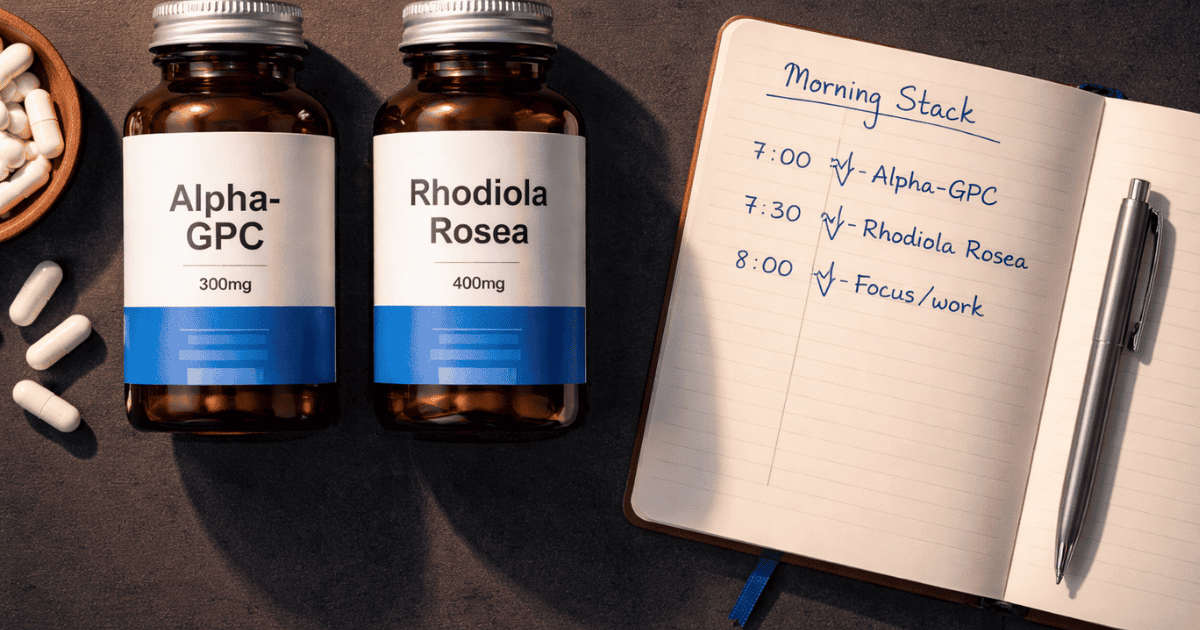
Alpha-GPC Rhodiola Stack: The Stress-Performance Stack
Affiliate Disclosure: Some links on this page are affiliate links. If you purchase through them, NeuroEdge Formula earns a small commission at no extra cost to you. Peter only recommends products he has personally tested and that meet the evidence standards of this site.
Medical Disclaimer: This guide is for educational purposes only and does not constitute medical advice. Alpha-GPC and Rhodiola interact with certain medications and health conditions. Consult a qualified healthcare provider before beginning any supplement regimen, particularly if you take prescription medications (including antidepressants or blood-pressure medication) or have a pre-existing condition. Peter Benson is a cognitive enhancement researcher, not a medical doctor.
The Alpha-GPC Rhodiola Stack: Focus That Holds Under Pressure
| What the stack does | Pairs a cholinergic substrate (Alpha-GPC) with an adaptogen (Rhodiola Rosea) to address two different bottlenecks at once: raw acetylcholine availability for focus and memory encoding, and the stress and fatigue that erode cognitive performance under demand. |
| Why they complement | The mechanisms do not overlap. Alpha-GPC supplies choline for acetylcholine synthesis. Rhodiola modulates the HPA-axis and cortisol response and resists mental fatigue. One raises the ceiling on focus; the other slows the stress-driven decline that lowers it. |
| Typical protocol | Alpha-GPC 300mg + Rhodiola 200–400mg (extract standardised to ~3% rosavins / ~1% salidroside), taken together in the morning on an empty stomach or with a light breakfast. Alpha-GPC acts within 1–2 hours; Rhodiola has a partial acute effect that builds over 1–2 weeks. |
| Best suited to | Demanding cognitive work under time or stress pressure — deep-work sessions, exam preparation, high-stakes deadlines — where both sharp focus and fatigue resistance matter. Less relevant for pure long-term memory building, where Bacopa is the better cholinergic partner. |
| Evidence standard | Each compound has some individual human-trial support, but the Rhodiola evidence base is contested and the specific combination has never been tested in a dedicated trial. The case for pairing them is mechanistic plus personal testing — not a combination trial. See the honest evidence summary below. |
| Biggest mistake | Taking Rhodiola too late in the day. Its mild stimulating, cortisol-modulating action can disrupt sleep if taken in the afternoon or evening. Both are morning compounds — dose them early and once. |
Most nootropic pairings fail for the same reason: the two compounds address the same mechanism, so the second one adds cost without adding capability. The Alpha-GPC Rhodiola stack is interesting precisely because the two compounds have almost nothing mechanistically in common — and that is what makes them work together. Alpha-GPC raises the raw material available for the acetylcholine system that governs focus and memory encoding. Rhodiola is used to blunt the stress and fatigue that erode cognitive performance under real-world demand. One raises the ceiling; the other slows the floor from rising to meet it.
In 18+ years of building and testing nootropic protocols, I have found this pairing to be one of the more reliable “performance under pressure” combinations — distinct from a pure memory stack like Bacopa + Alpha-GPC, and better suited to demanding work sessions than to slow long-term memory building. This guide covers the mechanism behind the pairing, the exact protocol, how it fits into the broader NeuroEdge stacking framework and the wider Nootropics & Supplements guide, and — just as important — the honest limitations of the evidence.
I will be direct about that evidence from the outset. Alpha-GPC has genuine clinical-trial support, though mostly in impaired populations rather than healthy adults. Rhodiola’s human evidence is real but contested — the most rigorous systematic review to date judged it contradictory and at high risk of bias. And the specific combination of the two has never been tested in a controlled trial. The case for stacking them is mechanistic, supported by the individual evidence base and by personal testing. I will flag exactly where the evidence is strong and where it is inferential throughout.
How Each Compound Works
Alpha-GPC — the cholinergic substrate
Alpha-GPC (L-Alpha glycerylphosphorylcholine) is one of the most bioavailable choline sources available, and it crosses the blood-brain barrier efficiently. Once in the brain, it supplies the choline needed to synthesise acetylcholine — the neurotransmitter most directly involved in focus, attention, and the encoding of new memories. Where many choline sources are poorly absorbed or fail to reach the brain in meaningful quantities, Alpha-GPC delivers usable substrate to the cholinergic system. Its strongest human evidence comes from impaired populations: a multicentre, double-blind, placebo-controlled RCT in mild-to-moderate Alzheimer’s dementia found consistent cognitive improvement over 180 days at 400mg three times daily (De Jesus Moreno Moreno, 2003).
Evidence in healthy adults is thinner and less consistent. A frequently cited conference-proceedings study by Parker and colleagues (2015) found no statistically significant acute benefit of Alpha-GPC on mood or cognition in young healthy adults, with large individual variability between people. So for a healthy adult the focus and mental-clarity effect described here — typically felt within one to two hours of dosing — is best understood as inferential, resting on the mechanism and on personal testing rather than on strong healthy-population trials. The full mechanism, dosing detail, and the TMAO consideration are covered in the complete Alpha-GPC guide.
Rhodiola Rosea — the fatigue and stress buffer
Rhodiola Rosea is an adaptogen — a compound studied for helping the body resist the physiological effects of stress. Its marker constituents, rosavins and salidroside, are thought to modulate the HPA (hypothalamic-pituitary-adrenal) axis and the cortisol response, and to act on pathways involved in mental fatigue. In several human trials, standardised Rhodiola extract has reduced fatigue and improved mental performance during stressful, demanding conditions. A double-blind crossover study in 56 physicians on night duty reported a reduction in a mental-fatigue index at a low daily dose (Darbinyan, 2000), and a small placebo-controlled pilot study in students during an examination period reported improved mental performance and reduced stress-related fatigue (Spasov, 2000). Unlike a stimulant, Rhodiola does not push the system harder; the idea is that it makes the system more resistant to the degradation that stress and sustained effort normally cause. Full detail is in the complete Rhodiola guide.
Be honest about the Rhodiola evidence. Those two trials are real, but they are not the whole picture, and it would be misleading to present them as settled proof. The most rigorous review to date — a 2012 systematic review by Ishaque and colleagues — assessed the available trials and concluded that the evidence for Rhodiola is “contradictory and inconclusive,” with every included study at high or unclear risk of bias.
That review specifically re-appraised the physician and student trials cited above and noted that their fatigue-measurement tools were not validated, which is why it treated their positive findings as inconclusive rather than confirmatory. The US National Center for Complementary and Integrative Health reaches the same conclusion: there is not yet enough reliable evidence to say Rhodiola is useful for any health purpose, and most human research is of low-to-moderate quality. Rhodiola belongs in this stack as a reasonable, low-risk bet on a mechanism — not as a proven ingredient.
Why the pairing is coherent: Alpha-GPC works on the cholinergic layer — raising the availability of the neurotransmitter that drives focus. Rhodiola works on the energy and stress layer — aiming to keep cortisol and fatigue from degrading that focus over a long session. They target genuinely different mechanisms, which is the defining criterion for a real stack rather than redundant duplication. The logic is that Alpha-GPC raises your peak while Rhodiola extends how long you can hold it — with the honest caveat that the second half of that claim rests on contested evidence.
What the Evidence Actually Supports
A colour-coded read of each claim behind this stack — from well-established mechanism to commonly claimed but unsupported.
The NeuroEdge Focus-Under-Pressure Protocol
300mg (standardised 50% form)
Morning, with water · effects within 1–2 hrs · cholinergic focus substrate
200–400mg (standardised ~3% rosavins / ~1% salidroside)
Morning, same dose window · partial acute effect, builds over 1–2 weeks · fatigue/cortisol buffer
Timing: Both in the morning, together, on an empty stomach or with a light breakfast. Never dose Rhodiola after midday — it can disrupt sleep.
Introduce sequentially: If you are new to both, add Rhodiola first for 1–2 weeks, then add Alpha-GPC — so you can attribute effects and side effects to the right compound.
Cycling: Rhodiola is commonly cycled (for example, 6–8 weeks on, 1–2 weeks off) as a precaution, and NCCIH notes it is considered possibly safe for up to about 12 weeks. Alpha-GPC does not require cycling. These are starting references drawn from how the compounds are used and studied — not a prescription.
Worked Example: A Two-Week Introduction
The single most useful thing you can do with a two-compound stack is introduce it in a way that tells you which compound is doing what. Here is the sequential-introduction method applied step by step. It is a template for the process, not a promise of a particular result.
Baseline. Take nothing new. Each afternoon, jot a 1–10 rating for focus and for fatigue, and note when in the day your concentration usually falls off. This gives you something to compare against — without it, any later change is guesswork.
Add Rhodiola alone, 200mg each morning. Rhodiola is the slower-building of the two, so it goes first and gets time to work. Keep logging. Because you have added only one thing, any shift in your late-day fatigue rating can reasonably be attributed to it — and if overstimulation or jitteriness shows up, you know exactly what caused it and can hold at the low dose.
Add Alpha-GPC 300mg alongside the morning Rhodiola. Alpha-GPC acts fast, within an hour or two, so its contribution to same-day focus is the easiest of the two to feel. Now the two logs — the fatigue trend you established with Rhodiola, and the acute focus change you notice when Alpha-GPC comes in — let you read each compound separately.
Judge the stack over the whole two-to-three-week window, not on any single day. If your ratings show sharper focus and less late-session drop-off, the pairing is earning its place. If only one rating moved, keep the compound that helped and drop the other — a smaller stack you can actually read beats a bigger one you cannot.
Where I Source These Two
For both compounds, sourcing quality matters more than most people assume. For Alpha-GPC, look for the standardised 50% form with a published certificate of analysis. For Rhodiola, the extract should be standardised to ~3% rosavins and ~1% salidroside — the roughly 3:1 ratio used in the trials — rather than unstandardised “Rhodiola root powder,” which is not equivalent. These are the products I use.
Alpha-GPC — Nootropics Depot
Standardised 50% Alpha-GPC with published third-party testing. This is the source I use for the cholinergic side of this stack.
Rhodiola Rosea — Nootropics Depot
Standardised to the ~3% rosavins / ~1% salidroside ratio used in the clinical trials — not unstandardised root powder. The Rhodiola I use for this pairing.

Peter’s Testing Notes — Alpha-GPC + Rhodiola
18+ years testing protocols · Updated July 2026
I came to this pairing looking for something specific: a stack for demanding, high-pressure work sessions where the problem was not memory but holding sharp focus while under stress and time pressure. Alpha-GPC on its own gives me a clear, clean focus lift within about ninety minutes — but on genuinely stressful, deadline-heavy days, I noticed that focus degrading faster than usual by early afternoon. Adding Rhodiola is what I reached for to address that failure point.
The subjective signature of the combination, in my own use, is “focus that holds under pressure.” On matched Creyos testing sessions, the Alpha-GPC effect on attention tasks is the more clearly measurable of the two; Rhodiola’s contribution shows up less as a test-score jump and more as the absence of the late-session decline I get on high-stress days without it. That is consistent with the mechanism — Rhodiola is not adding raw cognitive horsepower, it is aiming to remove a stress-driven subtraction. I want to be honest that this is a harder effect to capture in a single test score than it is to feel across a four-hour work block, and that my own read of it is exactly the kind of subjective, single-person impression that the formal Rhodiola evidence has struggled to pin down.
The one mistake I made early and want you to avoid: I took Rhodiola at lunchtime on a heavy day, and slept badly that night. Its mild cortisol-modulating, mildly stimulating action does not belong in the afternoon. Since moving both compounds to a single morning dose, that problem disappeared entirely. This is a morning stack — treat it as one.
Illustrative example, not a real individual or testimonial. The scenario below is a composite written to show how the decision is made. It is not a real person, contains no claimed results, and individual responses vary.
Choosing This Stack Over the Alternatives
Picture a project lead heading into a two-week product launch: long days, frequent context-switching, and the specific feeling that concentration is fine in the morning but frays under the afternoon’s accumulated pressure. The bottleneck here is not memory — nothing needs to be committed to long-term recall — so a memory-focused pairing would be solving the wrong problem. The bottleneck is holding a sharp working state while the stress load climbs. That is the exact profile this stack is built for, which is why it would be the reasonable choice over an Alpha-GPC + Bacopa memory pairing.
Now change one detail: the same person is instead spending those two weeks learning a dense new certification syllabus they need to retain for an exam months away. The bottleneck flips to long-term encoding, and the better answer flips with it — toward Bacopa as the cholinergic partner. The lesson is not that one stack is stronger; it is that you pick the pairing by naming the bottleneck first.
When to Use This Stack — and When to Be Cautious
This is a targeted pairing, not a general-purpose stack. It earns its place when the cognitive demand involves both focus and stress or fatigue resistance: deep work under deadline, examination periods, high-stakes presentations, or any sustained session where you need to stay sharp while under pressure. If your goal is pure long-term memory building rather than performance under pressure, Bacopa is the better cholinergic partner for Alpha-GPC — it extends acetylcholine signalling and has stronger direct memory-consolidation evidence. Choose the pairing that matches the bottleneck you are actually trying to solve.
On safety, two points matter most. First, drug interactions: anyone taking prescription medication — particularly antidepressants, blood-pressure medication, or stimulants — should speak to a healthcare provider before starting. This is not boilerplate: NCCIH specifically documents a reported interaction between Rhodiola and losartan, a common blood-pressure drug, and Rhodiola’s stimulating quality can compound with other stimulants. Second, tolerability: anyone prone to overstimulation or anxiety should start Rhodiola at the low end (200mg) and assess, since reported side effects include dizziness, headache and insomnia, and its activating quality does not suit everyone. This is not a complete list of interactions or cautions — treat it as a prompt to check your own situation with a professional, not a clearance.
Rhodiola has not been established as safe in pregnancy or breastfeeding, so it should be avoided in those situations. And because the combination itself is untested, the sensible posture is conservative: start low, add one compound at a time, and stop if anything feels off.
Key Takeaways — Alpha-GPC + Rhodiola
The pairing rationale is that the mechanisms don’t overlap. Alpha-GPC supplies cholinergic substrate for focus; Rhodiola is used to buffer the stress and fatigue that degrade it. One aims to raise the peak, the other to extend how long you hold it.
Protocol: Alpha-GPC 300mg + Rhodiola 200–400mg, both in the morning. Never dose Rhodiola after midday — it disrupts sleep. Standardise Rhodiola to ~3% rosavins / ~1% salidroside.
Be honest about the evidence. Alpha-GPC’s healthy-adult data is thin and Rhodiola’s is contested — a systematic review called it contradictory and at high risk of bias. Treat this as a reasonable bet on a mechanism, not a proven protocol.
The combination has never been tested in a trial. Introduce the two sequentially so you can attribute effects correctly, and check interactions (antidepressants, blood-pressure drugs) with a provider first.
Alpha-GPC + Rhodiola — FAQ
Can you take Alpha-GPC and Rhodiola together?
They are commonly stacked because their mechanisms do not overlap: Alpha-GPC supplies choline for acetylcholine synthesis (focus and memory encoding), while Rhodiola is used to modulate the stress and fatigue response. No adverse interaction between the two has been established in healthy adults, though it is worth knowing that the combination itself has not been formally studied. The usual approach is to take both together in the morning: Alpha-GPC 300mg and Rhodiola 200–400mg standardised to ~3% rosavins. Anyone on prescription medication should consult a healthcare provider first, as both compounds can interact with certain drugs.
What time of day should I take the Alpha-GPC and Rhodiola stack?
In the morning, both together, on an empty stomach or with a light breakfast. This timing matters most for Rhodiola: its mild stimulating and cortisol-modulating action can disrupt sleep if taken in the afternoon or evening. Alpha-GPC’s cognitive effects appear within one to two hours, making a morning dose ideal for a day of demanding work. A single morning dose of the pairing is the standard protocol — avoid splitting Rhodiola into a later second dose.
Is Alpha-GPC + Rhodiola better than Alpha-GPC + Bacopa?
Neither is universally better — they solve different problems. Alpha-GPC + Rhodiola is a “performance under pressure” pairing: sharp focus plus an attempt to resist stress and fatigue, best for demanding work sessions and high-stakes deadlines. Alpha-GPC + Bacopa is a memory pairing: Bacopa extends acetylcholine signalling and has stronger direct evidence for long-term memory consolidation. Choose Rhodiola if your bottleneck is stress and endurance during focused work; choose Bacopa if your goal is building long-term memory. Name the bottleneck first, then pick the pairing.
How long before the Alpha-GPC and Rhodiola stack works?
The two compounds work on different timescales. Alpha-GPC can produce a noticeable focus effect within one to two hours of dosing — potentially the same day, though healthy-adult evidence for this is mixed. Rhodiola has at most a partial acute effect and is intended to build over one to two weeks of consistent daily use. Evaluate the stack over at least two to three weeks rather than judging it on the first dose, and use a consistent measure — either systematic cognitive testing or a simple daily focus-and-fatigue log — rather than subjective impression alone.
Is the evidence for this stack actually strong?
Partly, and it is worth being clear about which part. Alpha-GPC has solid clinical-trial evidence in impaired populations but thinner, mixed evidence in healthy adults. Rhodiola’s human evidence is genuinely contested — a systematic review concluded it is contradictory and at high risk of bias, and NCCIH says there is not yet enough reliable evidence to confirm a benefit. The specific combination has never been tested. So the stack is best framed as a mechanistically sensible, low-risk experiment you evaluate on yourself — not an intervention with proven combined effects.
Get “7 Days to a Sharper Brain” — Free
Peter Benson’s personal daily protocol, rebuilt from 18 years of testing.
| ✓ | Day 1 — Sleep foundation + Magnesium Glycinate |
| ✓ | Day 2 — L-Theanine + Caffeine focus stack |
| ✓ | Day 3 — Brain nutrition timing for stable energy |
| ✓ | Day 4 — BDNF movement protocol |
| ✓ | Day 5 — 90-60-30 sleep environment sequence |
| ✓ | Day 6 — Stress resilience + cognitive load framework |
| ✓ | Day 7 — Neuroplasticity, Lion’s Mane + your complete assembled daily stack |
Join 2,000+ readers optimising their cognitive performance. Unsubscribe anytime.
Key References
Full references for each compound are in their individual guides. Key sources underpinning this pairing and its honest limitations:
- De Jesus Moreno Moreno M. (2003). Cognitive improvement in mild to moderate Alzheimer’s dementia after treatment with choline alfoscerate — multicentre, double-blind, randomised, placebo-controlled trial. Clinical Therapeutics, 25(1):178–193. PMID 12637119
- Parker AG, et al. (2015). The effects of Alpha-GPC, caffeine or placebo on mood, cognitive function, power, speed and agility (conference proceedings; no significant acute cognitive effect in healthy adults). Journal of the International Society of Sports Nutrition, 12(Suppl 1):P41. PMC4595381
- Darbinyan V, et al. (2000). Rhodiola rosea and mental fatigue in physicians on night duty — double-blind crossover. Phytomedicine, 7(5):365–371. PMID 11081987
- Spasov AA, et al. (2000). Rhodiola rosea SHR-5 extract during a stressful examination period — placebo-controlled pilot study. Phytomedicine, 7(2):85–89. PMID 10839209
- Ishaque S, et al. (2012). Rhodiola rosea for physical and mental fatigue: a systematic review (evidence “contradictory and inconclusive”; all trials at high/unclear risk of bias). BMC Complementary and Alternative Medicine, 12:70. PMID 22643043
- NIH / National Center for Complementary and Integrative Health. Rhodiola: Usefulness and Safety. NCCIH
Peter Benson
Cognitive Enhancement Researcher | 18+ Years Independent Research
Peter Benson has spent 18+ years testing nootropic compounds and protocols through personal experimentation and systematic cognitive testing via Creyos. The Alpha-GPC + Rhodiola pairing is one of the protocols he has personally used and refined for demanding, high-pressure cognitive work.
Last reviewed: July 2026 | Educational content only. Not medical advice.