Advanced Nootropic Stacking Protocols
Medical Disclaimer: Advanced nootropic stacking involves combining multiple compounds with distinct pharmacological mechanisms. Drug-drug and drug-supplement interactions exist. Individuals taking prescription medications — particularly psychiatric medications, blood thinners, blood pressure medications, and diabetes medications — must consult a qualified healthcare provider before implementing any stack. This information is for educational purposes only and does not constitute medical advice. Start with the lowest effective dose of each compound and introduce one variable at a time.
If you have completed the 12-week beginner stack protocol — introduced compounds individually, established baseline measurements, evaluated each compound across its appropriate timeline, and confirmed which ones produce meaningful effects for your individual neurochemistry — you are ready for advanced stacking. If you have not completed that foundation, return to it first. Advanced stacking is not “more supplements = better results.” It is the systematic combination of compounds with complementary mechanisms to produce synergistic effects that isolated compounds cannot achieve, applied with the precision required to distinguish signal from noise across multiple simultaneous variables.
After 18+ years of systematic self-experimentation with hundreds of compounds and stacking protocols — maintaining detailed logs, objective cognitive tracking, and documented outcome assessment — I have identified the principles that separate effective advanced stacking from expensive polypharmacy that produces more placebo and side effects than genuine cognitive enhancement. This is the graduate-level guide: cycling protocols to prevent tolerance, context-specific stacking for different cognitive demands, the complete integrated morning performance stack, and the methodology for building a personalized protocol that adapts to your actual measured responses rather than generic recommendations.
This article assumes you are already familiar with the individual compounds covered throughout NeuroEdge Formula — the L-Theanine + Caffeine stack, Lion’s Mane, Bacopa Monnieri, Omega-3 DHA, Creatine, Alpha-GPC and Rhodiola Rosea — and the biohacking protocols from cold exposure, intermittent fasting, and HRV training. What follows is how to combine them intelligently.
Part 1: The Five Principles of Advanced Stacking
Principle 1: Mechanism Diversity — No Redundancy
The most common stacking error is combining multiple compounds that operate through the same mechanism, producing redundancy rather than synergy. Three cholinergic compounds (Alpha-GPC + CDP-Choline + Huperzine A) do not produce three times the cognitive benefit — they produce overlapping acetylcholine elevation with diminishing returns and increased risk of cholinergic side effects including headaches and gastrointestinal discomfort. The correct approach: one compound per mechanism class, selected for the highest evidence quality and best individual response in your baseline testing.
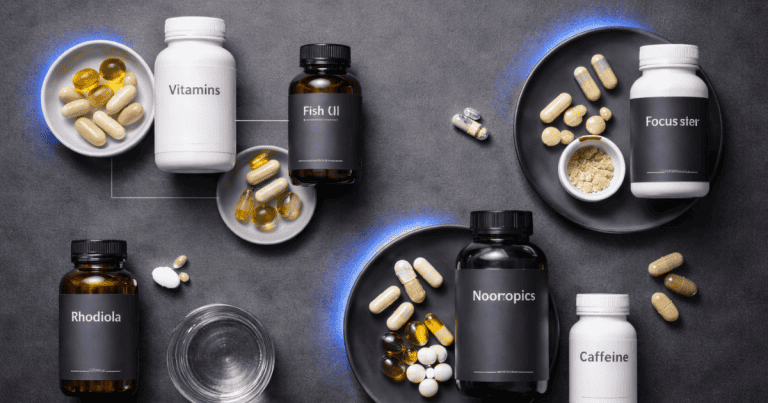
The mechanism classes that matter for cognitive stacking: Cholinergic (acetylcholine substrate) — Alpha-GPC or CDP-Choline, not both. Catecholaminergic (norepinephrine/dopamine) — Caffeine, Rhodiola, cold exposure. Neuroplasticity (BDNF/NGF) — Lion’s Mane, aerobic exercise, fasting. GABAergic/Anxiolytic — L-Theanine, Magnesium L-Threonate. Structural/Neuroprotective — Omega-3 DHA, Phosphatidylserine. Metabolic/Energy — Creatine, CoQ10. Adaptogenic/HPA Axis — Rhodiola, Ashwagandha.
A well-constructed stack includes one compound from each relevant mechanism class for the specific cognitive outcome you are targeting — never multiple compounds from the same class stacked simultaneously without a clear mechanistic reason and documented individual response showing additive benefit.
Principle 2: Timing Optimization — Pharmacokinetics Matter
Stacking compounds with different pharmacokinetic profiles — time to peak plasma concentration, duration of action, elimination half-life — allows you to sequence cognitive performance states across the day rather than producing a single undifferentiated “enhanced” state. The mistake is taking everything at once because it is convenient. The correct approach is strategic timing that aligns peak compound effects with the cognitive demands you are facing.
Morning catecholaminergic activation (Rhodiola on waking, caffeine + L-Theanine 90 minutes post-waking, cold exposure pre-work) produces the alertness and attentional focus required for demanding analytical work. Mid-morning cholinergic support (Alpha-GPC 30–60 minutes before peak cognitive demand) sustains that performance through prolonged sessions. Evening adaptogenic and GABAergic compounds (Ashwagandha, Magnesium L-Threonate) shift the system toward parasympathetic dominance and sleep preparation. This is not guesswork — it is the deliberate exploitation of known pharmacological timelines to produce the cognitive state sequence your work demands require.
Principle 3: Cycling to Prevent Tolerance
Continuous daily use of any receptor-active compound eventually produces receptor downregulation — the adaptive response through which the nervous system maintains homeostasis by reducing sensitivity to chronically elevated signaling. Caffeine tolerance is the most familiar example: the adenosine receptor downregulation that occurs with daily caffeine use progressively reduces its cognitive enhancement effects and increases the withdrawal symptoms experienced without it. The same principle applies to every neuroactive compound in your stack.
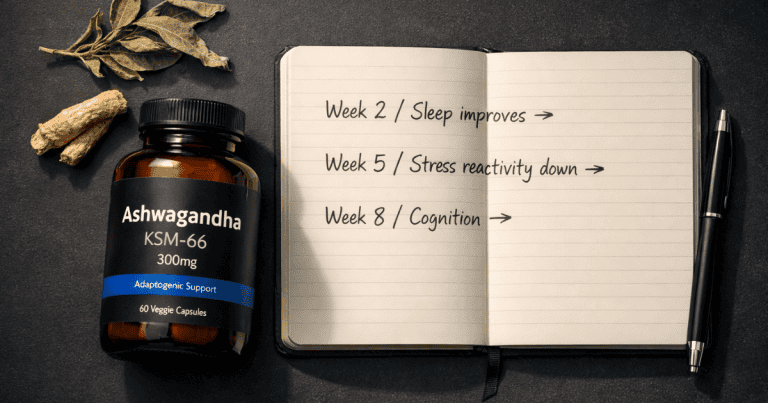
The cycling protocols that prevent tolerance: Acute-effect compounds (caffeine, Alpha-GPC, Rhodiola) — use strategically rather than daily. Reserve for high-demand cognitive work days rather than maintaining a constant baseline. 5 days on, 2 days off is a practical rhythm for most people. Neuroplasticity compounds (Lion’s Mane, Bacopa) — these operate through structural mechanisms rather than receptor activation and do not produce classic tolerance. Continuous daily use for 12–16 weeks, followed by a 2–4 week break, then resume. Adaptogens (Rhodiola, Ashwagandha) — 8–12 weeks continuous, 2–4 week break. This cycling prevents HPA axis dependency and maintains the adaptogenic sensitivity that makes them effective.
Principle 4: Context-Specific Stacking — Match Stack to Demand
Not all cognitive work is the same — and the optimal stack for sustained analytical focus is different from the optimal stack for creative problem-solving, which is different from the optimal stack for high-stress performance under pressure. Advanced stacking recognizes this and builds context-specific protocols rather than a single “daily stack” applied uniformly.
Deep analytical work stack: Caffeine (100mg) + L-Theanine (200mg) + Alpha-GPC (300–600mg) — maximal cholinergic and catecholaminergic activation for sustained attentional focus and working memory demand. Creative/divergent thinking stack: L-Theanine (200–400mg) alone or with minimal caffeine (50mg) — alpha wave enhancement and reduced analytical filtering, no Alpha-GPC which can make some people feel “too focused” for creative work. High-stress performance stack: Rhodiola (300–500mg) + L-Theanine (200mg) + Ashwagandha (300mg if pre-loaded) — adaptogenic HPA regulation and anxiolytic GABA support without the overstimulation that caffeine can produce under acute stress.
Principle 5: Individual Response Tracking — Data Over Dogma
The most important principle is also the most commonly violated: your individual neurochemical response to any compound or stack is the only data that matters for your protocol design. Generic recommendations — including everything in this article — are starting hypotheses to test, not prescriptions to follow blindly. The compounds and doses that produce optimal effects for one person frequently produce suboptimal or even adverse effects for another due to genetic polymorphisms in metabolic enzymes, receptor density variations, baseline neurotransmitter status differences, and medication interactions.
The non-negotiable methodology: maintain a daily log tracking compound doses, timing, subjective cognitive performance (focus quality, mental clarity, creativity, stress resilience) on 1–10 scales, and objective cognitive testing (Cambridge Brain Sciences, Dual N-Back, domain-specific performance metrics). Review weekly to identify patterns. When a stack modification produces measurable improvement, you have found something genuinely useful for your neurology. When it produces no change or negative effects, discontinue regardless of how well-evidenced the compound is in the literature. Your n=1 data supersedes population averages.
Part 2: The Complete Integrated Morning Performance Stack
This is the full-system protocol I use personally for high-demand cognitive work — integrating behavioral interventions, acute nootropics, and timing optimization into a single coordinated sequence. It assumes you have already established the foundational layer (quality sleep, consistent circadian rhythm, baseline fitness) covered in the Sleep and Brain Health hubs.
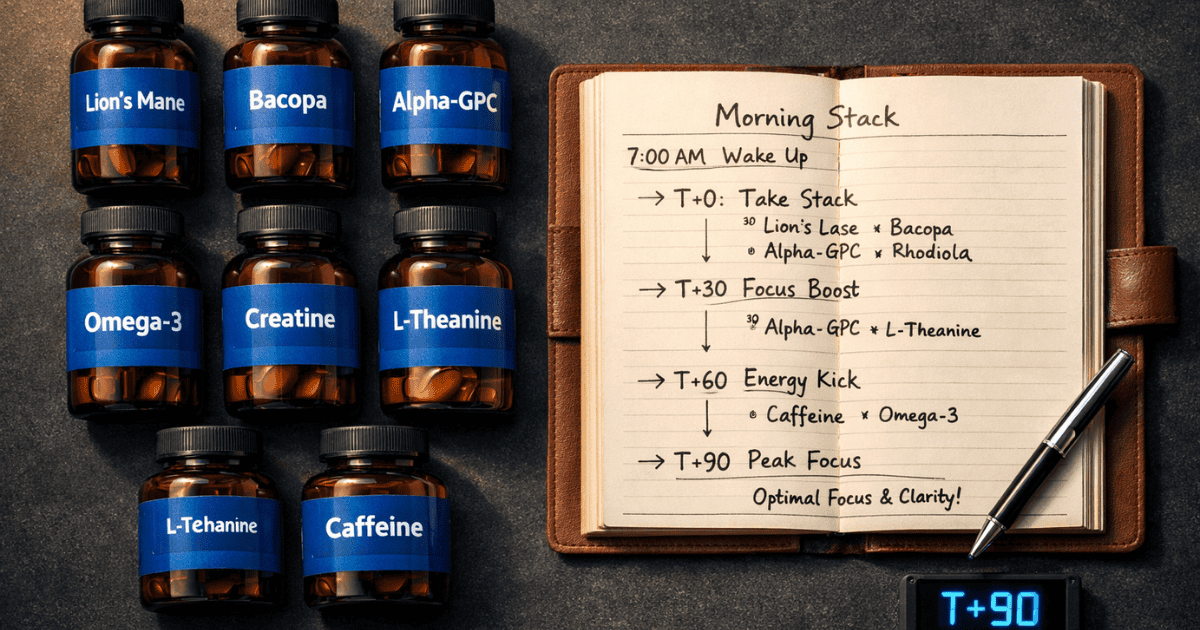
The Complete Morning Stack — Timeline
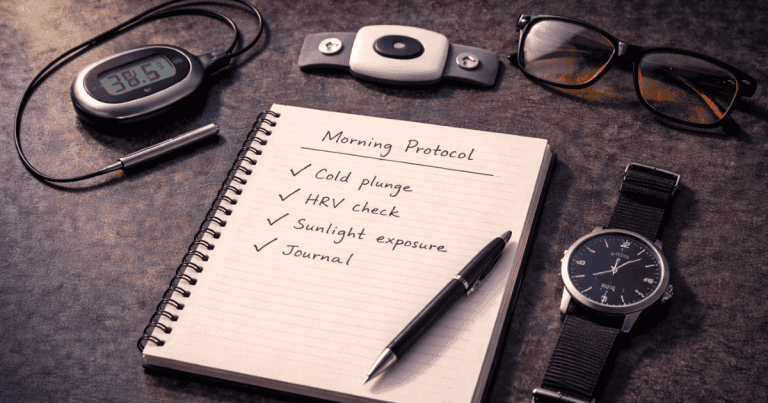
T-0 (On Waking): Rhodiola Rosea 300–500mg on empty stomach. Outdoor light exposure 10–15 minutes within 30 minutes of waking for circadian reset.
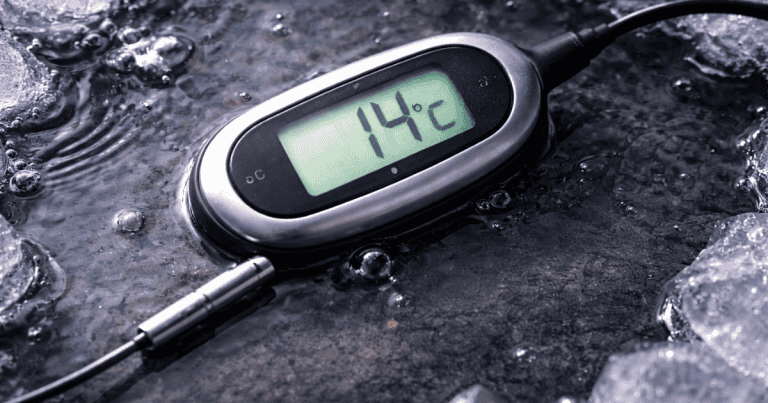
T+30–45 min: Cold exposure protocol 2–5 minutes coldest comfortable water temperature. The norepinephrine surge from cold exposure (200–530% depending on temperature and duration) provides the catecholaminergic activation that primes the attentional system for the caffeine effect to come.
T+90 min: Caffeine 100mg + L-Theanine 200mg. This timing (90 minutes post-waking) allows the cortisol awakening response to peak and decline naturally before caffeine amplification, preventing the jittery overstimulation that earlier caffeine timing produces.
T+90 min (with breakfast): The structural/neuroprotective foundation — Omega-3 DHA 1000–2000mg, Creatine 5g, Lion’s Mane 1000mg, Bacopa 300mg. These compounds do not produce acute effects and their timing relative to meals (for fat-soluble absorption) matters more than their timing relative to work demands.
T+120 min (30 min pre-work): Alpha-GPC 300–600mg if the work session ahead is particularly demanding or prolonged. This ensures peak brain choline availability coincides with peak cognitive demand rather than arriving hours early or late.
Evening (1–2 hours pre-bed): Magnesium L-Threonate 1500–2000mg + Ashwagandha 300–600mg. This shifts the system toward parasympathetic dominance and supports the overnight recovery that determines tomorrow morning’s cognitive capacity.
The synergistic logic: Rhodiola’s adaptogenic HPA normalization sets the baseline stress resilience for the day. Cold exposure provides acute norepinephrine without the adenosine system manipulation that caffeine produces. Caffeine + L-Theanine 90 minutes later produces the focused-but-calm attentional state that pairs optimally with the still-elevated norepinephrine from cold. Alpha-GPC ensures acetylcholine substrate availability keeps pace with the increased demand that caffeine-amplified cognitive work produces. The evening adaptogenic/GABAergic layer ensures the sympathetic activation from the morning stack does not persist into sleep preparation.
This is not a beginner protocol — it is the integration of multiple advanced interventions that requires familiarity with each individual component’s effects on your specific neurology before combining them. Start with the beginner stack. Graduate to this.
Part 3: Context-Specific Stack Protocols
Stack A: Maximum Sustained Focus (Analytical Work, Writing, Programming)
Primary mechanisms: Cholinergic substrate (Alpha-GPC), adenosine blockade (caffeine), alpha-wave calm focus (L-Theanine), metabolic energy support (creatine).
Protocol: Caffeine 100mg + L-Theanine 200mg + Alpha-GPC 300–600mg, taken 30–60 minutes before work session. Creatine 5g with breakfast (not timing-dependent but supports sustained ATP availability). If work session exceeds 3–4 hours, a second 50mg caffeine + 100mg L-Theanine dose at the 3-hour mark maintains performance without overstimulation.
When to use: Deep work sessions requiring sustained attention, complex problem-solving, technical writing, financial analysis — any cognitive demand where working memory load is high and distractibility is the primary performance limiter.
Stack B: Creative Problem-Solving and Divergent Thinking
Primary mechanisms: Alpha-wave enhancement (L-Theanine), reduced analytical filtering (minimal or no caffeine), parasympathetic tone support (Magnesium), REM-supported pattern recognition (quality sleep the night before).
Protocol: L-Theanine 200–400mg alone, or with minimal caffeine 50mg if some alertness support is needed. No Alpha-GPC — the cholinergic “tunnel vision” it can produce is counterproductive for divergent creative work. Magnesium L-Threonate 500mg can be added if anxiety or mental rigidity is a barrier. Morning aerobic exercise (30–45 min Zone 2) before the creative session primes BDNF-supported cognitive flexibility.
When to use: Brainstorming sessions, creative writing, strategic planning, any work where the goal is generating novel connections and ideas rather than executing within established frameworks. This stack is the opposite of Stack A — deliberately reducing the analytical precision that interferes with creative fluidity.
Stack C: High-Stress Performance (Presentations, Negotiations, Competitions)
Primary mechanisms: Adaptogenic stress buffering (Rhodiola), anxiolytic calm (L-Theanine, Ashwagandha if pre-loaded), HPA axis regulation, autonomic balance (HRV training the week prior).
Protocol: Rhodiola 300–500mg on waking the day of performance. L-Theanine 200–400mg 60 minutes before performance. If Ashwagandha has been used consistently for 2+ weeks (pre-loading required for adaptogenic effects), 300mg morning-of provides additional HPA support. No caffeine — the adenosine blockade that enhances focus can amplify the sympathetic activation that high-stress contexts already produce, pushing into anxious overstimulation territory. If energy support is needed, consider Rhodiola’s mild stimulating effect sufficient.
When to use: Any high-stakes performance where the primary challenge is stress management rather than cognitive complexity — public speaking, job interviews, competitive contexts, conflict navigation. The goal is calm confidence and stress resilience, not maximum analytical focus.
Part 4: Tolerance Management and Cycling Protocols
Tolerance is the silent killer of advanced stacking effectiveness. Compounds that produce dramatic initial effects gradually produce diminishing returns as receptor downregulation, enzyme upregulation, or compensatory mechanisms restore homeostasis. The strategic response is not increasing doses to chase the initial effect — that accelerates tolerance and increases side effect risk — but implementing cycling protocols that periodically reset sensitivity.
The 5/2 Rhythm for Acute Compounds
Caffeine, Alpha-GPC, and Rhodiola are best used strategically rather than daily. The 5/2 rhythm — five consecutive days of use followed by two days off — is practical for most work schedules and sufficient to prevent the receptor adaptations that daily use produces. On off-days, substitute behavioral interventions that produce similar cognitive effects through different mechanisms: morning cold exposure for caffeine’s alertness (norepinephrine without adenosine receptor involvement), aerobic exercise for sustained focus support (BDNF and dopamine without cholinergic demand), and strategic breaks rather than pharmacological performance extension.
The subjective experience: Week 1 of reintroduction after a 2-day break produces noticeably stronger effects than Week 4 of continuous daily use. This is receptor sensitivity recovery confirming the cycling is working. If you do not notice a difference, either your baseline tolerance is already substantial (requiring a longer reset period) or the dose is too high to produce perceptible changes in effect quality.
The 12-Week Cycle for Neuroplasticity Compounds
Lion’s Mane and Bacopa operate through structural neuroplasticity mechanisms rather than acute receptor activation, and their effects require 8–16 weeks of consistent daily use to fully manifest. The appropriate cycling protocol: 12–16 weeks continuous daily use, followed by a 2–4 week break, then resume. This timeline allows the full NGF-driven dendritic changes and bacoside-supported synaptic modifications to develop and stabilize, then provides a reset period before the next cycle.
The cognitive effects of neuroplasticity compounds do not disappear immediately upon discontinuation — the structural changes they supported persist for weeks to months, gradually declining in the absence of continued NGF/BDNF stimulation. The break serves to reset any tolerance-like adaptation and to provide a clean contrast period that allows you to assess the ongoing contribution these compounds are making to your baseline cognitive capacity.
Caffeine Tolerance Reset — The 7–14 Day Protocol
If caffeine no longer produces meaningful alertness enhancement — if you need it to feel normal rather than to enhance performance — you have developed substantial tolerance and dependency. The reset protocol: complete caffeine cessation for 7–14 days. Days 1–3 are the most acutely uncomfortable (headache, fatigue, irritability) as adenosine receptors that were chronically blocked suddenly normalize. By day 7, withdrawal symptoms resolve and baseline energy returns without caffeine. By day 14, receptor sensitivity is substantially restored.
Reintroduction strategy: start at 50mg rather than your previous dose (which was likely 200–400mg if tolerance was substantial). The 50mg dose post-reset will produce cognitive effects comparable to 200mg pre-reset, confirming the receptor sensitivity has recovered. Maintain the 5/2 cycling rhythm going forward to prevent reaccumulation of tolerance. In my own experience, an annual 14-day caffeine reset is sufficient to maintain caffeine as a genuine cognitive enhancement tool rather than a dependency requirement.
Part 5: Safety, Interactions, and When Not to Stack
Advanced stacking magnifies both benefits and risks. Drug-supplement interactions, compound-compound interactions, and individual contraindications all become more complex as the number of simultaneous interventions increases. The safety-first principle that governs all content at NeuroEdge Formula applies with particular force to advanced stacking.
Critical Medication Interactions
SSRIs and Serotonergic Compounds: Rhodiola and Ashwagandha both have mild serotonergic activity that can theoretically interact with selective serotonin reuptake inhibitors. While serious interactions are rare at standard supplement doses, individuals on SSRIs should introduce adaptogens one at a time under medical supervision and monitor for serotonin syndrome symptoms (agitation, confusion, rapid heart rate, high blood pressure). Blood Thinners: Omega-3 at high doses (>3g daily) has antiplatelet effects that can interact with warfarin, clopidogrel, and aspirin. Individuals on anticoagulant medication require medical clearance before high-dose omega-3 supplementation. Stimulant Medications: Stacking caffeine or other catecholaminergic compounds with prescription stimulants (Adderall, Ritalin, Vyvanse) amplifies cardiovascular stress and sympathetic activation. This is not recommended without explicit medical guidance.
When Not to Stack — The Subtraction Protocol
Sometimes the highest-leverage intervention is removing compounds rather than adding them. If you experience persistent side effects (headaches, gastrointestinal distress, sleep disruption, anxiety, irritability), the correct response is systematic subtraction — removing one compound at a time in reverse order of introduction until the side effect resolves, then identifying the causative compound. If cognitive performance has plateaued or declined despite adding more compounds, the problem is likely overstimulation, tolerance, or sleep degradation from excessive sympathetic activation — and the solution is reducing the stack to the minimal effective combination.
The quarterly audit protocol I use personally: every 12–16 weeks, discontinue all non-structural compounds (everything except Omega-3, Creatine, Lion’s Mane, Bacopa) for 7–14 days. Measure cognitive performance during this baseline period. Reintroduce compounds one at a time and measure the marginal cognitive benefit each one contributes. Any compound that does not produce a perceptible, measurable improvement beyond baseline is a candidate for permanent removal. This prevents the accumulation of compounds that made sense to try but do not meaningfully contribute to ongoing performance.
The Advanced Stacking Mindset — Precision Over Proliferation
The goal of advanced stacking is not to take the maximum number of compounds your budget allows. It is to identify the minimal effective combination of compounds with complementary mechanisms that produce synergistic cognitive performance improvements beyond what any single intervention achieves alone — applied with the timing precision, cycling discipline, and individual response tracking that distinguish effective protocols from supplement collection.
After 18+ years of systematic testing, the most important lesson I have internalized is this: the compounds and protocols that work consistently across time are rarely the ones that produce the most dramatic initial effects. They are the ones whose mechanisms are well-enough understood to optimize, whose side effect profiles are manageable enough to sustain, and whose benefits compound across months and years of consistent intelligent application. That is what advanced stacking is — the long game played with precision.
For readers new to nootropics, begin with the 12-week beginner stack. For those ready to integrate behavioral biohacking protocols with supplementation, explore the complete framework in the biohacking pillar guide. For the foundational sleep and exercise that determine how well any stack works, see Sleep & Recovery and Brain Health & Longevity.
The complete NeuroEdge Formula protocol — from foundational sleep optimization through advanced nootropic stacking — is documented across 42 articles covering six content hubs. This is Article 42 — the capstone. The foundation is complete. Your implementation begins now.
References
- Srámek, P., et al. (2000). Human physiological responses to immersion into water of different temperatures. European Journal of Applied Physiology, 81(5), 436–442. PubMed
- Shimazu, T., et al. (2013). Suppression of oxidative stress by β-hydroxybutyrate. Science, 339(6116), 211–214. PubMed
- Mattson, M.P., et al. (2017). Impact of intermittent fasting on health. Ageing Research Reviews, 39, 46–58. PubMed
- Lehrer, P.M., & Gevirtz, R. (2014). Heart rate variability biofeedback. Biofeedback, 42(1), 26–31. PubMed
- Gomez-Pinilla, F. (2008). Brain foods: the effects of nutrients on brain function. Nature Reviews Neuroscience, 9(7), 568–578. PubMed
- Avgerinos, K.I., et al. (2018). Effects of creatine supplementation on cognitive function. Experimental Gerontology, 108, 166–173. PubMed
- Sagaro, G.G., et al. (2024). Alpha-GPC supplementation and cognitive performance. Journal of Clinical Medicine. PubMed
- Darbinyan, V., et al. (2000). Rhodiola rosea in stress-induced fatigue. Phytomedicine, 7(5), 365–371. PubMed
- Rae, C., et al. (2003). Oral creatine monohydrate supplementation improves brain performance. Proceedings of the Royal Society B, 270(1529), 2147–2150. PubMed
- Mori, K., et al. (2013). Effects of Hericium erinaceus on amyloid β. Biomedical Research, 34(6), 293–298. PubMed
- Kongkeaw, C., et al. (2014). Meta-analysis of Bacopa monnieri. Journal of Ethnopharmacology, 151(1), 528–535. PubMed
- Thayer, J.F., et al. (2009). A meta-analysis of heart rate variability and neuroimaging. Neuroscience & Biobehavioral Reviews, 33(2), 71–80. PubMed
Tags: advanced nootropic stacking, nootropic cycling protocols, tolerance management nootropics, context-specific cognitive stacks, caffeine tolerance reset, mechanism-based stacking, morning performance stack, deep work nootropic stack, creative nootropic stack, stress performance stack, synergistic nootropics, systematic stacking methodology, personalized nootropic protocol, advanced biohacking, cognitive performance optimization
About Peter Benson
Peter Benson is a cognitive enhancement researcher with 18+ years of systematic self-experimentation in nootropics, neuroplasticity, and biohacking protocols. He has personally tested hundreds of compounds and stacking combinations with documented cognitive tracking and outcome assessment. NeuroEdge Formula documents the complete methodology and protocols developed across nearly two decades of research. This is Article 42 — the final piece of the foundation.