Ashwagandha Complete Research Review
Educational information, not medical advice. Ashwagandha is generally well-tolerated but has real cautions — including rare reports of liver injury, and interactions with thyroid, autoimmune and pregnancy considerations (see the cautions section below). Talk to your doctor before starting, especially if you take medication or have a health condition.
Affiliate disclosure: this article contains an affiliate link. If you buy through it, NeuroEdge may earn a small commission at no extra cost to you. We only link products that meet our sourcing standards, and a commission never influences what we recommend.
| What it’s best at | Reducing stress and cortisol — this is ashwagandha’s strongest evidence, and it’s one of the better-studied adaptogens. Randomised trials show meaningful reductions in stress scores and serum cortisol (Chandrasekhar 2012). |
| Also promising | Anxiety, sleep and stress-related cognition show real but more modest effects. Much of the research is short-term and often industry-funded, so keep expectations grounded. |
| The safety nuance | Trials show good tolerability, including liver readings — but there are rare real-world reports of ashwagandha-linked liver injury. It’s not zero-risk, so quality and awareness matter. |
| How to take it | A standardised root extract (e.g. KSM-66, ~5% withanolides), typically 300–600 mg a day with food. Benefits build over weeks, not instantly — it’s not a stimulant. |
| Who should be cautious | Anyone with thyroid or autoimmune conditions, those pregnant, on sedatives, or with liver concerns should check with a doctor first (see cautions below). |
Ashwagandha and the Brain: What the Evidence Shows (and the Liver-Safety Question)
By Peter Benson, Cognitive Enhancement Researcher | 18+ Years Independent Research · Last Updated: September 2026
Ashwagandha has become the poster child of the modern supplement boom — an ancient Ayurvedic herb now sold everywhere as a cure for stress, poor sleep, low energy and more. What’s unusual is that, unlike a lot of trendy supplements, ashwagandha actually has decent evidence behind its headline claim: it genuinely does appear to reduce stress and cortisol. But the full picture is more nuanced than either the hype or the backlash suggests, and it includes a real safety wrinkle — rare cases of liver injury — that most enthusiastic write-ups skip over. This guide gives you the honest version: what’s well-supported, what’s overstated, and what to actually watch for.
We’ll cover how ashwagandha works, its strongest and weakest evidence, the liver-safety question in plain terms, and how to use it sensibly — with the same evidence-first approach this site brings to every compound in Nootropics & Supplements.
A starting reference based on the doses used in trials, not a prescription. Benefits build over weeks — it isn’t an acute stimulant.
| Studied dose | Commonly 300 mg twice daily, or 600 mg once daily, of a standardised root extract — the range used in most stress and anxiety trials (roughly 250–600 mg/day). |
| Form to look for | A standardised root extract — for example, one delivering around 5% withanolides. Root-only extracts are the most-studied for stress; some root-and-leaf extracts are more concentrated and more sedating at lower doses. |
| When to take | With food. Splitting the dose morning and evening is common; taking it in the evening may suit people using it for sleep. |
| Time to effect | Stress and anxiety benefits typically build over about 4–8 weeks of consistent use. Don’t expect an immediate, felt “hit.” |
| How to start | Begin at the lower end, build up if needed, and reassess after several weeks. Buy from a reputable, third-party-tested source (see cautions on quality). |
What Ashwagandha Is and How It Works
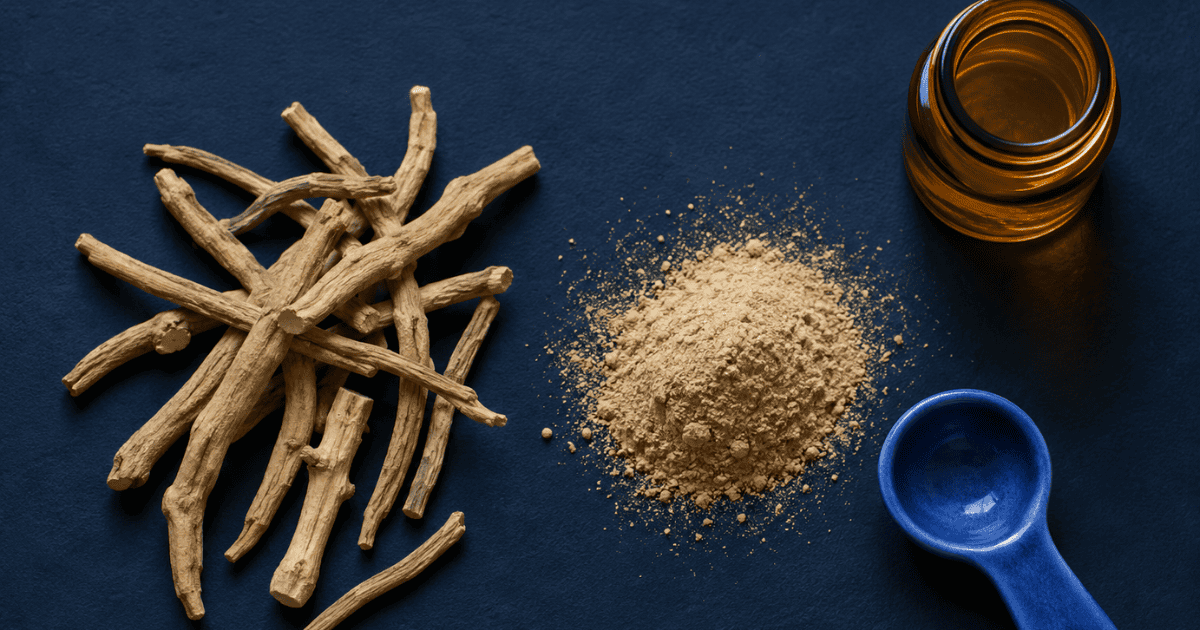
Ashwagandha (Withania somnifera) is a small shrub used in Ayurvedic medicine for centuries, classified as an adaptogen — a substance thought to help the body resist and adapt to stress. Its active compounds are a group of molecules called withanolides, which is why quality extracts are standardised to a certain withanolide percentage. The most-studied preparations are standardised root extracts, and you’ll often see specific branded versions on labels.
Mechanistically, the leading explanation for its effects is action on the body’s stress system — the hypothalamic-pituitary-adrenal (HPA) axis that governs cortisol release. Ashwagandha appears to dampen this stress response, which fits both its traditional use and its modern trial results. There’s also evidence of effects on GABA signalling (relevant to calming and sleep) and antioxidant activity. The through-line is stress regulation — and, importantly, that’s also where its evidence is strongest.
The Strongest Evidence: Stress and Cortisol
This is where ashwagandha earns its reputation. In a well-known randomised, double-blind, placebo-controlled trial, Chandrasekhar and colleagues (2012) gave stressed adults a standardised ashwagandha root extract and found significant reductions in stress and anxiety scores and in serum cortisol compared with placebo, with only mild side effects comparable to the placebo group. That combination — a subjective improvement backed by an objective drop in the main stress hormone — is more than most stress supplements can show.
It isn’t a one-off. Multiple randomised trials and meta-analyses have found ashwagandha reduces perceived stress and cortisol relative to placebo, making it one of the better-evidenced options in the crowded adaptogen space — a genuine standout compared with something like rhodiola, whose evidence is thinner. If there’s one thing ashwagandha is reasonably likely to do, it’s take the edge off chronic stress. That said — as the next sections make clear — “reasonably likely” is not “guaranteed,” and even this strong claim comes with caveats worth knowing.
Anxiety, Sleep and Cognition — Real but More Modest
Beyond core stress, ashwagandha has a spread of secondary claims, and they range from decent to preliminary. For anxiety, several randomised trials show reductions versus placebo — sensible, given the overlap with stress — though the effects are generally modest and shouldn’t be mistaken for a substitute for proper anxiety treatment. For sleep, there’s reasonable support: a trial by Langade and colleagues (2019) and later reviews suggest it can improve sleep quality and help people fall asleep, likely downstream of its calming, stress-lowering effect — which makes it a plausible aid within a broader approach to sleep and recovery.
For cognition specifically, the evidence is more preliminary. Some trials in stressed adults report improvements in memory, attention and executive function — but it’s unclear how much of that is a direct cognitive effect versus simply the knock-on benefit of being less stressed and better rested. In other words, ashwagandha is best understood as a stress-and-sleep tool that may indirectly help your thinking, rather than a direct nootropic you’d take to sharpen focus on demand. That’s a meaningful distinction for setting realistic expectations.
The Honest Caveats on the Evidence
Before you rearrange your supplement shelf, a few grounding points. Much of the ashwagandha research shares a familiar set of limitations: the trials are often small, short (typically 6 to 12 weeks), conducted in a single region, and — importantly — frequently funded by the companies that make the branded extracts. None of that makes the findings worthless; the stress-and-cortisol result in particular has been replicated enough to take seriously. But it does mean effect sizes may be flattering, long-term effects are under-studied, and a healthy discount on the more dramatic marketing claims is warranted.
The practical translation: treat ashwagandha as a reasonably well-supported tool for stress and sleep, with modest, gradual benefits — not as the transformative “one herb for everything” it’s often sold as. It’s one of the more legitimate supplements in its category, which is exactly why it deserves an honest accounting rather than either hype or dismissal. And that honesty has to include the one genuinely important safety issue the marketing tends to bury.
The Liver-Safety Question
Here’s the part that deserves more attention than it usually gets. In controlled clinical trials, ashwagandha has generally looked reassuringly safe — including studies that specifically checked liver function and found no adverse changes over weeks or even months of use. On that evidence alone, you’d conclude it’s benign for the liver.
But the real world has produced a different signal. There are documented case reports — including a published case series from Iceland and the US drug-induced liver injury network (Björnsson et al., 2020) — of people developing liver injury after taking commercial ashwagandha products, typically within a few weeks to months. These reactions appear to be rare and idiosyncratic (they don’t happen to most people and aren’t simply dose-related), and product quality or contamination may play a role in some cases. This doesn’t make ashwagandha dangerous for the average user, but it does move it out of the “completely harmless” category. The sensible response isn’t fear — it’s respect: buy from reputable, third-party-tested brands, don’t stack it with other liver-stressing substances heedlessly, and stop and seek medical advice if you develop signs of liver trouble (see the cautions box below). Being an honest guide means naming this, not hiding it — the same principle that runs through how we treat supplement safety across the board.
Imagine someone under sustained work stress who wants to give ashwagandha a fair, evidence-aligned try. Here’s what doing it well looks like — and how it differs from the impatient, hype-driven version.
The hype-driven way: they buy a random cheap product, take it expecting to feel calmer that evening, notice nothing dramatic in a few days, and either quit or double the dose out of impatience. They never checked the source, set no timeline, and treated a slow-building adaptogen as if it were a fast-acting sedative.
The evidence-aligned way: they choose a standardised root extract from a reputable, tested brand, start at a modest dose with food, and commit to an eight-week trial — the timeframe the research actually uses. They don’t expect an acute hit; instead they watch for a gradual easing of stress and better sleep over weeks. They note their baseline stress and sleep so they can judge honestly, and they know the warning signs of liver trouble to act on in the unlikely event they appear.
At eight weeks they make a clear-eyed call: if stress and sleep are meaningfully better, it’s earned a place; if not, they stop, having lost little. The lesson is that ashwagandha rewards patience and quality, and punishes the “take it and feel it tonight” mindset — which is exactly the mindset the marketing encourages.
Ashwagandha — Evidence Ranked
🟢 Well supported | 🟡 Real but qualified | 🔴 Commonly claimed, not supported
| Claim | Evidence | Basis |
|---|---|---|
| Reduces stress and cortisol | 🟢 Well supported | Multiple RCTs + meta-analyses; objective cortisol drop (Chandrasekhar 2012) |
| Reduces anxiety | 🟡 Supported, modest | Several RCTs; effects modest; not a substitute for anxiety treatment |
| Improves sleep | 🟡 Reasonable support | RCT + reviews; likely downstream of stress relief (Langade 2019) |
| Directly sharpens cognition | 🟡 Preliminary / indirect | Some memory/executive gains, likely via less stress & better sleep — not a direct nootropic |
| Completely harmless / no safety concerns | 🔴 Not accurate | Rare liver-injury case reports; thyroid, autoimmune, pregnancy cautions (Björnsson 2020) |
| A transformative “cure-all” for energy, hormones and more | 🔴 Overstated | Marketing outruns the (often short, industry-funded) evidence |
With ashwagandha, sourcing matters more than usual — both because the studied benefits come from standardised root extracts specifically, and because the rare liver-injury reports make third-party testing genuinely worth paying for. What you want is a standardised root extract (such as KSM-66, ~5% withanolides) from a reputable, tested supplier — not an unstandardised whole-herb powder of unknown potency and purity.
Nootropics Depot Ashwagandha (KSM-66® Root Extract)
The KSM-66 standardised root extract used across much of the stress research — root-only, standardised to withanolides, third-party tested for purity and potency. The spec and testing are exactly what this article argues you should prioritise.
View KSM-66 Ashwagandha →Affiliate link — NeuroEdge may earn a commission at no extra cost to you. We only recommend products that meet our sourcing standards, and a commission never changes what we recommend, including our cautions above.
The NeuroEdge Ashwagandha Protocol
Use it for what it’s good at, safely and patiently. Updated September 2026.
Use it for what it’s best-evidenced for — stress, cortisol and sleep — not as a direct focus enhancer or a cure-all.
Choose a standardised root extract from a reputable, third-party-tested brand — quality matters here more than with most supplements.
Trial it for about 8 weeks against a noted baseline. If stress and sleep improve, keep it; if not, stop — no felt “hit” is expected.
Clear it with a doctor if you have thyroid, autoimmune, liver or pregnancy considerations — and stop if any liver-warning signs appear.
Peter’s Notes — Ashwagandha
First-person, n=1 — impressions, not measurements · Updated September 2026
Ashwagandha is a compound I take fairly seriously, precisely because its main claim actually survives contact with the evidence — which is rare in the adaptogen aisle. My honest read is that if I were choosing one herb to help blunt a stressful stretch, this is the one with the best case behind it. But I hold it as a slow, background stress tool, not a nootropic; I’ve never experienced it as something you feel acutely, and the studies agree it works over weeks.
What changed my framing over the years was the liver-safety story. Early on I’d have called ashwagandha simply “safe,” full stop. Reading the case reports taught me to hold it as “low-risk but not no-risk,” which in practice means I only ever point people toward properly tested products and I take the warning signs seriously rather than waving them off. It’s a small shift in attitude that I think matters for an herb this popular.
So my stance is measured enthusiasm: genuinely one of the better-supported supplements for stress and sleep, worth an honest 8-week trial, best from a reputable source, and not the miracle the loudest marketing makes it. Respect it — for both what it can do and the rare risk it carries. (These notes are direction-only impressions, not measured results.)
Liver injury (the one most people miss). Although clinical trials show good liver tolerability, there are rare, real-world case reports of ashwagandha-associated liver injury — usually appearing within weeks to months and appearing to be idiosyncratic rather than dose-driven. Buy only third-party-tested products, avoid combining it carelessly with other liver-stressing substances (including heavy alcohol), and stop and seek medical advice promptly if you notice yellowing of the skin or eyes, dark urine, unusual fatigue, nausea, or pain in the upper-right abdomen.
Thyroid. Ashwagandha can raise thyroid hormone levels. If you have a thyroid condition or take thyroid medication, use it only under medical supervision, as it may push levels too high.
Autoimmune conditions, pregnancy and hormones. Because it can stimulate immune activity, it may not suit people with autoimmune disease. It should be avoided in pregnancy (traditionally regarded as unsafe), and because it may influence hormones such as testosterone, those with hormone-sensitive conditions should be cautious.
Sedatives, blood sugar and surgery. Its calming effect can add to sedatives, benzodiazepines and alcohol; it may lower blood sugar and blood pressure; and it’s generally advised to stop it before scheduled surgery.
This is not a complete list of interactions or precautions. Ashwagandha is generally well-tolerated, but it isn’t risk-free — talk to your doctor before starting, especially if you take any medication, have a chronic condition, or are pregnant or breastfeeding.
Key Takeaways — Ashwagandha
| ✓ | Its stress-and-cortisol evidence is genuinely good. Randomised trials show reduced stress scores and serum cortisol versus placebo (Chandrasekhar 2012), making it one of the better-evidenced adaptogens — a real standout in a hyped category. |
| ✓ | Anxiety, sleep and cognition are real but modest. Sleep has reasonable support (Langade 2019); cognitive gains are preliminary and probably indirect — via less stress and better sleep, not a direct nootropic effect. |
| ✓ | Discount the hype. Much of the research is short, small and industry-funded. The effects are worth having but gradual and moderate — not the transformative cure-all the marketing implies. |
| ✓ | It isn’t risk-free — mind the liver. Trials look clean, but rare real-world liver-injury reports exist (Björnsson 2020). Use third-party-tested products, and stop and seek care at any sign of liver trouble. Thyroid, autoimmune and pregnancy cautions also apply. |
| ✓ | Use it well. A standardised root extract (e.g. KSM-66, ~5% withanolides), 300–600 mg/day with food, on a patient 8-week trial judged against a baseline. Quality and patience are the whole game. |
Ashwagandha — FAQ
What is ashwagandha actually good for?
Its strongest, best-evidenced use is reducing stress and cortisol. Randomised controlled trials show it lowers perceived stress and serum cortisol compared with placebo (Chandrasekhar et al. 2012), which is more than most stress supplements can demonstrate. It also has reasonable support for improving sleep and modest support for reducing anxiety. Cognitive benefits are more preliminary and probably indirect — a knock-on effect of being less stressed and better rested. Think of it as a stress-and-sleep tool, not a direct focus enhancer.
Is ashwagandha safe for your liver?
For most people, yes — but it’s not entirely risk-free, and this is worth understanding. In clinical trials, ashwagandha has shown good liver tolerability with no adverse changes. However, there are documented real-world case reports of ashwagandha-associated liver injury, including a published case series (Björnsson et al. 2020), usually appearing within weeks to months of use. These reactions seem rare and idiosyncratic. The sensible approach is to buy third-party-tested products, avoid stacking it carelessly with other liver-stressing substances, and stop and seek medical advice if you develop signs of liver trouble such as jaundice, dark urine or persistent nausea.
How long does ashwagandha take to work?
It’s a slow-building adaptogen, not a fast-acting sedative — so don’t expect to feel calmer within an hour of your first dose. In the trials, stress and anxiety benefits typically emerge over about 4 to 8 weeks of consistent daily use. This is why a fair trial means committing to roughly eight weeks and judging against how you felt at the start, rather than quitting after a few days because nothing dramatic happened. Patience is genuinely part of using it correctly.
What dose and form should I take?
Look for a standardised root extract — for example, KSM-66 standardised to around 5% withanolides, which is the type used in much of the research. Typical studied doses are 300 mg twice daily or 600 mg once daily, taken with food; the broader range is roughly 250–600 mg a day. Starting lower and building up is reasonable. Avoid unstandardised whole-herb powders of unknown potency, since the studied benefits come specifically from standardised extracts, and quality control also matters for safety.
Who should avoid ashwagandha?
Several groups should be cautious or avoid it without medical guidance: people with thyroid conditions or on thyroid medication (it can raise thyroid hormone), those with autoimmune diseases (it can stimulate immune activity), anyone who is pregnant or breastfeeding (it’s traditionally considered unsafe in pregnancy), and people with hormone-sensitive conditions or liver concerns. It can also add to the effect of sedatives and may lower blood sugar and blood pressure, and it’s generally stopped before surgery. If you take any medication or have a health condition, check with your doctor before starting.
Get “7 Days to a Sharper Brain” — Free
Peter Benson’s personal daily protocol, rebuilt from 18 years of testing
Seven evidence-based interventions, in the exact order that makes each one more effective — from sleep foundation to neuroplasticity and Lion’s Mane.
Join 2,000+ readers optimising their cognitive performance. Unsubscribe anytime.
Scientific References
- Chandrasekhar K, Kapoor J, Anishetty S. (2012). A prospective, randomized double-blind, placebo-controlled study of safety and efficacy of a high-concentration full-spectrum extract of ashwagandha root in reducing stress and anxiety in adults. Indian Journal of Psychological Medicine, 34(3):255–262. DOI: 10.4103/0253-7176.106022
- Langade D, Kanchi S, Salve J, Debnath K, Ambegaokar D. (2019). Efficacy and safety of ashwagandha (Withania somnifera) root extract in insomnia and anxiety: a double-blind, randomized, placebo-controlled study. Cureus, 11(9):e5797. DOI: 10.7759/cureus.5797
- Björnsson HK, Björnsson ES, Avula B, et al. (2020). Ashwagandha-induced liver injury: a case series from Iceland and the US Drug-Induced Liver Injury Network. Liver International, 40(4):825–829. DOI: 10.1111/liv.14393

Peter Benson
Cognitive Enhancement Researcher | 18+ Years Independent Research
Peter has spent 18+ years testing supplements against the evidence rather than the marketing. He rates ashwagandha as one of the genuinely better-supported stress adaptogens — while insisting on the honest caveats, including the rare but real liver-safety concern.
Last reviewed: September 2026 | Educational content only. Not medical advice.