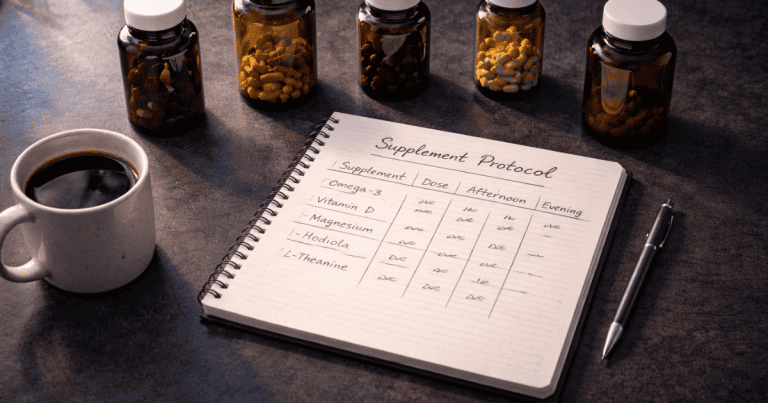
Five amber supplement bottles arranged with notebook and coffee representing the evidence-based nootropics for memory stack

The Best Nootropics for Memory: What the Research Shows

Most memory supplements are marketing claims. A small number have genuine clinical evidence. The evidence-based memory nootropic stack — Bacopa, Phosphatidylserine, Alpha-GPC, Lion’s Mane, and Magnesium L-Threonate — with mechanisms, doses, timelines, and how each compound addresses a different stage of memory formation.

Dark minimalist bedroom with supplements on nightstand representing sleep as the primary memory consolidation mechanism for learning

Sleep and Memory Consolidation: Why Sleep Is Non-Negotiable for Learning

Sleep is not the absence of cognitive activity — it is the completion of it. Every encoding strategy and spaced repetition session depends on what the brain does during the subsequent sleep period. The complete neuroscience of hippocampal replay, sleep spindles, REM integration, and the protocol for optimizing sleep as a direct memory enhancement strategy.

Hand writing interconnected concept notes representing working memory as the cognitive workspace for active thinking and problem solving

Working Memory: What It Is and How to Expand It

Working memory is the cognitive workspace where thinking happens — and one of the strongest predictors of intelligence, learning, and professional performance ever identified. The complete neuroscience of PFC persistent activity, catecholamine tone, chunking, and the four-layer protocol for optimizing working memory capacity through neurochemistry, cognitive load management, and targeted supplementation.

Flashcard Leitner box system on dark desk representing the evidence-based spaced repetition memory retention method

Spaced Repetition: The Evidence-Based Method for Retaining Anything

Spaced repetition is the most consistently replicated finding in 140 years of memory research — producing 200–300% superior long-term retention compared to cramming. The neuroscience of the forgetting curve and reconsolidation, the complete Anki implementation protocol, and the five mistakes that cause most learners to underperform despite using the system.

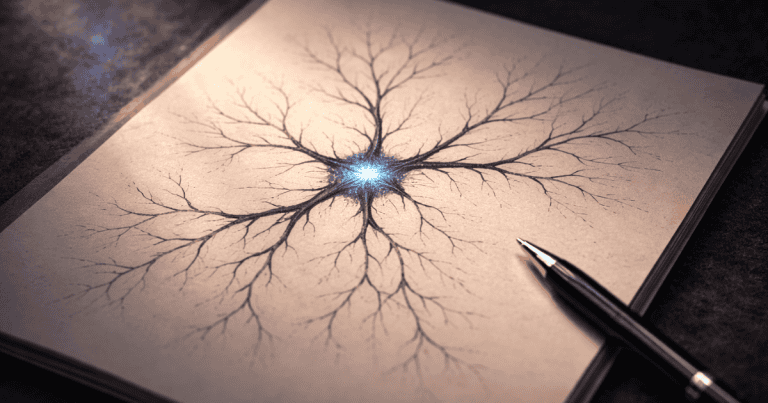
Abstract neural branching diagram on paper representing the neuroscience of learning and long-term memory formation

The Neuroscience of Learning: How Long-Term Memory Is Formed

Most people learn using strategies that produce familiarity — not memory. The neuroscience reveals why. From long-term potentiation at the NMDA receptor to hippocampal-cortical systems consolidation during sleep, this is how long-term memories are actually formed — and exactly what that means for how you should be studying.

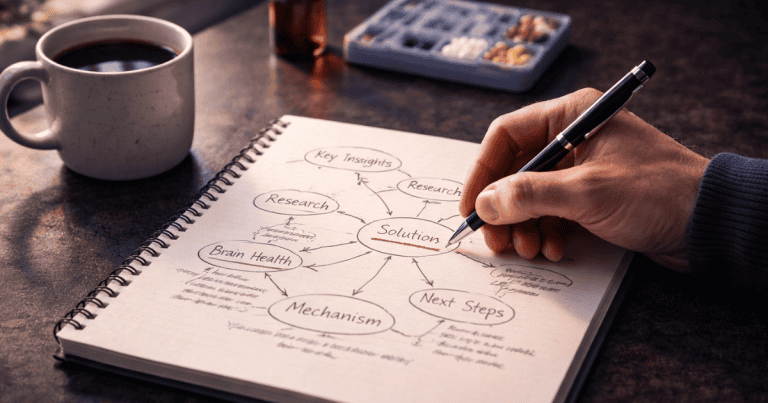
Open notebook with concept map and supplements on dark desk representing the evidence-based memory improvement protocol

The Complete Guide to Memory Improvement: Evidence-Based Strategies for Retention, Recall, and Learning

Memory is not a fixed capacity — it is a dynamic biological process that can be understood and deliberately optimized. The complete neuroscience of encoding, consolidation, and retrieval, the behavioral strategies of active recall and spaced repetition, and the supplementation stack that optimizes the neurochemical environment for strong memory formation.