Spaced Repetition: The Evidence-Based Method for Retaining Anything
Affiliate Disclosure: Some links in the Sourcing section are affiliate links. If you buy through them, NeuroEdge Formula earns a small commission at no extra cost to you. The technique in this guide is free and does the real work — the optional supplements are a distant secondary, and Peter only links to products he has personally tested.
Educational Disclaimer: This guide is for educational purposes only and is not medical advice. The techniques and supplements discussed are not treatments for any learning disability or neurological condition. If you have concerns about memory or learning difficulties, consult a qualified healthcare provider. Peter Benson is a cognitive enhancement researcher, not a medical doctor.
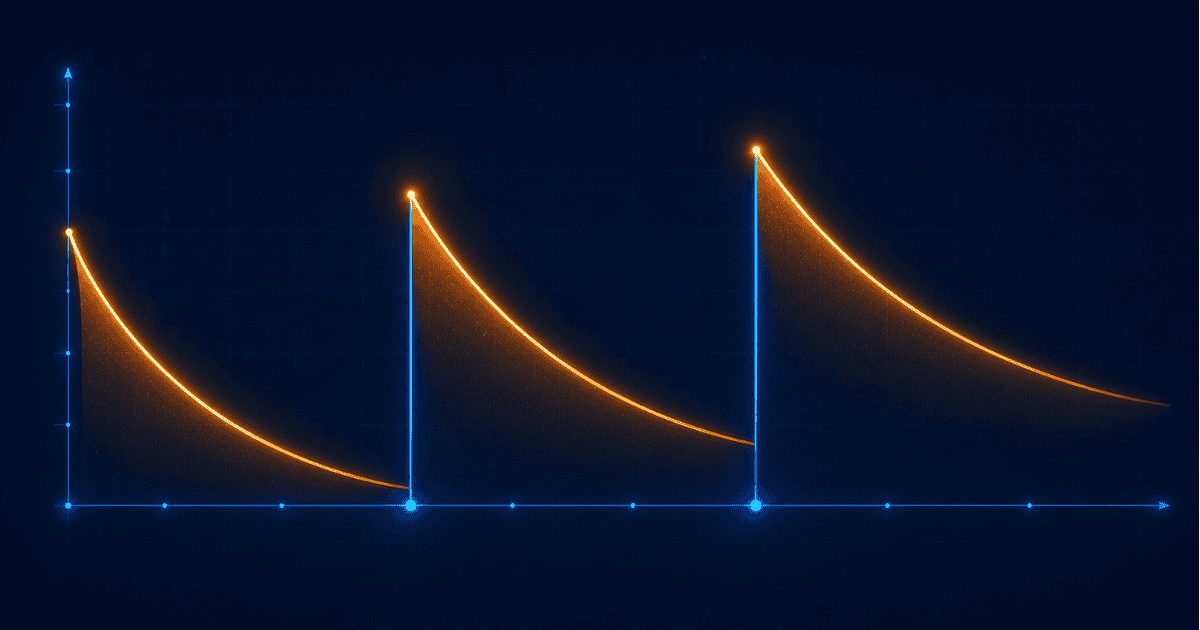
| What it is | A method that schedules review at increasing intervals, timed to roughly when you’d otherwise start forgetting. Each well-timed retrieval strengthens the memory and extends the next gap — producing far more durable retention than cramming the same material in the same total time. |
| The evidence | One of the most replicated findings in memory research. Cepeda et al.’s (2006) meta-analysis synthesised 317 experiments and found spaced practice reliably beats massed practice — echoing a result first documented by Ebbinghaus in 1885 and confirmed repeatedly since. |
| Starting intervals | Review new material within about a day (the first review matters most), then roughly 3 → 7 → 14 → 30 → 60 days. The optimal gap grows with how long you need to keep the information — the longer the horizon, the longer the gaps. |
| Best implementation | Anki (free, desktop + mobile) is the usual starting point — a proven algorithm handles the scheduling. Review daily for 10–20 minutes, and make your own cards using question-on-front, answer-on-back. The app matters less than daily consistency and card quality. |
| The calibration rule | If review feels effortless, you’re reviewing too soon; if you’re failing most cards, too late. Aim for a level where recall takes genuine effort but usually succeeds — a practical application of “desirable difficulty” (Bjork), not a precise numerical target. |
| Biggest mistake | Re-reading instead of retrieving. The benefit comes from the attempt to pull the answer from memory — not from seeing it again. Peeking at the card before you flip eliminates the effect. Struggle, then reveal; the struggle is the mechanism. |
Spaced Repetition: The Science, and How to Actually Use It
By Peter Benson, Cognitive Enhancement Researcher | 18+ Years Independent Research · Last reviewed & citations verified: August 2026
Spaced repetition is among the most evidence-backed learning techniques available — and one of the most systematically ignored by formal education. The core finding isn’t new: Hermann Ebbinghaus mapped the forgetting curve in 1885, showing that retention decays sharply after learning and that well-timed review interrupts that decay. What took another century was turning the finding into tools anyone could use. Free software like Anki now puts a good scheduling algorithm on everyone’s phone, and the technique carries one of the strongest replication records in cognitive psychology.
After 18+ years researching memory and learning — and applying spaced repetition to the technical literature and to Mandarin Chinese begun at 42 — my experience matches the research closely: it works, but only when implemented correctly. The most common failure is passive re-reading during reviews, which removes the very mechanism that makes it effective. This guide covers the neuroscience, the correct implementation, and its pairing with active recall — the combination that produces the largest single gain in learning efficiency most people can make. For the wider framework, see the Memory & Learning hub.
The companion piece on working memory covers the capacity limits that make spacing necessary in the first place — together they give the full picture of how encoding and consolidation work.
The Neuroscience — Why Forgetting Is a Feature
Ebbinghaus and the forgetting curve
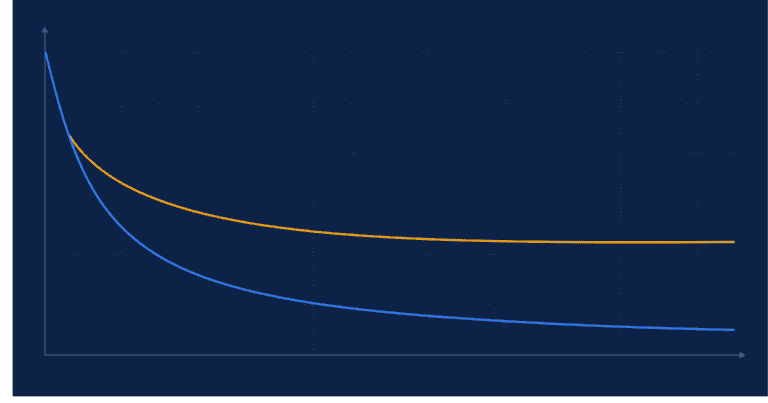
Ebbinghaus spent years memorising and self-testing on nonsense syllables, producing in 1885 the first systematic map of how memory decays. The forgetting curve has been replicated many times since: a large share of new material becomes hard to retrieve within the first day, then the rate of loss slows. The curve is roughly exponential, not linear — which is why the first review is the most valuable. Reviewing within about a day interrupts the steepest part of the decay and markedly extends how long the material stays accessible.
Why the brain forgets — consolidation and use-dependence
Forgetting isn’t a malfunction — it’s efficient housekeeping. The brain prunes connections it isn’t regularly using, keeping the architecture matched to current demands. A memory laid down in a single session is biologically fragile: the synaptic changes are lightly potentiated and fade without reinforcement. Each successful spaced retrieval drives long-term potentiation, progressively strengthening the connection and helping shift the memory from temporary hippocampal storage toward more stable cortical networks. That’s why material retrieved five times over five weeks is far more durable than the same material reviewed five times in one sitting — even though the total effort is identical.
Desirable difficulty — why struggling to remember is the point
Robert Bjork coined “desirable difficulty” for the counterintuitive finding that making learning harder in specific ways improves long-term retention. Spaced repetition is the classic case: by waiting until some forgetting has occurred, you make the retrieval more effortful — and it’s that effort that strengthens the trace. A review where you recall everything instantly (because you reviewed too soon) adds little; a review where you have to work for it, and succeed, adds the most. That’s the honest basis for the common “aim for around 85% correct” heuristic — it’s a rule of thumb for keeping reviews effortful-but-mostly-successful, not a precise law. The practical target is simply: if it’s easy, space it out further.
Study Techniques, Graded Honestly
🟢 Strong | 🟡 Moderate | 🔴 Weak or counterproductive
The Evidence — Key Findings
The definitive meta-analysis
Cepeda et al. (2006) — 317 experiments on spacing
A meta-analysis drawing on 839 assessments across 317 experiments and roughly 14,000 participants. Two conclusions anchor the practical advice. First, spaced practice reliably outperforms massed practice across ages, materials and retention intervals. Second, the optimal gap isn’t fixed — it scales with how long you need to remember: short gaps suit a test next week, longer gaps suit retention over a year. It’s the most comprehensive confirmation of a spacing effect that had already been observed for over a century.
Cepeda NJ, et al. Psychol Bull. 2006;132(3):354–380. PMID 16719566
Retrieval vs re-study
Karpicke & Blunt (2011) — testing beats re-studying
Students learned science texts under different conditions. On a delayed test, the group that practised retrieval recalled roughly 50% more than the group that studied repeatedly — and it also beat elaborate concept mapping, even when the final test itself was a concept map. Tellingly, students expected re-studying and mapping to work better. The lesson: it’s the act of retrieving, not re-exposure, that builds durable memory — which is exactly the engine inside spaced repetition.
Karpicke JD, Blunt JR. Science. 2011;331(6018):772–775. PMID 21252317
Techniques compared
Dunlosky et al. (2013) — ten techniques ranked
A landmark review evaluated ten common study techniques. Practice testing (retrieval) and distributed practice (spacing) earned the only “high utility” ratings. Highlighting, underlining, rereading and summarising landed at “low utility” — the evidence simply doesn’t support them as standalone strategies. It’s the most practically useful evidence-based guide to choosing study methods, and it lines up exactly with the neuroscience: passive exposure doesn’t consolidate; active retrieval does.
Dunlosky J, et al. Psychol Sci Public Interest. 2013;14(1):4–58. PMID 26173288
Sleep completes the job
Why sleep multiplies what spacing starts
A spaced retrieval generates a fresh, still-fragile trace. Sleep — especially deep slow-wave sleep — then files it, transferring it toward stable cortical storage. So a review followed by a good night consolidates better than the same review followed by a short or broken one. The most effective schedules therefore treat review and sleep as two halves of one process, not separate habits. The mechanism is covered in sleep and memory consolidation.
See also the sleep architecture guide.
🧮 Worked example — turning one dense paragraph into lasting memory
Say you’ve just read a paragraph explaining how long-term potentiation works, and you want to still know it in a month. Here’s the technique applied, step by step.
Don’t card the paragraph — decompose it. A single card “Explain LTP” is unrateable; you’ll half-remember and fudge the score. Break it into specific pairs: front “What triggers LTP at a synapse?” / back “Repeated high-frequency activation of the connection.” Front “What does LTP do to the connection?” / back “Strengthens it, so future firing is easier.” Two clean cards beat one vague one.
Writing the cards is the first review. Deciding what’s worth carding and phrasing the question precisely is itself an encoding event — which is exactly why you make your own rather than downloading a deck.
Retrieve, don’t peek. Tomorrow, read the question and attempt full recall before flipping. If the answer comes instantly every time, your gap is too short — let the algorithm push it out until recall takes real effort.
Sleep on it. The review generates the trace; the night files it. An evening review followed by a full night beats a rushed morning review before a poor one.
The worked judgement: notice the effort went into decomposing the idea and honestly attempting recall — not into re-reading. You didn’t study more; you turned each contact with the material into a retrieval, and let spacing and sleep do the consolidating.
The NeuroEdge Protocol
The NeuroEdge Spaced Repetition Protocol
The implementation that actually delivers the effect — three free steps that do the work, plus an optional fourth.
Step 1 — Make your own cards
Never download pre-made decks. Creating a card is itself a retrieval event. One specific question on the front, one specific answer on the back. If a card feels complex, split it in two.
Step 2 — Review with discipline
10–20 minutes daily, same time. Attempt full recall before flipping — never peek first. Rate honestly: if you needed a hint, it’s “hard,” not “good.” If recall feels effortless, let the gaps grow.
Step 3 — Let sleep finish it
Evening review works well because consolidation happens overnight. A poor night after a session gives back some of the gains. The sleep protocol and spacing are stages of one process.

Peter’s Testing Notes — Spaced Repetition
First-person, n=1 · direction-only · Updated August 2026
I’ve used Anki systematically since 2018, first for the technical literature — cards for specific claims, mechanisms and trial details from papers I was reading. The improvement in retention was hard to miss: material I’d previously have lost within a few weeks stayed accessible months later, on a modest daily review budget. The clearest early lesson was that card quality mattered far more than quantity. A specific, well-formed question produces a genuine retrieval event; a vague, sprawling card produces a guessing exercise that consolidates nothing.
The application I’m most invested in is Mandarin Chinese, begun at 42. Mandarin is genuinely hard — tonal, character-based, structurally unlike English — and adult language learning leans more on deliberate strategy than childhood acquisition does. What spacing addresses is the biggest bottleneck: vocabulary retention. I keep the intervals in the zone where reviews are effortful but mostly successful; when recall gets too easy, I let the gaps stretch. I’m deliberately not quoting precise retention percentages here — my logging is n=1 and I’d rather report the direction than dress a personal trend up as data.
On supplements, I’ll be honest about the limits of what I can claim: any effect I notice is on how readily new vocabulary “sticks” on first exposure — the encoding phase — not on the spacing mechanism, which is doing the heavy lifting for free. I can’t cleanly separate a supplement effect from the confounds of more practice and a growing vocabulary, so I hold that impression loosely. The technique is the part I’d stake a claim on; the rest is a maybe.
Sourcing Standards
To be clear about priorities: spaced repetition is free, and it is what produces the result. No supplement substitutes for making your own cards and reviewing them honestly. If — and only if — your foundations are already solid, these are the dose-transparent encoding-support products I’ve tested; the full evidence for each lives in its own guide.
Nootropics Depot — Bacopa Monnieri
A standardised Bacopa extract; the full evidence and dosing sit in the Bacopa guide. Acts on encoding over 8–12 weeks — not a shortcut around the technique.
Nootropics Depot — Alpha-GPC
A dose-transparent cholinergic; details in the Alpha-GPC guide. Supports the encoding phase that spacing then consolidates — optional, not essential.
Key Takeaways — Spaced Repetition
The retrieval attempt is the mechanism — not the re-exposure. The benefit comes from pulling the answer from memory. Peeking at the card before you flip removes the effect. Struggle, then reveal.
Effortless recall means you’re reviewing too soon. If cards come instantly every time, the gap is too short and little consolidation is happening. Let the interval grow until recall takes real work.
Make your own cards. Deciding what’s worth carding and phrasing it precisely is deep processing that pre-made decks skip. Card creation is the first review.
Sleep completes what spacing starts. The trace generated during review is consolidated overnight. Evening review plus a full night beats morning review before a broken one.
10–20 minutes daily beats hours once a week. Consistency of daily review beats the same total time in occasional long sessions. The minimum daily session outperforms the optimal weekly cram.
Spaced Repetition — FAQ
How long does spaced repetition take to work?
Improved recall is usually noticeable within a few weeks of consistent daily review, and the clearest benefit tends to appear around the two-to-three-month mark, when you find yourself retaining material you’d otherwise have lost. For complex material like a second language, the payoff keeps compounding for a year or more as higher-interval cards move into a low-maintenance phase. The investment is front-loaded into good encoding; the returns continue long after.
Is Anki the best spaced repetition app?
Anki is the most widely used and most customisable, with a proven algorithm and a large community — free on desktop, Android and web, with a one-time iOS purchase. For most people it’s the right starting point. Alternatives include RemNote (notes and cards in one tool, lowering card-creation friction), Mochi (a cleaner interface if Anki feels overwhelming) and SuperMemo (a more sophisticated algorithm, steeper learning curve). Ultimately the app matters far less than daily consistency and card quality.
Can it work for complex concepts, not just facts?
Yes — but complex concepts must be decomposed into specific cards. Trying to card “how the immune system works” as one item produces an unrateable card; breaking it into specific question–answer pairs (“which cells drive adaptive immunity?” → “T cells and B cells”) produces useful retrieval events. The decomposition is itself a deep learning activity. Skills follow the same spacing principle, except the “retrieval” is practice: spacing out practice attempts across days beats massing them in one session.
What’s the best interval schedule?
A reasonable starting sequence for new material is: review within about a day, then roughly 3, 7, 14, 30 and 60 days. After that, a card on a two-month cycle needs only a handful of reviews a year to maintain. The optimal gap grows with how long you need to retain the material (Cepeda et al., 2006). In practice, Anki’s algorithm handles the interval maths from your ratings — so the most important thing is to rate honestly rather than inflate scores to dodge hard cards.
Do nootropics help with spaced-repetition learning?
Only at the margins, and only if the fundamentals are already in place. Cholinergic supplements such as Bacopa and Alpha-GPC act on encoding quality — how well material goes in — not on the spacing-and-retrieval mechanism that does the real work, which is free. They typically need 8–12 weeks to show anything measurable, and the evidence for each is covered in its own guide. Sort out card quality, daily review and sleep first; treat supplements as an optional extra, never a substitute.
Get “7 Days to a Sharper Brain” — Free
Peter Benson’s personal daily protocol, rebuilt from 18 years of testing
Seven evidence-based interventions, in the exact order that makes each one more effective — from sleep foundation to your complete assembled daily stack.
Join 2,000+ readers optimising their cognitive performance. Unsubscribe anytime.
Scientific References
- Cepeda NJ, Pashler H, Vul E, Wixted JT, Rohrer D. (2006). Distributed practice in verbal recall tasks: a review and quantitative synthesis. Psychological Bulletin, 132(3):354–380. PMID 16719566
- Karpicke JD, Blunt JR. (2011). Retrieval practice produces more learning than elaborative studying with concept mapping. Science, 331(6018):772–775. PMID 21252317
- Dunlosky J, Rawson KA, Marsh EJ, Nathan MJ, Willingham DT. (2013). Improving students’ learning with effective learning techniques. Psychological Science in the Public Interest, 14(1):4–58. PMID 26173288
- Rohrer D, Taylor K. (2007). The shuffling of mathematics problems improves learning. Instructional Science, 35:481–498. DOI 10.1007/s11251-007-9015-8
- Bjork RA, Bjork EL. (1992). A new theory of disuse and an old theory of stimulus fluctuation. In From Learning Processes to Cognitive Processes: Essays in Honor of William K. Estes. (The “desirable difficulties” framework.)
- Ebbinghaus H. (1885). Über das Gedächtnis (Memory: A Contribution to Experimental Psychology, trans. 1913). (Original forgetting-curve research.)
Peter Benson
Cognitive Enhancement Researcher | 18+ Years Independent Research
Peter has applied spaced repetition systematically since 2018 — first to the technical neuroscience literature, and since 2021 to Mandarin Chinese, begun at age 42. He writes about the mechanisms behind cognitive performance rather than the hype around them. Every study cited here was verified against source.
Last reviewed: August 2026 | Educational content only. Not medical advice.