The Neuroscience of Learning: How Long-Term Memory Is Formed
Affiliate Disclosure: Some links in the Sourcing section are affiliate links. If you buy through them, NeuroEdge Formula earns a small commission at no extra cost to you. The free interventions in this guide — exercise, attention, elaboration, sleep and retrieval — do the real work; the supplements are an optional last layer, and Peter only links to products he has personally tested.
Educational Disclaimer: This guide is for educational purposes only and is not medical advice. Supplement use should be discussed with a qualified healthcare provider, particularly if you have pre-existing conditions or take medications. Peter Benson is a cognitive enhancement researcher, not a medical doctor.
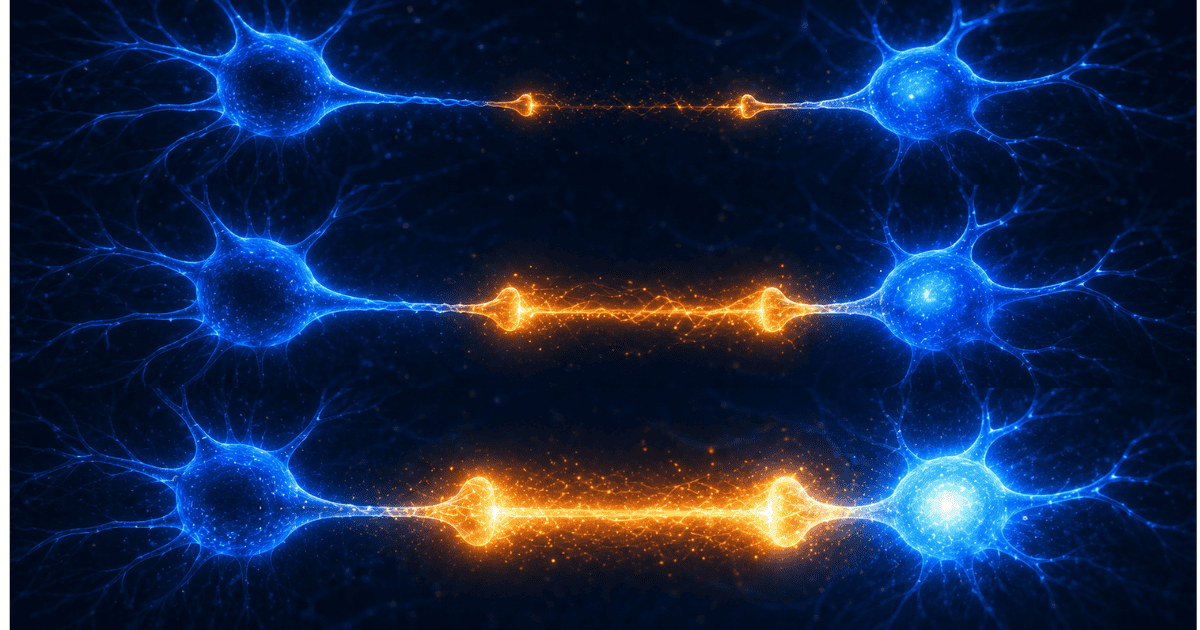
| What learning is, biologically | The physical strengthening of synaptic connections between neurons — long-term potentiation (LTP). Repeat a pattern of neural activation and those connections become stronger, faster and more durable. This is the molecular basis of Hebb’s principle: neurons that fire together, wire together (Bliss & Lømo, 1973). |
| The three-stage model | Every memory passes through encoding (acquisition), consolidation (stabilisation, largely during sleep) and retrieval (access). Each stage has different requirements. Most people over-invest in encoding (study time) and neglect consolidation and retrieval — which is where the most improvement is available. |
| BDNF — the plasticity molecule | Brain-Derived Neurotrophic Factor acts as fertiliser for the connections that encode new learning. It’s raised by aerobic exercise (transiently, for roughly an hour or two afterwards), by challenging cognitive work and by good sleep (Cotman & Berchtold, 2002). Chronic stress, poor sleep and inactivity lower it — and impair new learning. |
| Why retrieval beats re-reading | Retrieving information — not re-reading it — is what strengthens the trace. Each successful retrieval is an LTP event; re-reading only produces familiarity. Karpicke & Blunt (2011) found retrieval practice produced roughly 50% more retained material than re-studying for the same time. |
| Sleep’s non-negotiable role | Consolidation — transferring encoded memories from hippocampal storage to stable cortical networks — happens largely during sleep, especially deep slow-wave sleep (Stickgold, 2005). Learning without sleeping on it leaves the trace fragile and half-formed. |
The Neuroscience of Learning: How Memory Actually Forms
By Peter Benson, Cognitive Enhancement Researcher | 18+ Years Independent Research · Last reviewed & citations verified: August 2026
Every learning technique validated by neuroscience works for the same fundamental reason: it strengthens synaptic connections between specific neurons, and stronger connections mean more durable, more accessible memories. Long-term potentiation — the molecular mechanism of learning — is not a metaphor; it’s a physical change in the structure and chemistry of synapses that can be observed, measured and deliberately encouraged. Understanding why techniques work lets you evaluate new approaches, combine them intelligently and tailor the sequence to your goals. The technique guides tell you what to do; this one gives you the biology that explains why.
After 18+ years researching cognitive performance, the most consistent thing I’ve found is that most people invest their effort at the wrong stage. Study time (encoding) gets the lion’s share; consolidation (sleep) and retrieval practice get almost none — even though those two stages hold the most available improvement for most learners. This guide covers all three stages, the BDNF mechanism behind plasticity, and — as a distant last layer — the supplements that support the biology. For technique implementation, see the spaced repetition guide; for the full framework, the Memory & Learning hub.
The Three-Stage Memory Model — Encoding, Consolidation, Retrieval
Encoding — Initial Memory Formation
Encoding is the initial neural activation that forms a provisional memory trace. When new information is processed, the hippocampus coordinates co-activation of neurons across cortical areas — the firing pattern that will, if strengthened, become the memory. What determines encoding strength: attention (divided attention produces markedly weaker traces than focused attention), emotional salience (emotionally significant information is tagged by the amygdala for priority), elaborative depth (connecting new information to existing knowledge creates more synaptic linkages and more retrieval routes), and BDNF availability (how readily new synapses form during the event).
The most common encoding error is passive re-reading: it produces recognition (familiarity) without retrieval (the pathway isn’t exercised), generating the illusion of learning without the underlying LTP that constitutes actual memory formation.
Consolidation — Sleep-Dependent Stabilisation
After encoding, the trace is labile — fragile and vulnerable to interference. Consolidation stabilises and reorganises it into more durable storage, and it happens largely during deep slow-wave sleep: the hippocampus replays the day’s encoded patterns to the cortex via sharp-wave ripples, coordinated with cortical slow oscillations and sleep spindles. This dialogue transfers memories from fragile hippocampal storage toward stable cortical networks. REM sleep is thought to add a further step — helping integrate new memories with existing knowledge and extract patterns — though its precise role is less settled than that of slow-wave sleep.
The practical consequence: studying and then sleeping poorly forfeits much of the session’s benefit. Stickgold’s review of the field (2005) leaves little doubt that offline reprocessing during sleep is a major contributor to how memories are formed and shaped. Sleep isn’t a recovery activity after learning; it’s the consolidation event that completes what study begins. The mechanism is covered in sleep and memory consolidation.
Retrieval — Active Strengthening
Retrieval isn’t merely using a formed memory — it’s an active strengthening event. Each time a trace is successfully accessed, the pathway to it is reactivated and strengthened, and the memory becomes more durable. This is why testing yourself beats re-reading for the same time. Active recall works because it is itself a learning event: Karpicke & Blunt (2011) documented roughly 50% more retained material from retrieval practice than from re-studying. The same LTP mechanism is what makes spaced repetition so powerful.
Bjork’s “desirable difficulty” principle: retrieval that takes genuine effort — where you almost can’t remember before you do — produces more strengthening than easy retrieval. The struggle is the mechanism. That’s the honest basis for the common “aim for around 85% correct” heuristic in spaced repetition — a practical rule of thumb for keeping reviews effortful-but-mostly-successful, not a precise law. In practice: if recall is easy, space it out further.
🧮 Worked example — learning a hard new topic across one day
Say you need to learn a dense new topic — a section of statistics, say — and actually retain it. Here’s the three-stage biology, applied.
Before (prime the encoding). Take a 20-minute brisk walk or run, then start. You’re using the post-exercise window when the brain’s growth-factor support for new synapses is raised — so spend it on genuinely new material, not review.
During (encode actively). Phone in another room, single task. After each sub-section, close the book and write what you just learned from memory — that’s a retrieval, not re-reading — then link it to something you already know (“this is like X”). The linking is elaborative encoding; it builds extra routes back to the memory.
That night (consolidate). Protect a full night’s sleep. The session did the encoding; slow-wave sleep does the filing. A poor night here gives back much of the day’s gain.
Thereafter (strengthen by retrieval). Put the key facts into spaced review, attempting recall before checking. Each effortful, successful retrieval is another strengthening event.
The worked judgement: only one of these five moves is “studying harder.” The gains come from sequencing — exercise before new material, retrieval-and-elaboration during, sleep after, spaced retrieval thereafter — each stage feeding the next. Skip the sleep or the retrieval and you’ve paid for the expensive part (encoding) and thrown away the cheap parts that make it stick.
Learning Interventions — Graded Honestly
🟢 Strong | 🟡 Moderate | 🔴 Ineffective or counterproductive
The Evidence — Foundational Findings
The mechanism of learning
Bliss & Lømo (1973) — the discovery of LTP
Stimulating a neural pathway at high frequency produced a long-lasting increase in synaptic strength — potentiation that persisted for hours. This was the first direct demonstration of long-term potentiation, and it remains the cellular foundation for how the brain is understood to store information. Every effective learning technique is, at bottom, a way of producing more LTP, or stronger LTP, at the right synapses.
Bliss TV, Lømo T. J Physiol. 1973;232(2):331–356. PMID 4727084
Retrieval vs re-study
Karpicke & Blunt (2011) — retrieval strengthens
On a delayed test, students who practised retrieval recalled roughly 50% more than those who re-studied — and retrieval also beat elaborate concept mapping. It’s the clearest demonstration that the act of retrieving, not re-exposure, builds durable memory — the behavioural signature of LTP strengthening the retrieval pathway.
Karpicke JD, Blunt JR. Science. 2011;331(6018):772–775. PMID 21252317
Sleep and exercise
Stickgold (2005) & Cotman & Berchtold (2002)
Stickgold’s Nature review synthesised converging evidence that offline reprocessing during sleep is a major component of how memories are formed and shaped — the case for sleep as the consolidation stage. Cotman & Berchtold showed that voluntary aerobic exercise raises BDNF and other growth factors, stimulates neurogenesis and improves learning — the molecular basis for exercising before you learn. Together they cover the two stages most people neglect.
Stickgold R. Nature. 2005;437(7063):1272–1278. PMID 16251952 · Cotman & Berchtold. Trends Neurosci. 2002;25(6):295–301
Techniques, ranked
Cepeda (2006) & Dunlosky (2013)
Cepeda’s meta-analysis of 317 experiments established spaced practice as one of the most robust effects in memory research, with the optimal gap scaling to how long you need to retain. Dunlosky’s review ranked ten study techniques: practice testing and distributed practice earned the only “high utility” ratings, while highlighting and rereading landed at “low utility.” The behavioural evidence lines up exactly with the biology — active retrieval consolidates; passive exposure doesn’t.
Cepeda NJ, et al. Psychol Bull. 2006;132(3):354–380. PMID 16719566 · Dunlosky J, et al. PSPI. 2013;14(1):4–58. PMID 26173288
The NeuroEdge Protocol
The NeuroEdge Optimal Learning Sequence
The neuroscience-aligned sequence — each stage feeding the next. The first four moves are free and do the work; supplements are an optional last layer (see Sourcing).
Before — prime
20–30 min aerobic exercise, then learn. BDNF is transiently raised for an hour or two afterward — use that window for genuinely new material, not review.
During — encode actively
Undivided attention + elaboration. Single task, no notifications. After each section: close the resource, write it from memory (retrieval), then connect it to something you already know (elaboration).
After — consolidate
Protect a full night’s sleep. Consolidation completes what encoding began; a poor night forfeits much of the session. The sleep protocol helps.
Ongoing — strengthen
Spaced retrieval. Daily spaced review, attempting recall before checking. Each effortful retrieval is a strengthening event — keep the interval where recall takes real work.

Peter’s Testing Notes — Neuroscience of Learning
First-person, n=1 · direction-only · Mandarin from age 42 · Updated August 2026
The most practically useful thing I’ve taken from the neuroscience of learning is the consolidation-first framing. When I started Mandarin at 42, I made the classic error of maximising study time while treating sleep as the thing to compress when time was tight. My Anki retention was more erratic than it should have been, and the pattern that eventually became obvious was that the intervals weren’t my main problem — the nights between were.
When I started loosely tracking sleep quality (Oura deep-sleep duration) against the next morning’s recall on due cards, the direction was consistent enough to change how I work: better nights reliably produced better next-morning accuracy on the same cards. I’m deliberately not quoting precise percentages — it’s n=1 and I’d rather report the direction than dress a personal trend up as data. But it was enough to convince me that the consolidation event between encoding and testing was doing more than the review interval itself.
On the supplement layer, I’ll be honest about the limits of what I can claim: any effect I notice is on the encoding phase — how readily new material “clicks” during a session — not on consolidation or retrieval, which are doing the heavy lifting for free. I can’t separate it cleanly from more practice and better sleep, so I hold it loosely. The sequence is the part I’d stake a claim on: exercise before new material, active retrieval and elaboration during, a protected night after, spaced review thereafter. That ordering changed my learning more than any single element.
Sourcing Standards — The Optional Supplement Layer
To be clear about priorities: exercise, attention, elaboration, sleep and spaced retrieval do the work, and they’re free. Supplements are a distant last layer that support two stages — encoding and consolidation — and only matter once the fundamentals are solid. If you want them, these are the dose-transparent products I use; full evidence for each lives in its own guide.
Nootropics Depot — Bacopa Monnieri (encoding)
A standardised Bacopa extract; cholinergic support for the encoding phase over 8–12 weeks. Full evidence and dosing in the Bacopa guide.
Nootropics Depot — Alpha-GPC (encoding)
A dose-transparent cholinergic (≥50% GPC) for acute encoding support before a demanding session. Details in the Alpha-GPC guide.
Nootropics Depot — Magnesium Glycinate (consolidation)
Chelated magnesium (elemental dose declared) to support deep-sleep quality — the consolidation environment. More in the magnesium for sleep guide.
Key Takeaways — Neuroscience of Learning
Learning is a physical change in synapses, not just an intellectual act. Long-term potentiation is the mechanism (Bliss & Lømo, 1973). Every effective technique produces more LTP, or stronger LTP, at the right connections.
Most study time goes to encoding — the stage with the least room to improve. Consolidation and retrieval hold the real leverage. Move sessions earlier, protect sleep, and add spaced retrieval before adding study hours.
Sleep after study is the primary consolidation event, not recovery. Slow-wave sleep transfers encoded traces to stable cortical storage (Stickgold, 2005). The encoding investment is only realised through the sleep that follows it.
Exercise before learning raises BDNF, the substrate for synapse formation. Aerobic exercise transiently lifts BDNF for roughly one to two hours (Cotman & Berchtold, 2002). Learning in that window has more molecular support — a deliberate timing strategy, not a wellness nicety.
Elaboration beats isolation. Explicitly linking new information to what you already know builds more synaptic routes back to it. Five minutes of deliberate elaboration after each section is one of the highest-return moves in study design.
Neuroscience of Learning — FAQ
What is long-term potentiation, and why does it matter for learning?
Long-term potentiation (LTP) is the strengthening of a synaptic connection through repeated activation — the molecular mechanism underlying learning and memory, first demonstrated by Bliss and Lømo in 1973. When two neurons fire together repeatedly, the connection becomes physically stronger: the receiving neuron inserts more receptors, making it more responsive to future signals. This is what Hebb’s principle describes — neurons that fire together, wire together. Every effective learning technique produces LTP through a different route: spaced retrieval through repeated activation of the trace, elaborative encoding through new linkages, exercise through BDNF that supports the machinery of synapse formation.
Why is sleep so important for learning?
Sleep is when consolidation — transferring encoded memories from fragile hippocampal storage to stable cortical networks — largely occurs. During deep slow-wave sleep, the hippocampus replays encoded patterns to the cortex via sharp-wave ripples, coordinated with slow oscillations and sleep spindles; this dialogue stabilises and integrates the day’s learning. REM sleep is thought to help integrate new memories with existing knowledge and extract patterns, though its precise role is less settled. A study session without adequate sleep afterward is biologically incomplete — the encoding happened, but the consolidation that converts it into durable memory did not (Stickgold, 2005).
How does BDNF affect learning?
Brain-Derived Neurotrophic Factor acts as a molecular fertiliser for new synapse formation and plasticity: it supports the growth and maintenance of neurons and facilitates the synaptic changes of LTP. Aerobic exercise transiently raises BDNF, with the elevation lasting roughly one to two hours afterward (Cotman & Berchtold, 2002). Learning in that window has more molecular substrate available for synapse formation, which supports stronger initial encoding. Chronically low BDNF — associated with inactivity, poor sleep and chronic stress — impairs learning efficiency. The precise minute-by-minute kinetics vary between people and studies, so treat “exercise before you learn” as a sound directional strategy rather than a stopwatch rule.
Why does active recall work better than re-reading?
Because retrieval is itself a learning event, not just access to a formed memory. Each time you successfully retrieve information, the pathway to it is reactivated and strengthened via LTP. Re-reading produces recognition — the information feels familiar — without exercising the retrieval pathway. Karpicke and Blunt (2011) found roughly 50% more retained material from retrieval practice than from re-studying for the same time. Only retrieval attempts produce the strengthening events; that’s why testing yourself, not re-reading, is the engine of durable memory.
Can adults learn as effectively as children?
Adults learn differently rather than less effectively overall. Children’s brains have higher baseline plasticity and a longer critical period for some kinds of learning (such as native-like pronunciation), and they lean more on implicit pattern absorption. Adult brains have lower baseline plasticity but compensate with more developed explicit learning systems, greater working memory for complex material, richer knowledge to connect new information to, and the ability to apply deliberate strategy. The interventions in this guide — exercise, elaborative encoding, retrieval practice and sleep optimisation — suit adult learners especially well, because they target exactly the explicit systems and modifiable mechanisms (cholinergic tone, BDNF) that adults can deliberately use.
Get “7 Days to a Sharper Brain” — Free
Peter Benson’s personal daily protocol, rebuilt from 18 years of testing
Seven evidence-based interventions, in the exact order that makes each one more effective — from sleep foundation to your complete assembled daily stack.
Join 2,000+ readers optimising their cognitive performance. Unsubscribe anytime.
Scientific References
- Bliss TV, Lømo T. (1973). Long-lasting potentiation of synaptic transmission in the dentate area of the anaesthetised rabbit following stimulation of the perforant path. Journal of Physiology, 232(2):331–356. PMID 4727084 (Original LTP paper.)
- Karpicke JD, Blunt JR. (2011). Retrieval practice produces more learning than elaborative studying with concept mapping. Science, 331(6018):772–775. PMID 21252317
- Stickgold R. (2005). Sleep-dependent memory consolidation. Nature, 437(7063):1272–1278. PMID 16251952
- Cotman CW, Berchtold NC. (2002). Exercise: a behavioural intervention to enhance brain health and plasticity. Trends in Neurosciences, 25(6):295–301. DOI 10.1016/S0166-2236(02)02143-4
- Cepeda NJ, Pashler H, Vul E, Wixted JT, Rohrer D. (2006). Distributed practice in verbal recall tasks. Psychological Bulletin, 132(3):354–380. PMID 16719566
- Dunlosky J, Rawson KA, Marsh EJ, Nathan MJ, Willingham DT. (2013). Improving students’ learning with effective learning techniques. Psychological Science in the Public Interest, 14(1):4–58. PMID 26173288
Peter Benson
Cognitive Enhancement Researcher | 18+ Years Independent Research
Peter has applied the neuroscience of learning to his own systematic self-experimentation for 18+ years, including Mandarin Chinese begun at age 42, using Creyos cognitive testing and Oura sleep tracking to gauge each element of the sequence. He writes about the mechanisms behind cognitive performance rather than the hype around them. Every study cited here was verified against source.
Last reviewed: August 2026 | Educational content only. Not medical advice.