
Best Nootropics for Beginners — NeuroEdge Formula
Affiliate Disclosure: Some links on this page are affiliate links. If you purchase through them, NeuroEdge Formula earns a small commission at no extra cost to you. Peter only recommends products he has personally tested and that meet the evidence standards of this site.
Educational information, not medical advice. This article summarises published research for general educational purposes. It is not a substitute for professional medical advice. Consult a qualified healthcare provider before starting any supplement, particularly if you take medication, have a health condition, or are pregnant or breastfeeding.
| Best first nootropic | L-theanine combined with caffeine — the most replicated acute cognitive effect available to a beginner, and the cheapest to test. |
| Key statistic | 100mg L-theanine with 50mg caffeine improved both speed and accuracy on an attention-switching task in 27 participants (Owen et al., 2008). |
| Slowest to work | Bacopa monnieri — the trials that found effects ran 12 weeks. Nothing meaningful happens in the first fortnight. |
| Important caveat | Most measured effects are small and domain-specific. Nothing here produces the transformation the marketing implies. |
| Evidence standard | Human randomised controlled trials and meta-analyses only. No compound included on animal data alone. |
| Biggest mistake | Starting four compounds at once. You learn nothing about what works, and you cannot attribute a side effect to anything. |
The 5 Best Nootropics for Beginners (Backed by Research)
By Peter Benson, Cognitive Enhancement Researcher | 18+ Years Independent Research · Last reviewed & citations re-verified: July 2026
Most people start with nootropics the same way: they read a list, buy five bottles, take everything at once, feel something vague for a fortnight, and quietly stop. The problem isn’t the compounds. It’s that almost every beginner guide is written to sell a stack rather than to teach you how to evaluate one — and the compounds with the loudest marketing are rarely the ones with the strongest human evidence behind them.
I’ve spent more than 18 years testing this category on myself, and the honest summary is that a handful of things work modestly, most things do nothing detectable, and the difference is almost always visible in the research if you know where to look. This guide covers five compounds that clear a specific bar: human randomised controlled trials, not animal studies or mechanistic speculation. I’ve ranked them by evidence quality rather than by popularity, which is why one very famous mushroom doesn’t appear. For the wider context on how these fit together, start with the Nootropics & Supplements guide, and if you haven’t already, read the safety guide before you buy anything.
1. L-Theanine + Caffeine: Start Here
If you only ever try one thing from this list, make it this one. The combination has been tested repeatedly in healthy adults, the effects are acute enough that you can evaluate them within an hour, and the cost is trivial — you almost certainly already have the caffeine.
In a placebo-controlled crossover study, Owen and colleagues compared 50mg of caffeine with and without 100mg of L-theanine across 27 participants. The combination improved both the speed and the accuracy of performance on an attention-switching task at 60 minutes, and reduced susceptibility to distracting information in a memory task at both 60 and 90 minutes. Caffeine alone improved subjective alertness and accuracy, but not the same breadth of measures. A separate trial by Haskell and colleagues, using 250mg L-theanine with 150mg caffeine, found effects from the combination that were not present when either compound was given alone.
The mechanism is genuinely elegant rather than hand-waving. Caffeine blocks adenosine receptors, which removes the accumulating pressure to feel tired. L-theanine independently promotes a calm, alert state. Together you get the alertness without the edge — which is why people who find coffee makes them jittery often tolerate the combination comfortably. What it does not do is make you smarter; the measured effects are on attention and distraction resistance, not intelligence. That distinction matters, and I go into the ratios in detail in the full L-theanine and caffeine stack guide.
2. Creatine Monohydrate: The Most Underrated on the List
Creatine is filed under gym supplement in most people’s minds, which is why it’s the compound beginners most often skip and most often should not. Your brain is metabolically expensive, and creatine supports the phosphocreatine system that buffers cellular energy — in neurons as well as muscle.
The best current synthesis is a 2024 systematic review and meta-analysis by Xu and colleagues covering 16 randomised controlled trials and 492 participants. It reported a significant improvement in memory, with a standardised mean difference of 0.31 — a small-to-moderate effect — along with improvements in processing speed. Two honest caveats belong right next to that number. First, the same analysis found no significant effect on global cognitive function or executive function, and the benefits were more pronounced in older adults and in people with existing health conditions than in healthy young adults. Second, this meta-analysis has since been formally criticised for a statistical error — double-counting participants across multiple comparisons — so the 0.31 figure is best treated as suggestive rather than settled. An earlier systematic review by Avgerinos and colleagues reached broadly similar, similarly modest conclusions.
So the honest framing is this: if you’re 28, sleeping well and eating meat regularly, creatine may do very little for your cognition. If you’re sleep-deprived, vegetarian, or over 50, the case is considerably stronger. It remains one of the most-studied and best-tolerated supplements in existence, which is more than can be said for most of this category. More detail in the creatine and cognitive performance article.
3. Rhodiola Rosea: For Fatigue, Not for Focus
Rhodiola is worth including because its evidence base points at something specific and unusual: it appears to help when you are depleted, rather than improving baseline performance in rested people. That’s a narrower claim than most adaptogen marketing makes, and it’s the reason the compound is useful.
The most relevant trials used a standardised extract called SHR-5 and tested it in genuinely fatigued populations. Spasov and colleagues studied students across a stressful examination period and found significant improvements in mental fatigue and general wellbeing over 20 days. A later trial in 161 military cadets demonstrated a pronounced anti-fatigue effect on capacity for mental work. A randomised, placebo-controlled study by Olsson and colleagues in people with stress-related fatigue found improvements in attention alongside a reduced cortisol response to waking (Olsson et al., 2009).
Two honest caveats. Much of the strongest Rhodiola research comes from a small cluster of Scandinavian and Eastern European groups using the same proprietary extract, which is a genuine limitation on how confidently it generalises. And if you are well rested, expect very little — this is a compound for the depleted, not a daily performance enhancer. My full assessment is in the Rhodiola rosea guide.
4. Bacopa Monnieri: Real, Slow, and Narrower Than Advertised
Bacopa is sold almost universally as a memory herb. The evidence supports something more specific and less exciting, and getting this right is a good test of whether a source is being straight with you.
Start with the pooled data. Kongkeaw and colleagues’ 2014 meta-analysis, pooling 437 participants, found that Bacopa shortened the time taken to complete the Trail B test by 17.9 milliseconds and reduced choice reaction time — a robust, consistent effect on speed of attention. On memory, the honest picture is more modest than the marketing but not empty: a separate systematic review by Pase and colleagues found Bacopa improved performance on 9 of 17 tests of memory free recall, with little effect in other domains. So there is a real memory signal — specifically free recall — but it is small, slow, and nothing like the dramatic boost the packaging promises.
Two practical points follow. First, a 17.9-millisecond attention gain and a modest free-recall improvement are laboratory-scale effects — real, measurable, statistically robust, and almost certainly not something you will notice subjectively. Anyone claiming a dramatic memory transformation from Bacopa is describing something the evidence does not show. Second, the trials that found effects ran for 12 weeks. If you take Bacopa for three weeks and conclude it does nothing, you haven’t tested it. Expect gastrointestinal upset if you take it on an empty stomach — take it with food. The full Bacopa article covers the dosing detail.
5. Magnesium Glycinate: The Indirect Route
Magnesium isn’t a nootropic in the usual sense — it won’t sharpen your afternoon. It earns its place because the fastest route to better cognition for most people isn’t a cognitive enhancer at all; it’s fixing the sleep that’s quietly degrading everything else.
A 2025 randomised, double-blind, placebo-controlled trial by Schuster and colleagues gave 250mg of elemental magnesium as bisglycinate to 155 adults reporting poor sleep. It found a modest but statistically significant reduction in insomnia severity compared with placebo, with the effect size small — and exploratory analysis suggesting notably greater improvements in participants whose dietary magnesium intake was low. (One author is affiliated with a contract research organisation funded by nutraceutical companies — worth noting, though the modest, carefully-hedged result doesn’t read as oversold.) That low-intake detail is the useful one: this is a correction for a shortfall more than an enhancement.
Form matters more than dose here. Magnesium oxide is cheap, poorly absorbed and mostly acts as a laxative; glycinate is well absorbed and gentle. If your sleep is genuinely poor, this is a more sensible first purchase than any focus compound on this list — see the magnesium glycinate and sleep guide for the full protocol.
The Evidence, Ranked Honestly
What I Deliberately Left Out
Lion’s Mane appears near the top of almost every beginner list. It isn’t on mine, and the reason is instructive. The famous nerve growth factor findings come overwhelmingly from cell and animal work, and the small number of human trials are limited in size and population. That doesn’t mean it does nothing — it means the evidence doesn’t yet justify recommending it ahead of five compounds with human randomised trials behind them. Come back to it once you’ve tested the basics.
The same reasoning excludes most of the racetam family, which beginners encounter early and should approach last, and any product built around a proprietary blend that won’t disclose individual doses. A blend that hides its amounts is hiding something.
🧮 Worked example — telling whether your first pick actually works
The reason beginners conclude “nootropics don’t work” is almost never the compound — it’s judging it by vibe. Here’s how to test your first pick, L-theanine and caffeine, in a way that could actually detect its real effect.
Match the test to what the trials measured. The Owen study found gains in attention-switching and distraction resistance — not “feeling smart.” So pick something concrete you do most mornings that leans on focus: a timed block of email triage, a set of practice problems, a short online reaction-time task. That’s your measure.
Exploit the fact that it’s acute. Unlike Bacopa or creatine, this pairing works within an hour — which lets you compare within the same week. Across ten working mornings, take 100–200mg L-theanine with your usual coffee on five of them (spread out, not five in a row) and coffee alone on the other five, ideally without deciding the night before which is which. Rate focus and jitteriness at a fixed time, and log your concrete measure.
Worked judgement: at the end, compare the theanine mornings to the coffee-only mornings. If the smoothness and your focus measure are reliably better with theanine — the “steady instead of wired” feeling most people report — you’ve found something worth keeping, and cheaply. If the two sets look the same, that’s a real answer too: it’s not doing much for you, and you’ve spent two weeks and a few pounds to learn it rather than adding it to a pile of bottles forever. Either way you now know, which puts you ahead of most people in this hobby.
The NeuroEdge Beginner’s Sequence
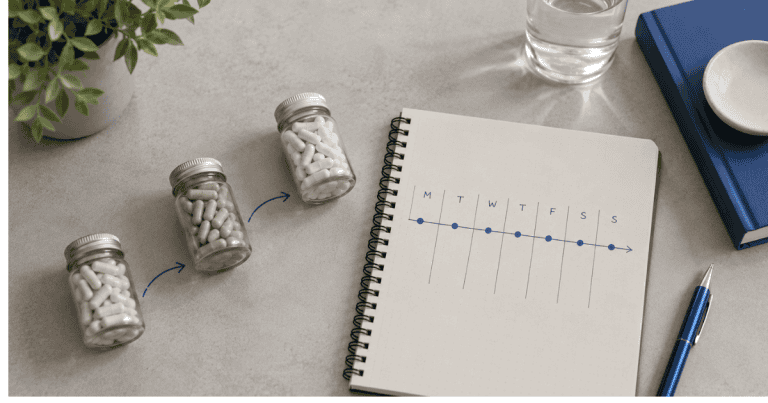
One compound at a time, four weeks each. This is slower than you want it to be, and it is the only way you will learn anything reliable about your own response.
Take 100–200mg L-theanine with your usual coffee, 90 minutes or more after waking. Start at a 2:1 theanine-to-caffeine ratio. Add nothing else. Note focus and jitteriness at the same time each day.
3–5g creatine monohydrate daily, any time, with water. No loading phase required. Consistency matters more than timing.
If sleep is poor, 200–250mg elemental magnesium as glycinate, 60–90 minutes before bed. Do not skip this step to get to the more interesting compounds faster.
300mg standardised Bacopa with food, daily, for a minimum of 12 weeks. Add Rhodiola only if you are dealing with genuine fatigue, and only during those periods — not continuously.

Peter’s Testing Notes
I made every mistake on this list before I learned to test properly. My first serious attempt, years ago, involved six compounds started within a fortnight of each other. When I felt better, I had no idea which one to credit; when I developed a persistent headache, I had no idea which to blame. I stopped everything and started again, one at a time. It is slower and far more useful.
On the specifics: the theanine-caffeine combination is the only item here whose effect I can feel reliably and reproduce on demand. I take 200mg theanine with roughly 100mg caffeine, and the difference in how the first two hours of work feel — steady rather than wired — is obvious enough that I no longer drink coffee without it. Creatine at 5g daily produced nothing I could detect subjectively over months, which is roughly what the evidence predicts for a rested adult who eats meat; I continue taking it for the long-term case, not for a felt effect. Bacopa I ran for 16 weeks at 300mg with breakfast, sourced from Nootropics Depot. My Creyos scores across that block were flat. What I did notice, from about week nine, was a modest improvement in word-retrieval speed — the sensation of reaching for a name and getting it. That is n=1, unblinded, and entirely consistent with expectation effects, so I report it as an observation rather than a finding.
The honest headline after 18 years: the largest cognitive gains I have ever measured came from fixing sleep, not from any compound in this article.
Sourcing Standards: What I Look For Before I Buy
Beginners lose more money to bad sourcing than to bad compound choices. Three checks, every time: a standardised extract with the active percentage printed on the label, third-party testing that confirms the label is honest, and no proprietary blends concealing individual doses. Here is what clears that bar for the compounds above.
Buying theanine on its own is what lets you tune the ratio — start at 1:1 with your coffee, then adjust. A combined capsule locks you into whatever ratio the manufacturer picked.
Caffeine and L-theanine paired in one capsule with the doses disclosed. Useful if you’d rather not measure two things every morning — you trade ratio control for convenience.
Standardised bacoside content stated on the label — every trial that found an effect used a standardised extract, so an unstandardised powder isn’t the same product. This is the one in my own stack.
Creatine is deliberately absent from this list. It’s the one compound here where brand genuinely doesn’t matter — any third-party-tested creatine monohydrate will do the job, and paying more buys you nothing.
Key Takeaways
| • | Start with L-theanine and caffeine. Strongest evidence, fastest feedback, lowest cost. |
| • | One compound at a time, four weeks minimum. Stacking from day one teaches you nothing. |
| • | Bacopa’s effect is real but modest — mainly speed of attention, with some memory free-recall — and takes 12 weeks to show. |
| • | Creatine’s cognitive benefits are clearest in older adults, vegetarians and the sleep-deprived. |
| • | If your sleep is poor, fix that first. It outperforms every compound on this list. |
Frequently Asked Questions
What is the best nootropic for a complete beginner?
L-theanine combined with caffeine. It has the strongest human trial evidence of any beginner-accessible option, the effects appear within an hour so you can evaluate it quickly, and it costs very little. A placebo-controlled study found that 100mg of L-theanine with 50mg of caffeine improved both speed and accuracy on an attention-switching task and reduced susceptibility to distraction. Start at 100–200mg of theanine with your usual coffee and adjust the ratio from there.
How long before nootropics start working?
It varies enormously by compound, which is why people give up too early. L-theanine with caffeine works acutely, within 30 to 60 minutes. Rhodiola shows effects within days to a fortnight. Creatine and magnesium take roughly two to four weeks of consistent use. Bacopa is the outlier: the trials that found benefits ran for 12 weeks, so anything shorter than that is not a fair test. Match your expectations to the compound rather than to the marketing.
Does Bacopa monnieri actually improve memory?
Modestly, and more slowly and subtly than the marketing claims. A systematic review found Bacopa improved free recall on 9 of 17 memory tests (Pase et al., 2012), so there is a genuine memory signal — but a meta-analysis of 437 participants found its most robust pooled effect was on speed of attention, shortening Trail B completion time by 17.9 milliseconds, rather than on memory (Kongkeaw et al., 2014). Taken together: the memory benefit is real but small, specific to free recall, takes about 12 weeks to appear, and is unlikely to be subjectively obvious. Anyone promising a dramatic memory boost is overselling it.
Can I take several nootropics at once when starting?
You can, but you will learn nothing useful from it. If you start four compounds together and feel better, you cannot tell which one is responsible, whether two are interacting, or whether you are simply sleeping better that month. If you develop a side effect, you cannot attribute it either. Introduce one compound at a time and hold it for at least four weeks before adding anything. It feels slow, and it is the only approach that produces information you can actually use.
Why isn’t Lion’s Mane on this list?
Because the evidence standard for this guide is human randomised controlled trials, and Lion’s Mane does not yet meet it convincingly. The widely-quoted findings about nerve growth factor come predominantly from cell culture and animal research, and the human trials that exist are small and limited in scope. That is not a verdict that it does nothing — it is a statement that five other compounds have better human evidence, and a beginner should test those first.
Get “7 Days to a Sharper Brain” — Free
Peter Benson’s personal daily protocol, rebuilt from 18 years of testing
Seven evidence-based interventions, in the exact order that makes each one more effective — from sleep foundation to your complete assembled daily stack.
Join 2,000+ readers optimising their cognitive performance. Unsubscribe anytime.
Peter has personally tested every compound in this guide over 18+ years of systematic self-experimentation, ranking them by human-trial evidence rather than popularity. This guide was re-verified against source in July 2026. He is not a clinician; this is educational, not medical advice. Last reviewed: July 2026.
Scientific References
- Owen GN, Parnell H, De Bruin EA, Rycroft JA. The combined effects of L-theanine and caffeine on cognitive performance and mood. Nutritional Neuroscience. 2008;11(4):193–198. PMID: 18681988
- Haskell CF, Kennedy DO, Milne AL, Wesnes KA, Scholey AB. The effects of L-theanine, caffeine and their combination on cognition and mood. Biological Psychology. 2008;77(2):113–122. PMID: 18006208
- Xu C, Bi S, Zhang W, Luo L. The effects of creatine supplementation on cognitive function in adults: a systematic review and meta-analysis. Frontiers in Nutrition. 2024;11:1424972. PMC11275561 · PMID: 39070254 (subsequently criticised for double-counting)
- Avgerinos KI, Spyrou N, Bougioukas KI, Kapogiannis D. Effects of creatine supplementation on cognitive function of healthy individuals: a systematic review of randomized controlled trials. Experimental Gerontology. 2018;108:166–173. PMID: 29704637
- Pase MP, Kean J, Sarris J, Neale C, Scholey AB, Stough C. The cognitive-enhancing effects of Bacopa monnieri: a systematic review of randomized, controlled human clinical trials. Journal of Alternative and Complementary Medicine. 2012;18(7):647–652. PMID: 22747190
- Kongkeaw C, Dilokthornsakul P, Thanarangsarit P, Limpeanchob N, Scholfield CN. Meta-analysis of randomized controlled trials on cognitive effects of Bacopa monnieri extract. Journal of Ethnopharmacology. 2014;151(1):528–535. PMID: 24252493
- Spasov AA, Wikman GK, Mandrikov VB, Mironova IA, Neumoin VV. A double-blind, placebo-controlled pilot study of the stimulating and adaptogenic effect of Rhodiola rosea SHR-5 extract on the fatigue of students. Phytomedicine. 2000;7(2):85–89. PMID: 10839209
- Shevtsov VA, Zholus BI, Shervarly VI, et al. A randomized trial of two different doses of a SHR-5 Rhodiola rosea extract versus placebo and control of capacity for mental work. Phytomedicine. 2003;10(2–3):95–105. PMID: 12725561
- Olsson EM, von Schéele B, Panossian AG. A randomised, double-blind, placebo-controlled, parallel-group study of the standardised extract SHR-5 of the roots of Rhodiola rosea in the treatment of subjects with stress-related fatigue. Planta Medica. 2009;75(2):105–112. PMID: 19016404
- Kongkeaw C, et al. StatPearls: Bacopa monnieri. NCBI Bookshelf. NBK589635
- Schuster J, Cycelskij I, Lopresti A, Hahn A. Magnesium bisglycinate supplementation in healthy adults reporting poor sleep: a randomized, placebo-controlled trial. Nature and Science of Sleep. 2025;17:2027–2040. PMC12412596