DHA and Omega-3 for Brain Health
Medical Disclaimer: The information in this article is for educational purposes only and does not constitute medical advice. Always consult a qualified healthcare provider before beginning any supplement regimen, particularly if you take anticoagulant medications. This guide reflects published research and personal experience and does not substitute for professional medical evaluation.
Every compound guide in this series — Lion’s Mane, Bacopa, Rhodiola, Alpha-GPC — has referenced DHA as the structural substrate that amplifies everything else. That is not rhetorical emphasis. It is a mechanistic fact: docosahexaenoic acid is the most abundant omega-3 fatty acid in the human brain, comprising approximately 15–20% of total brain fatty acid content and representing the primary structural component of neuronal cell membranes throughout the cerebral cortex and retina.
Without adequate DHA, the membranes through which every neurochemical process in this protocol operates become less fluid, less permeable to the signals that nootropic compounds generate, and less capable of the structural plasticity that underlies learning and memory. Alpha-GPC increases acetylcholine production — but acetylcholine release requires healthy membrane fluidity that DHA provides. Lion’s Mane stimulates NGF — but the dendritic growth NGF induces depends on membrane phospholipid availability that DHA supplies. Bacopa drives dendritic branching — but the synaptic membranes at which new connections form require DHA for optimal receptor function and signal transduction.
DHA is not a nootropic in the conventional sense. It does not stimulate neurotransmitter systems or inhibit enzymes. It is the biological medium in which every other nootropic compound operates — and the most fundamental nutritional intervention for cognitive health that exists. After nearly two decades of researching cognitive enhancement, I consider it the non-negotiable foundation of any serious protocol, before any other compound is considered.
This guide covers the complete science of DHA’s role in brain function, what the human clinical research demonstrates across the full spectrum from fetal development to age-related cognitive decline, the exact dosing and sourcing that the evidence supports, and how DHA fits into the complete cognitive enhancement stack as the indispensable structural layer beneath everything else. This article builds on the full series — particularly the 5 best nootropics for beginners, the stacking guide, and the compound guides for Lion’s Mane, Bacopa Monnieri, and Alpha-GPC.
What Is DHA and Why Does the Brain Need It?
Docosahexaenoic acid (DHA) is a long-chain polyunsaturated omega-3 fatty acid with 22 carbon atoms and 6 double bonds, designated 22:6(n-3) in fatty acid nomenclature. It is biosynthetically derived from alpha-linolenic acid (ALA) — the plant-based omega-3 found in flaxseed, walnuts, and chia seeds — but the enzymatic conversion of ALA to DHA in humans is highly inefficient, with research confirming conversion rates of less than 1% in most adults. This metabolic limitation makes direct dietary or supplemental DHA consumption essential for maintaining adequate brain DHA levels — plant-based omega-3 sources alone are categorically insufficient for cognitive enhancement purposes.
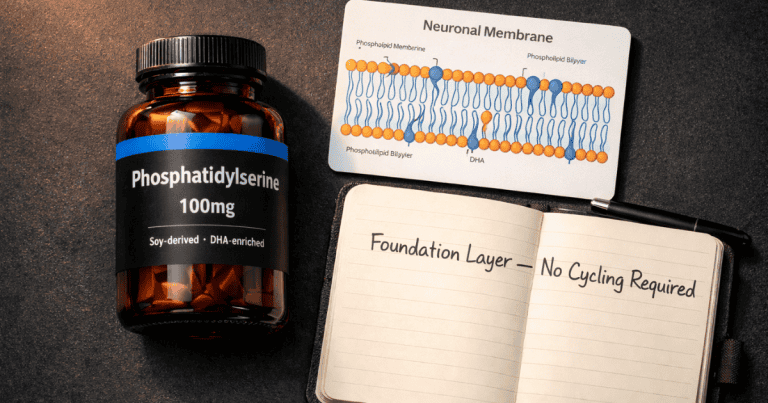
DHA is the most structurally unique fatty acid in the mammalian brain. Its six double bonds create an exceptionally flexible molecular structure that confers the membrane fluidity properties essential for rapid signal transduction, receptor function, and the dynamic membrane remodeling that underlies synaptic plasticity. Research on DHA and membrane biophysics confirms that DHA-containing phospholipids are found at extraordinarily high concentrations precisely in the brain regions with the highest demands for membrane dynamics — the synaptic vesicle membranes where neurotransmitter release occurs, the postsynaptic densities where receptor signaling is transduced, and the axon terminals where electrical signals are converted to chemical messages.
The brain’s extraordinary selectivity for DHA — maintaining high concentrations even under conditions of dietary deficiency by downregulating DHA catabolism — is among the strongest biological evidence for its indispensable role in neurological function. The brain does not selectively concentrate compounds unless they are essential to its operation.
How DHA Supports Cognitive Function: The Complete Mechanism
DHA’s cognitive benefits operate through mechanisms that are structurally foundational rather than pharmacologically acute — which is why its effects are cumulative, why adequate status matters more than acute supplementation, and why it is the substrate upon which every other nootropic compound in this series operates.
Neuronal Membrane Fluidity and Signal Transduction
The primary mechanism through which DHA supports cognitive function is its role in maintaining optimal neuronal membrane fluidity. Neuronal membranes studded with DHA-containing phospholipids are significantly more fluid than membranes with lower DHA content — a biophysical property that has direct consequences for cognitive function. Membrane fluidity determines the lateral mobility of receptor proteins within the membrane, the efficiency of G-protein coupled receptor signaling, the rate of neurotransmitter receptor clustering at synapses, and the kinetics of ion channel opening and closing that underlie electrical signaling.
Research on DHA and receptor function demonstrated that DHA depletion significantly reduces the functional sensitivity of dopamine D2 receptors and serotonin receptors — receptors critical for motivation, mood regulation, and the reward signaling that drives motivated learning. The recovery of receptor sensitivity with DHA repletion follows the same timeline as DHA incorporation into membrane phospholipids — weeks of consistent supplementation, not days — which is why DHA’s cognitive effects are measured over months rather than days and why consistent long-term supplementation matters more than acute dosing precision.
Synaptic Plasticity and Neuroplasticity Support
DHA is required for the membrane dynamics that underlie long-term potentiation (LTP) — the synaptic strengthening process that represents the cellular basis of learning and memory formation. Research on DHA and LTP found that DHA supplementation significantly enhanced LTP magnitude in the hippocampus — the brain region most critical for episodic memory formation — through mechanisms involving both membrane fluidity and direct modulation of the BDNF signaling pathways that govern synaptic plasticity.
This finding directly explains the DHA-neuroplasticity connection referenced throughout the earlier compound guides. When Lion’s Mane stimulates NGF and the brain responds by growing new dendritic processes, those new membranes are assembled from available phospholipid substrates — including DHA. Adequate DHA availability is not merely supportive of neuroplasticity; it is structurally required for the membrane assembly that makes physical neuroplasticity possible at the cellular level.
Neuroprotection and Anti-Neuroinflammation
DHA is the precursor to a family of bioactive lipid mediators — resolvins, protectins, and maresins — that actively resolve neuroinflammation and protect neurons from inflammatory damage. Research on DHA-derived neuroprotectins identified neuroprotectin D1 (NPD1) as a particularly potent neuroprotective mediator synthesized from DHA that protects neurons from oxidative stress-induced apoptosis and reduces the neuroinflammatory signaling that contributes to age-related cognitive decline.
Neuroinflammation is increasingly recognized as a central driver of cognitive aging — not merely a consequence of it. Research on neuroinflammation and cognitive decline confirms that chronic low-grade neuroinflammation impairs synaptic function, reduces neuroplasticity, and accelerates the progression of neurodegenerative pathology. DHA’s anti-neuroinflammatory mechanism through specialized pro-resolving mediator production represents one of the most compelling neuroprotective arguments for its long-term supplementation as a cognitive preservation strategy.
BDNF Upregulation
DHA supplementation has been shown to increase brain-derived neurotrophic factor (BDNF) expression — the neurotrophin most directly associated with learning, memory formation, and the neuroplasticity that underlies cognitive adaptation. Research on DHA and BDNF found that DHA supplementation significantly increased hippocampal BDNF expression and enhanced cognitive performance in learning tasks — a finding that mechanistically connects DHA’s membrane-level effects to the same neuroplasticity pathways that Lion’s Mane’s NGF stimulation targets, through the complementary BDNF pathway.
What the Human Clinical Research Actually Shows
DHA’s human clinical evidence base is one of the largest in nutritional neuroscience — encompassing thousands of studies across the full human lifespan from fetal development through late-life cognitive preservation. Synthesizing this evidence responsibly requires distinguishing between the most robust findings and areas where research remains preliminary.
Fetal and Early Life Brain Development
The most unambiguous DHA research concerns its role in fetal and early childhood brain development. Randomized controlled trials examining DHA supplementation during pregnancy have demonstrated significant effects on infant cognitive development, visual acuity, and neurological maturation. The brain accumulates DHA at its highest rate during the third trimester of pregnancy and the first two years of life — a critical window during which DHA deficiency has permanent consequences for cognitive architecture. This research is among the most consistent and methodologically robust in nutritional neuroscience, establishing DHA’s essential role in cognitive development beyond reasonable scientific dispute.
Cognitive Function in Healthy Adults
The evidence for DHA’s cognitive benefits in healthy adults — the population most relevant to cognitive enhancement — is meaningful but more complex than the developmental evidence. A randomized controlled trial by Stonehouse and colleagues examined DHA supplementation in 176 healthy adults aged 18–45 who had low habitual DHA intake. After six months of 1,160mg daily DHA, participants demonstrated significantly faster episodic memory and working memory reaction times compared to placebo — a finding of direct relevance to cognitive enhancement in the standard adult population.
A key moderating variable in adult DHA research is baseline status. Research on DHA and cognitive function consistently finds the largest effects in individuals with low baseline DHA status — those consuming little or no fatty fish, taking no omega-3 supplements, or with dietary patterns that limit DHA intake. For the majority of adults consuming typical Western diets — which are substantially deficient in DHA by any reasonable standard — supplementation to adequacy is likely to produce meaningful cognitive benefit.
Age-Related Cognitive Decline and Memory
The MIDAS trial (Memory Improvement with Docosahexaenoic Acid Study) — a randomized, double-blind, placebo-controlled trial in 485 healthy older adults with mild memory complaints — found that 900mg daily DHA for 24 weeks significantly improved episodic memory scores compared to placebo, with the improvement equivalent to approximately 3 years of age-related memory decline reversal. This is among the most cited DHA cognitive trials and represents one of the strongest human evidence statements for DHA’s memory-enhancing effects in adults over 55.
A systematic review and meta-analysis of omega-3 supplementation and cognitive function in older adults found significant improvements in processing speed and attention across the reviewed trials, with the most consistent effects in individuals supplementing for six months or longer — consistent with the time required for DHA to incorporate into brain membrane phospholipids and produce measurable neurological effects.
Depression, Mood, and the Cognitive Effects of Emotional State
The relationship between DHA and mood has direct cognitive relevance: depression and anxiety are among the most powerful inhibitors of cognitive performance, and the neuroinflammatory pathways implicated in depression overlap substantially with the pathways DHA modulates. Meta-analysis of omega-3 supplementation and depression found significant antidepressant effects of omega-3 supplementation — with direct implications for cognitive performance given the well-established cognitive impairment produced by depression and anxiety.
Free Download
Get the Free 7-Day Optimize Your Brain in 7 Days
The evidence-based diet, sleep, and supplement framework for your first week of cognitive enhancement — completely free.
Join 2,000+ readers optimizing their cognitive performance. Unsubscribe anytime.
DHA Dosage: The Evidence-Based Protocol
The Evidence-Based Dose Range
The most rigorous cognitive enhancement trials in healthy adults used between 900mg and 1,200mg of DHA daily. The MIDAS trial used 900mg DHA daily and demonstrated memory improvements equivalent to reversing three years of age-related decline. The Stonehouse et al. trial used 1,160mg DHA daily and demonstrated significant working memory and episodic memory improvements in younger healthy adults. My protocol recommendation is 1,000–2,000mg daily of DHA from a high-quality fish oil or algae oil supplement. Within this range, 1,000mg daily is the appropriate starting dose for adults with moderate to low habitual fatty fish consumption — typical of most Western dietary patterns.
The most scientifically precise approach to DHA dosing is baseline status measurement. The Omega-3 Index — a validated clinical test measuring the percentage of DHA and EPA in red blood cell membranes — provides direct evidence of your DHA status. An Omega-3 Index below 4% represents deficiency associated with increased cardiovascular and cognitive risk. An index of 8–12% is associated with optimal cognitive and cardiovascular outcomes in the research literature.
Timing and Co-Administration
DHA is fat-soluble and absorbs significantly better when taken with the largest meal of the day. Research on fish oil bioavailability confirmed that omega-3 fatty acid absorption increases by 50% or more when taken with a high-fat meal compared to a fasted state. For most users, this means taking DHA with dinner — the largest meal in most dietary patterns. This is the one exception to the morning timing preference that governs the rest of the protocol: DHA’s fat-soluble absorption requirement makes meal co-administration the priority over time-of-day optimization.
DHA should be taken consistently every day without cycling. Unlike stimulatory compounds that develop tolerance, DHA is a structural component that benefits from uninterrupted sustained supplementation. The brain phospholipid pool turns over slowly — changes in membrane DHA composition occur over weeks to months — making consistency the single most important dosing variable.
DHA vs. Combined DHA+EPA Formulations
For cognitive enhancement specifically, DHA is the primary active compound — it is DHA, not EPA, that concentrates in the brain and produces the neurological effects this article documents. The practical recommendation: prioritize products with a DHA-to-EPA ratio of 2:1 or higher, or choose DHA-dominant formulations. Products listing only total “omega-3” content without specifying DHA and EPA individually cannot be reliably dosed for cognitive enhancement — the DHA content is the relevant variable and must be stated.
DHA Source Selection: Fish Oil vs. Algae Oil
Fish Oil
Fish oil derived from fatty marine fish — sardines, anchovies, mackerel, and herring in quality products — is the most widely used and researched DHA source. Quality fish oil supplements use small oily fish rather than large predatory fish, reducing bioaccumulation of environmental contaminants. Research analyzing commercially available fish oil products found that a substantial proportion contained DHA and EPA levels significantly below stated label amounts and many showed evidence of oxidation. Third-party testing documentation confirming DHA/EPA content and oxidation markers (peroxide value, TOTOX score) is non-optional for quality verification. IFOS certification is the gold standard for fish oil quality assurance.
Algae Oil: The Vegetarian Alternative That Is Equally Effective
Algae oil — DHA extracted from microalgae, the same organisms that produce DHA at the base of the marine food chain — is the appropriate choice for individuals who do not consume fish, have fish or shellfish allergies, or prefer a sustainable non-animal source. Direct comparative research on fish oil and algae oil bioavailability found that algae-derived DHA was bioequivalent to fish oil DHA in terms of red blood cell DHA incorporation — the relevant measure of brain DHA delivery. Individuals who avoid fish for any reason can achieve the same cognitive benefits from algae oil at equivalent DHA doses with no meaningful efficacy compromise.
DHA Benefits: What the Evidence Supports
Supported by Human Clinical Research
Improved episodic memory and working memory in healthy adults. The Stonehouse et al. randomized controlled trial in 176 healthy adults demonstrated significantly faster episodic memory and working memory reaction times after six months of 1,160mg daily DHA — providing directly applicable evidence for cognitive enhancement in the standard adult population.
Reversal of age-related memory decline. The MIDAS trial in 485 healthy older adults demonstrated that 900mg daily DHA for 24 weeks improved episodic memory scores by the equivalent of approximately three years of age-related memory decline — one of the strongest single DHA cognitive efficacy findings in the published literature.
Essential role in fetal brain development. Multiple randomized controlled trials examining DHA supplementation during pregnancy demonstrate significant effects on infant cognitive development, visual acuity, and neurological maturation — the most unambiguous and consistently replicated cognitive effect of DHA in human research.
Mood support with indirect cognitive benefits. Meta-analysis of omega-3 supplementation and depression found significant antidepressant effects — with direct implications for cognitive performance given the well-established cognitive impairment produced by depression and anxiety.
Supported by Mechanistic Research and Consistent Observational Evidence
Neuroprotection against age-related cognitive decline. DHA-derived neuroprotectin D1 provides potent neuroprotective effects against the oxidative stress and neuroinflammation that drive cognitive aging — supported by strong mechanistic evidence and consistent observational epidemiology.
Synergistic amplification of neuroplasticity compounds. DHA’s role as the membrane substrate for Lion’s Mane’s NGF-induced dendritic growth, Alpha-GPC’s acetylcholine release, and Bacopa’s dendritic branching provides strong mechanistic justification for its inclusion as the structural foundation of any neuroplasticity protocol.
DHA Safety Profile
DHA from fish oil or algae oil has one of the most extensively characterized safety profiles in nutritional supplementation. The NIH Office of Dietary Supplements confirms omega-3 fatty acids are safe for most healthy adults at doses up to 3,000mg daily. At the 1,000–2,000mg DHA range used in cognitive enhancement protocols, serious adverse effects are exceptionally rare.
Anticoagulant interactions: Fish oil at doses above 3,000mg daily can potentiate anticoagulant medications including warfarin. At cognitive enhancement doses of 1,000–2,000mg, this risk is minimal for healthy adults not taking blood thinners, but anyone on anticoagulant therapy should discuss omega-3 supplementation with their prescribing physician. The complete safety framework is in the complete nootropic safety guide.
Fish and shellfish allergies: Individuals with fish or shellfish allergies should choose algae-derived DHA, which carries no fish allergen risk.
Pre-surgical discontinuation: Discontinue fish oil or algae oil 2 weeks before any scheduled surgical procedure as a precautionary measure against anticoagulant potentiation effects.
Oxidation quality concern: Oxidized fish oil — rancid product resulting from inadequate quality control — is not merely ineffective but may be counterproductive, introducing oxidized lipids that could contribute to inflammatory burden. Always purchase from suppliers providing third-party oxidation testing documentation, and store fish oil in a cool, dark environment. If your fish oil smells strongly rancid, discard and replace.
DHA in the Complete Cognitive Enhancement Stack
DHA + Lion’s Mane (Neuroplasticity Foundation): Lion’s Mane stimulates NGF production, driving the growth of new neural connections. DHA provides the membrane phospholipid substrate from which those new connections are physically assembled. Research on DHA and neuroplasticity confirms that adequate DHA availability significantly enhances the brain’s LTP response — making DHA a functional amplifier of Lion’s Mane’s NGF-driven structural effects.
DHA + Bacopa Monnieri (Memory Consolidation Support): Bacopa drives dendritic branching through cholinergic and antioxidant mechanisms. DHA ensures the synaptic membranes at which Bacopa’s new dendritic connections form are optimally fluid and receptor-dense — addressing memory enhancement at both the structural and functional levels simultaneously.
DHA + Alpha-GPC (Cholinergic Optimization): Alpha-GPC increases acetylcholine production. DHA determines the membrane environment in which acetylcholine is released and its receptors respond. Research on DHA and receptor function confirms that DHA status directly modulates the functional sensitivity of acetylcholine receptors — making DHA a direct amplifier of cholinergic supplementation strategies.
The Complete Protocol Foundation (DHA + Lion’s Mane + Bacopa + Alpha-GPC): This four-compound combination addresses cognitive enhancement at four complementary levels: structural membrane substrate (DHA), NGF-mediated neuroplasticity (Lion’s Mane), cholinergic memory consolidation (Bacopa), and acetylcholine precursor supply (Alpha-GPC). DHA is not the most dramatic compound in this stack — it is the one without which the other three perform below their potential.
Frequently Asked Questions About DHA for Brain Health
How much DHA do I need per day for brain health?
The evidence-based recommendation for cognitive enhancement is 1,000–2,000mg of DHA daily, with 1,000mg as an appropriate starting dose for most adults. The most directly applicable clinical trials used 900–1,160mg DHA daily and demonstrated significant cognitive improvements over six months. Individuals consuming fewer than two servings of fatty fish per week are likely deficient by cognitive optimization standards and should target the upper end of this range during an initial six-month repletion period. The most precise approach is testing your Omega-3 Index and supplementing to achieve an index of 8–12%.
How long does DHA take to improve cognitive function?
DHA incorporation into brain membrane phospholipids occurs over weeks to months of consistent supplementation, not days. The primary cognitive enhancement trials showing significant memory improvements used supplementation periods of six months or longer. Measurable increases in red blood cell DHA content typically occur within 4–8 weeks of consistent supplementation, but the cognitive effects that depend on membrane composition changes follow the membrane remodeling timeline. Consistency over months is the critical variable, not dose precision over days.
Is algae oil as good as fish oil for brain health?
Yes — algae oil is bioequivalent to fish oil for brain DHA delivery. Direct comparative research found that algae-derived DHA produces the same red blood cell DHA incorporation as fish oil at equivalent doses. Fish acquire their DHA by eating DHA-producing microalgae; algae oil simply provides the same DHA from the original biological source. Individuals who avoid fish for any reason can achieve the same cognitive benefits from algae oil at equivalent DHA doses with no meaningful efficacy compromise.
Can I get enough DHA from diet alone without supplements?
For most adults consuming typical Western diets, dietary DHA alone is insufficient for cognitive optimization. Achieving 1,000mg daily of DHA from food requires approximately two servings of fatty fish per week — a consumption level substantially exceeded by most people’s actual dietary patterns. Plant-based omega-3 sources (flaxseed, walnuts, chia seeds) provide ALA, which converts to DHA at less than 1% efficiency in most adults — categorically inadequate for meeting cognitive enhancement DHA targets.
What should I look for when buying a DHA supplement?
The most important quality criteria for DHA supplements are: stated DHA content per serving (not just total omega-3 — DHA must be specified separately), third-party testing documentation confirming DHA/EPA levels match label claims, oxidation testing confirming peroxide value and TOTOX score within acceptable ranges, IFOS or equivalent certification for fish oil products, and manufacturer transparency about fish species and geographic origin. Avoid products listing only “omega-3” content without DHA specification, and products without oxidation testing documentation. For algae oil, choose products specifying DHA content per serving and providing third-party purity verification.
Is DHA Worth Taking? The Evidence-Based Verdict
The question of whether DHA is worth taking is the easiest in this entire series: DHA is not optional for the human brain. It is a structural requirement — a non-negotiable component of the neuronal membranes through which every cognitive process operates. The question is not whether you need DHA. It is whether you are consuming enough of it, and for the majority of adults on Western dietary patterns, the answer is demonstrably no.
The clinical evidence for DHA’s cognitive benefits in healthy adults is meaningful — particularly the MIDAS trial and the Stonehouse et al. trial, which provide direct randomized controlled trial evidence for memory improvements at doses achievable through supplementation. The mechanistic evidence for DHA as the structural amplifier of every other compound in this protocol is compelling. And the safety profile at cognitive enhancement doses is among the best documented in nutritional supplementation.
1,000–2,000mg of DHA daily from a quality third-party-tested fish oil or algae oil, taken with your largest meal, consistently without cycling. That is the protocol. It is simple, inexpensive relative to the rest of the stack, and foundational to everything else working at full potential.
Before any other compound in this series, establish your DHA foundation. Measure your Omega-3 Index if you want precision. Supplement consistently for at least three months before assessing other compounds’ effects — because the cognitive improvements documented for Lion’s Mane, Bacopa, and Alpha-GPC are measured in research conducted on participants whose DHA status is not controlled for deficiency. Your protocol’s ceiling is partly determined by whether you have laid this foundation first.
For the complete beginner protocol, see the 5 best nootropics for beginners. For how DHA integrates with the full stack, see the nootropic stacking guide. For the realistic timeline of when DHA’s cognitive effects become measurable, the 90-day nootropic timeline provides the framework. And for the safety considerations governing DHA use alongside the rest of your protocol, the complete nootropic safety guide covers everything relevant.
References
- Stonehouse, W., et al. (2013). DHA supplementation improved both memory and reaction time in healthy young adults. American Journal of Clinical Nutrition, 97(5), 1134–1143. PubMed
- Yurko-Mauro, K., et al. (2010). Beneficial effects of docosahexaenoic acid on cognition in age-related cognitive decline (MIDAS Trial). Alzheimer’s & Dementia, 6(6), 456–464. PubMed
- Dangour, A.D., et al. (2012). Omega-3 fatty acids and cognitive health in older people. British Journal of Nutrition, 107(S2), S152–158. PubMed
- Sublette, M.E., et al. (2011). Meta-analysis of the effects of eicosapentaenoic acid in clinical trials in depression. Journal of Clinical Psychiatry, 72(12), 1577–1584. PubMed
- Bazan, N.G. (2005). Neuroprotectin D1 (NPD1): a DHA-derived mediator that protects brain and retina against cell injury-induced oxidative stress. Brain Pathology, 15(2), 159–166. PubMed
- Su, H.M. (2010). Mechanisms of n-3 fatty acid-mediated development and maintenance of learning memory performance. Journal of Nutritional Biochemistry, 21(5), 364–373. PubMed
- Arterburn, L.M., et al. (2006). Bioequivalence of docosahexaenoic acid from different algal oils. Lipids, 41(12), 1011–1024. PubMed
- Burdge, G.C., & Calder, P.C. (2005). Conversion of alpha-linolenic acid to longer-chain polyunsaturated fatty acids in human adults. Reproduction Nutrition Development, 45(5), 581–597. PubMed
- NIH Office of Dietary Supplements. Omega-3 Fatty Acids Fact Sheet for Health Professionals. NIH ODS
About Peter Benson
Peter Benson is a cognitive enhancement researcher with 18+ years of personal and professional experience in nootropics, neuroplasticity, and brain optimization protocols. He has personally helped hundreds of individuals improve their mental performance through evidence-based supplementation and lifestyle strategies. NeuroEdge Formula is his platform for sharing rigorous, safety-first cognitive enhancement guidance.