
Digital distraction and the Brain
Medical Disclaimer: The information in this article is for educational purposes only and does not constitute medical advice. Always consult a qualified healthcare provider before beginning any supplement regimen or making significant changes to your health protocols. Individual responses vary. This guide reflects published research and 18+ years of personal experience and does not substitute for professional medical evaluation.
Digital distraction is not a willpower problem. It is an engineered neurological vulnerability — one that the most sophisticated behavioral scientists on earth, armed with essentially unlimited data on human attention and reward processing, have spent over a decade deliberately exploiting. Understanding this is the first and most important step toward reclaiming your attention, because approaching digital distraction as a discipline problem leads to strategies that are systematically overmatched by the neurochemical mechanisms they are trying to overcome.
The attention economy — the business model in which your attention is the product being sold to advertisers — is built on a precise understanding of the brain’s reward circuitry, its orienting reflexes, its susceptibility to variable reward schedules, and its inability to habituate to novelty. Social media platforms, news feeds, email systems, and messaging applications are not accidentally engaging. They are deliberately designed to produce the specific neurological states that maximize time-on-platform at the expense of every other cognitive priority you have.
This article provides the neuroscience of why digital distraction is so difficult to resist, what it is doing to your brain’s attentional architecture over time, and — most importantly — the complete evidence-based protocol for structural attention reclamation that actually works against these mechanisms rather than simply trying to out-willpower them. It builds directly on the focus guide, the deep work protocol, and the morning routine guide — addressing the specific attentional threat that modern digital environments pose to every intervention those guides describe.
After 18+ years of coaching individuals through cognitive performance optimization, the single most consistent obstacle to sustained improvement is unmanaged digital distraction. The biology is not on the side of the person trying to resist. But the structural interventions in this guide change the terms of the contest entirely.
The Neuroscience of Digital Distraction: How Your Attention Is Being Captured
Digital platforms capture attention through three neurological mechanisms that operate largely beneath conscious awareness. Understanding each mechanism is what allows the structural interventions to be targeted precisely rather than applied generically.
Mechanism 1 — The Variable Reward Schedule and Dopamine Anticipation
The most powerful neurological mechanism underlying digital distraction is the variable reward schedule — the same mechanism that makes slot machines so compelling. Research on variable reward schedules and dopamine signaling established that dopamine release in the nucleus accumbens — the brain’s reward center — is strongest not in response to the reward itself but in response to the anticipation of an uncertain reward. When you check email, social media, or messaging apps, the dopamine system fires not because you found something interesting but because you might find something interesting. The uncertainty is the neurological driver.
This is why “just quickly checking” feels compulsive rather than deliberate. The dopamine system has been conditioned through thousands of variable reward exposures to anticipate a possible reward every time the checking behavior is performed. The behavior is not driven by the conscious decision to check — it is driven by the dopaminergic anticipation that precedes the conscious decision. By the time awareness registers the impulse to check, the neurochemical drive is already active. Resisting at this point requires PFC executive override of a dopaminergic impulse — a contest the PFC frequently loses, particularly under cognitive fatigue, stress, or low motivation states.
The structural implication is critical: strategies that rely on deciding not to check in the moment are fundamentally mismatched with this mechanism. The checking impulse is neurochemically upstream of the decision. Effective digital distraction management must be structural — removing the possibility of the behavior before the dopaminergic impulse arises, not relying on in-the-moment willpower to override it after it has already been activated.
Mechanism 2 — The Involuntary Orienting Response and Notification Architecture
The brain’s alerting network — responsible for maintaining readiness for novel stimuli — responds to incoming signals automatically and involuntarily. This is an evolutionarily ancient mechanism: in the ancestral environment, novel sounds and movements represented either opportunities or threats, and the organisms that investigated them outcompeted those that did not. The orienting response — the automatic shift of attention toward a novel stimulus — was survival-critical.
Digital notification systems exploit this reflex with precision. Every ping, buzz, banner, or badge represents a novel stimulus that triggers the same involuntary orienting response that evolved to detect predators and food sources. Research on the attentional cost of notifications found that even notifications that are ignored — that receive no behavioral response — produce measurable decrements in ongoing task performance. The orienting response fires regardless of whether you act on it. The attentional cost is incurred whether or not you look at the phone. This is why device silencing is insufficient — the orienting reflex fires on the vibration or LED indicator just as reliably as on a sound. Physical removal, not silencing, is the structural intervention that actually blocks this mechanism.
Mechanism 3 — Attentional Residue and the DMN Reactivation Problem
Research on attentional residue by Sophie Leroy established a third mechanism beyond immediate distraction: when attention switches from one task to another — including to checking a digital platform — cognitive resources remain partially allocated to the interrupted task, and new cognitive resources are partially allocated to the new task, with neither task receiving full attentional engagement. This split allocation — attentional residue — persists for minutes after returning to the original task and produces measurable decrements in performance quality that are independent of and additive to the 23-minute re-engagement cost described in the deep work guide.
For habitual digital distraction patterns — checking every 3–5 minutes — attentional residue essentially never clears. The brain is permanently in a state of partial allocation across multiple tasks, none of which receives the full PFC engagement that deep processing requires. This is the neurological mechanism that produces the subjective experience that many knowledge workers report: working all day but accomplishing little, feeling mentally exhausted but not satisfied, and finding it genuinely difficult to identify what was actually accomplished.
What Chronic Digital Distraction Does to the Brain Over Time
The neurological damage from chronic digital distraction is not metaphorical. Sustained patterns of frequent attentional switching produce measurable structural and functional changes to the attentional systems — changes that compound over months and years of chronic exposure and that require deliberate, sustained effort to reverse.
The Lowered Distraction Threshold
Research on media multitasking and attentional control by Ophir, Nass, and Wagner found that heavy media multitaskers — individuals with chronic high digital distraction patterns — performed significantly worse than light multitaskers on attentional filtering tasks, working memory tasks, and task-switching tasks. Critically, heavy multitaskers were more distractible by irrelevant stimuli — they had a lower threshold for distraction, not a higher capacity for managing it. Chronic digital distraction does not build multitasking skill. It degrades the attentional filtering capacity that single-task deep work requires.
The neurological mechanism is consistent with the general principle of use-dependent plasticity: the brain optimizes for the attentional patterns it practices most consistently. Consistent practice of frequent attentional switching — the default mode of heavy digital platform use — gradually lowers the PFC’s threshold for distraction, making the default mode network’s mind-wandering tendency progressively harder to suppress and sustained task engagement progressively more effortful.
Reduced Working Memory Capacity
The Ward et al. research (referenced throughout this Focus hub) established that smartphone presence reduces available working memory capacity even without active use — through the cognitive resources allocated to suppressing the checking impulse. For chronic heavy digital platform users, this suppression burden is essentially continuous throughout the waking day, representing a chronic drain on the PFC working memory capacity that focused work requires. The cumulative effect over months and years is a measurable reduction in the effective working memory capacity available for the cognitively demanding tasks that produce the most valuable output.
Impaired Capacity for Boredom and Sustained Attention
Research on boredom tolerance and attentional capacity found that individuals with low boredom tolerance — a characteristic strongly associated with chronic digital platform use — showed significantly impaired sustained attention performance on cognitively demanding tasks. The neurological connection is direct: the immediate relief from boredom that smartphones provide trains the dopamine system to expect constant stimulation and to signal distress at its absence. Deep work requires tolerating the cognitive discomfort of sustained engagement with a difficult task — and chronic digital use systematically degrades the capacity to tolerate exactly that discomfort.
Free Download
Get the 7-Day Brain Optimization Protocol
The evidence-based diet, sleep, and supplement framework for your first week of cognitive enhancement — completely free.
Join 2,000+ readers optimizing their cognitive performance. Unsubscribe anytime.
The Attention Reclamation Protocol: Structural Solutions to Neurological Problems
Because digital distraction operates through neurological mechanisms that are largely upstream of conscious decision-making, effective management requires structural interventions — changes to the environment, device configuration, and daily schedule that remove the possibility of the distracting behavior before the neurochemical drive to perform it arises. Willpower-based approaches fail systematically against these mechanisms. Structural approaches succeed because they do not require willpower at the moment of temptation.
Layer 1 — Device Architecture: Making Distraction Physically Difficult
Phone-free work zones: The single highest-leverage structural intervention is the physical separation of the smartphone from the primary work environment during work periods. Not silenced — physically absent. The Ward et al. research established that working memory reduction from smartphone proximity occurs even when the device is face-down and silent. For deep work sessions and morning protocol execution, the phone is in another room. This is not a convenience — it is a neurological necessity for the attentional capacity that productive cognitive work requires.
Notification elimination (not management): The conventional advice to manage notifications — turning off “non-essential” ones while keeping “important” ones — fails to address the orienting reflex mechanism. Every remaining notification still triggers the involuntary orienting response. The effective structural intervention is notification elimination for all applications except genuinely time-critical communications during work periods. The practical implementation: during work periods, all notifications are disabled system-wide. A scheduled communication window — once or twice daily, at defined times — handles all messaging, email, and social media responses. Outside this window, the notification system does not exist.
App removal and friction engineering: Social media and news applications installed on the primary work device represent zero-friction access to the highest-dopaminergic-reward platforms available. Removing these applications from work devices — accessing them only through a browser, only during defined communication windows, only on a secondary device — introduces friction that is sufficient to interrupt the automatic checking behavior before it executes. The checking impulse fires; the automatic execution pathway encounters resistance; the PFC has a brief window to apply deliberate override. Friction engineering does not eliminate the checking impulse — it converts it from an automatic behavior to a deliberate decision, which is the prerequisite for behavioral change.
Layer 2 — Schedule Architecture: Containing Distraction in Defined Windows
The batch communication model: Email, messaging, and social media are neurologically incompatible with sustained deep work — not because they are inherently problematic but because they demand the exact attentional mode (rapid switching, novelty-seeking, social monitoring) that is the opposite of the sustained single-task engagement deep work requires. The evidence-based approach is to batch all communication into defined daily windows — typically 30–60 minutes in late morning and 30 minutes in late afternoon — and to treat these windows as the entirety of the communication workday. Outside these windows, communication platforms do not exist.
The business-world objection — “but what if something urgent comes up?” — reflects a misunderstanding of the actual frequency of genuine urgency in knowledge work. Research on email urgency perception found that the overwhelming majority of emails perceived as requiring immediate response do not, in fact, require immediate response. The urgency is a psychological construct reinforced by variable reward anticipation — not an accurate assessment of the communication’s actual time-sensitivity. Batching communication for 2 weeks consistently reveals that almost nothing was as time-sensitive as the dopamine system claimed it was.
The analog morning protocol: As established in the morning routine guide, no digital device contact for the first 60 minutes of the day is the single most impactful schedule intervention for morning cognitive performance. The morning is the period of highest neuroplasticity, highest natural cortisol arousal, and highest potential attentional quality. Using it for digital consumption — email, news, social media — trades the day’s highest-value cognitive window for the lowest-value digital content available. The analog morning protocol protects this window completely.
Layer 3 — Neurochemical Support: Optimizing the Biology of Attention Reclamation
Structural interventions address the environmental triggers of digital distraction. Neurochemical optimization addresses the biological variables that determine how effectively the PFC can maintain task-positive engagement when distracting impulses arise.
Dopamine baseline management: The compulsive digital checking that characterizes attentional hijacking is strongest when dopamine baseline is low — a state associated with chronic stress, sleep deprivation, and sedentary behavior. Physical exercise, quality sleep, and stress management through the Ashwagandha and mindfulness protocols covered in this hub directly raise dopamine baseline, reducing the dopaminergic pull of variable reward digital platforms relative to the intrinsic reward of focused work. This is not a metaphorical connection — the neurochemical mechanisms are direct and documented.
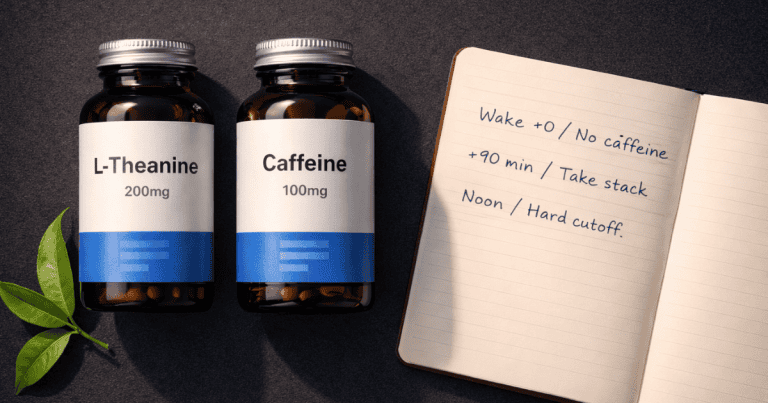
The caffeine and L-theanine protocol for distraction resistance: The alert-but-relaxed alpha wave state produced by the caffeine and L-theanine combination is neurologically similar to the state produced by mindfulness training — and both states produce the same functional result: increased PFC executive control over the attentional impulses that digital platforms exploit. Taking the caffeine and L-theanine combination before the deep work session strengthens exactly the neurochemical substrate that resisting distraction requires.
Mindfulness training as distraction-resistance training: The foundational mindfulness practice described in the focus guide is the most direct neurological training available for distraction resistance — because noticing the impulse to check a device and returning to the breath is neurologically identical to the skill required in a work session. Every mindfulness session trains the specific neural circuit — from DMN activation to task-positive network re-engagement — that distraction resistance requires. Consistent mindfulness practice is not complementary to the structural interventions; it is the neurological training that makes them most effective.
Layer 4 — The Attention Reclamation Timeline: What to Expect
The timeline for attention reclamation follows a predictable pattern that is important to understand, because the first two weeks of structural digital distraction management are typically the most uncomfortable — and the period at which most people abandon the protocol.
Week 1–2 (Withdrawal and Discomfort): The dopaminergic reward circuitry conditioned by years of variable reward digital use does not immediately recalibrate when the variable reward access is removed. The first 1–2 weeks typically produce increased restlessness, difficulty tolerating the absence of checking, and a subjective sense that important things are being missed. This is not evidence that the protocol is failing — it is neurochemical evidence that it is working. The discomfort reflects the dopaminergic withdrawal from a conditioned variable reward pattern. It resolves within 2 weeks in most individuals.
Week 3–4 (Stabilization): Restlessness reduces. The impulse to check is still present but becomes more recognizable as an impulse rather than an urgent necessity. Deep work session quality measurably improves as attentional residue clears more completely between sessions. Morning productivity noticeably increases as the analog morning protocol takes effect.
Week 5–8 (Recalibration): The dopamine baseline begins resetting to levels appropriate for the actual reward environment. Focused work begins to feel intrinsically rewarding rather than effortful. The structural interventions begin to feel natural rather than restrictive. Mindfulness training, operating in parallel, has strengthened the PFC’s attentional executive control to the point where distraction impulses are noticed and released rather than automatically acted upon.
Week 9–12 (New Baseline): The new attentional architecture is the default rather than an effortful maintenance. Deep work sessions reach 90 minutes with qualitatively superior focus. Morning productivity is consistent and reliable. The structural interventions are no longer experienced as restrictions but as the conditions that make valued cognitive work possible.
Frequently Asked Questions About Digital Distraction
Why is digital distraction so hard to resist even when I know it’s hurting my productivity?
Digital distraction is hard to resist because the neurological mechanisms driving it are largely upstream of conscious decision-making. Variable reward schedules produce dopaminergic anticipation that fires before you consciously decide to check your phone — by the time you are aware of the impulse to check, the neurochemical drive is already active. Resisting at this point requires PFC executive override of a dopaminergic impulse, which is a contest the PFC frequently loses under cognitive fatigue, stress, or low motivation. Additionally, the involuntary orienting reflex fires automatically in response to notifications regardless of conscious intention to ignore them — incurring attentional costs that cannot be prevented through willpower alone. Effective distraction management must therefore be structural — removing the environmental triggers before the neurochemical drives arise — rather than relying on in-the-moment willpower against already-activated neurochemical mechanisms.
Does social media use actually change the brain?
Yes — chronic heavy social media and digital platform use produces measurable changes to attentional architecture through the same use-dependent neuroplasticity mechanisms that govern all skill development. Research on media multitasking found that heavy multitaskers showed significantly greater distractibility — a lower threshold for distraction — compared to light multitaskers, along with impaired working memory and attentional filtering performance. The brain adapts to the attentional patterns it practices most consistently: consistent practice of rapid attentional switching optimizes neural circuits for switching rather than for sustained engagement. This is not permanent damage — the same neuroplasticity that produces attentional degradation from chronic distraction patterns produces attentional improvement from consistent deep work and mindfulness training. But recovery requires deliberate sustained practice of the attentional skills that digital distraction erodes.
How long does it take to reclaim attention after chronic digital distraction?
The attention reclamation timeline follows a predictable pattern across approximately 8–12 weeks of consistent structural intervention. Weeks 1–2 are the most uncomfortable — dopaminergic withdrawal from conditioned variable reward patterns produces restlessness and difficulty tolerating the absence of checking. This resolves within 2 weeks. Weeks 3–4 bring stabilization: deep work quality measurably improves, morning productivity increases, and distraction impulses begin to feel like impulses rather than urgent necessities. Weeks 5–8 produce recalibration: focused work begins feeling intrinsically rewarding, structural interventions feel natural, and mindfulness training has strengthened PFC executive control over attentional impulses. By weeks 9–12, the new attentional architecture has become the default — 90-minute deep work sessions are achievable with qualitatively superior focus, and the structural interventions are no longer experienced as restrictions but as the conditions that make valued cognitive work possible.
Is it enough to just turn off notifications?
Notification management is insufficient because it addresses only one of the three neurological mechanisms driving digital distraction. Turning off notifications reduces orienting reflex triggers — but it does not address the variable reward dopaminergic drive to check platforms proactively, and it does not address attentional residue from knowing the platforms are accessible. Research on smartphone proximity found that the mere presence of a silent, face-down smartphone reduces working memory capacity — meaning the cognitive cost of digital platform proximity is incurred regardless of whether notifications are active. Effective attention reclamation requires structural interventions at all three levels: device removal from the work environment (orienting reflex), scheduled communication windows (variable reward management), and friction engineering through app removal and browser-only access (automatic behavior interruption). Notification management alone addresses one of three mechanisms — it is a necessary but insufficient component of the complete protocol.
Can supplements help with digital distraction resistance?
Supplements support distraction resistance through the neurochemical pathways that govern PFC executive control — but they work with structural interventions rather than substituting for them. The caffeine and L-theanine combination strengthens PFC catecholamine signaling, producing the alert-but-relaxed state that supports executive override of distraction impulses. Rhodiola Rosea’s cortisol-modulating and monoamine-preserving effects prevent the stress-induced PFC degradation that makes distraction resistance most difficult during demanding or fatiguing periods. Ashwagandha’s HPA axis regulation raises the chronic stress floor that otherwise chronically impairs PFC executive function. Lion’s Mane and Bacopa build the long-term cholinergic and neuroplasticity foundations that make sustained attentional engagement progressively less effortful over time. None of these compounds eliminate the dopaminergic drive to check digital platforms — but they optimize the neurochemical environment in which the structural interventions and mindfulness training produce their full distraction-resistance effect.
Reclaiming Attention as a Neurological Practice
Digital distraction is the most significant threat to cognitive performance in the modern environment — not because it is unavoidable, but because the mechanisms driving it are neurological rather than behavioral, and the strategies most commonly deployed against them are mismatched at the level of mechanism. Willpower-based approaches fail systematically against dopaminergic conditioning, involuntary orienting reflexes, and attentional residue. Structural approaches succeed because they operate at the same neurological level as the mechanisms they are countering.
The complete attention reclamation protocol — device architecture, schedule architecture, neurochemical optimization, and mindfulness-based distraction resistance training — addresses all three neurological mechanisms simultaneously. Applied consistently over 8–12 weeks, it produces a qualitatively different attentional architecture: one in which deep work is the natural default rather than the constant struggle, and in which the cognitive output that defines professional and intellectual excellence becomes reliably accessible rather than occasionally achieved.
For the deep work protocol that this attention reclamation enables, see the complete deep work guide. For the morning protocol that protects the day’s highest-value attentional window, see the morning routine guide. For the supplementation stack that optimizes the neurochemical substrate of distraction resistance, see the caffeine and L-theanine, Rhodiola, and Ashwagandha guides.
References
- Volkow, N.D., et al. (2011). Dopamine in drug abuse and addiction: Results of imaging studies and treatment implications. Archives of Neurology, 64(11), 1575–1579. PubMed
- González, V.M., & Mark, G. (2004). Constant, constant, multi-tasking craziness: Managing multiple working spheres. Proceedings of CHI 2004. PubMed
- Leroy, S. (2009). Why is it so hard to do my work? The challenge of attention residue when switching between work tasks. Organizational Behavior and Human Decision Processes, 109(2), 168–181. PubMed
- Ophir, E., Nass, C., & Wagner, A.D. (2009). Cognitive control in media multitaskers. Proceedings of the National Academy of Sciences, 106(37), 15583–15587. PubMed
- Ward, A.F., et al. (2017). Brain drain: The mere presence of one’s own smartphone reduces available cognitive capacity. Journal of the Association for Consumer Research, 2(2), 140–154. PubMed
- Bench, S.W., & Lench, H.C. (2013). On the function of boredom. Behavioral Sciences, 3(3), 459–472. PubMed
- Posner, M.I., & Petersen, S.E. (1990). The attention system of the human brain. Annual Review of Neuroscience, 13, 25–42. PubMed
- Lazar, S.W., et al. (2005). Meditation experience is associated with increased cortical thickness. NeuroReport, 16(17), 1893–1897. PubMed
- Arnsten, A.F. (2009). Stress signalling pathways that impair prefrontal cortex structure and function. Nature Reviews Neuroscience, 10(6), 410–422. PubMed
Tags: digital distraction, attention economy, variable reward schedule dopamine, orienting reflex notifications, attentional residue, media multitasking brain, smartphone working memory, attention reclamation, deep work distraction, digital distraction neuroscience, social media brain changes, batch communication, dopamine reset, distraction resistance, focus and smartphones
About Peter Benson
Peter Benson is a cognitive enhancement researcher and mindfulness coach with 18+ years of personal and professional experience in nootropics, neuroplasticity, and attention optimization protocols. He has personally coached hundreds of individuals through integrated focus improvement programs combining evidence-based mindfulness training with targeted supplementation strategies. NeuroEdge Formula is his platform for sharing rigorous, safety-first cognitive enhancement guidance.