
Digital distraction and the Brain
📘 Educational Information
This article explains the science of digital distraction and reflects independent research, not clinical guidance. If you feel your technology use has become genuinely compulsive or is harming your wellbeing, that’s worth discussing with a qualified professional — this is educational information, not a substitute for personalised advice.
| The core idea | Digital distraction isn’t a personal failing — apps are deliberately engineered to exploit the brain’s reward-learning system. You’re not weak; the deck is stacked. |
| The mechanism | Unpredictable rewards (likes, new content) drive the dopamine-based “wanting” system that motivates us to seek — not the pleasure of getting (Berridge & Robinson, 2016). |
| Key finding | The mere presence of your own phone — even face-down and untouched — measurably reduces working memory and fluid intelligence (Ward et al., 2017). |
| Real cost | In a controlled study, a week with notifications on produced measurably higher inattention and hyperactivity than a week with them off (Kushlev et al., 2016). |
| Biggest mistake | Trying to out-willpower the design. The winning move is to change the environment so the pull never fires — not to resist it moment by moment. |
Digital Distraction and the Brain: Why It’s So Hard to Resist
By Peter Benson, Cognitive Enhancement Researcher | 18+ Years Independent Research · Last reviewed & citations verified: August 2026
You sit down to work, and forty minutes later you surface from a scroll-hole with no memory of deciding to open the app. If that makes you feel weak-willed, I want to reframe it: you’re not fighting your own laziness, you’re fighting billion-dollar systems engineered by teams of behavioural scientists to capture exactly your attention. In 18+ years of studying cognitive performance, I’ve come to see digital distraction as less a willpower problem and more a design problem — and understanding the mechanism is the first step to disarming it.
This article is about the why: how your phone and its apps exploit the brain’s reward system, why their presence costs you even when you’re not using them, and what the research genuinely shows (as opposed to the “dopamine detox” hype). It’s part of the Focus & Productivity Optimisation guide. For the practical defence — how to protect your focus once you understand the enemy — I’ll point you to the companion guides rather than repeat them here.
The Reward-Learning Machine in Your Pocket
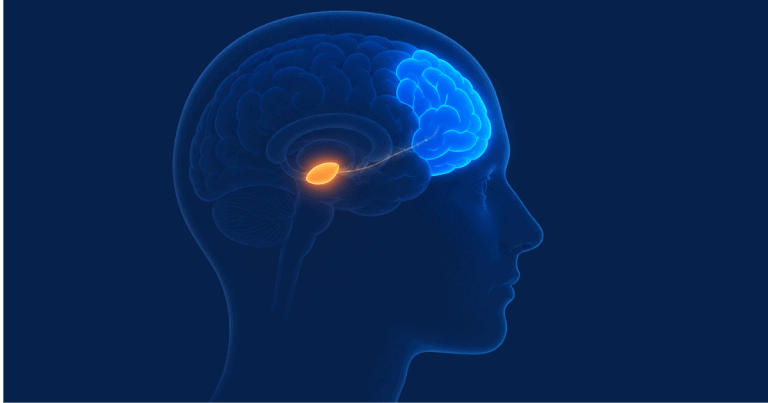
Let’s start with the neuroscience, done honestly — because the popular version gets it wrong. The common claim is that apps give you “dopamine hits” of pleasure. That’s not quite it. Dopamine isn’t primarily the chemistry of liking something; it’s the chemistry of wanting — of anticipation and the drive to seek. In their influential work distinguishing these two systems, Berridge and Robinson showed that dopamine drives the “wanting” that pulls us toward a reward, which can operate independently of how much we actually enjoy it once we get there (Berridge & Robinson, 2016). That’s why you can scroll compulsively while barely enjoying a single post.
This anticipatory system is most powerfully activated not by rewards, but by unpredictable rewards. This is one of the oldest findings in behavioural science: intermittent, variable reinforcement drives more persistent behaviour than predictable reinforcement — it’s the principle that makes slot machines compelling. And it maps directly onto social media. A rigorous study analysing over one million posts from more than 4,000 users found that social media engagement follows the formal principles of reward learning — people post and check in patterns that track the rate of social reward, exactly as a lab animal works a lever for food (Lindström et al., 2021). The researchers describe it, only half-metaphorically, as a Skinner box for the modern human.
The Design Tricks That Exploit It
Once you understand that unpredictable rewards drive seeking behaviour, the design of these products stops looking like convenience and starts looking like what it is: a set of features engineered to maximise engagement. Pull-to-refresh is a slot-machine lever — you tug, and a variable payload of new content may or may not appear. Infinite scroll removes every natural stopping point, so there’s never a moment where the interface invites you to stop. Autoplay makes continuing the default and quitting the effortful choice. And the red notification badge weaponises our instinctive orienting response to a signal that “something has changed,” compelling a check.
None of these are accidents. They’re the applied output of persuasive-design principles, refined through relentless A/B testing on billions of users. The uncomfortable implication is the one I opened with: expecting raw willpower to beat a system optimised by thousands of experiments to defeat exactly that willpower is not a fair fight. Which is precisely why the effective response is environmental, not motivational — a point I’ll return to.
The Cost You Pay Even When You Resist
Here’s the finding that genuinely changed how I work. You might assume that as long as you don’t actually check your phone, it isn’t costing you anything. Not so. In a pair of experiments testing the “brain drain” hypothesis, researchers found that the mere presence of your own smartphone reduces available cognitive capacity — measured as working memory and fluid intelligence — even when it’s face-down, silent, and you never touch it (Ward et al., 2017). The effect was strongest in the most phone-dependent people. Notably, the researchers found that intuitive fixes like turning the phone face-down or switching it off didn’t help; only physically separating from it did.
The mechanism is elegant and a little unsettling: not thinking about something you’re conditioned to attend to is itself an effortful act that consumes attentional resources. A visible phone creates a low-level, continuous demand on the very working memory capacity you need for demanding work. This is why “just having it nearby, on silent” is not a solution — the phone taxes you by existing in your visual field.
How Notifications Reshape Your Attention
Beyond the pull to check, constant interruption appears to reshape attention itself. In a controlled study of 221 people, a week spent with notifications switched on and the phone within reach produced measurably higher inattention and hyperactivity — symptoms associated with ADHD — than a week with notifications off, even in people with no ADHD diagnosis, and that inattention in turn predicted lower productivity and wellbeing (Kushlev, Proulx & Dunn, 2016). The devices don’t just interrupt us in the moment; a heavily interrupted week leaves us measurably more scattered.
Each interruption also carries a residue. When a notification pulls you off task, part of your attention stays snagged on it, degrading the work you return to — the attention-residue effect I explore in depth in the guide to deep work. The interruption is never just the interruption; it’s the drag it leaves behind (Mark, Gudith & Klocke, 2008; Leroy, 2009).
What This Means for Taking Back Your Attention
Everything above points to one conclusion: because the pull is engineered and the cost is paid even passively, the answer is to change your environment so the mechanism never gets to fire — not to fight it in real time and lose. Add friction where the apps have removed it: log out so re-entry takes effort, remove the worst offenders from your phone entirely, turn off non-human notifications, and switch to greyscale to strip the reward-signalling colour from the interface. Above all, put the phone in another room during focused work — the brain-drain research shows “nearby but silent” isn’t enough.
The full practical playbook belongs to two companion guides rather than this one. For protecting sustained personal concentration, see deep work; for managing the specifically social and organisational pressure to stay reachable, see how to improve focus at work. This article’s job was to show you why the fight feels so unfair — because once you see the machinery, redesigning your environment stops feeling like deprivation and starts feeling like reclaiming something that was quietly taken.
🧮 Worked example — friction-proofing a focused morning
Take a Tuesday where you need three hours of focused writing but keep losing the morning to your phone. Instead of resolving to “resist better,” you spend your willpower once — the night before — designing the pull out of the environment.
The night before. Log out of the two apps that eat you (so re-entry needs a password), switch the phone to greyscale, and turn off every notification that isn’t a real person calling. The reward cues are now disarmed before the morning even starts.
09:00 — the phone leaves the room. Into a drawer in another room, not face-down on the desk — because the brain-drain research shows presence alone taxes you even untouched.
When the urge hits. It will — usually right at the first hard part of the task. But there’s nothing to check: no badge, no colour, and the phone isn’t in reach. The “wanting” fires at nothing and passes in seconds, because you removed the target rather than trying to resist the pull.
If you genuinely need it (a two-factor code, a call), you use it and put it back in the drawer. The friction of walking to another room is exactly what stops a “quick check” becoming forty minutes.
The worked judgement: notice you spent willpower once, the night before, on setup — not forty times during the morning fighting the pull. That’s the whole move: pay the cost upfront in design, so the moment-to-moment resistance you’d inevitably lose is never required. On a day you skip the setup, you’ll feel the difference within the first hour — which is itself the proof that the environment, not your character, was doing the work.
The Claims, Graded Honestly
Digital-distraction discourse is full of overclaiming. Here’s what the evidence supports. 🟢 Strong · 🔴 Overclaimed
The NeuroEdge Protocol
The NeuroEdge Friction Protocol
Beat engineered design by re-engineering your environment. Add friction where the apps removed it — so the pull can’t fire.
1 — Kill the signals
Turn off all non-human notifications. Remove red badges. You decide when to check — the app doesn’t get to summon you.
2 — Add friction
Log out of the worst offenders, or delete them from your phone and use the browser only. Every extra step breaks the automatic reach.
3 — Strip the reward cues
Switch the phone to greyscale. Removing the reward-signalling colour makes the whole device markedly less compelling — a small change with an outsized effect.
4 — Physical distance
During focused work, phone in another room — not face-down on the desk. The brain-drain research is clear that “nearby but silent” still costs you.

Peter’s Testing Notes — I’m Not Immune Either
First-person, n=1 · reported honestly · Updated August 2026
I’ll be candid: I am not immune to any of this, and years of studying it didn’t make me immune. Knowing exactly how variable rewards work does not stop me reaching for my phone — which is itself the strongest evidence that willpower isn’t the lever. What did work was accepting that and going after the environment instead. Greyscale was the single change that surprised me most: stripping the colour out made my phone feel weirdly inert, like a tool rather than a slot machine, and my pickup count dropped without any effort of resistance.
The brain-drain finding is the one I trust most from my own experience. When I write with my phone in another room versus face-down on the desk, the difference in how quickly I drop into deep focus is obvious — not subtle. I can’t cleanly separate that from placebo in an n=1 setup, so I hold it loosely, but it’s consistent enough across months that I’ve made “phone in the other room” a non-negotiable for anything demanding.
The honest limitation of this whole article: understanding the mechanism doesn’t defeat it. Insight is necessary but not sufficient. The behaviour only changed when I stopped relying on insight and redesigned the environment around it.
Key Takeaways — Digital Distraction & the Brain
Digital distraction is engineered, not a character flaw. Apps exploit reward learning with unpredictable rewards — the same principle behind slot machines.
Dopamine drives “wanting,” not pleasure — which is why you can scroll compulsively while barely enjoying it (Berridge & Robinson, 2016).
The mere presence of your phone reduces cognitive capacity even untouched (Ward et al., 2017). “Nearby but silent” isn’t enough — separation is.
Notifications don’t just interrupt — a week with them on measurably raised inattention and hyperactivity (Kushlev et al., 2016).
Don’t out-willpower the design — re-engineer your environment. Friction, greyscale, and physical distance beat resistance every time.
Digital Distraction & the Brain — FAQ
Does social media really affect the brain like a slot machine?
The comparison is more than metaphor. A study analysing over a million posts from more than 4,000 users found that social media engagement follows the formal principles of reward learning — people post and check in patterns that track the rate of social reward, much as an animal works a lever for food (Lindström et al., 2021). The key ingredient both share is unpredictable, intermittent reward: you don’t know whether this check will bring likes or something new, and that uncertainty is precisely what makes the behaviour so persistent and hard to stop.
Is a “dopamine detox” a real thing?
Not as usually described. You cannot “reset” or “detox” dopamine — it’s a neurotransmitter essential to normal function, not a toxin that builds up. The popular framing is pseudoscience dressed in neuro-language. That said, the underlying behaviour has real value: deliberately reducing your exposure to highly stimulating, reward-dense digital inputs can help recalibrate what feels engaging, so ordinary tasks stop seeming unbearably dull by comparison. The effect is real; the “dopamine detox” branding around it is not. Focus on the behaviour, ignore the neuro-mythology.
Does having my phone nearby affect me even if I don’t use it?
Yes — this is one of the more striking findings in the field. In controlled experiments, the mere presence of your own smartphone reduced available cognitive capacity, measured as working memory and fluid intelligence, even when it was face-down, silent, and never touched (Ward et al., 2017). The proposed mechanism is that actively not attending to something you’re conditioned to check consumes attentional resources in itself. The practical upshot is clear: for demanding work, keeping the phone in another room beats keeping it nearby on silent.
Why can’t I just use willpower to resist my phone?
Because you’re not in a fair fight. The apps competing for your attention are refined through relentless testing on billions of users, specifically to defeat the willpower you’d use to resist them. Expecting raw self-control to win against systems engineered for exactly that purpose sets you up to fail and then blame yourself. The effective strategy is to stop relying on in-the-moment resistance and instead change your environment so the pull never fires — turning off notifications, adding friction, and physically separating yourself from the device during focused work.
Does switching my phone to greyscale actually help?
Many people, myself included, find it makes a real difference, though the formal evidence base is still limited. The logic is sound: bright, saturated colour — especially the reds used in notification badges and app icons — acts as a reward-signalling cue that draws the eye and heightens engagement. Removing it strips out part of what makes the interface compelling, so the phone feels more like a neutral tool and less like something pulling for your attention. It costs nothing to try, takes thirty seconds to enable in accessibility settings, and is easily reversed if it doesn’t help you.
Get “7 Days to a Sharper Brain” — Free
Peter Benson’s personal daily protocol, rebuilt from 18 years of testing
Seven evidence-based interventions, in the exact order that makes each one more effective — from sleep foundation to your complete assembled daily stack.
Join 2,000+ readers optimising their cognitive performance. Unsubscribe anytime.
Scientific References
- Ward AF, Duke K, Gneezy A, Bos MW. (2017). Brain drain: the mere presence of one’s own smartphone reduces available cognitive capacity. Journal of the Association for Consumer Research, 2(2):140–154. DOI 10.1086/691462
- Kushlev K, Proulx J, Dunn EW. (2016). “Silence your phones”: smartphone notifications increase inattention and hyperactivity symptoms. Proceedings of the 2016 CHI Conference on Human Factors in Computing Systems, 1011–1020. ACM
- Lindström B, Bellander M, Schultner DT, Chang A, Tobler PN, Amodio DM. (2021). A computational reward learning account of social media engagement. Nature Communications, 12(1):1311. PMC7910435
- Berridge KC, Robinson TE. (2016). Liking, wanting, and the incentive-sensitization theory of addiction. American Psychologist, 71(8):670–679. PMC5171207
- Mark G, Gudith D, Klocke U. (2008). The cost of interrupted work: more speed and stress. Proceedings of CHI 2008, 107–110. ACM
- Leroy S. (2009). Why is it so hard to do my work? The challenge of attention residue when switching between work tasks. Organizational Behavior and Human Decision Processes, 109(2):168–181. ScienceDirect
Peter Benson
Cognitive Enhancement Researcher | 18+ Years Independent Research
Peter has spent 18+ years researching cognitive performance and testing focus and attention interventions through systematic self-experimentation, tracking sleep, HRV and cognitive performance data. He writes about the mechanisms behind cognitive performance rather than the hype that surrounds them. Every study cited here was verified against source.
Last reviewed: August 2026 | Educational content only. Not medical advice.