
Deep Work: The Neuroscience of Distraction-Free Productivity
Affiliate disclosure: This article contains a small number of affiliate links to products I personally use. If you buy through them, NeuroEdge Formula may earn a commission at no extra cost to you. I only ever link to things I’ve tested and would recommend regardless. Recommendations are never influenced by commissions.
⚕️ Educational Information, Not Medical Advice
This article reflects independent research and personal experimentation, not clinical guidance. I’m a cognitive enhancement researcher, not a medical doctor. Any supplements mentioned affect individuals differently — consult a qualified healthcare provider before starting anything new, particularly if you have a pre-existing condition or take medication.
Deep Work: The Science of Sustained Focus (and How to Actually Protect It)
By Peter Benson — Cognitive Enhancement Researcher | 18+ Years Independent Research · Last reviewed: July 2026
Here’s the uncomfortable truth about most productivity advice: it treats focus as a willpower problem. Try harder. Want it more. Push through. In my 18+ years of testing cognitive interventions on myself — tracking the results with an Oura Ring, Creyos cognitive assessments and a lot of honest note-taking — I’ve found the opposite is true. Deep work isn’t something you force. It’s something you protect. And the thing you’re protecting it from is far more specific, and far more measurable, than “distraction.”
This guide is about deep work: sustained, single-task cognitive effort on genuinely demanding problems. I’ll walk through what the research actually says about why fragmented work is so costly, why the popular numbers you’ve heard are often wrong, and how I structure and defend deep-work sessions in practice. It sits inside our broader Focus & Productivity Optimisation guide, which covers the stack, timing and environmental mechanics in depth — here I’m focused specifically on the depth of focus itself and how to stop losing it.
What deep work actually is (and isn’t)
Deep work is a state of undistracted concentration in which you push your cognitive capabilities toward their limit on a single, demanding task. The term was popularised by computer scientist Cal Newport, but the underlying phenomenon is well grounded in attention research. What matters for our purposes is the contrast: deep work is the opposite of the fragmented, shallow, notification-punctuated activity that fills most knowledge-work days.
It’s worth separating deep work from flow state, because people conflate them. Flow is a specific subjective experience — effortless absorption, distorted time perception — that sometimes emerges during deep work but isn’t guaranteed. Deep work is the deliberate practice: you can do genuinely deep work while it feels effortful and unpleasant. Flow is a bonus that shows up more reliably once you’ve removed the interruptions that keep breaking your concentration before it can build. Deep work is the discipline; flow is the occasional reward.
The reason this distinction matters is that focus builds incrementally. Concentration isn’t a switch you flip — it’s a state your brain assembles over minutes, layering context and working-memory content until you’re operating at depth. Every interruption doesn’t just pause that process. It partially demolishes it, and you have to rebuild. Which brings us to the single most important concept in this entire article.
Attention residue: why switching is so expensive
In 2009, organisational psychologist Sophie Leroy published research introducing a concept that explains the felt experience of scattered work better than anything else I’ve encountered: attention residue. When you switch from Task A to Task B, a portion of your attention stays cognitively engaged with Task A — especially if it was left unfinished or under time pressure. That residue occupies working-memory capacity you need for Task B, and Leroy’s experiments showed it produces measurably slower, less accurate performance that persists into the new task rather than fading after a brief adjustment.
This is the mechanism that makes “just a quick email check” so destructive. The email itself might take ninety seconds. The residue it leaves — the fragment of your mind still turning over that half-formed reply — degrades the next stretch of your real work in a way you rarely notice in the moment. This is also why attention residue interacts directly with working memory: the residual load literally competes for the limited mental workspace demanding tasks depend on.
The “23 minutes” figure you’ve probably heard — and why it’s misleading
You’ve almost certainly seen the claim that it takes “23 minutes and 15 seconds” to refocus after an interruption, attributed to researcher Gloria Mark. I want to be honest about this one, because getting citations right is central to how I work. That precise figure does not appear in Mark’s peer-reviewed papers — fact-checkers who went looking for the original source traced it to a 2006 interview, and it has been copied across thousands of articles ever since without anyone checking. To be fair to Mark, she stands behind the number and it reflects her genuine research programme on fragmented work — but the exact “23:15” lives in interviews and her later book, not in a peer-reviewed results section. The actual published study most people cite, “The Cost of Interrupted Work: More Speed and Stress” (Mark, Gudith & Klocke, 2008), found something more nuanced and arguably more interesting.
In that experiment, people who were interrupted actually completed their tasks slightly faster — but they did so by working harder, under more stress, and with more frustration and time pressure. In other words, the brain compensates for interruption by burning more effort and generating more strain. The cost of fragmentation isn’t necessarily a visible chunk of “lost” clock time; it’s a hidden tax paid in cognitive load and stress. That reframing matters, because it explains why a heavily interrupted day can leave you exhausted even when your output looks fine on paper.
Stress compounds the damage
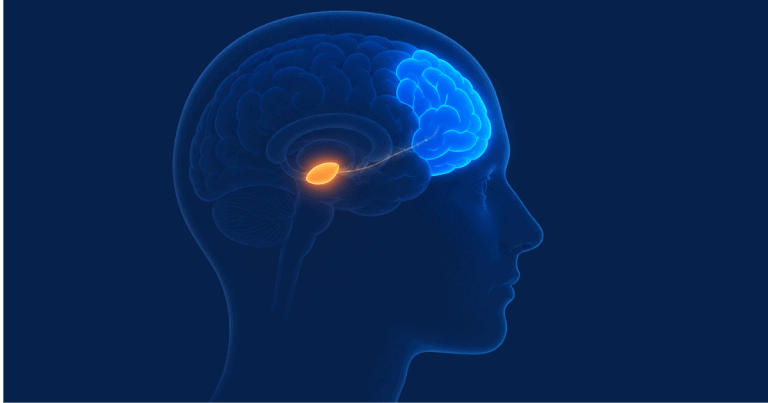
This connects to a deeper neurobiological point. The prefrontal cortex — the brain region responsible for the working memory, planning and top-down control that deep work depends on — is exquisitely sensitive to stress. In her review of stress signalling in the prefrontal cortex, neuroscientist Amy Arnsten documents how even mild, uncontrollable stress rapidly impairs prefrontal function. So the stress generated by a fragmented, interrupt-driven day doesn’t just feel bad — it directly degrades the very machinery you need for deep cognitive work. Fragmentation and stress form a loop: interruptions raise stress, stress weakens the prefrontal cortex, and a weakened prefrontal cortex makes you more susceptible to the next distraction.
The multitasking myth
If attention residue is the cost, multitasking is the trap that generates it constantly. The uncomfortable reality, as the Cleveland Clinic summarises through the work of neuropsychologist Cynthia Kubu, is that the human brain is fundamentally a monotasker. When you believe you’re doing two demanding things at once, you’re really performing rapid task-switching — and paying the residue tax on every switch. One frequently cited estimate suggests only around 2.5% of people (sometimes called “supertaskers”) can genuinely multitask without a performance cost; for everyone else, “multitasking” is just self-imposed fragmentation with a flattering name.
The problem isn’t only external interruptions. A striking amount of fragmentation is internally generated — the mind simply wanders off. In a landmark Science study using a smartphone sampling app, Matthew Killingsworth and Daniel Gilbert found that people spend 46.9% of their waking hours thinking about something other than what they’re doing. As the the Harvard team noted, this mind-wandering not only fragments attention but tends to make people less happy. Deep work, then, is partly a practice of training the mind to stay put — and partly a matter of designing conditions that make wandering less likely. For readers who find sustained attention especially hard, our guide to ADHD and focus problems goes deeper into attention regulation.
How to protect deep work in practice
Everything above points to the same conclusion: the leverage is structural, not motivational. You don’t win at deep work by wanting focus more badly. You win by engineering conditions in which switching simply doesn’t happen. Three principles do most of the heavy lifting.
First, single-task by default. Not as an aspiration but as a rule with a physical setup behind it. One task, one screen, phone out of the room — not face-down on the desk, out of the room. The mere visible presence of a phone measurably taxes attention. This single change does more than any app or technique.
Second, batch and schedule interruptions rather than absorbing them as they arrive. Email and messages are not a live feed to be monitored; they’re a queue to be processed at set times. Every notification you disable is an act of protecting the prefrontal cortex from an unnecessary switch. Much of the damage comes from digital sources specifically, which I cover in detail in digital distraction and the brain.
Third, work in protected blocks aligned to your natural rhythm. Your brain doesn’t sustain peak concentration indefinitely; it tends to operate in roughly 90-minute cycles. Rather than re-explain the mechanics here, I’ll point you to the full ultradian and caffeine-timing protocols in the Focus & Productivity hub. The key deep-work principle is simply this: schedule your most demanding cognitive work into a protected block early, before the day’s interruptions accumulate. I do mine first thing after waking, which is also why a solid morning routine matters so much for deep-work output.
The one supplement lever worth knowing
Let me be clear about proportion: deep work is roughly 95% behaviour and environment. Supplements are a minor lever, and anyone selling you focus in a capsule is overselling. That said, there is one genuinely well-evidenced pharmacological aid worth knowing about — the combination of L-theanine and caffeine. A randomised trial by Owen and colleagues (2008) found that 50 mg caffeine with 100 mg L-theanine improved both speed and accuracy on an attention-switching task and reduced susceptibility to distraction, with further support from Haskell and colleagues (2008). The L-theanine takes the edge off caffeine’s jitter, giving you calm, sustained alertness rather than a spike-and-crash. I use it before demanding sessions — but I treat the full protocol as hub material, covered in our L-theanine and caffeine stack guide. Sourcing notes are below.
One defended morning, start to finish
Abstract principles are easy to nod along to and hard to apply, so here’s the whole thing in motion — a single demanding task (say, writing a strategy document) defended across one morning.
The night before, you decide the single output — “first draft of section one” — and write it down. Deciding in advance removes the start-of-session dithering where attention leaks before you’ve even begun.
At the start, the phone goes in another room, not face-down on the desk. One document open, everything else closed, notifications off system-wide. If you use the L-theanine + caffeine option, you took it 30–40 minutes earlier so it’s active now.
During the block, you work for 75 minutes on that one task. When a thought arrives — “I should reply to that message,” “did I book the dentist” — you write it on a capture pad beside you and immediately return. You do not act on it. Each captured thought is an interruption prevented, and the residue it would have left never forms.
At the break, you take a real 15 minutes — stand, move, look out a window, hydrate — rather than “resting” by scrolling, which just starts a new residue-generating task. The point of the break is to clear residue, not create more.
Only afterwards — perhaps after a second block — do you open email and work through the capture pad in one batched pass. Notice what this morning never contained: a single mid-task switch. That absence, not any heroic act of willpower, is the entire mechanism. The output arrives because nothing was allowed to interrupt it.
Evidence hierarchy: what actually protects deep focus
Ranked by strength of evidence, from best-supported to most preliminary. Honest grading — I don’t inflate levels.
The NeuroEdge Protocol
The NeuroEdge Deep Work Protocol
Phase 1 — Set the stage
Phone out of the room. One task, one screen, notifications off. Decide the single output before you start. Optional: L-theanine + caffeine (100 mg / 50 mg) 30–45 min prior.
Phase 2 — The block
A single 60–90 minute block on one demanding task. When an intrusive thought arrives, write it on a capture pad and return — don’t act on it. No switching, no exceptions.
Phase 3 — Clear the residue
A complete 10–15 min break: stand, move, look at distance, hydrate, fully disengage. This clears attention residue before the next block rather than carrying it forward.
Phase 4 — Batch the rest
Only after the deep block: process email and messages in one batched pass. Shallow work is scheduled, not continuous. Protect the morning block above all else.

Peter’s Testing Notes
First-person, n=1 — reported honestly
The single change that transformed my deep work wasn’t a supplement or an app — it was moving my phone to a different room. For years I kept it face-down on the desk and told myself that was enough. It wasn’t. When I started leaving it in the kitchen during morning blocks, my subjective sense of “sinking in” arrived faster and my attention felt steadier across the week. That’s an n=1 observation, not a controlled trial, and I hold it loosely — but the effect was large enough that I’ve never gone back.
On the L-theanine and caffeine stack: I take it before my hardest morning session some days, not daily — I don’t want tolerance blunting the effect, and I protect my sleep by keeping all caffeine well before midday. The honest limitation: on days I’m under-slept, no stack rescues deep work. Poor recovery beats every focus intervention I’ve tested, every time. That’s the least marketable finding in cognitive enhancement and the truest.
Currently I run two protected blocks of a little over an hour each before midday, phone elsewhere, capture pad beside me. Everything shallow waits until after. It is not glamorous and it is not complicated — and it has outperformed every clever productivity system I’ve trialled in 18 years.
Sourcing standards
Supplements are the minor lever here, but if you want the one evidence-backed option, quality and dose transparency matter. These are the two pre-formulated products I’ve personally used and can vouch for. Neither is necessary for deep work — behaviour and environment do the real work — but both save you measuring and capsuling raw powders.
Performance Lab Caffeine 2
A pre-balanced caffeine + L-theanine + tyrosine capsule — the same pairing from the Owen and Haskell trials, without measuring powders. This is the one I reach for before demanding morning blocks.
Mind Lab Pro
A broader daily nootropic (including L-theanine) for those who prefer one stack rather than single ingredients. Caffeine-free, so it pairs with your own coffee if you’d rather control caffeine separately.
Key takeaways
| → | Deep work is protected single-tasking, not a willpower feat. The lever is structural — engineer conditions where switching can’t happen. |
| → | Attention residue (Leroy, 2009) is the core cost of every switch — a “quick” interruption degrades the work that follows it, not just the moment. |
| → | The famous “23 minutes to refocus” figure isn’t in the peer-reviewed paper. The real finding: interrupted work is done faster but at a hidden cost in stress and effort. |
| → | The brain is a monotasker; minds wander ~47% of waking hours. Phone in another room does more than any technique. |
| → | Supplements are a minor lever. L-theanine + caffeine has real RCT support, but no stack rescues deep work on an under-slept day. |
Frequently asked questions
How long should a deep work session be?
Most people do best with blocks of 60 to 90 minutes, followed by a genuine 10–15 minute break. Beginners often start at 45–50 minutes and extend as their concentration capacity builds. The number that matters isn’t the maximum length but the absence of switching within the block — a protected 50-minute block beats a distracted three-hour one. Quality of attention, not duration, is what defines deep work.
Is the “23 minutes to refocus after an interruption” claim true?
Not as usually stated. That precise figure traces to a 2006 interview, not a peer-reviewed results section, and it’s been repeated across the internet without verification. The published research by Gloria Mark and colleagues (2008) found that interrupted people completed tasks slightly faster — but by working harder and experiencing significantly more stress and frustration. The genuine cost of interruption is a hidden tax in cognitive load and strain rather than a fixed block of lost minutes, which is arguably more concerning because it’s invisible.
Do I need supplements to do deep work?
No. Deep work is roughly 95% behaviour and environment — single-tasking, removing your phone, batching interruptions and scheduling protected blocks. Supplements are a minor supporting lever at most. The one combination with solid randomised-trial evidence for focus is L-theanine and caffeine, which improves attention-switching and reduces distraction (Owen et al., 2008). But it’s an enhancer of an already-good setup, not a fix for a fragmented one. If you’re under-slept, address sleep first — nothing else compensates for it.
What’s the difference between deep work and flow state?
Deep work is the deliberate practice of sustained, single-task concentration — something you can do even when it feels effortful. Flow is a specific subjective state of effortless absorption that sometimes emerges during deep work but isn’t guaranteed and can’t be forced directly. Think of deep work as the discipline you control and flow as the occasional reward that shows up more often once you’ve removed interruptions. You aim for deep work; flow arrives on its own terms.
Why can’t I focus even when I remove distractions?
Because a large share of fragmentation is internally generated. Research found people’s minds wander during nearly half of waking hours (Killingsworth & Gilbert, 2010), independent of external interruptions. Removing your phone handles external distraction; internal distraction needs a different tool — a capture pad to offload intrusive thoughts so you can return to the task, plus practice at gently redirecting attention. Underlying stress and poor sleep also make wandering far more likely, since both impair the prefrontal control systems that hold focus in place.
7 Days to a Sharper Brain
Peter Benson’s personal daily protocol, rebuilt from 18 years of testing
Seven evidence-based interventions, in the exact order that makes each one more effective — from sleep foundation to neuroplasticity and Lion’s Mane.
Join 2,000+ readers optimising their cognitive performance. Unsubscribe anytime.
Scientific references
1. Leroy, S. (2009). Why is it so hard to do my work? The challenge of attention residue when switching between work tasks. Organizational Behavior and Human Decision Processes, 109(2), 168–181. Link
2. Mark, G., Gudith, D., & Klocke, U. (2008). The cost of interrupted work: More speed and stress. Proceedings of the SIGCHI Conference on Human Factors in Computing Systems, 107–110. Link
3. Killingsworth, M. A., & Gilbert, D. T. (2010). A wandering mind is an unhappy mind. Science, 330(6006), 932. Link
4. Arnsten, A. F. T. (2009). Stress signalling pathways that impair prefrontal cortex structure and function. Nature Reviews Neuroscience, 10(6), 410–422. Link
5. Owen, G. N., Parnell, H., De Bruin, E. A., & Rycroft, J. A. (2008). The combined effects of L-theanine and caffeine on cognitive performance and mood. Nutritional Neuroscience, 11(4), 193–198. Link
6. Haskell, C. F., Kennedy, D. O., Milne, A. L., Wesnes, K. A., & Scholey, A. B. (2008). The effects of L-theanine, caffeine and their combination on cognition and mood. Biological Psychology, 77(2), 113–122. Link
7. Cleveland Clinic. (2021). Why multitasking doesn’t work. Cleveland Clinic Health Essentials. Link
8. Harvard Gazette. (2010). Wandering mind not a happy mind. Link
Peter Benson
Cognitive Enhancement Researcher | 18+ Years Independent Research
Peter has personally tested the protocols in this guide over 18+ years of systematic self-experimentation, tracking sleep, HRV and cognitive performance data as part of his ongoing research practice. NeuroEdge Formula is his platform for sharing rigorous, safety-first cognitive enhancement guidance.
Last reviewed: July 2026