
How to Prevent Cognitive Decline: The Evidence-Based Protocol
Medical Disclaimer: This guide is for educational purposes only and does not constitute medical advice. Cognitive decline and dementia are serious medical conditions requiring professional evaluation and management. If you or someone you know is experiencing significant cognitive changes, consult a qualified healthcare provider promptly. The strategies described here are preventive lifestyle interventions, not treatments for diagnosed cognitive impairment or dementia. Peter Benson is a cognitive enhancement researcher, not a medical doctor.
| What drives cognitive decline | Four main mechanisms: (1) amyloid and tau accumulation disrupting synaptic signalling — the Alzheimer’s pathway; (2) neuroinflammation accelerating synaptic loss; (3) vascular damage reducing brain blood flow; (4) depletion of cognitive (synaptic) reserve below the threshold needed to compensate for normal age-related loss. Each responds to different interventions. |
| How much is modifiable | A large share of risk is within your control. The 2020 Lancet Commission estimated that addressing 12 modifiable risk factors could prevent or delay about 40% of dementia cases; its 2024 update raised this to 14 factors and up to 45%. Genetics matters — APOE-ε4 is the main common risk gene — but the exercise, diet and sleep evidence applies across genotypes. |
| Highest-evidence intervention | Aerobic exercise — it touches all four mechanisms (BDNF and hippocampal volume, anti-inflammatory signalling, vascular protection, reserve-building) and has the most consistent and mechanistically diverse evidence of any single lever (Erickson et al. 2011). |
| Sleep’s role in prevention | Deep (slow-wave) sleep is when the brain’s clearance of amyloid-β is thought to ramp up. Experimentally, one night of total sleep deprivation raised CSF amyloid-β in healthy adults (Ooms et al. 2014) — a direct link between poor sleep and amyloid, beyond sleep’s role in memory. |
| The cognitive reserve idea | Cognitive reserve is the brain’s accumulated buffer — the synaptic density and network efficiency that lets it tolerate more pathology before symptoms appear. It is built through education, cognitive challenge, social engagement and skill learning across life. The earlier it is built, the larger the buffer later. |
| When to start | Now. Amyloid accumulation begins roughly 15–20 years before symptoms; vascular risk factors do their damage silently over decades. The best-evidenced levers — exercise, Mediterranean/MIND diet, sleep, cognitive challenge — pay off most when begun in midlife, not in response to symptoms. |
How to Prevent Cognitive Decline: What the Evidence Actually Shows
By Peter Benson, Cognitive Enhancement Researcher | 18+ Years Independent Research · Last Updated: August 2026
The question of how to prevent cognitive decline has a more useful answer than it did a decade ago. Evidence from longitudinal studies, prospective cohorts and intervention trials increasingly shows that the rate of cognitive ageing is substantially modifiable — and, more importantly, the mechanisms are now understood well enough to match interventions to biological targets: aerobic exercise for BDNF and hippocampal volume, sleep quality for amyloid clearance, a Mediterranean or MIND dietary pattern for neuroinflammation, and sustained cognitive challenge for reserve. Generic advice to “keep your brain active” is no longer the ceiling; the evidence supports more specific, mechanism-matched choices.
Two caveats upfront. This guide covers prevention for cognitively healthy people, not treatment for diagnosed impairment or dementia — if you or someone you know is experiencing significant cognitive changes affecting daily function, professional evaluation is the first step, not lifestyle optimisation. And no lever here is a guarantee: the honest claim is meaningful risk reduction, not elimination. For the wider framework, see the Brain Health & Longevity hub.
The Four Mechanisms — What Actually Drives Cognitive Decline
Amyloid and Tau Accumulation
Alzheimer’s disease — the most common cause of dementia — is characterised by amyloid-beta plaques outside neurons and tau tangles inside them, disrupting synaptic signalling and eventually causing neuronal death. This accumulation begins roughly 15–20 years before symptoms, which is why prevention has to start long before any change is noticeable. During deep, slow-wave sleep the brain’s clearance of amyloid-β is thought to increase — the leading (though still-debated) explanation is the glymphatic system. The empirical hook is direct: Ooms and colleagues (2014) found that a single night of total sleep deprivation raised CSF amyloid-β in healthy middle-aged men, and selectively disrupting slow-wave sleep does the same (Ju et al. 2017). The prevention takeaway for this mechanism: protect deep-sleep quality throughout midlife — the Sleep & Recovery guide covers the how.
Neuroinflammation
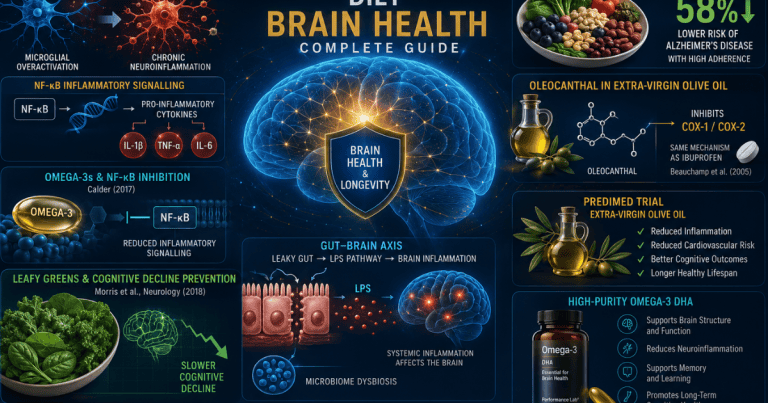
Chronic low-grade neuroinflammation — driven by microglial overactivation and elevated pro-inflammatory signalling in the brain — accelerates synaptic pruning, impairs neurogenesis and creates an environment hostile to learning and memory. The same inflammatory pathways implicated in cardiovascular disease and type 2 diabetes increasingly appear to contribute to cognitive decline. That overlap is why an anti-inflammatory dietary pattern shows up in cognitive-ageing research, why omega-3 DHA keeps appearing in the conversation, and why the gut-brain axis matters here too. Primary levers: Mediterranean/MIND diet, adequate DHA, exercise (anti-inflammatory beyond its BDNF effect), and sleep.
Vascular Damage
Vascular dementia is the second most common type, and vascular pathology contributes to a large share of Alzheimer’s cases — mixed Alzheimer’s-vascular dementia is the most common pattern of all. Hypertension, diabetes, dyslipidaemia, smoking and sedentary behaviour damage cerebral blood vessels, reducing blood flow and causing white-matter lesions that fray cognitive connectivity. The SPRINT MIND trial — a large RCT — found that intensive blood-pressure control in hypertensive older adults significantly reduced the risk of mild cognitive impairment (the trial’s primary dementia endpoint did not reach significance on its own, likely because it was stopped early). Aerobic exercise, Mediterranean diet and metabolic-health management are the primary levers here — and they overlap almost entirely with cardiovascular prevention.
Cognitive (Synaptic) Reserve Depletion
Cognitive reserve is the accumulated buffer of synaptic density and network efficiency that determines how much neuronal loss can be sustained before symptoms appear. Higher-reserve brains compensate for greater pathology before impairment becomes clinically obvious. Reserve is built by activities that drive synaptogenesis and neuroplasticity: aerobic exercise (BDNF → hippocampal neurogenesis), learning genuinely difficult new skills, formal education, and sustained social engagement. The 2020 Lancet Commission identified 12 modifiable risk factors accounting for about 40% of dementia cases — its 2024 update raised this to 14 factors and up to 45% — and each maps onto one or more of these four mechanisms. Among the most impactful: education (reserve), hypertension (vascular), physical inactivity (BDNF), hearing loss and social isolation (engagement).
Cognitive Decline Prevention — Evidence Ranked
🟢 Strong | 🟡 Moderate / observational | 🔴 Not supported
| Intervention | Evidence | Primary mechanism targeted |
|---|---|---|
| Aerobic exercise (≈150 min/week) | 🟢 Strongest available | All four: BDNF → hippocampal volume; anti-inflammatory; vascular; reserve via neurogenesis |
| Sleep quality (protect deep sleep) | 🟢 RCT: sleep loss raises amyloid | Amyloid clearance during deep sleep; one night’s total sleep loss raised CSF amyloid (Ooms 2014) |
| Mediterranean / MIND diet | 🟢 Prospective cohorts | Neuroinflammation reduction; vascular protection; DHA for membrane integrity (Morris 2015) |
| Blood-pressure control | 🟢 SPRINT MIND RCT (MCI) | Vascular — intensive BP control cut MCI risk in hypertensive older adults |
| Cognitive challenge / new-skill learning | 🟡 Observational (reserve) | Reserve-building; strongest for lifelong education, weaker for mid/late-life skill uptake |
| DHA omega-3 (≈1–2g/day) | 🟡 Mixed clinical evidence | Neuroinflammation; membrane integrity; benefit clearest with low baseline intake |
| Social engagement | 🟡 Lancet Commission factor | Reserve maintenance; depression prevention (itself a risk factor) |
| Brain-training games (Lumosity etc.) | 🔴 Commonly claimed, not shown | Improves the trained task only; no generalised reserve or dementia-prevention evidence |
Illustrative example, not a real individual or testimonial. A method-only composite for explanation. It is not a prescription and does not represent guaranteed or typical results — individual circumstances vary, and anyone with a health condition should speak to a doctor first.
The most useful thing about the four-mechanism map is that a handful of habits each hit more than one target — so a sensible week is not four separate programmes, it is four or five overlapping habits. Picture a cognitively healthy person in midlife building one.
Exercise anchors it. Three or four aerobic sessions at a “can hold a conversation but working” intensity, plus two short strength sessions, cover BDNF, vascular health, anti-inflammatory signalling and reserve-building in a single habit — which is why exercise dominates the evidence. Sleep is protected, not negotiated: a consistent schedule and a wind-down that reliably delivers deep sleep, because that is when amyloid clearance is thought to ramp up. Meals follow a Mediterranean/MIND pattern most days — oily fish, olive oil, plants, legumes — hitting the inflammatory and vascular mechanisms together. And one genuinely demanding new skill — a language, an instrument — practised a few times a week, chosen because difficulty, not novelty alone, seems to drive the reserve effect.
Notice what is not in the week: no device is essential, and no supplement is doing the heavy lifting. The highest-evidence levers are behavioural, mostly free, and — because amyloid and vascular damage accumulate silently for decades — most valuable when begun long before any symptom would appear.
The NeuroEdge Cognitive Longevity Protocol
Mechanism-matched preventive levers targeting all four drivers of decline. These are preventive strategies for cognitively healthy individuals, not treatments for impairment. Updated August 2026.
150+ min/week aerobic, plus 2 strength sessions. The most evidence-supported lever — BDNF, hippocampal neurogenesis, anti-inflammatory signalling, vascular protection, reserve. Non-negotiable regardless of everything else. Erickson et al. (2011): about +2% hippocampal volume over a year of walking.
7.5–8 hours; protect deep sleep. Consistent schedule, cool dark room, no late alcohol. Magnesium glycinate and glycine are commonly used to support sleep quality. Because deep-sleep amyloid clearance is a plausible Alzheimer’s-prevention pathway, sleep is a direct brain-health strategy, not just general wellness.
Mediterranean/MIND pattern; adequate DHA. Oily fish, olive oil, vegetables, legumes, minimal ultra-processed food. If dietary DHA is low, a quality fish-oil or algal-DHA source can help close the gap. One dietary pattern covers both the inflammatory and vascular mechanisms.
Learn a demanding new skill; stay socially engaged. The harder and more sustained the challenge, the more it appears to build. Language and instrument learning are the most-studied reserve activities; social isolation is itself a Lancet Commission risk factor.
Peter’s Testing Notes — Cognitive Decline Prevention
First-person, n=1 — impressions and framing, not measurements · Updated August 2026
Prevention is a different game from performance. When I work on attention, working memory or processing speed, I’m optimising what’s measurable today. Prevention is an investment whose return won’t be visible for 20 or 30 years — so I’m less interested in acute effects and more interested in whether something is plausibly building long-term structural capital: synaptic density, hippocampal volume, vascular health, amyloid clearance. Exercise and sleep dominate that evaluation because their structural benefits are the most robustly documented, and because they cost nothing.
I treat a demanding new skill as a deliberate cognitive-reserve investment — the reserve rationale for sustained, genuinely difficult learning is one of the better-established ideas in this area, even if the “start a language at 50 and delay dementia” version is observational and debated. I also keep a periodic cognitive baseline, less because I expect decline at my age than because a personal baseline is the only way to notice a change in trajectory early enough to act on it.
On supplements in a prevention context, I’ll be blunt: the direct evidence for any supplement preventing dementia is limited, so I weight them as minor, mechanistically-justified support rather than primary strategy. Magnesium glycinate is part of my own routine for sleep quality — which, given the amyloid-clearance link, I think of as a sleep investment as much as anything. Exercise and sleep are the primary strategies; everything else is a rounding error by comparison. (These notes are direction-only pending my own logged specifics.)
Key Takeaways — How to Prevent Cognitive Decline
| ✓ | A large share of dementia risk is modifiable. The 2020 Lancet Commission estimated ~40% of cases could be prevented or delayed by addressing 12 risk factors (14 factors / up to 45% in the 2024 update). Genetics matters, but exercise, Mediterranean diet and sleep quality help across genotypes, including APOE-ε4 carriers. |
| ✓ | Sleep is a plausible direct Alzheimer’s-prevention lever. Deep-sleep amyloid clearance is the leading (if debated) mechanism; one night of total sleep deprivation raised CSF amyloid-β in healthy adults (Ooms 2014). Chronic poor sleep is a risk factor, not just a wellness footnote. |
| ✓ | Aerobic exercise is the strongest single lever. It addresses all four mechanisms — amyloid, inflammation, vascular, reserve — with the most consistent evidence of anything available, though definitive long-term RCT proof of preventing dementia is still limited for every lever here, not just exercise. |
| ✓ | Start in midlife, not in response to symptoms. Amyloid accumulation begins ~15–20 years before symptoms; the return on exercise, diet, sleep and reserve-building is largest when begun in the 35–55 window. |
| ✓ | Real learning beats brain-training games. Commercial brain-training shows near-transfer only. Genuinely difficult, sustained skill acquisition is the better reserve-builder — and while observational work links bilingualism to a ~4-year-later symptom onset, that finding is debated and confounded, so treat it as suggestive, not settled. |
Cognitive Decline Prevention — FAQ
Can cognitive decline be prevented?
It can be meaningfully slowed and its onset delayed through modifiable lifestyle factors — but it cannot be guaranteed to be entirely prevented, particularly for people at high genetic risk. The 2020 Lancet Commission identified 12 modifiable risk factors accounting for about 40% of dementia cases (raised to 14 factors and up to 45% in the 2024 update): physical inactivity, hypertension, smoking, obesity, diabetes, hearing loss, depression, social isolation, excess alcohol, traumatic brain injury, air pollution, low education, and — added in 2024 — untreated vision loss and high LDL cholesterol. The honest distinction is meaningful risk reduction, not elimination.
What is the best thing you can do to prevent Alzheimer’s disease?
On current evidence, aerobic exercise and sleep quality have the strongest mechanistic and epidemiological support. Exercise raises BDNF, promotes hippocampal neurogenesis, lowers neuroinflammation and protects blood vessels. Deep sleep is when the brain’s amyloid clearance is thought to increase; a single night of total sleep deprivation raised CSF amyloid-β in one RCT. A Mediterranean or MIND diet adds anti-inflammatory and vascular protection. None eliminates genetic risk, but all reduce it — discuss family history and individual risk factors with your healthcare provider.
At what age does cognitive decline start?
Some aspects — processing speed, certain working-memory functions — begin a very gradual decline from the late 20s, but the change is so small at that stage that accumulating knowledge and experience more than compensate. More noticeable age-related changes tend to appear in the 50s and 60s. Alzheimer’s amyloid accumulation typically begins 15–20 years before symptoms, so for someone diagnosed at 70 the underlying process began around 50–55 — which is exactly why prevention investments at 35–50 are the highest-value window.
Does learning a language help prevent dementia?
Possibly — but the evidence is observational and genuinely debated, so it is worth being careful here. Some studies, starting with Bialystok and colleagues (2007), report that bilingual people show dementia symptoms around four years later than monolinguals with equivalent pathology, which would fit the cognitive-reserve idea. Others find the effect only in certain groups, or argue it is confounded by immigration status and education differences. What is on firmer ground is the general principle: sustained, genuinely difficult cognitive engagement — of which active language learning is one good example — builds reserve. Treat the specific “delays dementia by X years” figure as suggestive rather than settled.
Do brain-training games prevent cognitive decline?
Current evidence does not support it. Brain-training programmes (Lumosity, BrainHQ and similar) produce near-transfer effects — you get better at the trained task — without the generalised reserve-building or structural changes linked to dementia prevention. A 2014 consensus statement from a large group of cognitive scientists and neuroscientists concluded that broad cognitive-enhancement claims from these programmes significantly exceeded the evidence, and in 2016 the US Federal Trade Commission fined Lumosity’s maker for deceptive advertising. A brisk 30-minute walk has a stronger claim to neuroprotection than 30 minutes of brain-training. Novel, genuinely complex skill acquisition — a language, an instrument, learning to code — builds reserve in a way these apps do not.
Get “7 Days to a Sharper Brain” — Free
Peter Benson’s personal daily protocol, rebuilt from 18 years of testing
Seven evidence-based interventions, in the exact order that makes each one more effective — from sleep foundation to neuroplasticity and Lion’s Mane.
Join 2,000+ readers optimising their cognitive performance. Unsubscribe anytime.
Scientific References
- Erickson KI, et al. (2011). Exercise training increases size of hippocampus and improves memory. PNAS, 108(7):3017–3022. PMID 21208450
- Livingston G, et al. (2020). Dementia prevention, intervention, and care: 2020 report of the Lancet Commission. The Lancet, 396(10248):413–446. PMID 32738937
- Livingston G, et al. (2024). Dementia prevention, intervention, and care: 2024 report of the Lancet standing Commission. The Lancet. (14 risk factors; up to 45% of cases potentially preventable.) thelancet.com
- Ooms S, et al. (2014). Effect of 1 Night of Total Sleep Deprivation on Cerebrospinal Fluid β-Amyloid 42 in Healthy Middle-Aged Men: A Randomized Clinical Trial. JAMA Neurology, 71(8):971–977. PMID 24887018
- Ju YS, et al. (2017). Slow wave sleep disruption increases cerebrospinal fluid amyloid-β levels. Brain, 140(8):2104–2111. DOI: 10.1093/brain/awx148
- SPRINT MIND Investigators / Williamson JD, et al. (2019). Effect of Intensive vs Standard Blood Pressure Control on Probable Dementia. JAMA, 321(6):553–561. PMID 30688979
- Morris MC, et al. (2015). MIND diet associated with reduced incidence of Alzheimer’s disease. Alzheimer’s & Dementia, 11(9):1007–1014. PMID 25681666
- Bialystok E, Craik FIM, Freedman M. (2007). Bilingualism as a protection against the onset of symptoms of dementia. Neuropsychologia, 45(2):459–464. PMID 17125807
- Cotman CW, Berchtold NC. (2002). Exercise: a behavioural intervention to enhance brain health and plasticity. Trends in Neurosciences, 25(6):295–301. PMID 12086747
- Alzheimer’s Association. Alzheimer’s prevention and risk reduction. Alz.org

Peter Benson
Cognitive Enhancement Researcher | 18+ Years Independent Research
Peter has researched cognitive decline prevention for 18+ years, with a focus on the biological mechanisms driving decline and the lifestyle interventions that target each. The strategies here reflect the best available evidence as of August 2026 and inform his own longevity practice. He is not a clinician — this guide is educational, not medical advice.
Last reviewed: August 2026 | Educational content only. Not medical advice. Not a substitute for professional evaluation.