Gut Brain Connection
Educational information, not medical advice. This article summarises research on the gut-brain connection for general educational purposes. It is not a substitute for professional medical advice. Consult a qualified healthcare provider before changing your diet or starting any supplement, particularly if you have a gastrointestinal condition, take medication, or are pregnant.
| What it is | The gut-brain connection is a two-way signalling network linking your digestive tract, its resident microbes, and your brain through neural, immune, and metabolic channels. |
| Strongest human evidence | Diet reliably reshapes the microbiome within days, and a fermented-food diet raised microbial diversity and lowered inflammatory markers over 10 weeks (Wastyk et al., Cell 2021). |
| Key statistic | Around 90–95% of the body’s serotonin is produced in the gut by enterochromaffin cells — but it does not cross the blood-brain barrier. |
| Important caveat | The most dramatic findings — behaviour transferred between animals via microbiome transplant — come from rodent studies. Human cognitive data is early, and clusters in older adults. |
| Evidence standard | Human RCTs prioritised over animal studies; mechanistic claims separated from proven cognitive outcomes. |
| Biggest mistake | Buying a probiotic capsule and expecting sharper focus. The strongest lever is dietary fibre diversity and fermented foods, not a pill. |
The Gut-Brain Connection: What the Evidence Actually Says About Your Microbiome and Cognition
By Peter Benson, Cognitive Enhancement Researcher | 18+ Years Independent Research · Last Updated: August 2026
You have almost certainly seen the headline: your gut is your “second brain,” the bacteria in your intestines control your mood, and fixing your microbiome will fix your focus. It is one of the most over-sold ideas in cognitive health — and, frustratingly, one of the most genuinely interesting once you strip away the hype. The gut-brain connection is real, it is measurable, and it matters. But the version that sells supplements bears little resemblance to what the human research actually supports.
In more than 18 years of studying cognitive enhancement and tracking my own biology — 26-plus months of continuous Oura Ring data, regular Creyos cognitive testing, HRV logs — I have watched the gut-brain field swing from fringe to mainstream. What I want to do here is give you the honest version: what is well established, what is promising but unproven in humans, and what is still confined to mice. If you want the wider picture of how diet, inflammation and cognition interact, start with the Brain Health & Longevity guide, which sets the context for everything below.
What the Gut-Brain Connection Actually Is
Your digestive tract contains its own dense network of neurons — the enteric nervous system — which is why the Cleveland Clinic notes that more nerve cells sit in your gut than anywhere else in the body outside the brain. That is where the “second brain” nickname comes from. It is a useful label, but it oversells the point: the enteric nervous system manages digestion superbly and can operate without instruction from the head, yet it is not thinking, remembering or making decisions.
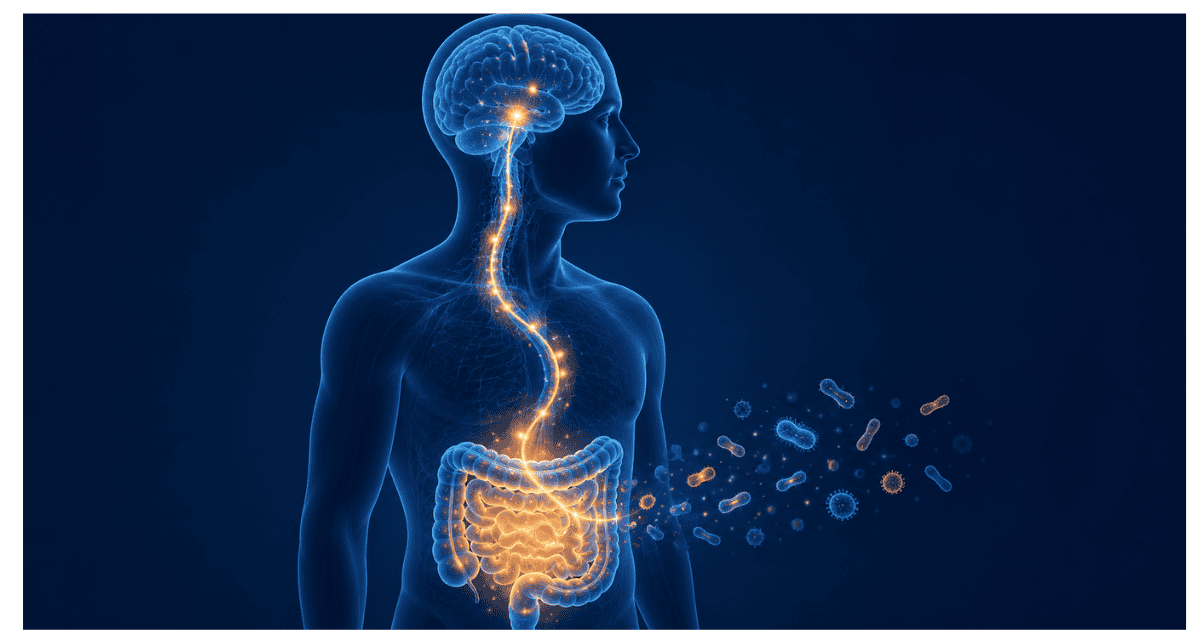
The more accurate picture is a communication system. Signals pass constantly in both directions between the gut, its microbial residents, and the central nervous system. According to the landmark review by Cryan and colleagues in Physiological Reviews, the microbiota and brain communicate through several parallel routes: the vagus nerve, the immune system, tryptophan and other amino-acid metabolism, and microbial metabolites such as short-chain fatty acids. When people talk about the “gut-brain axis,” this bundle of channels is what they mean. No single one of them is the master switch.
The Serotonin Claim, Corrected
You will read everywhere that “90% of your serotonin is made in your gut, so gut health is mood health.” The first half is true. Specialised intestinal cells called enterochromaffin cells produce the large majority of the body’s serotonin — between roughly 90% and 95% of it, according to reviews of peripheral-serotonin physiology. The second half is where the reasoning quietly falls apart.
Gut-derived serotonin does not cross the blood-brain barrier. It works locally — regulating gut motility, secretion and sensation — and participates in signalling, but it does not travel up to top up the serotonin in your brain. In fact the two pools are made by different enzymes and kept functionally separate. So the gut can influence mood and cognition, but not by shipping serotonin northward. It does so indirectly: by controlling how much tryptophan (serotonin’s precursor) reaches the brain, by stimulating vagal signalling, and by shaping systemic inflammation. This is the distinction that separates a citable, defensible claim from a viral oversimplification, and it is worth holding onto whenever you see the “happy chemical lives in your gut” line.
How Gut Microbes Actually Signal the Brain
Three routes carry the strongest mechanistic evidence. The first is the vagus nerve, the main physical cable between gut and brainstem, which relays information about the state of the gut — including signals shaped by microbial activity. The second is microbial metabolism: when gut bacteria ferment dietary fibre, they produce short-chain fatty acids such as butyrate, propionate and acetate. These influence the gut lining, immune signalling and the blood-brain barrier, and are one of the clearest reasons that what you feed your microbes matters more than which single strain you swallow.
The third route is immune and inflammatory. A disrupted or less diverse microbiome is associated with a more permeable gut lining and higher systemic inflammation, and chronic inflammation is one of the better-established contributors to cognitive decline. This is the mechanistic thread that connects gut health to long-term brain health, and it is why gut interventions overlap so heavily with the anti-inflammatory dietary patterns that show up repeatedly in cognitive-ageing research — and why omega-3 intake keeps appearing in the same conversations.
What the Human Evidence Actually Shows
Here is where honesty earns its keep. The most spectacular gut-brain results are from animals. In rodents, raising mice germ-free alters their behaviour and brain chemistry, and transplanting microbiota between animals can transfer behavioural traits along with the bacteria. These are genuine, replicated findings — proof of a causal gut-to-brain influence. But a mouse in a sterile isolator is not a person, and effects that size have never been demonstrated on human cognition.
In humans, the picture is real but more modest. On the mechanistic side it is strong: David and colleagues showed in Nature that diet reshapes the human gut microbiome within days, and a Stanford randomised trial by Wastyk and colleagues in Cell found that a fermented-food diet increased microbial diversity and lowered a broad panel of inflammatory markers over 10 weeks. Notably, a high-fibre diet alone did not raise diversity over that short window — a reminder that these systems move slowly.
When you move from “does it change the microbiome” to “does it improve cognition,” the strongest human signals cluster in older adults. A 12-week RCT in community-dwelling elders by Kim and colleagues found that a two-strain Bifidobacterium probiotic improved a measure of mental flexibility and reduced stress relative to placebo. And the well-designed PROMOTe trial in identical twins aged 60 and over found that a cheap daily prebiotic improved a composite cognitive score over placebo across 12 weeks — even though it did nothing for the study’s main muscle-strength outcome. Two caveats keep this honest: that cognitive result was a secondary outcome rather than the trial’s primary target, and both studies were in older adults. A systematic review of probiotic trials is more cautious about healthy younger adults, where the evidence for sharper everyday focus is thin. My honest read: gut interventions are a plausible, low-risk support for long-term brain health — genuinely encouraging in older adults — but not a proven acute cognitive enhancer for a healthy 30-year-old chasing focus.
| Intervention | Evidence level | What it does |
|---|---|---|
| Fermented foods (yogurt, kefir, kimchi) | 🟢 Human RCT | Raised microbial diversity, lowered inflammation over 10 weeks (Wastyk 2021) |
| Dietary fibre diversity (many plants) | 🟡 Moderate | Feeds short-chain-fatty-acid-producing microbes; benefits accrue over weeks to months |
| Pro-/prebiotics for cognition | 🟡 Growing (older adults) | Cognitive/mood benefit in adults 60+ (Kim 2021; PROMOTe 2024, secondary outcome); unproven in healthy young adults |
| Anti-inflammatory / Mediterranean diet | 🟡 Moderate | Lowers inflammation, supports diversity; tied to slower cognitive ageing |
| Germ-free / microbiome-transplant effects | 🔴 Rodent only — not shown in humans | Causal gut→brain proof, but this effect size has never been demonstrated in people |
What Actually Moves the Needle
Strip the field down to what is both well-supported and worth your effort, and it collapses into a short, unglamorous list: eat a wide variety of plants, include live-culture fermented foods, protect the microbes you have, and support the whole axis with sleep, movement and stress management. Diversity of fibre — the sheer number of different plant foods you eat across a week — is a better predictor of a healthy microbiome than any single “superfood.” Fermented foods appear to earn their reputation, and unlike most gut advice, that claim rests on a randomised human trial rather than a mouse.
Equally important is what you stop doing: minimising unnecessary antibiotics, going easy on ultra-processed foods and excess alcohol, and not expecting a single capsule to substitute for the diet underneath it. And because serotonin, melatonin and circadian rhythm are all entangled with gut function, sleep is not a separate topic — the same tryptophan pathway that feeds gut serotonin also feeds melatonin, which is one reason gut and sleep health track together. If sleep is your weak link, the Sleep & Recovery guide and the compounds covered in the guide to supplements for sleep are a more reliable lever than any probiotic. For the longer game, gut care sits alongside the other habits in preventing long-term cognitive decline.
Illustrative example, not a real individual or testimonial. A composite for explanation only. It does not represent guaranteed or typical results — individual responses vary, and anyone with a gut condition should speak to a doctor before overhauling their diet.
Say someone wants to put the two best-supported levers — plant diversity and fermented foods — into practice without turning eating into a spreadsheet. The trick is to count types, not portions, across the week. A mixed-bean chilli already banks four or five plants in one pot; a handful of mixed nuts and seeds on morning yogurt adds several more; a stir-fry with five vegetables and a couple of herbs quietly clears a dozen.
For the fermented side, they anchor it to meals they already eat: kefir or live yogurt at breakfast, a forkful of sauerkraut or kimchi alongside lunch, and miso in an evening soup a few nights a week. Crucially, they build up gradually — jumping straight to several servings a day is the fast route to a week of bloating — and they read labels for “live” or “raw,” since most supermarket sauerkraut is pasteurised and biologically inert.
The point of the example is the mechanism, not a number to hit: variety feeds a wider range of microbes, and live cultures are the one intervention with a randomised human trial behind them. What this does not promise is a sharper afternoon by Friday. The payoff here is a slow, compounding health habit — judged over months, not days.
The NeuroEdge Gut-First Cognitive Protocol
Aim for 25–30 different plant foods across the week — vegetables, fruit, legumes, nuts, seeds, whole grains, herbs. Variety, not volume, is the target. This is the single highest-leverage habit here.
Include a couple of servings a day of live-culture fermented foods: plain yogurt, kefir, kimchi, sauerkraut, miso or kombucha. This is the intervention that raised diversity and lowered inflammation in the Wastyk trial. Introduce gradually.
Reduce ultra-processed foods and excess alcohol, avoid unnecessary antibiotics, and add polyphenol-rich items (berries, cocoa, green tea, extra-virgin olive oil) that support beneficial microbes.
Prioritise sleep and daily movement, and use slow breathing to support vagal tone. The gut-brain axis is a system — sleep, stress and exercise all feed back into it, and none of them costs anything.
Peter’s Testing Notes
I ran a deliberate gut-focused block for roughly three months, and I want to be precise about what I can and cannot claim from it, because this is a textbook case of confounded n=1 testing. I moved from occasional fermented foods to a daily habit — kefir at breakfast, a portion of kimchi or sauerkraut most days — and pushed my weekly plant variety from a lazy dozen or so up past 30. I tracked throughout with my Oura Ring and ran Creyos tests roughly fortnightly.
What improved clearly was subjective: digestion settled, and by about week three the mid-afternoon heaviness after lunch largely disappeared. My Oura data showed a modest but real improvement in sleep consistency over the period. What I cannot honestly claim is a cognitive effect. My Creyos scores across the block were flat — no signal in working memory or processing speed I would attribute to the gut work rather than noise. And the honest confounder is obvious: eating 30 plants a week and more fermented food also means eating better overall, sleeping in a more regular pattern, and drinking less. I cannot separate “microbiome” from “I simply lived more healthily.” My working conclusion, four months in and continuing, is that this is a worthwhile long-game health habit with a genuine subjective payoff — and that anyone promising you sharper focus from a probiotic in a fortnight is selling something the evidence does not support.
Key Takeaways
| • | The gut-brain connection is a genuine two-way signalling system, but it is a communication network — not a hidden control centre for your mind. |
| • | Most of the body’s serotonin is made in the gut, but it does not cross into the brain — the “gut makes your happy chemical” claim is misleading. |
| • | The most dramatic behavioural findings are from rodents; human cognitive benefits so far cluster in older adults, not healthy young ones. |
| • | Fibre diversity and fermented foods are the best-supported, lowest-risk levers — a probiotic capsule is not a shortcut around diet. |
| • | Treat gut care as a long-game brain-health habit, not an acute focus enhancer. |
Frequently Asked Questions
Does the gut really affect the brain?
Yes, but through signalling rather than direct control. The gut and brain communicate constantly via the vagus nerve, the immune system, and microbial metabolites such as short-chain fatty acids. Animal studies show this influence can be powerful — germ-free mice behave differently, and behaviour can transfer with a microbiome transplant. In humans the effects are real but far smaller and less consistent. The gut is one meaningful input into brain health, not the master switch it is often portrayed as.
Is 90% of serotonin really made in the gut, and does that control my mood?
Roughly 90–95% of the body’s serotonin is indeed produced in the gut by enterochromaffin cells. But that serotonin does not cross the blood-brain barrier, so it does not directly supply the serotonin your brain uses for mood. Gut function can still influence mood indirectly — by affecting how much tryptophan reaches the brain, by vagal signalling, and by shaping inflammation — but the popular claim that your gut “makes your happy chemical” oversimplifies the biology.
Do probiotics improve memory or focus?
The evidence is modest and concentrated in older adults. One 12-week trial in elders found a two-strain probiotic improved mental flexibility and reduced stress, and the 2024 PROMOTe trial found a cheap prebiotic improved a composite cognitive score in twins over 60 — though that cognitive gain was a secondary outcome, and the same trial found no muscle benefit. In healthy younger adults chasing sharper focus, the evidence is much thinner. Probiotics are low-risk and may support gut health, but treating them as a reliable cognitive enhancer goes beyond what the research currently shows.
What is the single best thing to do for gut-brain health?
Increase the variety of plants you eat across the week. The diversity of your dietary fibre is a better predictor of a healthy, resilient microbiome than any single food or supplement, because different microbes thrive on different fibres. Adding live-culture fermented foods is the strong second step — it is the one intervention shown in a randomised human trial to raise microbial diversity and lower inflammation. Both cost far less than a shelf of probiotic capsules and rest on better evidence.
How long before gut changes affect the brain?
Diet can shift the composition of your gut microbiome within a few days, but that is not the same as a measurable brain benefit. In human trials, meaningful changes in microbial diversity and inflammation typically took weeks to months of consistent eating, and cognitive outcomes — where they appear at all — were measured over 12 weeks or longer. Set your expectations accordingly: this is a slow, compounding health habit, not something that pays off in a weekend.
Get “7 Days to a Sharper Brain” — Free
Peter Benson’s personal daily protocol, rebuilt from 18 years of testing
Seven evidence-based interventions, in the exact order that makes each one more effective — from sleep foundation to neuroplasticity and Lion’s Mane.
Join 2,000+ readers optimising their cognitive performance. Unsubscribe anytime.

Peter has personally tested the habits in this guide over 18+ years of systematic self-experimentation, tracking sleep, HRV and cognitive performance data as part of his ongoing research practice. Last reviewed: August 2026.
Scientific References
- Cryan JF, et al. The Microbiota-Gut-Brain Axis. Physiological Reviews. 2019;99(4):1877–2013. journals.physiology.org
- Kim CS, et al. Probiotic Supplementation Improves Cognitive Function and Mood with Changes in Gut Microbiota in Community-Dwelling Older Adults. J Gerontol A Biol Sci Med Sci. 2021;76(1):32–40. PMID: 32300799
- Wastyk HC, et al. Gut-microbiota-targeted diets modulate human immune status. Cell. 2021;184(16):4137–4153. PMID: 34256014
- David LA, et al. Diet rapidly and reproducibly alters the human gut microbiome. Nature. 2014;505(7484):559–563. PMID: 24336217
- Ni Lochlainn M, et al. Effect of gut microbiome modulation on muscle function and cognition: the PROMOTe randomised controlled trial. Nat Commun. 2024;15:1859. nature.com
- The Diverse Metabolic Roles of Peripheral Serotonin. Endocrinology. 2017;158(5):1049. (Review — enterochromaffin cells produce ~90–95% of body serotonin; peripheral serotonin does not cross the blood-brain barrier.) academic.oup.com
- Probiotic supplementation and cognitive function in older adults: a systematic review. Neurological Sciences. 2022. DOI: 10.1007/s10072-022-06540-8. Springer
- Cleveland Clinic. What To Know About the Gut-Brain Connection. my.clevelandclinic.org