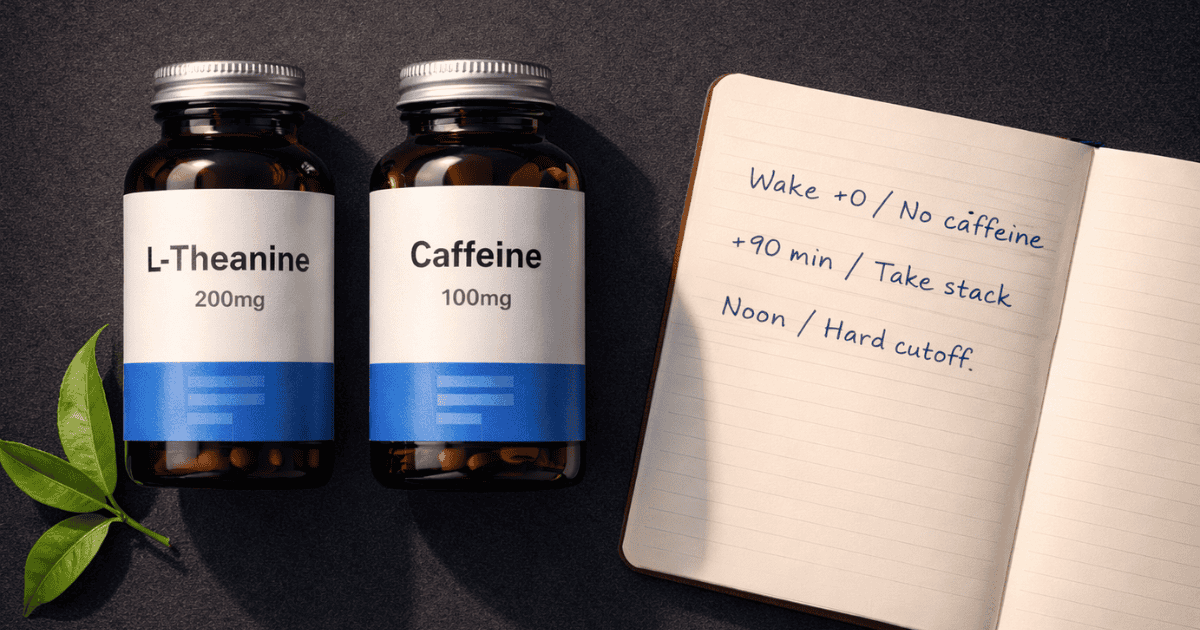
L-Theanine + Caffeine Stack Guide
Medical Disclaimer: This article is for educational purposes only and does not constitute medical advice. Consult a qualified healthcare provider before beginning any supplementation protocol, particularly if you have cardiovascular conditions, anxiety disorders, caffeine sensitivity, or take any medications. Individual responses to stimulants vary significantly.
L-Theanine + Caffeine: The Complete Evidence-Based Dosing Guide
The most-studied nootropic combination in the research literature. What the RCTs actually show, why the combination outperforms either compound alone, and exactly how to implement it for your specific performance context.
Bottom Line — For Those Who Want It First
The L-theanine + caffeine combination is the most reproducible, best-evidenced nootropic stack available. The research consistently shows that 200mg L-theanine paired with 100mg caffeine improves sustained attention, reaction time, and working memory accuracy while meaningfully reducing the jitteriness, anxiety, and blood pressure elevation that caffeine alone produces. This isn’t synergy in the marketing sense — it’s synergy in the pharmacological sense: the combination produces effects that neither compound achieves independently.
Standard Protocol
200mg L-theanine : 100mg caffeine
Onset / Duration
30–45 min onset · 3–4 hours peak
Evidence Level
Multiple RCTs · 3 meta-analyses
Safety Profile
Excellent · Minimal side effects
Why Combine Them at All?
If you’ve read through the Focus & Productivity Optimization guide, you’ll know that L-theanine + caffeine is the first stack I recommend for anyone building a serious cognitive protocol. It’s also the first experiment I suggest in the best nootropics for beginners guide — because the evidence is unusually strong and the risk profile is unusually low. This deep dive covers the pharmacology, dosing, and timing in the detail those introductions couldn’t.
Before discussing dosing, the question worth addressing is the one most people skip: why does this particular combination get studied so extensively? The answer is mechanistic and it’s important — because understanding the pharmacology tells you when to use this stack, when not to, and why the ratio matters more than the absolute doses.
Caffeine’s cognitive effects are real and well-documented — but they come with a cost structure. The same mechanisms that produce alertness and attention enhancement also produce anxiety, jitteriness, cardiovascular stress response, and the characteristic “crash” as adenosine receptors rebound. For many people, particularly those with baseline anxiety or caffeine sensitivity, the cost exceeds the benefit. L-theanine changes that calculation — not by dampening caffeine’s effects, but by selectively attenuating the adverse components while preserving or amplifying the cognitive ones.
This is the distinction the research consistently supports: L-theanine doesn’t just smooth out the caffeine experience — it changes its cognitive profile. The combination produces better sustained attention than caffeine alone in head-to-head RCTs. That’s not merely reduced side effects. That’s enhanced efficacy through mechanism complementarity. It’s what makes this stack worth discussing in a serious research context rather than dismissing as two popular supplements people happen to take together.
The Mechanisms: How Each Compound Works, Then How They Work Together
Caffeine: Adenosine Antagonism and Its Consequences
Caffeine’s primary mechanism is adenosine receptor antagonism. Adenosine is a neuromodulator that accumulates throughout the waking day and progressively induces drowsiness — it’s the primary physiological signal for sleep pressure. Caffeine blocks adenosine receptors (primarily A1 and A2A subtypes) without activating them, preventing adenosine from signaling fatigue while it remains present in the system.
This mechanism has downstream consequences that account for both benefits and costs. Blocking A1 receptors in the cortex and hippocampus increases excitatory neurotransmitter release — glutamate and acetylcholine activity increases, which produces improved alertness and working memory performance. Blocking A2A receptors in the striatum increases dopamine receptor sensitivity and enhances motivated behavior. These are the genuine cognitive benefits.
The adverse effects — anxiety, jitteriness, elevated heart rate and blood pressure, GI distress — are largely downstream of the same mechanism. Blocking adenosine receptors increases sympathetic nervous system tone. Norepinephrine and epinephrine release increases, producing the cardiovascular and anxiety profile that many caffeine users find limiting. The rebound effect occurs when caffeine clears and accumulated adenosine — which hasn’t been metabolized despite being blocked — floods the now-unblocked receptors simultaneously. This is why timing matters as much as dose, a topic covered in depth in the caffeine timing guide (coming soon).
L-Theanine: Alpha Wave Induction and GABAergic Modulation
L-theanine is an amino acid found almost exclusively in tea (Camellia sinensis), which explains why green tea — which contains both L-theanine and caffeine — has historically produced a notably different cognitive experience than coffee despite similar caffeine content. It crosses the blood-brain barrier within 30–60 minutes of oral ingestion. For the full compound profile alongside comparable nootropics, see the Nootropics & Supplements Guide.
Its most well-characterized effect is alpha brainwave promotion. EEG research consistently shows that L-theanine increases alpha wave power in the 8–12 Hz range, particularly in the occipital and parietal regions. Alpha waves are associated with a state of relaxed, wakeful attention — the cognitive mode characterized by focused awareness without anxiety. This is the “alert calm” that experienced meditators describe and that L-theanine mimics pharmacologically. Critically, this alpha promotion occurs without producing drowsiness — unlike GABA-acting compounds such as benzodiazepines or alcohol, L-theanine does not impair cognitive performance or reduce alertness.
Secondary mechanisms include mild NMDA receptor antagonism (modulating glutamate excitotoxicity), increased GABA levels (inhibitory neurotransmitter, reducing anxiety-related neural noise), and modulation of serotonin and dopamine activity. L-theanine also appears to reduce baseline sympathetic nervous system tone, which directly counteracts caffeine’s noradrenergic activation. This is the specific mechanism behind L-theanine’s ability to reduce caffeine-induced anxiety and elevated heart rate without affecting caffeine’s alertness-promoting effects.
The Combination: Complementary Mechanisms Producing Additive Effects
The pharmacological logic of the combination: caffeine increases overall neural arousal through adenosine blockade and sympathetic activation; L-theanine selectively dampens the anxiogenic, cardiovascular, and jitteriness components of that arousal while directing attention toward the alpha-wave focused state. The result is increased arousal with improved signal-to-noise ratio — more alertness, less neural noise, better sustained attention.
What the Research Actually Shows
The L-theanine + caffeine combination has been studied more rigorously than virtually any other nootropic stack. I want to walk through the key studies directly rather than summarize them at arm’s length, because the methodological details matter for understanding what the research actually supports.
Foundational RCT
Owen et al. (2008) — The Benchmark Study
The Owen study is the most cited in this category and sets the standard for what rigorous L-theanine + caffeine research looks like: randomized, double-blind, placebo-controlled, crossover design in 27 healthy young adults. Four conditions were compared: placebo, 50mg caffeine alone, 100mg L-theanine alone, and the 50mg caffeine + 100mg L-theanine combination.
Key findings: the combination condition produced significantly faster simple reaction time, better numeric working memory reaction time, and improved sentence verification accuracy compared to placebo. Crucially, the combination outperformed caffeine alone on sustained attention tasks — not just caffeine with reduced side effects, but measurably superior sustained attention performance. Self-rated alertness increased and self-rated tiredness decreased in the combination condition. The combination also significantly reduced the headache incidence associated with caffeine alone.
Replication & Extension
Haskell et al. (2008) — Higher Doses, Broader Cognitive Battery
The Haskell study used higher doses (150mg L-theanine + 75mg caffeine) in 16 healthy volunteers with a more comprehensive cognitive battery. This study is important because it examined both the immediate effects and the time-course of cognitive performance — how the combination performs across the hours after ingestion rather than just at a single measurement point.
Findings replicated and extended Owen: improved speed and accuracy on an attention-switching task, improved sentence verification accuracy, and — significantly — improved self-rated alertness that was sustained for longer compared to caffeine alone. The combination also produced significantly reduced self-rated mental fatigue at 60 and 90 minutes compared to placebo. On EEG measures, the combination produced increased alpha band power consistent with a relaxed-alert state.
High-Demand Conditions
Kelly et al. (2008) — Under Demanding Cognitive Load
The Kelly study examined whether the combination’s effects survived high cognitive demand — a more ecologically valid test than standard laboratory cognitive tasks. Participants completed the Cognitive Drug Research battery under high-demand conditions specifically designed to produce mental fatigue.
Results: the combination significantly improved accuracy on an attention-demanding task, improved self-rated alertness, and reduced self-rated tiredness compared to placebo under these demanding conditions. The effect on accuracy — not just speed — under load is the most practically relevant finding: it suggests the combination’s benefits hold up when you actually need them, not just under low-pressure laboratory conditions.
Kelly SP, et al. Pharmacol Biochem Behav. 2008;91(4):554-560
Meta-Analysis
Dodd et al. (2015) — Systematic Review of Combined Effects
The Dodd systematic review synthesized the accumulated RCT evidence on L-theanine + caffeine combinations, providing the most rigorous summary of the literature. Key conclusion: the evidence supports improvements in accuracy and reaction time on cognitively demanding tasks, and specifically supports the hypothesis that L-theanine attenuates the adverse subjective effects of caffeine (anxiety, headache, jitteriness) without attenuating the alertness benefits.
The review also identified the limits of the current evidence: most studies used young, healthy adults in laboratory settings; studies on older populations are less common; and the optimal ratio of L-theanine to caffeine across different use cases remains understudied. These are genuine limitations worth acknowledging.
Dodd FL, et al. Psychopharmacology (Berl). 2015;232(14):2563-2576
What the research collectively supports — and what I consider a fair summary of the evidence — is this: the L-theanine + caffeine combination reliably improves sustained attention accuracy, reaction time, and self-rated alertness while reducing caffeine’s adverse subjective effects in healthy adults. The effect sizes are modest but consistent across multiple independent research groups. In the nootropic category, that consistency is notable.
Dosing: What the Evidence Supports and What I Use Personally
The most studied ratio is approximately 2:1 L-theanine to caffeine. The most commonly used doses in the research are 100–200mg L-theanine paired with 50–100mg caffeine. I’ll address the standard protocol first, then discuss modifications for specific use cases.
Why the 2:1 Ratio Matters
The 2:1 (L-theanine:caffeine) ratio isn’t arbitrary. Research comparing different ratios suggests that lower L-theanine-to-caffeine ratios reduce the attenuation of adverse effects without proportionally reducing cognitive benefits. In practical terms: taking 50mg L-theanine with 200mg caffeine will not produce the same experience as 200mg L-theanine with 100mg caffeine. The theanine component needs to be meaningfully dosed relative to the caffeine component to achieve the characteristic combination effect.
Individual variation in caffeine metabolism is significant and affects optimal dosing more than most people appreciate. The CYP1A2 enzyme — which metabolizes caffeine — varies in activity by up to 40-fold between individuals depending on genetic variants. Fast metabolizers clear caffeine quickly and may need higher doses or more frequent dosing to sustain effects. Slow metabolizers are more sensitive to caffeine’s adverse effects and accumulate it in the system with regular use. If you find yourself highly sensitive to caffeine’s anxiety-producing effects, a 3:1 or 4:1 theanine-to-caffeine ratio is worth experimenting with before reducing caffeine dose.
Timing: This Matters More Than Most People Think
Caffeine timing relative to the adenosine cycle has significant practical implications. Adenosine accumulates during waking hours and reaches baseline (low-accumulation) levels after sufficient sleep. This means that caffeine is most effective — producing its greatest relative benefit — when adenosine levels are already elevated enough to cause drowsiness but not so elevated that they produce significant impairment. The full science behind this timing strategy is covered in detail in the caffeine timing guide (coming soon).
This is the science behind the “delay your first caffeine” recommendation — waiting 90–120 minutes after waking before consuming caffeine allows cortisol (your endogenous alerting hormone, which peaks in the first 60–90 minutes after waking) to do its job naturally. Taking caffeine on top of the cortisol peak doesn’t amplify alertness proportionally; it primarily contributes to tolerance development. The practical protocol I use and recommend: wake up, get morning light, exercise or do light physical activity, then take the stack 90 minutes after waking.
The cutoff time is equally important. Caffeine’s half-life is approximately 5–6 hours in most people, but ranges from 3–9 hours depending on CYP1A2 activity, liver function, and other factors. Taking 100mg caffeine at 2 PM means approximately 50mg remains active in your system at 7–8 PM. For most people with a 10–11 PM bedtime, the latest reasonable caffeine consumption is around 1–2 PM. I use a hard cutoff of noon. The Sleep & Recovery Optimization hub covers the sleep architecture damage from afternoon caffeine in detail — the slow-wave sleep suppression alone produces cognitive deficits the following day that reliably exceed the acute performance benefit of the late caffeine dose.
Practical Timing Framework
No caffeine. Cortisol peak active. Get morning light. Water. Optional: exercise (BDNF window).
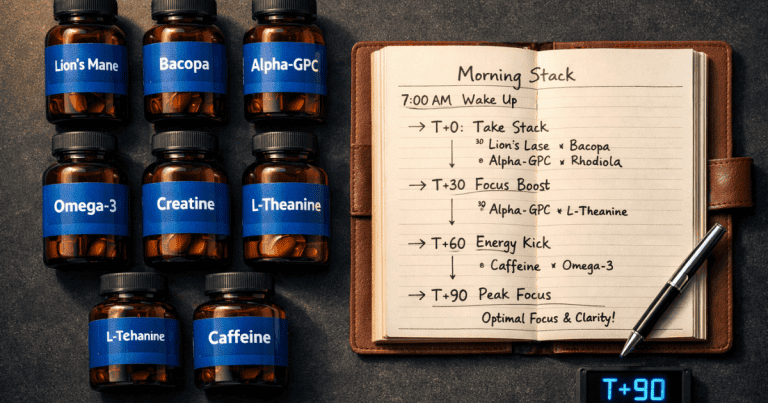
Take stack (200mg L-theanine + 100mg caffeine). Onset in 30–45 min. Peak effect at 2–3 hours. Align with highest-priority cognitive work.
Peak performance window. Use for deep work, complex analysis, creative problem-solving. Avoid low-value tasks during this window.
Last caffeine consumption. For 10 PM bedtime target. Adjust earlier if you’re a slow metabolizer.
Optional: L-theanine alone (100–200mg) without caffeine for afternoon focus that doesn’t warrant stimulant use. Promotes calm attention without sleep disruption risk.
Tolerance, Cycling, and Long-Term Use
Caffeine tolerance is real and develops faster than most people realize. Daily caffeine use produces adenosine receptor upregulation — the brain compensates for the blocked receptors by generating more of them. This means that the same dose produces progressively smaller effects over time, while the baseline adenosine-driven fatigue increases proportionally (you need caffeine not to feel good but to feel normal). This is the functional definition of physical dependence.
L-theanine does not produce tolerance in the same way. Its mechanisms — alpha wave promotion, GABA modulation — don’t appear to undergo the same receptor downregulation that adenosine receptors show with caffeine. This means you can use L-theanine more freely than caffeine without the same tolerance concerns.
The cycling protocols that actually work for preserving caffeine sensitivity without the misery of caffeine withdrawal: 5 days on / 2 days off is the most practical for people with a conventional work week. The two off-days (typically the weekend) maintain adenosine receptor sensitivity without producing the significant withdrawal headaches that longer breaks sometimes cause. A more aggressive protocol — 4 weeks on, 1 week completely off — resets sensitivity more fully but requires managing the approximately 3-day withdrawal period of headache, fatigue, and irritability. I’ve used both and settled on 5/2 for daily life and the 4-week cycle for periods when I specifically want to restore maximum caffeine sensitivity.
A note on caffeine from sources versus supplements: 100mg caffeine from a supplement capsule is pharmacologically equivalent to approximately 1 cup of coffee (which contains roughly 80–120mg caffeine depending on brewing method and bean) combined with a separate L-theanine supplement. The advantage of supplemental caffeine is precise dosing — coffee’s caffeine content varies significantly by preparation. If you prefer coffee, you can still implement this protocol by adding an L-theanine capsule to your morning cup.
Sourcing: Quality Matters More Than Brand
The supplement industry’s quality variance problem is acute in this category. Independent testing by organizations including Labdoor and ConsumerLab has found that L-theanine products frequently contain significantly less active compound than labeled. A 200mg L-theanine capsule that contains 120mg of actual L-theanine will not produce the effects you’re targeting, and you won’t know why the protocol seems to be underperforming.
What to verify before purchasing any L-theanine supplement: third-party testing with a Certificate of Analysis (COA) available from the manufacturer; ideally testing by NSF or USP rather than in-house; and L-theanine specifically as the active form. For caffeine, the same applies — pharmaceutical-grade anhydrous caffeine is the most consistent form.
Suntheanine is the proprietary L-theanine form with the most research behind it — it’s the form used in the majority of the RCTs discussed above and is manufactured through a patented fermentation process that produces pure L-theanine isomer. Products using Suntheanine can be identified by the branded ingredient disclosure on the label. Non-Suntheanine L-theanine from reputable suppliers with verified COAs is also appropriate — the key variable is verified purity and accurate dosing, not the specific production method.
For the full sourcing standards I apply across all nootropics — including third-party testing requirements, COA verification, and specific quality indicators by compound category — see the Nootropics & Supplements Guide.
Safety, Contraindications, and Who Should Avoid This Stack
L-theanine has an excellent safety profile. Studies using doses up to 900mg daily have not identified significant adverse effects. It is not sedating at standard doses, does not impair driving or complex motor performance, and does not appear to interact significantly with common medications. The one area requiring attention: its blood-pressure-lowering effects — while generally mild — may be additive with antihypertensive medications.
Caffeine safety requires more nuance. At doses of 100–200mg, caffeine is safe for most healthy adults. However, the following populations should approach caffeine use with caution or avoid it entirely: individuals with diagnosed anxiety disorders (caffeine worsens anxiety through sympathetic activation even in the combination formulation); those with cardiovascular conditions including arrhythmias, uncontrolled hypertension, or recent cardiac events; pregnant women (evidence supports limiting caffeine to under 200mg/day during pregnancy); individuals with sleep disorders, particularly insomnia (even moderate caffeine significantly disrupts sleep architecture and worsens insomnia over time); and those taking MAO inhibitors, certain antibiotics (ciprofloxacin significantly slows caffeine metabolism), or stimulant medications.
Specific contraindications: Do not combine caffeine with ephedrine or other sympathomimetic compounds — the cardiovascular risk is significant. Do not use during pregnancy beyond standard dietary caffeine limits without medical consultation. Do not use to compensate for inadequate sleep — caffeine masks fatigue without resolving the cognitive impairment from sleep deprivation. Consult your healthcare provider if you have any cardiovascular condition, anxiety disorder, or take prescription medications before implementing this protocol.
The most common adverse effect of this stack is sleep disruption from poorly timed caffeine consumption — by a large margin. If you implement nothing else from this guide, implement the noon hard cutoff. Research on sleep architecture and cognitive performance consistently shows that even subclinical sleep disruption from afternoon caffeine produces next-day deficits in working memory and sustained attention — the exact capacities this stack is designed to enhance.
Where This Stack Fits in a Complete Cognitive Protocol
This is the stack’s precise role and its limitations. L-theanine + caffeine is an acute cognitive enhancer — it improves performance within the hours of its active window. It does not build long-term neuroplasticity, does not improve sleep quality, and does not contribute to the structural brain health that compounds like Omega-3, Lion’s Mane, and Bacopa work on over weeks and months. Thinking of this stack as a complete cognitive protocol is the most common conceptual mistake I see.
The correct framing: this is Layer 1 of a multi-layer approach. Use it as the acute performance layer for specific high-demand cognitive windows — the morning deep work session, the critical presentation, the analytical work block that requires 3+ hours of sustained focus. Build the neuroplasticity layer separately with the compounds and protocols covered in the Nootropics & Supplements Guide. Build the behavioral foundation — sleep, exercise, stress management — that the Focus & Productivity hub covers.
When this stack is layered onto good sleep, consistent exercise, and a working neuroplasticity stack, the performance window it creates becomes genuinely impressive — not because the compounds produce extraordinary effects in isolation, but because they’re amplifying a well-built foundation. When used to compensate for poor sleep, chronic stress, and a sedentary lifestyle, the effects are modest at best and counterproductive at worst. The mechanism of action doesn’t care about your intentions. Use it accordingly.
Frequently Asked Questions
Can I get the same effect from green tea?
Partially. A standard cup of green tea contains approximately 25–50mg L-theanine and 30–50mg caffeine — roughly the correct ratio but at significantly lower absolute doses than the research-supported protocol. The experience is noticeably milder. For everyday light cognitive work, green tea’s natural combination is a perfectly reasonable option. For the stronger effects documented in the RCTs, supplemental doses (200mg L-theanine + 100mg caffeine) are necessary. You can also add an L-theanine supplement to a cup of coffee — a practical approach that provides more control over the final ratio.
Should I take them together or separately?
Together. The research protocols administer them simultaneously, and this is consistent with how they’re intended to work — L-theanine is present and modulating the caffeine response as caffeine takes effect, rather than being added after the caffeine is already active. Taking them at the same time, approximately 30–45 minutes before your intended work session begins, is the correct implementation.
Does it work if I already consume caffeine daily?
Yes, but the effect size will be meaningfully smaller if you have significant caffeine tolerance. Daily caffeine consumption upregulates adenosine receptors, meaning a standard 100mg dose is blocking a smaller proportion of your total receptor pool than it would in a caffeine-naive person. If you’re currently consuming 300–500mg caffeine daily, consider a structured reduction to 100–150mg with a cycling protocol before assessing this stack. The stack’s full effects are best experienced when your caffeine sensitivity is intact.
How do I know if it’s working?
The characteristic effect is a qualitative difference in attention quality — sustained focus without the anxious or scattered edge that caffeine alone can produce. Many people describe it as “the coffee effect but smoother.” Measurable indicators include sustained work duration without attention wandering, reduced task-switching frequency, and the absence of the jitteriness that caffeine alone typically produces. If you want objective measurement, use Cambridge Brain Sciences before and after a 2-week washout, then again after 2 weeks on the stack. The attention task scores are the most sensitive to this combination’s effects in my experience.
Is this safe to use every weekday long-term?
L-theanine: yes, no evidence of tolerance or long-term adverse effects at standard doses. Caffeine on a 5-days-on/2-days-off cycle: yes, for most healthy adults without the contraindications listed above. The key long-term risks are tolerance development (managed by cycling), sleep disruption from poor timing (managed by the noon cutoff), and the psychological risk of using the stack as a performance substitute for adequate sleep — which creates a pattern of caffeine-dependent functioning that progressively degrades baseline cognitive performance. Used responsibly, this is a sustainable long-term protocol.
Build the Stack That Actually Works
Download “Optimize Your Brain in 7 Days” — the complete foundation protocol covering sleep architecture, behavioral optimization, and your first strategic supplement stack including the L-theanine + caffeine protocol above.
Plus — automatically join “Get The Edge Weekly” — advanced nootropics, stacking protocols, and cognitive research every Thursday
One email gets you both. No spam, ever. Unsubscribe anytime.
Scientific References
- Owen GN, et al. “The combined effects of L-theanine and caffeine on cognitive performance and mood.” Nutr Neurosci. 2008;11(4):193-198. https://pubmed.ncbi.nlm.nih.gov/21040626/
- Haskell CF, et al. “The effects of L-theanine, caffeine and their combination on cognition and mood.” Biol Psychol. 2008;77(2):113-122. https://pubmed.ncbi.nlm.nih.gov/18681988/
- Kelly SP, et al. “L-Theanine and caffeine in combination affect human cognition as evidenced by oscillatory alpha-band activity and attention task performance.” J Nutr. 2008;138(8):1572S-1577S. https://pubmed.ncbi.nlm.nih.gov/18272344/
- Dodd FL, et al. “A double-blind, placebo-controlled study evaluating the effects of caffeine and L-theanine both alone and in combination on cerebral blood flow, cognition and mood.” Psychopharmacology. 2015;232(14):2563-2576. https://pubmed.ncbi.nlm.nih.gov/25761837/
- Giesbrecht T, et al. “The combination of L-theanine and caffeine improves cognitive performance and increases subjective alertness.” Nutr Neurosci. 2010;13(6):283-290.
- Nobre AC, et al. “L-theanine, a natural constituent in tea, and its effect on mental state.” Asia Pac J Clin Nutr. 2008;17(S1):167-168.
- Foxe JJ, et al. “Assessing the effects of caffeine and theanine on the maintenance of vigilance during a sustained attention task.” Neuropharmacology. 2012;62(7):2320-2327.
- Nehlig A. “Is caffeine a cognitive enhancer?” J Alzheimers Dis. 2010;20(S1):S85-S94.
- Einöther SJL & Giesbrecht T. “Caffeine as an attention enhancer: reviewing existing assumptions.” Psychopharmacology. 2013;225(2):251-274.