
Circadian Rhythm Optimisation
⚕️ Educational Information, Not Medical Advice
This circadian rhythm optimisation guide reflects independent research and personal experimentation, not clinical guidance. I’m a cognitive enhancement researcher, not a medical doctor. Persistent sleep problems, extreme chronotypes and shift-work schedules can involve genuine circadian rhythm sleep–wake disorders that need proper assessment. If your sleep is significantly disrupted, or you’re managing a mood disorder, speak with a qualified healthcare provider rather than self-treating with light exposure.
Circadian Rhythm Optimisation: The Levers That Actually Move Your Clock
By Peter Benson, Cognitive Enhancement Researcher | 18+ Years Independent Research · Last Updated: August 2026
Circadian rhythm advice has become a checklist: morning sunlight, blue-blocking glasses, no food after seven, cold shower, sauna, magnesium at nine. Some of it works. Some of it works on something other than what you were told. And the items are presented as though they carry roughly equal weight, which is the part that quietly wastes people’s effort — because they don’t, and the gap between the strongest lever and the weakest is enormous. Real circadian rhythm optimisation starts with knowing which is which.
I’ve been tracking my own sleep and recovery data continuously for over 26 months on an Oura Ring, alongside 18+ years of experimenting with cognitive protocols. What the data made obvious to me is something the research says plainly and the internet keeps blurring: your body doesn’t have one clock, it has many, and different interventions act on different ones. This article sorts them by what they actually do. It belongs to our Sleep & Recovery guide, and pairs closely with our breakdown of sleep architecture — timing and structure are different problems, and confusing them is common.
You don’t have a body clock. You have a hierarchy of them.
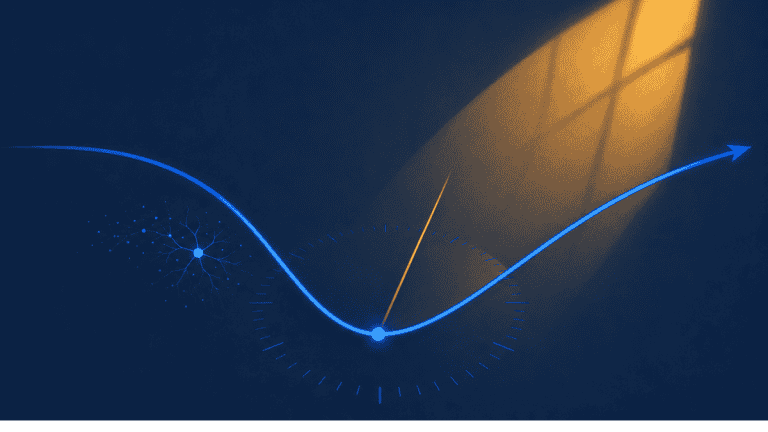
This is the structural fact that makes the rest of the article make sense. The master clock sits in the suprachiasmatic nucleus, a small cluster of neurons in the hypothalamus, and it synchronises tissue-specific peripheral clocks throughout the body, entraining to the 24-hour day through light signals arriving via the retinohypothalamic tract. Almost every organ runs its own clock — liver, gut, adipose tissue, muscle — and those clocks take timing cues from the master clock but also, importantly, from local signals.
The National Institute of General Medical Sciences describes the SCN as the master clock, regulated by light and receiving direct input from the eyes. That anatomical detail — a direct wire from retina to clock, unmediated by anything else — is why light occupies a category of its own among circadian interventions. Nothing else in your daily routine has a dedicated neural pathway to the pacemaker.
Once you hold that hierarchy in mind, a lot of contradictory advice resolves. Interventions that shift the master clock change when you feel sleepy and alert. Interventions that shift peripheral clocks change metabolic timing without necessarily touching your sleep at all. Both are worth doing. They are not the same thing, and the popular framing that lumps them together as “fixing your circadian rhythm” is why people try eating earlier, notice their sleep hasn’t changed, and conclude the whole field is nonsense.
Light is the lever. Everything else is adjustment.
The evidence for evening light disrupting the clock is unusually clean, because it was tested under laboratory conditions rather than inferred from surveys. Participants read on a light-emitting device for four hours before a fixed 10pm bedtime across five consecutive evenings, and were compared against five evenings reading printed books. The device condition suppressed melatonin, delayed the circadian clock, lengthened the time taken to fall asleep, reduced and delayed REM sleep, and left participants less alert the following morning (Chang et al., 2015).
Note the detail that makes this study useful: bedtime was fixed. Participants weren’t allowed to stay up later, which means the effects measured are purely biological rather than behavioural. In real life the effect compounds, because evening light also makes you feel less sleepy at the time, so you go to bed later as well. A follow-up study allowing self-selected bedtimes found tablet use delayed melatonin onset, pushed sleep onset later, and impaired next-morning alertness (Chinoy et al., 2018) — the laboratory effect plus the behavioural one stacked on top.
The morning half of the equation is less dramatically documented but follows from the same mechanism, and in practice I think it matters more. Evening light pushes the clock later; morning light pulls it earlier and anchors it. Most people optimise the evening — blue-blockers, dimmed screens, amber bulbs — and then spend their entire morning indoors under lighting that is, in circadian terms, close to darkness. Indoor lighting typically sits in the low hundreds of lux; an overcast morning outdoors is often ten times that, and direct sun far more. If you fix only one thing, fix the morning — and if the habit is the hard part rather than the principle, our guide to building a morning routine that holds is the practical companion to this.
What meal timing actually does — and what it doesn’t
This is where I’d push back hardest on the standard advice, because there’s a well-designed study that answers the question directly and it’s rarely reported accurately.
Researchers gave participants three meals at five-hour intervals, beginning either half an hour or five and a half hours after waking, then measured circadian rhythms under tightly controlled laboratory conditions. Following the late-meal schedule, plasma glucose rhythms were delayed by 5.69 hours and PER2 clock-gene rhythms in adipose tissue by 0.97 hours — clear evidence that feeding time regulates human molecular clocks. But the same study found meal timing did not affect the master clock markers, plasma melatonin and cortisol, nor subjective sleepiness, nor clock gene expression in whole blood (Wehrens et al., 2017).
Read that carefully, because it’s precise and it’s important. Shifting meals by five hours — a large intervention, far larger than most people would attempt — moved metabolic clocks substantially and moved the master clock not at all. So “eat earlier to fix your circadian rhythm” is half right in a misleading way. Early eating is genuinely worth doing for metabolic timing, and the evening-meal-to-glucose-handling relationship is real. It is not a tool for changing when you feel sleepy. If your problem is that you can’t fall asleep until 2am, adjusting dinner will not solve it. Light will. The same distinction applies to caffeine, incidentally: an early-afternoon cut-off protects sleep pressure and continuity rather than clock phase — a genuine benefit through an entirely different mechanism, covered in our guide to caffeine timing.
Social jetlag: the weekend undoing your weekdays
The most consequential circadian problem for most working adults isn’t screens or dinner timing. It’s the two-day schedule change we all run every week and don’t think of as an intervention at all.
Researchers surveying 501 volunteers described this mismatch between biological and social time as “social jetlag” — finding that later chronotypes show the largest differences in sleep timing between work days and free days, accumulating sleep debt during the week which they compensate for at the weekend (Wittmann et al., 2006). The compensating is the trap. Sleeping in on Saturday feels restorative and partially is, but it shifts your sleep midpoint later, which is functionally a small westward flight. Sunday night you can’t sleep, Monday morning you’re impaired, and you’ve re-created the problem you were recovering from.
The practical implication is unglamorous and unpopular: a consistent wake time matters more than a consistent bedtime, and weekends are not exempt. Wake time is the anchor because it determines when you get your first light exposure. If you genuinely need extra recovery sleep, an hour’s lie-in costs far less than three, and a short afternoon nap costs less still. This is also why chasing sleep quantity while ignoring regularity often disappoints — a point that overlaps with our guide to falling asleep faster.
Why the same protocol produces different results
Two people can follow identical light protocols and get meaningfully different outcomes, and this isn’t compliance failure — it’s biology. Chronotype varies substantially across a population, from genuine early types to genuine late types, shaped by both clock-gene variation and environment (Wittmann et al., 2006).
Sensitivity to light itself also varies. In a small imaging study, individual differences in suprachiasmatic-area activation in response to light correlated with how strongly the same light level suppressed melatonin (McGlashan et al., 2018). It’s a pilot study with ten participants, so hold it loosely — but it offers a mechanistic explanation for something anyone who has compared notes with a partner already knows: identical evening lighting affects different people to different degrees.
What follows practically is that protocols are starting points, not prescriptions. If dim evenings do nothing for you, you may simply be less light-sensitive, and your effort is better spent on wake-time consistency. If you’re a late chronotype fighting an early schedule, aggressive morning light and disciplined evening dimming are working against a genuine biological headwind — worth doing, but expect partial rather than complete correction. And if sleep onset remains stubborn once your light exposure is genuinely consistent, that’s the point at which our guide to magnesium glycinate for sleep becomes relevant — not before.
Worked example — sorting your own levers
Illustrative example, not a real individual or testimonial. A composite scenario used to show the method. Individual responses vary and are not typical results.
Take a hypothetical late-chronotype office worker who can’t fall asleep before roughly 1am and drags through mornings. The internet’s default response is “stop eating after 7pm and buy blue-blockers.” The hierarchy in this article gives a different order of operations — and the order is the whole point.
Step 1 — Name the clock. The complaint is sleep timing: late onset, hard waking. That’s a master-clock problem, so the only levers with real leverage are the ones with a line to the master clock — light and, indirectly, wake time. Meal timing is immediately deprioritised, because the evidence shows it moves metabolic clocks, not sleep timing (Wehrens et al., 2017). That single reframe saves weeks of tinkering with dinner.
Step 2 — Fix the anchor. One wake time, seven days a week — not a bedtime target. Waking at, say, 07:00 on both Saturday and Wednesday removes the weekend midpoint drift that would otherwise re-delay the clock every Monday (Wittmann et al., 2006). This comes first because it costs nothing and it sets the timing of every subsequent light exposure.
Step 3 — Add morning light. Ten to twenty minutes outdoors within an hour of that fixed wake time, no sunglasses. For a late chronotype this is the phase-advancing signal that pulls the clock earlier — the direction they actually want.
Step 4 — Dim the last two hours. Only now does evening light management earn its place: overhead lights off, screens dimmed or away. It’s step four, not step one, because it’s the phase-delay you’re removing rather than the phase-advance you’re adding — useful, but secondary to the morning signal.
Step 5 — Only then, the periphery. Earlier dinner and a caffeine cut-off go last. They’re worth doing for glucose handling and sleep continuity respectively — but you’d add them knowing they won’t move the clock, so you don’t credit them (or blame them) for changes in sleep timing.
What to expect: a late chronotype fighting an early schedule should anticipate partial correction over days-to-weeks, not a wholesale rewrite of their biology — the headwind is real. The value of the sequence isn’t speed; it’s that when something works, you know which lever did it, and when something doesn’t, you haven’t wasted the effort on a clock it was never going to reach.
Evidence hierarchy: which clock does each lever move?
Graded by what the intervention demonstrably shifts — not by how often it appears in routine advice.
The NeuroEdge Protocol
The NeuroEdge Circadian Anchor Protocol
Ordered by leverage, not by time of day. Do the first two before you consider the rest.
01 — Fix the wake time
Same wake time seven days a week, within about 30 minutes. Weekends included. This is the anchor everything else hangs from, and it’s free.
02 — Get outside early
10–20 minutes outdoors within an hour of waking, without sunglasses. Overcast counts — outdoor light on a grey day still vastly exceeds indoor lighting.
03 — Dim the last two hours
Overhead lights off, lamps low, screens dimmed or put away. The trial effect appeared over five evenings — this is a habit, not a single-night fix.
04 — Then adjust the periphery
Earlier dinner, caffeine cut-off, consistent exercise timing. Worth doing for metabolic and sleep-pressure reasons — just don’t expect them to move your clock.

Peter’s Testing Notes
First-person, n=1 — reported honestly
I wake at 06:00 and have done for years, but for a long stretch that was only true on weekdays. Weekends drifted to 08:00 or later, and I regarded that as recovery. Twenty-six months of continuous Oura data changed my mind about it — not because of a dramatic finding, but because the weekly pattern was so repetitive it became impossible to ignore. My worst sleep-onset latency of the week was, consistently, Sunday night. My lowest readiness score was, consistently, Monday. I’d been reading that as “Sunday-night dread about work” for years. It correlated far better with Saturday’s lie-in than with anything on my calendar.
Tightening weekend wake time to within about 45 minutes of weekdays produced the clearest change I’ve recorded from a single sleep intervention: Sunday sleep-onset latency came down markedly and Monday stopped being a write-off. The honest caveats are substantial. This isn’t blinded, I knew exactly what I expected to see, and I made the change during a period when work was less demanding — I can’t rule out that Mondays improved partly for reasons unrelated to my clock.
The morning walk is the other habit I’ve kept, roughly 15 minutes outdoors after waking, year-round. I can’t isolate its effect in my data at all, because I’ve never run it as a discrete variable — it’s been part of my routine since long before I was tracking anything. I keep it because the mechanism is sound and the cost is zero, which is a weaker reason than I’d like but an honest one. What I’ve abandoned is fussing over dinner timing for circadian purposes. I eat earlier because it suits my digestion and my sleep feels less disturbed, not because I think it’s moving my clock — and the research suggests it isn’t.
Key takeaways
| → | You have a master clock and many peripheral clocks. Different interventions move different ones — conflating them is why circadian advice disappoints. |
| → | Light is the only lever with a direct neural pathway to the master clock. It outranks everything else on this list. |
| → | Meal timing shifts metabolic clocks, not sleep timing — a 5-hour delay moved glucose rhythms while leaving melatonin and cortisol unchanged (Wehrens et al., 2017). |
| → | Weekend lie-ins recreate misalignment every week. A consistent wake time is the highest-leverage free intervention available. |
| → | Chronotype and light sensitivity vary between people. Treat any protocol as a starting point to be tested, not a prescription. |
Frequently asked questions
How long does it take to reset your circadian rhythm?
Days to weeks, depending on how far you’re shifting and how consistent you are. In the controlled trial on evening light exposure, measurable changes in melatonin timing and circadian phase appeared across five consecutive evenings of a modest intervention (Chang et al., 2015), which gives a sense of the timescale — this is not a single-night fix, but nor does it take months. Larger shifts take proportionally longer, and consistency matters more than intensity. One perfect week followed by an inconsistent one will leave you roughly where you started.
Does eating late really disrupt your circadian rhythm?
It disrupts some clocks and not others, which is the detail usually lost. When researchers delayed meals by five hours, plasma glucose rhythms shifted by 5.69 hours and adipose PER2 clock-gene rhythms by 0.97 hours — but melatonin, cortisol and subjective sleepiness were unaffected (Wehrens et al., 2017). So late eating genuinely disrupts metabolic timing, which matters for glucose handling and long-term metabolic health. It does not appear to shift the master clock that governs when you feel sleepy. If your goal is falling asleep earlier, light exposure is the effective lever, not dinner time.
Do blue light blocking glasses actually work?
The underlying mechanism is real: short-wavelength light is what most strongly suppresses melatonin and delays circadian phase, and evening exposure to light-emitting devices demonstrably produces those effects (Chang et al., 2015). Filtering short-wavelength light is a recognised countermeasure. That said, glasses address one input while leaving overhead lighting, room brightness and the behavioural pull of the device itself untouched. My honest view is that they’re a reasonable supplement to dimming your environment, not a replacement for it — and considerably less valuable than getting proper light in the morning.
Is it bad to sleep in at weekends?
It carries a real cost that most people don’t attribute correctly. Research describing “social jetlag” found that later chronotypes show the largest differences in sleep timing between work days and free days, building sleep debt during the week and compensating at the weekend (Wittmann et al., 2006). The compensation shifts your sleep midpoint later, which functions like a short westward flight — hence difficulty sleeping on Sunday night and impaired Monday mornings. If you need recovery sleep, an extra hour costs far less than three, and a daytime nap costs less still.
What is the most important thing for circadian rhythm?
Light, and specifically the pattern of bright days and dim evenings. The master clock in the suprachiasmatic nucleus receives direct input from the eyes and entrains to the day–night cycle through that pathway, which no other intervention has. In practical terms this means two habits carry most of the value: a consistent wake time that anchors when you receive your first light of the day, and getting outdoors early. Everything else — meal timing, caffeine cut-offs, exercise scheduling, supplements — is worth doing for its own reasons but is adjustment rather than foundation.
Get “7 Days to a Sharper Brain” — Free
Peter Benson’s personal daily protocol, rebuilt from 18 years of testing.
✓ Day 1 — Sleep foundation + Magnesium Glycinate
✓ Day 2 — L-Theanine + Caffeine focus stack
✓ Day 3 — Brain nutrition timing for stable energy
✓ Day 4 — BDNF movement protocol
✓ Day 5 — 90-60-30 sleep environment sequence
✓ Day 6 — Stress resilience + cognitive load framework
✓ Day 7 — Neuroplasticity, Lion’s Mane + your complete assembled daily stack
Join 2,000+ readers optimising their cognitive performance. Unsubscribe anytime.
Scientific references
1. Chang, A. M., Aeschbach, D., Duffy, J. F., & Czeisler, C. A. (2015). Evening use of light-emitting eReaders negatively affects sleep, circadian timing, and next-morning alertness. PNAS, 112(4), 1232–1237. DOI: 10.1073/pnas.1418490112
2. Wehrens, S. M. T., Christou, S., Isherwood, C., et al. (2017). Meal timing regulates the human circadian system. Current Biology, 27(12), 1768–1775.e3. PMID: 28578930 · PMC5483233
3. Wittmann, M., Dinich, J., Merrow, M., & Roenneberg, T. (2006). Social jetlag: Misalignment of biological and social time. Chronobiology International, 23(1–2), 497–509. DOI: 10.1080/07420520500545979
4. Chinoy, E. D., Duffy, J. F., & Czeisler, C. A. (2018). Unrestricted evening use of light-emitting tablet computers delays self-selected bedtime and disrupts circadian timing and alertness. Physiological Reports, 6(10), e13692. PMC5974725
5. McGlashan, E. M., Poudel, G. R., Vidafar, P., Drummond, S. P. A., & Cain, S. W. (2018). Imaging individual differences in the response of the human suprachiasmatic area to light. Frontiers in Neurology, 9, 1022. PMC6281828
6. Verma, A. K., et al. (2025). Clinical Chronobiology: Circadian Rhythms in Health and Disease. PMC. PMID: 39961369 · PMC12323393
7. National Institute of General Medical Sciences. Circadian rhythms and the SCN. nigms.nih.gov
Peter Benson
Cognitive Enhancement Researcher | 18+ Years Independent Research
Peter has personally tested every protocol in this guide over 18+ years of systematic self-experimentation, tracking sleep, HRV and cognitive performance data as part of his ongoing research practice. NeuroEdge Formula is his platform for sharing rigorous, safety-first cognitive enhancement guidance.
Last reviewed: August 2026