
Deep Work: The Neuroscience of Distraction-Free Productivity
Medical Disclaimer: The information in this article is for educational purposes only and does not constitute medical advice. Always consult a qualified healthcare provider before beginning any supplement regimen or making significant changes to your health protocols. Individual responses vary. This guide reflects published research and 18+ years of personal experience and does not substitute for professional medical evaluation.
Deep work is the cognitive state in which your most valuable professional and intellectual output is produced. It is the state in which complex problems get solved, original ideas emerge, difficult skills are acquired, and work that actually matters gets done. It is also, for most knowledge workers in the modern environment, increasingly rare — and the scarcity of deep work is not a discipline problem. It is a biology problem.
Cal Newport’s framework made the concept of deep work widely recognized — the practice of focusing without distraction on cognitively demanding tasks, producing work at the limit of your ability. But what the productivity literature has largely missed is the neuroscience underneath it: why deep work produces qualitatively superior output, what is actually happening in the brain during deep cognitive states, why the modern environment is so specifically hostile to achieving and maintaining them, and — most importantly — what the complete biological toolkit for reliably entering and sustaining deep work actually looks like.
This article provides that neurological foundation. It builds directly on the complete focus guide — particularly the prefrontal cortex mechanisms, default mode network biology, and the integrated behavioral-supplementation protocol — and goes deeper into the specific neuroscience of deep cognitive states, the attentional architecture required to achieve them, and the complete protocol for making deep work sessions reliable and reproducible rather than occasional and effortful.
After 18+ years of researching cognitive enhancement and coaching individuals through focus optimization, the single most consistent finding is this: deep work is not achieved through willpower. It is engineered through biology.
What Is Deep Work at the Neurological Level?
Deep work is not simply “working hard” or “concentrating.” At the neurological level, it represents a specific brain state characterized by sustained activation of the task-positive attention network, suppression of the default mode network, high prefrontal cortex engagement, and the elevated dopaminergic signaling that supports motivated, directed cognitive processing. Understanding these components is what separates the approach in this guide from generic productivity advice.
The Neural Signature of Deep Cognitive States
During genuine deep work, several neurological processes occur simultaneously. The dorsolateral prefrontal cortex — the primary seat of working memory and executive attention — maintains elevated activity, holding task-relevant information in conscious access while filtering competing stimuli. The anterior cingulate cortex monitors for attentional conflicts and allocates cognitive control resources to suppress distracting thoughts. The default mode network is actively suppressed, preventing the mind-wandering and self-referential thought that characterizes shallow cognitive states. Research on neural correlates of sustained attention confirmed that this configuration — high task-positive network activation combined with simultaneous DMN suppression — is the neurological signature of the focused states that produce the highest quality cognitive output.
What makes deep work neurologically distinct from ordinary focused work is not merely the duration of attention but the depth of processing. Research on levels of processing in memory and cognition established that the depth at which information is processed — the degree to which it is connected to existing knowledge structures, analyzed for meaning, and elaborated through working memory — determines both the quality of cognitive output and the durability of learning. Deep work is the cognitive state in which this deep processing is possible; shallow, frequently interrupted work produces shallow processing regardless of the hours invested.
Myelin, Skill Acquisition, and Why Deep Work Builds Expertise
Deep work’s unique value for skill development has a direct neurobiological explanation. Research on myelin and neural circuit development established that the myelin sheath — the insulating layer that wraps neural circuits and increases their firing speed and signal strength — develops in direct proportion to the intensity and deliberateness of practice. When neural circuits fire repeatedly during deep, effortful cognitive work, oligodendrocytes respond by wrapping additional myelin layers around those circuits — increasing their speed, efficiency, and the ease with which they can be activated in the future. Shallow, distracted work fires neural circuits at insufficient intensity to drive significant myelination. Deep, focused work fires them at the intensity that myelin development requires. The practical implication is profound: hours of shallow work and hours of deep work are not equivalent units of skill development, even when applied to the same task. Deep work builds expertise neurobiologically in a way that shallow work does not.
Flow State and Deep Work: The Relationship
Deep work and flow state are related but distinct cognitive states. Flow — the complete absorption in a challenging task described by Csikszentmihalyi — represents the upper end of the deep work continuum. Research on the neuroscience of flow states found that flow is characterized by transient hypofrontality — a paradoxical reduction in explicit self-monitoring in the dorsolateral PFC — alongside elevated activity in the implicit processing regions that handle the automated aspects of skilled performance. Flow is most reliably accessed through the same conditions that facilitate deep work: clear task goals, matched challenge-skill balance, eliminated external distractions, and the neurochemical substrate that deep work protocols optimize. Deep work is the deliberate practice that builds toward flow; flow is the state that deep work, at its most optimized, occasionally produces.
Why Deep Work Is Neurologically Difficult in the Modern Environment
The difficulty of achieving deep work in modern knowledge work environments is not a function of individual willpower or character. It is a predictable neurological consequence of an environment that has been systematically designed — by social media platforms, communication tools, and organizational cultures — to exploit the brain’s attentional vulnerabilities in ways that make sustained deep cognitive states extremely difficult to achieve and maintain.
The Attention Economy and the Hijacked Alerting Network
The alerting network — one of Posner’s three attentional networks — is responsible for maintaining a state of readiness for incoming stimuli. It evolved to detect novelty and potential threats in the environment, and it responds to novel stimuli automatically and involuntarily. Modern digital environments exploit this network systematically: every notification, every new email, every social media update represents a novel stimulus that triggers an automatic orienting response — pulling attentional resources away from whatever the task-positive network was engaged with and toward the new stimulus. Research on the attentional cost of email and messaging interruptions found that knowledge workers are interrupted or self-interrupt every 3–5 minutes on average during a typical work day — a frequency that makes sustained deep cognitive states neurologically impossible to achieve, since each interruption reactivates the DMN and requires a costly re-engagement process to return to focused work.
The Re-engagement Cost: Why Interruptions Are More Expensive Than They Appear
Research on task resumption after interruption found that after an interruption — even a brief one — it takes an average of 23 minutes to return to the original task at the same depth of engagement. This 23-minute re-engagement cost is not due to the duration of the interruption itself but to the DMN activation that the interruption triggers. When an interruption occurs, the task-positive network disengages, the DMN activates, and the neural circuits associated with the interrupted task lose the working memory activation that supported deep processing. Re-engaging requires rebuilding that working memory context from scratch — a process that takes far longer than the interruption itself and produces shallower processing quality during the re-engagement period.
The implication for knowledge work is significant: a 4-hour work session with one interruption per hour is not equivalent to four 1-hour deep work blocks. It is neurologically closer to four 37-minute shallow work blocks separated by 23-minute re-engagement periods — producing none of the deep processing that characterizes genuine deep work and none of the myelination that drives skill development.
Digital Dopamine and the Shallowing of Attention
Research on variable reward schedules and dopamine signaling found that variable, unpredictable rewards — the structure underlying social media, email, and messaging platforms — produce stronger dopaminergic reinforcement than predictable rewards. This is the same mechanism underlying slot machine addiction: the unpredictability of the reward is what drives compulsive checking behavior. For knowledge workers, this means that the habitual attention to email, messaging, and social media is not merely a bad habit but a neurochemically reinforced behavior — one that the dopamine system actively drives through the same reward pathways that govern other compulsive behaviors. The result is not just frequent distraction but a gradually lowered threshold for distraction — a trained tendency toward attentional shallowing that makes the sustained PFC engagement required for deep work progressively more effortful over time.
Free Download
Get the 7-Day Brain Optimization Protocol
The evidence-based diet, sleep, and supplement framework for your first week of cognitive enhancement — completely free.
Join 2,000+ readers optimizing their cognitive performance. Unsubscribe anytime.
The Complete Deep Work Protocol: Engineering the Biology
Engineering reliable deep work sessions requires addressing the biology at every level — the neurochemical environment, the attentional architecture, the environmental design, and the mindfulness skills that determine whether the PFC can maintain task-positive engagement under the pressures of cognitive demand.
Step 1 — Neurochemical Preparation: The Pre-Session Stack
The neurochemical environment in which a deep work session begins determines its ceiling. The pre-session preparation protocol addresses the three neurochemical variables most directly relevant to deep cognitive states: catecholamine availability in the PFC, stress hormone suppression, and brain energy availability.
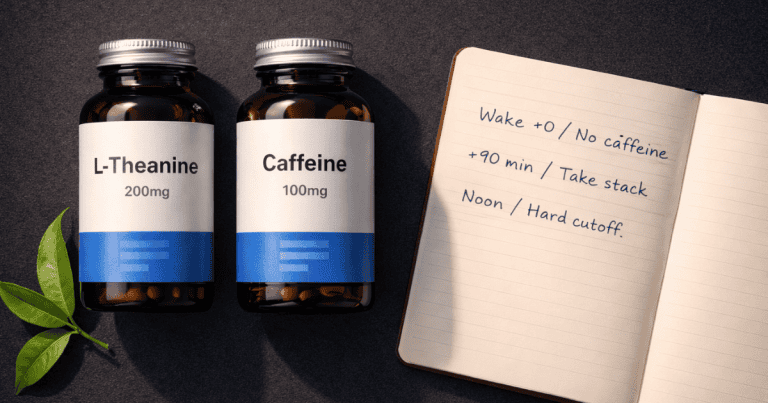
Caffeine and L-theanine (60–90 minutes before the session): The 1:2 ratio combination — 100–200mg caffeine with 200–400mg L-theanine — is the most evidence-supported acute neurochemical preparation for deep cognitive work. Caffeine’s adenosine blockade removes the fatigue signal that would otherwise compete with PFC engagement. L-theanine’s alpha wave promotion produces the alert-but-relaxed state that is neurologically optimal for sustained concentration — identical to the state that experienced meditators produce through practice. The combination should be timed 60–90 minutes before the deep work session to align peak effect with session start. Full protocol details are in the caffeine and L-theanine guide.
Rhodiola Rosea (30–60 minutes before demanding sessions): For deep work sessions that occur under conditions of stress, fatigue, or late in a cognitively demanding day, Rhodiola’s monoamine-preserving and cortisol-modulating mechanisms protect PFC dopamine and norepinephrine availability from stress-induced depletion. The result is maintained signal clarity in the attentional circuits despite the background conditions that would otherwise cause PFC function to degrade as session duration extends.
Creatine (daily, any time): Creatine’s phosphocreatine ATP buffering mechanism is particularly relevant to deep work — the most cognitively demanding and therefore most energy-intensive form of cognitive work. Sessions of genuine deep cognitive engagement deplete neural ATP faster than baseline mitochondrial production can replenish it; creatine’s phosphocreatine reservoir extends the window of high-quality PFC function before energy depletion becomes limiting. At 5g daily, the brain phosphocreatine saturation required for this protective effect is maintained continuously.
Step 2 — Environmental Architecture: Removing Attentional Competition
Environmental design for deep work is not about comfort — it is about removing every stimulus that would trigger the alerting network’s involuntary orienting response and break the task-positive network’s engagement. The environmental preparation protocol is non-negotiable: without it, no neurochemical preparation or mindfulness skill produces its full deep work benefit.
Device removal: As established by the Ward et al. smartphone research, the mere proximity of a smartphone reduces available working memory capacity even when it is silent. For deep work sessions, the phone is physically removed from the work environment — not silenced, not placed face down, removed. This is the single most impactful environmental intervention for deep work quality.
Communication blackout: Email, messaging applications, and social media notifications are closed entirely — not minimized — for the duration of the deep work session. The boundary between deep work time and communication time is explicit, communicated to colleagues if necessary, and not compromised by “just quickly checking” during the session. Each such check reactivates the DMN and restarts the 23-minute re-engagement clock.
Single-tab, single-task browser configuration: For computer-based deep work, the browser should contain only the tabs directly required for the current task. Each additional open tab represents a visual stimulus that competes for attentional resources and an available distraction pathway that the habitual checking impulse will exploit. Browser extensions that block distracting sites during deep work sessions (Freedom, Cold Turkey, or equivalent) provide external enforcement for the first weeks of protocol implementation before the behavioral habit is established.
Auditory environment: The auditory environment should be either silent or masked with non-lyrical sound. Research on background noise and cognitive performance found that moderate ambient noise (approximately 70 decibels) can enhance creative cognitive performance through moderate distraction — but that variable, unpredictable sounds (conversation, notifications, music with lyrics) consistently impair sustained attention by triggering involuntary auditory orienting responses. White noise, brown noise, or instrumental music at consistent volume are the appropriate choices for deep work environments.
Step 3 — Mindfulness Activation: The Pre-Session Practice
The 2–5 minute mindfulness transition practice before a deep work session is not optional if the goal is to maximize session quality from the first minutes rather than spending the first 10–15 minutes struggling to disengage the DMN. The pre-session practice is:
Sit at the work station with eyes closed. Take three deliberate, slow breaths — using the breath as an anchor to shift attentional mode from the ambient multi-tasking state of daily life to the single-pointed focused state that deep work requires. Spend 2–3 minutes with attention anchored on the breath, noticing when it wanders and returning it. Before opening eyes, bring to mind the specific task and outcome for the deep work session — the precise deliverable or cognitive objective. This intention-setting primes the PFC with the task representation that will govern attentional allocation during the session. Then open eyes and begin.
This practice works because it uses the same attention regulation circuit that the foundational mindfulness practice trains — applying it as a direct preparation for the specific attentional state the deep work session requires. It reduces DMN activation at session start, primes the task-positive network with the session objective, and produces measurably better session quality in the first 15 minutes compared to diving directly into work from a distracted ambient state.
Step 4 — Session Architecture: Structuring Time for Deep Cognitive States
Session length: Deep work sessions should be structured around the biology of sustained attention rather than arbitrary time blocks. The ultradian rhythm — the approximately 90-minute cycle of high and lower neural arousal — provides the biological framework. A single deep work session of 60–90 minutes, followed by a genuine recovery break (physical movement, non-screen rest, or a brief outdoor exposure), respects the neurological reality of attentional capacity better than attempting 3-hour marathon sessions that degrade into shallow work after the first 90 minutes. For those new to deliberate deep work practice, beginning with 45–60 minute sessions and building toward 90 minutes over 4–6 weeks is more sustainable than beginning with sessions that exceed current attentional capacity.
Session scheduling: Deep work sessions should be scheduled during the individual’s peak biological alertness window — typically 2–4 hours after waking for morning chronotypes, which aligns with the combined effects of the cortisol awakening response and the delayed caffeine timing protocol. Administrative work, email, and shallow tasks should be scheduled outside the peak alertness window — typically early afternoon for morning chronotypes — preserving peak neurochemical conditions for deep work.
The deep work ritual: Consistency in the time, location, and preparation sequence for deep work sessions reduces the cognitive friction of entering deep states over time. Research on habit formation and automaticity found that consistent context cues accelerate the automatization of behavioral sequences — meaning that consistently performing the same pre-session ritual (same location, same preparation sequence, same mindfulness practice) causes the ritual itself to become a contextual cue that initiates the attentional shift toward deep cognitive states. After 4–6 weeks of consistent ritual execution, the deep work state becomes progressively easier to access because the ritual has become a neurological trigger for it.
Step 5 — Managing Attention During the Session
Even with optimal neurochemical preparation, environmental design, and mindfulness priming, attention will wander during deep work sessions. This is not failure — it is the normal behavior of the default mode network under cognitive demand. The protocol for managing attention during the session is:
The productive struggle reframe: The moments of greatest cognitive difficulty in a deep work session — when a problem resists solution, when the right words do not come, when the analysis feels stuck — are precisely the moments of greatest myelination and cognitive development. The instinct to relieve this cognitive discomfort by checking email or switching tasks is the instinct that prevents deep work from producing its neurological benefits. The protocol is to notice the impulse to escape the difficulty, recognize it as the DMN’s habitual response to cognitive demand, and return to the task. Each such return is a training repetition of exactly the skill that deep work requires.
The capture-and-return technique: Intrusive thoughts, unrelated ideas, and open loops that surface during deep work sessions are captured immediately in a dedicated notebook or digital capture tool — with a single brief note — and returned from. The capture eliminates the working memory cost of suppressing the thought (which would otherwise consume PFC resources for the remainder of the session) without allowing it to derail the session. After the session, the capture list is processed. During the session, captured items are surrendered to the list and attention returns to the task.
Building Deep Work Capacity: The Progressive Development Protocol
Deep work is a skill — and like all skills, it is built progressively through deliberate practice rather than achieved immediately through effort. The capacity for sustained deep cognitive work develops through the same neurological mechanisms as any other skill: consistent practice that drives myelination of the attentional circuits, progressive overload that extends the ceiling of attentional stamina, and adequate recovery that allows the neurological adaptations to consolidate.
The Progressive Deep Work Schedule
Weeks 1–2 (Foundation): One deep work session daily of 45–60 minutes. Full environmental protocol. Pre-session mindfulness practice. Caffeine and L-theanine. No other deep work beyond this single session. The objective is establishing the ritual consistency that builds the contextual cue, not maximizing session volume. One reliable 50-minute deep work session daily produces more neurological development than three attempted sessions that degrade into distracted shallow work.
Weeks 3–4 (Extension): Extend the single daily session to 60–75 minutes as attentional stamina builds. Add a second shorter session (30–45 minutes) in the afternoon if schedule permits, scheduled outside the peak alertness window. Begin adding the structural nootropic stack — Lion’s Mane, Bacopa, Alpha-GPC — whose 8–12 week neuroplasticity timeline means beginning them now produces their full effects at the 12-week mark.
Weeks 5–8 (Development): Primary session extends toward 90 minutes. Secondary session to 50–60 minutes. The combination of mindfulness training and structural supplementation is now producing measurable changes — sessions feel qualitatively different, with less subjective effort required to maintain deep engagement and a more rapid recovery of attention after wandering episodes.
Weeks 9–12 (Integration): Two 90-minute deep work sessions daily becomes the sustainable target for most knowledge workers — 3 hours of genuine deep cognitive work that produces more high-quality output than 8 hours of distracted shallow work. The structural nootropics are approaching their full neuroplasticity effects. The mindfulness practice has produced measurable PFC structural changes documented in the research at 8 weeks. The complete integrated protocol is operating at capacity.
Frequently Asked Questions About Deep Work
How long should a deep work session be?
The evidence-based target for deep work session length is 60–90 minutes — aligned with the ultradian rhythm, the approximately 90-minute biological cycle of high and lower neural arousal. For those new to deliberate deep work practice, beginning with 45–60 minute sessions and building toward 90 minutes over 4–6 weeks is more sustainable than attempting longer sessions that exceed current attentional capacity and degrade into shallow work. The key metric is not session length but the quality of focus maintained throughout — a fully focused 50-minute session produces more myelination and cognitive development than a 90-minute session where attention wanders frequently after the first 30 minutes.
Why is deep work so hard to achieve?
Deep work is neurologically difficult in the modern environment because the digital ecosystem is specifically designed to exploit the brain’s attentional vulnerabilities. The alerting network responds to novel stimuli automatically and involuntarily — every notification, message, and social media update triggers an orienting response that breaks task-positive network engagement. Variable reward schedules on digital platforms produce stronger dopaminergic reinforcement than predictable rewards, training compulsive checking behavior through the same mechanism as slot machine addiction. And the 23-minute re-engagement cost of each interruption means that the typical knowledge worker — interrupted every 3–5 minutes — is neurologically incapable of achieving deep work without deliberate environmental design. The difficulty of deep work is not a willpower problem; it is a biological consequence of an environment that was not designed for sustained focused cognition.
How many hours of deep work per day is realistic?
Research on expert performance and deliberate practice suggests that most individuals reach a natural ceiling of 3–5 hours of genuine deep work per day — beyond which the quality of focused cognitive work degrades regardless of motivation or protocol. Newport’s observation that elite performers in cognitively demanding fields rarely exceed 4 hours of deep work daily is consistent with the neurological evidence on sustained PFC engagement. For most knowledge workers beginning a deep work practice, the realistic sustainable target is 2–3 hours daily across 1–2 sessions — an amount that, if genuinely deep, consistently produces more valuable output than 8 hours of distracted shallow work. The goal is quality and consistency, not maximum volume.
What is the best environment for deep work?
The optimal deep work environment removes every stimulus that would trigger the alerting network’s involuntary orienting response. Essential elements: smartphone physically removed from the work space (not silenced — removed, since its mere presence reduces working memory capacity); email and messaging applications closed entirely; browser containing only task-relevant tabs; auditory environment either silent or masked with consistent non-lyrical sound (white noise, brown noise, or instrumental music at stable volume); and a consistent location used exclusively for deep work to build the contextual cue that eventually makes the deep work state easier to access. The environmental design is not about comfort — it is about removing the attentional competition that would otherwise prevent the task-positive network from achieving and maintaining the deep engagement that produces high-quality cognitive output.
Do supplements help with deep work?
Yes — specific supplements directly support the neurochemical conditions that deep work requires. For acute session-specific support: caffeine and L-theanine at the 1:2 ratio optimize PFC dopamine and norepinephrine signaling and produce the alert-but-relaxed alpha wave state neurologically optimal for sustained concentration. Rhodiola Rosea protects PFC neurochemistry from stress-induced monoamine depletion during demanding sessions. Creatine’s phosphocreatine ATP buffering prevents the brain energy depletion that causes session quality to degrade after the first hour of intensive cognitive work. For long-term deep work capacity development: Lion’s Mane drives NGF production and myelination of the attentional circuits that deep work progressively develops, Bacopa enhances the cholinergic transmission that supports deep processing, and Alpha-GPC provides acetylcholine precursor for the attentional signal clarity that deep work demands. The complete supplementation protocol does not replace the environmental design and mindfulness skills that deep work requires — it optimizes the neurochemical environment in which those skills produce their full effect.
Deep Work as a Neurological Practice: The Integrated Approach
Deep work is not primarily a time management strategy. It is a neurological practice — one that requires understanding and engineering the biology of attention, the neurochemistry of focused cognitive states, and the attentional skills that determine whether the PFC can maintain the deep engagement that produces your most valuable work.
The complete protocol covers every biological variable: neurochemical preparation through the pre-session supplement stack, environmental design that removes attentional competition at the source, mindfulness activation that primes the task-positive network before the session begins, session architecture that respects the ultradian rhythm and the 23-minute re-engagement cost of interruptions, and the progressive development schedule that builds deep work capacity through the same myelination mechanisms that drive all skill development.
The result — after consistent application over 8–12 weeks — is not merely more productive work sessions. It is a qualitatively different cognitive capability: the ability to reliably enter and sustain the deep cognitive states in which complex problems are solved, difficult skills are acquired, and the work that actually advances your most important goals gets done.
For the complete neurochemical foundation that supports this protocol, see the complete focus guide. For the acute session supplement stack, see the caffeine and L-theanine guide and the Rhodiola guide. For the structural neuroplasticity foundation, see the Lion’s Mane and Bacopa guides. For the flow state that deep work practice builds toward, see the Flow State guide in this hub.
References
- Corbetta, M., & Shulman, G.L. (2002). Control of goal-directed and stimulus-driven attention in the brain. Nature Reviews Neuroscience, 3(3), 201–215. PubMed
- Craik, F.I.M., & Lockhart, R.S. (1972). Levels of processing: A framework for memory research. Journal of Verbal Learning and Verbal Behavior, 11(6), 671–684. PubMed
- Fields, R.D. (2008). White matter in learning, cognition, and psychiatric disorders. Trends in Neurosciences, 31(7), 361–370. PubMed
- Ulrich, M., et al. (2014). Neural correlates of experimentally induced flow experiences. NeuroImage, 86, 194–202. PubMed
- González, V.M., & Mark, G. (2004). Constant, constant, multi-tasking craziness. Proceedings of CHI 2004. PubMed
- Monk, C.A., Trafton, J.G., & Boehm-Davis, D.A. (2008). The effect of interruption duration and demand on resuming suspended goals. Journal of Experimental Psychology: Applied, 14(4), 299–313. PubMed
- Volkow, N.D., et al. (2011). Dopamine in drug abuse and addiction. Archives of Neurology, 64(11), 1575–1579. PubMed
- Lusk, S.L., et al. (2004). Effects of noise exposure on workers. AAOHN Journal, 52(11), 476–480. PubMed
- Lally, P., et al. (2010). How are habits formed: Modelling habit formation in the real world. European Journal of Social Psychology, 40(6), 998–1009. PubMed
Tags: deep work, deep work neuroscience, deep work protocol, distraction-free productivity, myelin and skill development, default mode network deep work, flow state deep work, 23 minute interruption cost, deep work sessions, deep work schedule, caffeine deep work, nootropics for deep work, attention management, deep work vs shallow work, ultradian rhythm productivity
About Peter Benson
Peter Benson is a cognitive enhancement researcher and mindfulness coach with 18+ years of personal and professional experience in nootropics, neuroplasticity, and attention optimization protocols. He has personally coached hundreds of individuals through integrated focus improvement programs combining evidence-based mindfulness training with targeted supplementation strategies. NeuroEdge Formula is his platform for sharing rigorous, safety-first cognitive enhancement guidance.