
Flow State: The Neuroscience and How to Trigger It Consistently
Affiliate Disclosure: This article contains one affiliate link to a product Peter personally uses. If you buy through it, NeuroEdge Formula earns a small commission at no extra cost to you. Recommendations are never influenced by commissions.
Educational Disclaimer: This article reflects independent research and personal experimentation, not clinical guidance. Peter Benson is a cognitive enhancement researcher, not a medical doctor. Any supplement mentioned affects individuals differently — consult a qualified healthcare provider before starting anything new, particularly if you have a pre-existing condition or take medication.
| What flow state is | A state of complete, effortless absorption in a task — action and awareness merge, self-consciousness fades, and time distorts. First described by psychologist Mihály Csíkszentmihályi. |
| The neuroscience | Transient hypofrontality: self-monitoring parts of the prefrontal cortex quieten. Jazz-improvisation fMRI shows deactivation of those regions (Limb & Braun, 2008). |
| Key condition | Challenge-skill balance — hard enough to demand full attention but not so hard it causes anxiety. A meta-analysis of 28 studies confirms it as a robust flow antecedent (Fong et al., 2015). |
| How to trigger it | Clear goals, immediate feedback, a matched challenge, and distraction-free deep focus. You can’t force flow directly — you build the conditions and let it emerge. |
| Evidence standard | Strong psychological research on the conditions; neuroimaging and brain-stimulation work is promising but still early. Graded honestly below. |
| Biggest mistake | Chasing flow as the goal. Flow is a by-product of the right conditions and deep engagement — pursue the work, and the state follows. |
Flow State: The Neuroscience of Effortless Focus (And How to Enter It)
By Peter Benson, Cognitive Enhancement Researcher | 18+ Years Independent Research · Last reviewed & citations verified: August 2026
You’ve felt it, even if you’ve never named it: those stretches where the work seems to do itself, distractions vanish, the inner critic goes quiet, and two hours pass like twenty minutes. That’s flow — and it’s not a mystical state reserved for elite athletes and artists. It’s a describable, increasingly well-understood mode of brain function with identifiable conditions you can deliberately create. In 18+ years of studying cognitive performance and tracking my own with tools like Creyos and an Oura Ring, flow is the state I’ve found hardest to force and most rewarding to engineer the conditions for.
This guide covers what flow actually is, the neuroscience of why it feels effortless, the conditions research shows reliably produce it, and how to set those conditions up in your own work. It’s part of the broader Focus & Productivity Optimisation framework.
A quick promise up front: I’ll be honest about where the science is solid and where it’s still early, because flow is a field where the hype often runs ahead of the evidence.
What Flow State Actually Is
Flow was first described in the 1970s by the psychologist Mihály Csíkszentmihályi, who noticed that artists, athletes and chess players kept reporting the same experience during peak performance: total absorption, a merging of action and awareness, a loss of self-consciousness, and a distorted sense of time. He called it “optimal experience” — a state in which people are so involved in an activity that nothing else seems to matter.
The defining features are consistent across domains: intense, focused concentration on the present moment; the sense that action and awareness have merged; a fading of self-conscious rumination; a feeling of control; a distorted experience of time (usually speeding up); and the activity becoming intrinsically rewarding — worth doing for its own sake. Crucially, flow isn’t relaxation. It’s a high-engagement state that sits at the intersection of full concentration and near-effortlessness, which is exactly what makes it feel so distinctive.
The Neuroscience: Why Flow Feels Effortless
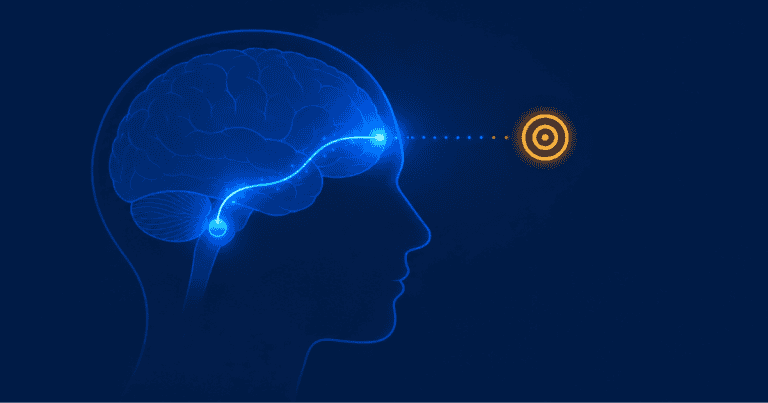
The leading neuroscientific explanation is the transient hypofrontality hypothesis: during flow, parts of the prefrontal cortex — the brain’s centre for self-monitoring, planning and critical self-talk — temporarily downregulate. When the region that generates your inner critic quietens, self-consciousness fades and action becomes fluid. That’s the neural correlate of “getting out of your own way.”
The most elegant evidence comes from jazz. When researchers had professional pianists improvise inside an fMRI scanner, they found a striking pattern: improvisation was characterised by extensive deactivation of the dorsolateral prefrontal cortex — a self-monitoring, inhibitory region — alongside activation of medial prefrontal areas linked to self-expression (Limb & Braun, 2008). In plain terms: to create freely, the musicians’ brains turned down the internal editor and turned up self-generated expression. Strictly, the study examined improvisation rather than flow directly — the authors didn’t set out to measure flow — but the pattern is the one the flow literature keeps pointing to, and it’s the closest thing we have to transient hypofrontality visible on a scan.
More recent work has even explored inducing flow directly through brain stimulation. A review of flow neuroscience highlights transcranial direct current stimulation (tDCS) — mild electrical stimulation of the prefrontal cortex — as a novel, experimental method for facilitating flow, with early studies reporting effects on subjective flow relative to sham stimulation (Gold & Ciorciari, 2020). This is genuinely intriguing, but I’ll be candid: it’s early-stage work with small samples and some conflicting results, and I’d treat “stimulate your way into flow” as a research direction rather than an established tool. The reliable levers remain behavioural.
The Conditions That Reliably Produce Flow
You can’t will yourself into flow, but you can build the conditions that summon it. The most important is challenge-skill balance: the task must be hard enough to demand your full capacity but not so hard it tips you into anxiety, and not so easy it drops you into boredom. Flow lives in the narrow channel between the two. A meta-analysis of 28 studies confirmed challenge-skill balance as a robust contributor to flow — with a moderate effect size — alongside clear goals and a sense of control (Fong, Zaleski & Leach, 2015).
Interestingly, that balance point isn’t fixed. Research on the moderators of challenge-skill balance found that the perceived importance of an activity shifts it — people report flow at lower objective challenge levels when the stakes feel meaningful (Engeser & Rheinberg, 2008). A task you care about pulls you into flow more readily than an identically difficult task you don’t.
Two further conditions matter. Clear goals give your attention a target, so you always know what “doing well” means moment to moment. And immediate feedback lets you adjust continuously without breaking concentration — which is why activities like climbing, music and coding produce flow so readily: the feedback is instant and unambiguous. In a workplace context, research on fostering flow at work points to designing tasks with exactly these features — clear goals, matched challenge and structured feedback (Bartholomeyczik et al., 2023).
Flow State Versus Deep Work
These two are constantly confused, and the distinction is practical. Deep work is the deliberate practice of sustained, distraction-free concentration on demanding tasks — something you can do even when it feels effortful and unpleasant. Flow is a subjective state of effortless absorption that sometimes emerges during deep work but can’t be produced on command. Put simply: deep work is the discipline you control; flow is the reward that sometimes arrives once you’ve removed distractions and hit the right challenge level. The reliable move is to practise deep work and set the conditions for flow — not to chase the state itself, which tends to evaporate the moment you reach for it.
How to Enter Flow Deliberately
The practical recipe follows directly from the conditions. Choose a task at the edge of your ability — challenging but achievable. Define a crisp, specific goal for the session so your attention has a clear target. Eliminate distractions ruthlessly, because flow cannot coexist with interruption; the fragmentation that destroys deep work destroys flow just as surely. Build in a way to get immediate feedback on your progress. Then commit to a sustained block — flow typically needs 15–20 minutes of uninterrupted engagement just to begin, which is why a protected morning block is such fertile ground for it.
One underrated factor is protecting the working memory capacity flow depends on — an intrusive-thought capture pad keeps stray concerns from pulling you out. And there’s a modest support worth a mention: the L-theanine and caffeine combination promotes calm, sustained attention, which can help you settle into the deep concentration that precedes flow. To be clear, no supplement produces flow — but supporting the underlying focus is legitimate, and sourcing notes are below.
🧮 Worked example — engineering a flow session for a hard writing task
Say you have to write the difficult analysis section of a report — genuinely demanding, but within reach. Here’s the protocol applied, rather than “hope flow shows up.”
Set the challenge. The section is hard enough to absorb you — good. If it felt hopeless (which breeds anxiety, not flow), you’d shrink the goal to just the first sub-argument to pull it back into the channel; if it were trivial, you’d raise the bar.
Define the goal. Not “work on the report” but “draft the three paragraphs making the case for X.” Now your attention knows what “doing well” means minute to minute — the clear-goal condition, made concrete.
Remove all friction. Phone in another room, notifications off, one document, one screen, capture pad beside you so stray thoughts (“email Sam,” “check the Q3 figure”) get parked instead of pulling you out mid-sentence.
Commit past the on-ramp. The first 15 minutes will feel effortful and distinctly un-flow-like. That’s the on-ramp, not failure — you keep going instead of bailing to check your phone.
The worked judgement: notice you never tried to “get into flow” — that’s the move that reactivates the self-monitoring flow needs switched off. You built the conditions and engaged with the writing. Around the 20-minute mark, if it’s going to happen, the self-consciousness drops away and the paragraphs start coming faster than you can second-guess them. And if it doesn’t fully arrive today, you still did a focused, distraction-free deep-work block — which is the part you actually control, and the reason the state has any chance at all.
What Actually Triggers Flow
Ranked by strength of evidence. The psychological conditions are far better established than the brain-stimulation work. 🟢 Strong · 🟡 Moderate · 🔴 Preliminary
The NeuroEdge Protocol
The NeuroEdge Flow Entry Protocol
1 — Set the challenge
Pick a task at the edge of your ability — stretching but achievable. Too easy breeds boredom; too hard breeds anxiety. Aim for the channel between.
2 — Define a clear goal
One specific, unambiguous target for the session. Your attention needs to know what “doing well” means, moment to moment.
3 — Remove all friction
Phone away, notifications off, one task, one screen. Capture pad for intrusive thoughts. Interruption is flow’s single greatest enemy.
4 — Commit past the on-ramp
Give it 15–20 uninterrupted minutes before expecting anything. Flow has an on-ramp; push through the initial resistance and let the state build.

Peter’s Testing Notes — Flow as a By-Product
First-person, n=1 · reported honestly · Updated August 2026
Flow is the state I’ve spent the most years trying to reverse-engineer, and the most humbling. The clearest thing my own tracking has taught me is that flow is a by-product, never a target. On the days I sat down determined to “get into flow,” I almost never did — the self-monitoring that flow requires you to switch off is exactly what you activate by watching for it. The days it arrived were the days I simply set a hard, meaningful task, killed distractions, and started.
On supplements: I’ve experimented with the L-theanine and caffeine stack before deep sessions for years. I want to be precise about what it does and doesn’t do — it supports the calm, sustained attention that precedes flow, but I no longer credit it with directly producing the state. That’s a distinction the marketing around “flow supplements” tends to blur, and I’d rather be honest: the stack helps me settle in; the work and the conditions do the rest. This is n=1 observation tracked with Creyos and personal notes, held loosely.
The single most reliable flow trigger I’ve found isn’t a substance or a technique — it’s genuine stakes. A task that actually matters to me pulls me under far faster than an identical task that doesn’t. Which fits the research on perceived importance almost perfectly.
Sourcing Standards
No supplement produces flow — the conditions do. But if you want the one attention-support option I actually use before deep sessions, this is the quality, dose-transparent product I reach for.
Performance Lab Caffeine 2
A caffeine capsule that already includes L-theanine, delivering the calm-focus pairing in one dose — the sustained attention that precedes flow, not flow in a bottle. Clean formulation; my go-to before a demanding deep session.
Key Takeaways — Flow State
Flow is total, effortless absorption — action and awareness merge, self-consciousness fades, and time distorts. It’s a describable brain state, not magic.
Transient hypofrontality explains the feel — self-monitoring prefrontal regions quieten. Jazz-improvisation fMRI shows this pattern directly (Limb & Braun, 2008).
Challenge-skill balance is the key condition — hard enough to absorb you, not so hard it triggers anxiety (Fong et al., 2015).
Set the conditions, then stop chasing. Clear goal, matched challenge, zero distraction, immediate feedback — flow is a by-product, not a target.
Deep work is the discipline you control; flow is the reward that sometimes follows. No supplement produces flow — meaningful stakes do more than any capsule.
Flow State — FAQ
Is flow state the same thing as deep work?
Related but not identical. Deep work describes the deliberate practice of sustained, distraction-free concentration on demanding tasks — something you can do even when it feels effortful. Flow describes a subjective state of effortless absorption that sometimes emerges during deep work but can’t be forced directly. Think of deep work as the discipline you control and flow as the occasional reward that appears once you’ve removed distractions and matched the challenge to your skill. You practise deep work; flow arrives on its own terms.
How long does it take to get into flow?
Flow generally has an on-ramp of roughly 15–20 minutes of uninterrupted engagement before the state begins to take hold. This is precisely why interruptions are so costly — a single distraction can reset the clock and force you to rebuild concentration from the start. To reach flow reliably, protect a continuous block of at least 30–45 minutes, remove all sources of interruption, and push through the initial period of resistance rather than abandoning the task when it doesn’t feel effortless immediately.
Can you force yourself into flow?
Not directly — and trying tends to backfire. Flow requires the self-monitoring parts of the prefrontal cortex to quieten, and actively watching for flow reactivates exactly that self-consciousness, keeping the state away. What you can do is reliably build the conditions that summon it: a task matched to your skill level, a clear goal, immediate feedback, and complete freedom from distraction. Set those up, engage fully with the work itself, and let flow emerge as a by-product rather than pursuing it as the objective.
What actually happens in the brain during flow?
The leading explanation is transient hypofrontality — parts of the prefrontal cortex responsible for self-monitoring and critical self-talk temporarily downregulate. When jazz musicians improvised inside an fMRI scanner, researchers observed extensive deactivation of the dorsolateral prefrontal cortex alongside activation of self-expression areas (Limb & Braun, 2008). That study measured improvisation rather than flow directly, but the pattern is the one the flow literature keeps returning to: the brain turns down its internal editor, which is why flow feels effortless and free of the usual self-conscious hesitation.
What kinds of tasks produce flow most easily?
Activities with built-in clear goals and immediate feedback tend to produce flow most readily — which is why climbing, music, sport, gaming and coding are classic examples. In each, you always know how you’re doing and can adjust instantly without breaking concentration. Any task can become flow-friendly if you engineer those features into it: define a specific goal, create a way to see progress in real time, and set a challenge level that stretches you. Tasks you find genuinely meaningful pull you into flow more easily than equally difficult ones you don’t care about.
Get “7 Days to a Sharper Brain” — Free
Peter Benson’s personal daily protocol, rebuilt from 18 years of testing
Seven evidence-based interventions, in the exact order that makes each one more effective — from sleep foundation to your complete assembled daily stack.
Join 2,000+ readers optimising their cognitive performance. Unsubscribe anytime.
Scientific References
- Limb CJ, Braun AR. (2008). Neural substrates of spontaneous musical performance: an fMRI study of jazz improvisation. PLoS ONE, 3(2):e1679. PMID 18301756
- Gold J, Ciorciari J. (2020). A review on the role of the neuroscience of flow states in the modern world. Behavioral Sciences, 10(9):137. PMID 32916878
- Fong CJ, Zaleski DJ, Leach JK. (2015). The challenge–skill balance and antecedents of flow: a meta-analytic investigation. The Journal of Positive Psychology, 10(5):425–446. Journal of Positive Psychology
- Engeser S, Rheinberg F. (2008). Flow, performance and moderators of challenge-skill balance. Motivation and Emotion, 32(3):158–172. Springer
- Bartholomeyczik K, Knierim MT, Weinhardt C. (2023). Fostering flow experiences at work: a framework and research agenda. Frontiers in Psychology, 14:1143654. PMID 37484110
- Csíkszentmihályi M. (1990). Flow: The Psychology of Optimal Experience. Harper & Row. (Foundational text establishing the flow construct.)
Peter Benson
Cognitive Enhancement Researcher | 18+ Years Independent Research
Peter has spent 18+ years researching cognitive performance and testing focus, attention, and flow-related interventions through systematic self-experimentation, tracking cognitive data with Creyos and an Oura Ring. He writes about the mechanisms behind cognitive performance rather than the hype that surrounds them. Every study cited here was verified against source.
Last reviewed: August 2026 | Educational content only. Not medical advice.