Neuroscience of Procrastination
Educational Disclaimer: This article is for educational purposes only and is not medical advice. Chronic, severe procrastination can accompany anxiety, depression, or ADHD, which deserve proper assessment. If procrastination is significantly harming your work, studies, or wellbeing, consult a qualified healthcare provider. Peter Benson is a cognitive enhancement researcher, not a medical doctor.
| What procrastination really is | Best understood not as a time-management or laziness problem, but as an emotion-regulation problem. You delay a task to escape the negative feeling it triggers — boredom, anxiety, self-doubt — trading a worse future for a better-feeling present. |
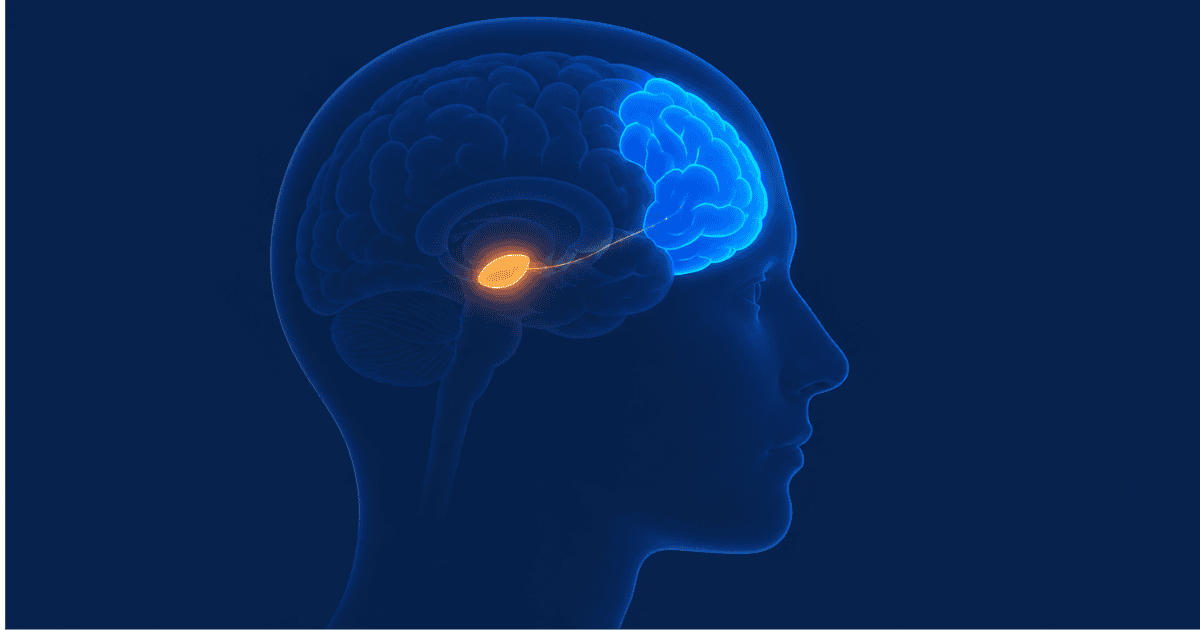
| The core mechanism | A tug-of-war between the limbic system (which wants to avoid the task’s unpleasant feeling now) and the prefrontal cortex (which holds the long-term goal). When the emotional signal wins, you procrastinate — regardless of how much you “want” the outcome. |
| The brain-structure finding | In a 264-person MRI study, people lower in the trait linked to procrastination had a larger amygdala and weaker connectivity between it and the regions that regulate it (Schlüter et al., 2018) — a single correlational study, but a suggestive one. |
| Why deadlines “work” | Procrastination follows delay discounting: a reward far in the future barely motivates you, but as the deadline nears its value spikes and finally overpowers the task’s aversiveness. The all-nighter isn’t discipline arriving — it’s the maths of time finally tipping. |
| What actually helps | Target the feeling, not the schedule: reduce the task’s aversiveness, regulate the emotion before it drives avoidance, self-forgive past procrastination (which one study links to less future delay), and shrink the first step below the threshold that triggers avoidance. |
| Biggest misunderstanding | That procrastinators lack willpower or care. The evidence points the other way — chronic procrastinators are often more anxious about the task and its consequences, which is precisely why avoidance feels so relieving in the moment. |
The Neuroscience of Procrastination: Why Your Brain Delays Important Work
By Peter Benson, Cognitive Enhancement Researcher | 18+ Years Independent Research · Last reviewed & citations verified: August 2026
You have a deadline. You know exactly how much trouble you are storing up by not starting. You may even feel a low hum of dread about it all day — and you still open a new browser tab instead. Then comes the familiar verdict: I’m lazy, I have no discipline, what is wrong with me. The neuroscience of procrastination tells a very different and more accurate story. Procrastination is not a character defect or a time-management failure. It is what happens when your brain chooses to escape a bad feeling now at the expense of your future self — and once you see the mechanism clearly, you can stop fighting the wrong battle.
In 18+ years of researching cognitive performance and testing interventions on myself, the reframe that helped me most was giving up on “try harder” entirely. Procrastination researchers have converged on a striking conclusion: it is fundamentally an emotion-regulation problem, not a productivity one. This article covers what is actually happening in the brain when you delay, why deadlines suddenly rescue you, the surprising finding that self-criticism makes procrastination worse, and a mechanism-based way out. It sits within the Focus & Productivity Optimisation framework, and it pairs closely with the companion piece on the dopamine-motivation connection — where motivation is about the pull toward a reward, procrastination is about the push away from a feeling.
One boundary first: everyone delays sometimes, and occasional procrastination is normal. Chronic, distressing procrastination that pervades your life can accompany anxiety, depression, or ADHD, and those deserve proper assessment rather than a productivity hack — a line covered near the end.
Procrastination Is Emotion Regulation, Not Time Management
The single most important shift in understanding procrastination came when researchers stopped treating it as a scheduling failure and started treating it as a mood problem. In an influential account, Sirois and Pychyl argued that procrastination is driven by the priority of short-term mood repair — we delay a task to relieve the negative feelings it provokes, prioritising how we feel right now over the goals of our future self. The task is boring, or hard, or threatens our sense of competence; approaching it produces an unpleasant feeling; and delaying makes that feeling go away. The relief is real and immediate, which is exactly why the habit is so sticky. It’s worth being clear that this is a well-supported theory built largely on correlational evidence, not a proven causal chain — but it fits the data better than any rival account.
It also explains something the “lazy” theory never could: why we procrastinate on tasks we genuinely care about, sometimes more than on trivial ones. If procrastination were about not caring, we would delay the unimportant work and rush to the important. Instead the pattern often reverses, because the tasks that matter most are the ones most loaded with emotional weight — fear of doing them badly, of being judged, of confirming a doubt about ourselves. The bigger the emotional charge, the stronger the pull to escape it.
The large-scale evidence backs this up. In the definitive meta-analysis of the field, drawing on 691 correlations, Piers Steel found that the strongest and most consistent predictors of procrastination were task aversiveness, impulsiveness, and low expectancy of success — not laziness, and not poor time-awareness. The more unpleasant a task feels and the less confident you are of succeeding, the more likely you are to put it off. Procrastination is your brain’s escape response to an aversive feeling, and it targets precisely the tasks that generate the most of it.
What’s Actually Happening in the Brain
Underneath the feeling is a genuine neural tug-of-war. On one side is the limbic system — older, faster, emotion-driven — which registers the task as a source of discomfort and pushes for immediate relief. On the other is the prefrontal cortex, which holds your long-term intention and tries to override the emotional pull in service of the goal. Every act of “just starting” is that regulatory system winning; every act of avoidance is the emotional system winning. Procrastination is not the absence of a control system — it is the emotional system out-competing it.
There is brain-imaging evidence consistent with this picture, though it needs to be read carefully. In a study of 264 adults, Schlüter and colleagues found that people lower in “action orientation” — a trait tied to difficulty initiating action — had a larger amygdala, the brain’s threat and emotion hub, and weaker functional connectivity between the amygdala and the dorsal anterior cingulate cortex, a region that helps regulate emotional responses and select actions. Two caveats matter. This is a single correlational study, so it shows association, not cause. And it measured action orientation rather than clinical procrastination directly, though the two are closely related. The researchers’ interpretation — that a larger, less-regulated amygdala may make someone more sensitive to a task’s potential downsides, so they hesitate and delay — is explicitly offered as informed speculation, and I’ll treat it that way.
Even held at that appropriate distance, it reframes the problem usefully. If procrastination were a willpower deficit, the fix would be more force. But if it involves an over-active threat response with under-active regulation, the fix is to lower the threat and strengthen the regulation — a completely different, and far more effective, set of strategies. The phone in your hand is not the disease; it is the nearest available mood-repair tool, a point explored further in the guide on digital distraction and the brain.
Why the Deadline Always Rescues You
Almost every procrastinator has the same experience: the task feels impossible for days, then becomes suddenly, urgently doable the night before it is due. That is not your discipline finally arriving. It is a well-described feature of how the brain values rewards over time, called delay discounting — the further away a reward or consequence is, the less weight your brain gives it now. Steel’s meta-analysis frames procrastination within exactly this logic (temporal motivation theory): a task’s motivational value is driven up by how much you expect to succeed and how much you value the outcome, and driven down by how far away the payoff is and how impulsive you are.
Early on, the deadline is distant, so the reward for acting is discounted almost to nothing — while the task’s aversiveness is right here, at full strength. Avoidance wins easily. As the deadline approaches, the consequence stops being abstract and becomes imminent, its value climbs steeply, and at some point it finally overpowers the task’s unpleasantness. You start. The lesson is not “use panic as a strategy” — that is stressful and caps the quality of your work — but rather that you can manufacture the same effect deliberately, by shrinking the psychological distance to the reward and lowering the task’s aversiveness, instead of waiting for a crisis to do it for you.
The Fixes That Actually Target the Mechanism
If procrastination is an emotion-regulation problem, then every effective strategy works by reducing the aversive feeling or regulating it before it drives avoidance. That immediately rules out the most common “solution” — self-criticism — and points to some counterintuitive ones.
Stop beating yourself up — it backfires. Harsh self-judgment after procrastinating adds a fresh layer of negative emotion to a task that is already emotionally loaded, which makes it even more aversive and even harder to approach next time. Research on self-forgiveness points the other way: in a study of first-year students, those who forgave themselves for procrastinating before one exam went on to procrastinate less before the next. It’s a single study, so hold it loosely — but it aligns cleanly with the mechanism, because letting go of the guilt removes emotional weight from the task.
Lower the task’s aversiveness directly. Because task aversiveness is the top predictor, shrinking it is the highest-leverage move. Break the task into a first step so small it carries almost no emotional charge — “open the document and write the worst possible first sentence.” The goal of the first action is not progress; it is to slip under the threshold that triggers the threat response, so the amygdala never gets its cue to push for escape. This is also the doorway into genuine deep work — the hard part is almost always starting, not continuing.
Regulate the feeling before it becomes avoidance. When you notice the pull to flee a task, name the emotion driving it — “this is anxiety about doing it badly,” not “I’m just not in the mood.” Labelling an emotion is itself a mild regulation strategy, and it converts a vague aversive urge into a specific, manageable feeling. This is the top-down regulation the procrastination-prone brain tends to under-use.
Reduce distance to the reward. Since delay discounting flattens far-off rewards, deliberately bring them closer — set a nearer sub-deadline that actually feels real, make progress visible, and attach a small immediate reward to completing the first work block. A structured start to the day makes this dramatically easier, which is one reason the morning routine for productivity pays off well beyond the routine itself.
🧮 Worked example — the four moves on a task you’re dreading
Take a report you’ve been avoiding for a week — the classic case where you care about the outcome, which is exactly why it’s loaded. Here’s the mechanism-based approach applied in real time, rather than “just make yourself do it.”
Name it. You sit down, feel the familiar flinch, and instead of “I’m not in the mood,” you say the true thing: “this is anxiety that the analysis will be wrong.” The vague dread becomes one specific, manageable feeling — and naming it hands it to the prefrontal cortex.
Shrink it. Your first action is not “write the report.” It’s “open the file and paste in the three section headings.” Two minutes, no judgement possible, no threat — so the amygdala never gets its cue.
Near it. You set a 25-minute timer — a sub-deadline close enough to feel real — and promise yourself a coffee the moment it goes off. The payoff is now minutes away instead of days, so delay discounting stops flattening it.
Forgive it. You avoided this yesterday. Instead of a self-telling-off that would make today’s attempt heavier, you treat yesterday as information — the task is aversive, now you know why — and start anyway.
The worked judgement: notice what this does not promise. The resistance doesn’t vanish — it drops below the threshold that triggers escape. You’re not summoning willpower; you’re removing the emotional charge that willpower was fighting. Most of the time, the momentum from a two-minute start carries you past the twenty-five-minute mark without noticing.
How Strong Is Each Claim?
🟢 Strong | 🟡 Moderate / single study | 🔴 Commonly claimed, not supported
The NeuroEdge Anti-Procrastination Protocol
Four moves that target the emotion, not the schedule. Use them in the moment you feel the pull to avoid — that flicker of resistance is the cue.
Label the feeling, not the task
“This is anxiety about doing it badly.” Naming the emotion is itself regulation — it hands the feeling to the prefrontal cortex instead of the amygdala.
Make step one emotionally weightless
Define a first action so small it carries no threat — one sentence, one problem, two minutes. Slip under the amygdala’s trigger threshold.
Pull the reward closer
Set a nearer real sub-deadline and a small immediate reward after the first block, so delay discounting stops flattening the payoff.
Drop the self-blame afterwards
If you did procrastinate, self-forgiveness is linked to less next-time procrastination. Guilt adds emotional weight to the task; forgiveness removes it.

Peter’s Testing Notes — Procrastination as a Feeling
18+ years testing cognitive protocols · Updated August 2026
The change that made the biggest difference to my own procrastination was almost embarrassingly simple: I stopped asking “why won’t I do this?” and started asking “what does this task make me feel?” Nearly every time, the honest answer was some flavour of I might do it badly. Once I could see that the resistance was an emotion and not a scheduling issue, the whole thing became far more tractable — you cannot out-discipline a feeling, but you can work with one.
The self-forgiveness idea surprised me enough that I tried it deliberately. For years my response to a wasted afternoon was a hard internal telling-off, which I assumed was keeping me honest. It seemed to do the opposite — the next day I would approach the same task carrying not just its original difficulty but a fresh layer of shame, and I would avoid it harder. Deliberately dropping the self-criticism, treating a lapse as information rather than a verdict, lowered the friction the next day for me. That’s one person’s experience, not evidence — but it lines up with what the research would predict, and it worked better than the discipline ever had.
The honest limit: this is emotion-regulation for ordinary, healthy procrastination. There were stretches where my avoidance was really a symptom of being genuinely overloaded or under-slept, and no amount of reframing fixed that — the task felt aversive because I had nothing left, not because of a mislabelled feeling. When the whole system is depleted, the answer is recovery, not a cleverer relationship with the task.
When Procrastination Is Something More
Everything above concerns ordinary procrastination — the everyday friction of aversive tasks. But procrastination that is severe, chronic, and genuinely distressing can be a feature of an underlying condition rather than a habit to be managed. Persistent task-initiation difficulty is a recognised part of ADHD, which involves real differences in the brain’s dopamine and executive-control systems, and pervasive avoidance can accompany anxiety and depression. These are not willpower matters and they do not respond to productivity tweaks alone — they warrant proper assessment. If your procrastination is relentless, spans nearly everything, and is harming your work or wellbeing, the right step is a conversation with a qualified healthcare provider; the guide on focus problems and ADHD covers where that line sits.
Key Takeaways — The Neuroscience of Procrastination
Procrastination is emotion regulation, not time management. You delay to escape a task’s aversive feeling — that’s why you procrastinate hardest on the tasks that matter most.
It has a plausible brain signature. One MRI study links difficulty initiating action to a larger amygdala and weaker amygdala-to-control-region connectivity — suggestive, correlational, not the last word.
Deadlines rescue you via delay discounting. Far-off rewards barely motivate; as the deadline nears, the consequence’s value spikes and overpowers avoidance. You can engineer this without the panic.
Self-criticism backfires; self-forgiveness appears to help. Guilt adds emotional weight to the task. One study links forgiving a lapse to less procrastination next time.
Severe, pervasive procrastination can be clinical. If it spans nearly everything and harms your life, that’s a matter for assessment (anxiety, depression, ADHD) — not a productivity hack.
The Neuroscience of Procrastination — FAQ
Is procrastination a sign of laziness?
No — the research points in almost the opposite direction. Procrastination is best understood as an emotion-regulation problem: you delay a task to escape the negative feelings it triggers, such as anxiety, boredom, or self-doubt. This is why people often procrastinate hardest on the tasks they care about most, because those carry the greatest emotional weight. Chronic procrastinators are frequently more anxious about a task and its consequences, not less invested. Framing it as laziness misses the mechanism and tends to make it worse, because the self-criticism adds further negative emotion to an already aversive task.
What part of the brain causes procrastination?
Procrastination reflects an imbalance between the limbic system, which drives the emotional urge to avoid an unpleasant task, and the prefrontal cortex, which holds your long-term goal and regulates that urge. One brain-imaging study of 264 adults found that people who struggled more to initiate action had a larger amygdala — the brain’s threat and emotion centre — and weaker connectivity between the amygdala and the dorsal anterior cingulate cortex, a region involved in regulating emotion and selecting actions. That’s a single correlational study, so treat it as a strong clue rather than a settled cause, but it fits the emotion-regulation picture well.
Why can I only work when the deadline is close?
Because of delay discounting: your brain gives far less weight to rewards and consequences that are distant in time. Early on, the payoff for starting is heavily discounted while the task’s unpleasantness is felt at full strength, so avoidance wins easily. As the deadline nears, the consequence becomes imminent and its motivational value climbs steeply until it finally overpowers the task’s aversiveness — and you start. This isn’t discipline arriving late; it’s the arithmetic of time tipping. You can reproduce the effect deliberately by setting nearer sub-deadlines and making progress and rewards feel immediate, rather than relying on last-minute panic.
Does being hard on myself help me stop procrastinating?
The evidence suggests it makes procrastination worse. Because procrastination is driven by avoiding negative feelings, harsh self-criticism after a lapse adds a fresh layer of guilt and shame to a task that already feels aversive, making it even harder to approach next time. A study of first-year students found that those who forgave themselves for procrastinating went on to procrastinate less on the following occasion. It’s a single study, so hold it loosely — but treating a lapse as information rather than a moral verdict removes emotional weight from the task, which is exactly what an emotion-regulation problem calls for.
When is procrastination a sign of something medical?
When it is severe, chronic, pervasive, and genuinely distressing rather than task-specific. Occasional procrastination on aversive tasks is normal. But persistent difficulty initiating action across nearly all areas of life is a recognised feature of ADHD, which involves real differences in dopamine and executive-control systems, and pervasive avoidance can accompany anxiety and depression. These are clinical matters that respond to proper assessment and support, not to productivity techniques alone. If procrastination is relentless and harming your work, studies, or wellbeing, speaking with a qualified healthcare provider is the appropriate next step.
Get “7 Days to a Sharper Brain” — Free
Peter Benson’s personal daily protocol, rebuilt from 18 years of testing
Seven evidence-based interventions, in the exact order that makes each one more effective — from sleep foundation to your complete assembled daily stack.
Join 2,000+ readers optimising their cognitive performance. Unsubscribe anytime.
Scientific References
- Sirois FM, Pychyl TA. (2013). Procrastination and the priority of short-term mood regulation: consequences for future self. Social and Personality Psychology Compass, 7(2):115–127. Wiley
- Steel P. (2007). The nature of procrastination: a meta-analytic and theoretical review of quintessential self-regulatory failure. Psychological Bulletin, 133(1):65–94. PMID 17201571
- Schlüter C, Fraenz C, Pinnow M, Friedrich P, Güntürkün O, Genç E. (2018). The structural and functional signature of action control. Psychological Science, 29(10):1620–1630. PMID 30118388
- Wohl MJA, Pychyl TA, Bennett SH. (2010). I forgive myself, now I can study: how self-forgiveness for procrastinating can reduce future procrastination. Personality and Individual Differences, 48(7):803–808. ScienceDirect
- Sirois FM. (2014). Procrastination and stress: exploring the role of self-compassion. Self and Identity, 13(2):128–145. Taylor & Francis
Peter Benson
Cognitive Enhancement Researcher | 18+ Years Independent Research
Peter Benson has spent 18+ years researching cognitive performance and testing focus, motivation, and productivity interventions through systematic self-experimentation. He writes about the mechanisms behind cognitive performance rather than the myths that surround them. Every study cited here was checked against source.
Last reviewed: August 2026 | Educational content only. Not medical advice.