The Forgetting Curve: Why Memories Fade and How to Slow It
By Peter Benson, Cognitive Enhancement Researcher · Updated October 2026 · Citations re-verified
Short answer: The forgetting curve describes how quickly new information fades if you don’t revisit it: loss is fastest soon after learning, then slows. Ebbinghaus mapped it in the 1880s and a 2015 study replicated it. Testing yourself and spacing reviews over time slow forgetting far more than rereading.
⚕️ Educational information, not medical advice — full disclaimer. This page is about ordinary forgetting. A sudden or marked change in your memory deserves a proper assessment by a doctor. This page contains no affiliate links.
You finish a lecture, a chapter or a training course feeling you’ve learned it. A week later much of it has gone, and it’s easy to conclude you have a bad memory. Usually you don’t. Fast early forgetting is what happens to almost everyone’s memories when nothing is done to keep them, and that pattern is the forgetting curve.
This guide to the forgetting curve covers what Ebbinghaus found, what modern research adds, why rereading barely changes it, and the two techniques that slow it. It sits in the Memory & Learning hub. Ordinary forgetting is normal and healthy; a sudden, out-of-character decline in memory is different and should be checked.
On this page
What is the forgetting curve?
In the 1880s the German psychologist Hermann Ebbinghaus ran one of the first careful memory experiments, on himself. He learned lists of nonsense syllables (deliberately meaningless, so prior knowledge couldn’t help), then measured how much faster he could relearn each list after delays from 20 minutes to a month. That “savings” measure showed how much of the original learning remained.
Savings isn’t the same as the percentage of information someone can freely recall. Modern studies use different memory tests, from free recall to recognition, which is another reason no single forgetting percentage applies to everyone.
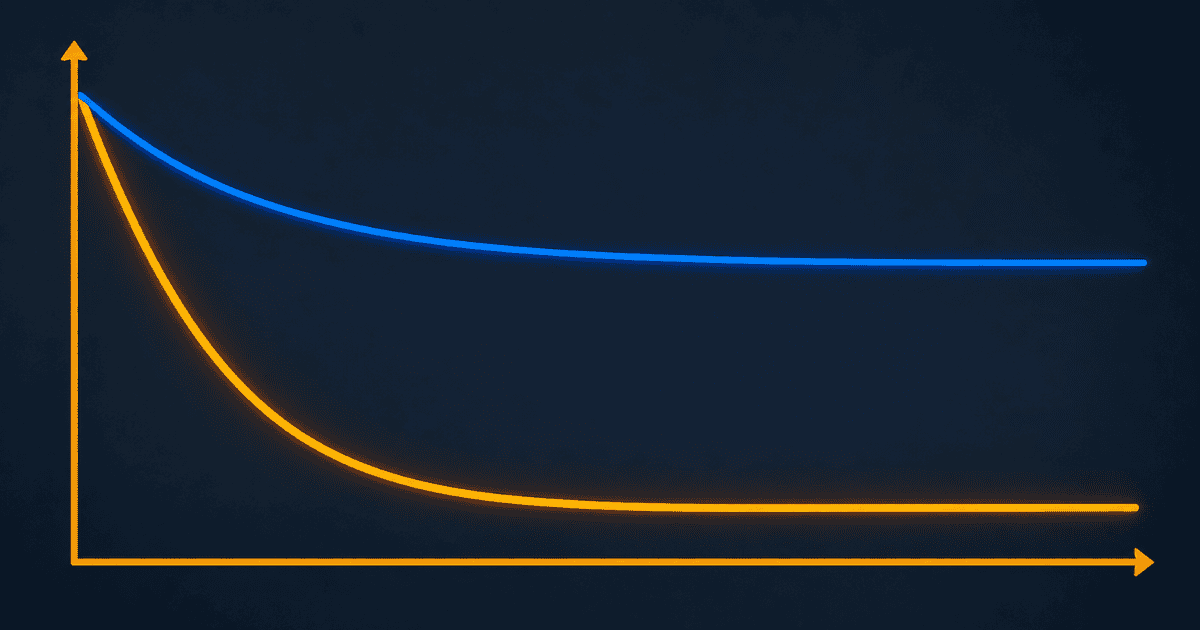
The result was a curve: retention fell fastest soon after learning, then more and more slowly. Forgetting isn’t linear; you don’t lose a steady amount each day. Later analyses found the decline is better described by a power-type function than a simple exponential (Wixted & Ebbesen, 1991), and a review of 210 data sets found a small family of similar curves fitted most retention data (Rubin & Wenzel, 1996). The exact mathematics matters less than the shape: a steep early drop that levels off.
Newly learned information is fragile at first, before it’s consolidated into longer-term memory, which is part of why the early period matters. It’s also why cramming can get you through a test the next morning and then fade quickly. Capacity limits during learning are covered in working memory.
Has the forgetting curve been replicated?
Yes. In 2015 Murre and Dros repeated Ebbinghaus’s method with one participant who spent about 70 hours learning lists and relearning them after delays from 20 minutes to 31 days. The curve closely resembled Ebbinghaus’s (Murre & Dros, 2015).
They also reported a possible upward shift in the curve from around the 24-hour measurement. Sleep-related consolidation is one possible explanation, and it fits wider research covered in sleep and memory consolidation, but the experiment didn’t test whether sleep caused it. With a single participant, it’s suggestive rather than a general rule about memory recovering after 24 hours.
Why don’t rereading and highlighting help much?
Rereading makes material feel fluent and familiar, and that fluency is easy to mistake for knowing it. Researchers call the result an illusion of competence: the material feels learned, so you stop working on it, and it fades anyway, because recognising something isn’t the same as being able to recall it.
In a well-known experiment, students who tested themselves on prose passages remembered more two days and a week later than students who restudied them the same number of times, even though restudying did slightly better on a test five minutes later and the restudy group felt more confident (Roediger & Karpicke, 2006). A major review rated rereading and highlighting as low-utility study techniques (Dunlosky et al., 2013).
How do you slow the forgetting curve?
Active recall. Retrieving information from memory, rather than reviewing it, strengthens it: material you’ve practised recalling tends to be forgotten more slowly than material you’ve only reread. Testing yourself, using flashcards, or closing the book and writing what you remember all count. The evidence is in the active recall guide, and the biology in the neuroscience of learning.
Spaced repetition. Spreading reviews over time, with gaps that widen, produces better long-term retention than the same reviews crammed together. A meta-analysis of 317 experiments confirmed the spacing effect (Cepeda et al., 2006), and a later study found the best gap grows with how long you need to remember (Cepeda et al., 2008). The method is covered in spaced repetition.
How they fit together: active recall is what you do; spacing is when you do it. They’re distinct effects, and spaced rereading still beats massed rereading, but combining spaced reviews with recall attempts is the practical way to get both.
Forgetting curve claims ranked by evidence
🟢 Stronger or replicated evidence · 🟡 Limited, mixed or preliminary evidence · 🔴 Not established or not supported
When should you do your first review?
An early review, often within the first day, is a reasonable starting point for newly learned material. The best timing depends on how well the information was learned, how difficult it is and how long you need to remember it. After that, adjust intervals according to how accurately you recall, rather than following a fixed schedule; widening gaps such as a few days, a week and a month are a common pattern. Make each review a recall attempt before you check. Flashcard apps adjust the timing for you.
Worked example — keeping a set of terms you learned today
Later today. Cover the definitions and try to produce each one from the term. Expect to miss several; mark them.
Tomorrow. Recall the whole set again, starting with yesterday’s misses. Some that felt impossible yesterday may now come with effort.
In a few days, then a week. Recall again at widening gaps. If items come easily, leave longer next time; if you miss them, review sooner.
Compared with rereading: reading the list five times today would feel more productive but leave less a month later. The difference is recalling rather than rereading, and spacing the attempts out.
The NeuroEdge Formula Forgetting Curve Self-Testing Framework
A practical routine based on the research, not a tested formula.
1. Review early
An early recall attempt, often within the first day, is a reasonable start; the best timing depends on the material and your goal.
2. Recall, don’t reread
Close the source and produce the answer, then check and note what you missed.
3. Adjust the gaps
Gradually widen the interval for material you recall accurately. If you keep forgetting an item, shorten the gap, improve the question or revisit the explanation. No single schedule suits everyone.
4. Protect sleep
Sleep supports consolidation; don’t trade it for extra review.
Peter’s Testing Notes
A personal note, not tracked data
Like most people, I used to study mainly by rereading and highlighting. For a certification exam I switched to closed-book recall and Anki flashcards, and I use flashcards now. I haven’t measured my own forgetting, so this page rests on the research.
An earlier version of this page described relearning Mandarin in my forties. That was not accurate and has been removed.
Key takeaways
| → | Forgetting is fastest soon after learning, then slows; it isn’t a steady daily loss. |
| → | The curve is real and replicated, from Ebbinghaus in the 1880s to a 2015 replication. |
| → | There’s no universal percentage: speed of forgetting depends on the material, how well it was learned and the person. |
| → | Rereading can help familiarity and immediate performance, but self-testing often produces better delayed retention; combine study with self-testing and spaced review. |
| → | Active recall plus spaced reviews slow forgetting; start with an early review and adjust the gaps to how well you recall. |
Frequently asked questions
How much do we forget, according to the forgetting curve?
There’s no single figure. Forgetting is fastest soon after learning and then slows, but how much is lost depends on the material, how well it was learned and the person. Ebbinghaus used meaningless syllables, which fade faster than meaningful material.
Is the forgetting curve scientifically valid?
Yes. Ebbinghaus documented it in the 1880s, a 2015 study replicated it closely, and analyses of hundreds of data sets find the same general shape: rapid early loss that slows over time.
How do you beat the forgetting curve?
Test yourself instead of rereading, and spread those tests out at widening intervals. Both have strong evidence. Sleeping well after learning helps too.
Why do I forget so quickly after studying?
Fast early forgetting is normal. Rereading and highlighting don’t harm memory, but they can create a feeling of familiarity that makes you overconfident, so you stop reviewing too soon. Recalling the material and spacing reviews slows forgetting.
When should I do my first review?
An early review, often within the first day, is a reasonable starting point. The best timing depends on how well you learned the material, how hard it is and how long you need it; then adjust intervals to how accurately you recall rather than following a fixed schedule.
Get “7 Days to a Sharper Brain” — Free
Peter Benson’s evidence-first starting framework
The habits with the strongest evidence first — sleep, movement, stress and learning — then how to add a single supplement and test whether it actually works for you.
No spam. Unsubscribe anytime.
⚕️ Educational Information, Not Medical Advice
This article is educational and is not medical advice. I’m a cognitive enhancement researcher, not a medical doctor. The guide covers lifestyle habits as well as supplements. Supplements can interact with medicines; consult a qualified healthcare provider before use, particularly if you take prescription medicines or are pregnant or breastfeeding.
Scientific references
1. Ebbinghaus, H. (1885). Über das Gedächtnis (translated 1913 by Ruger & Bussenius as Memory: A Contribution to Experimental Psychology).
2. Murre, J. M. J., & Dros, J. (2015). Replication and analysis of Ebbinghaus’ forgetting curve. PLoS One, 10(7), e0120644. DOI: 10.1371/journal.pone.0120644
3. Wixted, J. T., & Ebbesen, E. B. (1991). On the form of forgetting. Psychological Science, 2(6). DOI: 10.1111/j.1467-9280.1991.tb00175.x
4. Rubin, D. C., & Wenzel, A. E. (1996). One hundred years of forgetting: a quantitative description of retention. Psychological Review, 103(4), 734–760. PDF
5. Roediger, H. L., & Karpicke, J. D. (2006). Test-enhanced learning: taking memory tests improves long-term retention. Psychological Science, 17(3), 249–255. PMID: 16507066
6. Cepeda, N. J., Pashler, H., Vul, E., Wixted, J. T., & Rohrer, D. (2006). Distributed practice in verbal recall tasks: a review and quantitative synthesis. Psychological Bulletin, 132(3), 354–380. PMID: 16719566
7. Cepeda, N. J., Vul, E., Rohrer, D., Wixted, J. T., & Pashler, H. (2008). Spacing effects in learning: a temporal ridgeline of optimal retention. Psychological Science, 19(11), 1095–1102. PMID: 19076480
8. Dunlosky, J., Rawson, K. A., Marsh, E. J., Nathan, M. J., & Willingham, D. T. (2013). Improving students’ learning with effective learning techniques. Psychological Science in the Public Interest, 14(1), 4–58. PMID: 26173288
Cognitive Enhancement Researcher | 18+ Years Independent Research
Peter is not a clinician; this guide is educational, not medical advice. It was rewritten in October 2026 to add research on the mathematical form of forgetting and the Cepeda 2008 spacing study, soften the claim that most learning is lost within a day, and remove a personal account that was not accurate. Read about how NeuroEdge Formula evaluates research.
Last reviewed: October 2026 | Educational content only. Not medical advice.