
Breathwork and the Physiological Sigh: What the Evidence Shows
By Peter Benson, Cognitive Enhancement Researcher · Updated October 2026 · Citations re-verified
Short answer: The physiological sigh is a double inhale through the nose followed by a long exhale. Done for five minutes a day, it improved mood and lowered breathing rate more than mindfulness meditation in one month-long trial, and slow breathing generally shifts the body towards calm. Treat it as a modest tool, not a treatment.
⚕️ Educational information, not medical advice — full disclaimer. Gentle slow breathing is low-risk for most people, but hyperventilation and breath-holding practices can cause fainting: never do them in or near water, while driving or while standing. If you have a heart or lung condition, are pregnant, or have panic attacks, check with a healthcare provider first. This page contains no affiliate links.
Breathwork has become one of the most hyped corners of self-improvement, with claims ranging from instant calm to rewired nervous systems. The physiological sigh is the version with the most attention and some of the better evidence. It costs nothing, takes seconds and can be done anywhere. The evidence is real but modest, and the most dramatic techniques are not the best supported.
This guide covers what the physiological sigh is, why long exhales are linked to calm, what the trials show, which techniques are worth using, and which carry real risks. It sits in the Biohacking & Advanced Protocols hub.
On this page
What is the physiological sigh?
A physiological sigh is a double inhale followed by an extended exhale: a full breath in through the nose, a second shorter sip of air on top, then a long, slow release through the mouth. You already sigh spontaneously, roughly once every five minutes, mostly without noticing.
Spontaneous sighs have a mechanical job. The lungs contain millions of tiny air sacs, called alveoli, and some gradually collapse during normal breathing. A sigh’s extra-large breath reopens them; researchers who identified the brainstem neurons that trigger sighs describe the reflex as essential for lung function (Live Science, reporting a 2016 Nature study). Doing the same pattern deliberately to calm down is a newer idea. The calming effect is thought to come mainly from the long exhale, discussed next, rather than from reopening alveoli.
Why might a long exhale calm you down?
Heart rate naturally rises a little as you breathe in and falls as you breathe out. Slowing your breathing, and making exhales longer, is thought to tilt the autonomic nervous system towards its parasympathetic, “rest and digest” side. A systematic review of 15 studies found that breathing slower than 10 breaths a minute generally increased heart rate variability, a marker of vagal activity, and was linked with feeling more relaxed and less anxious, though several psychological effects weren’t statistically significant (Zaccaro et al., 2018).
That review is a useful map rather than a verdict: the studies were small, used different techniques, and none was a randomised controlled trial. The direction is consistent; the size of the effect in everyday life is less certain.
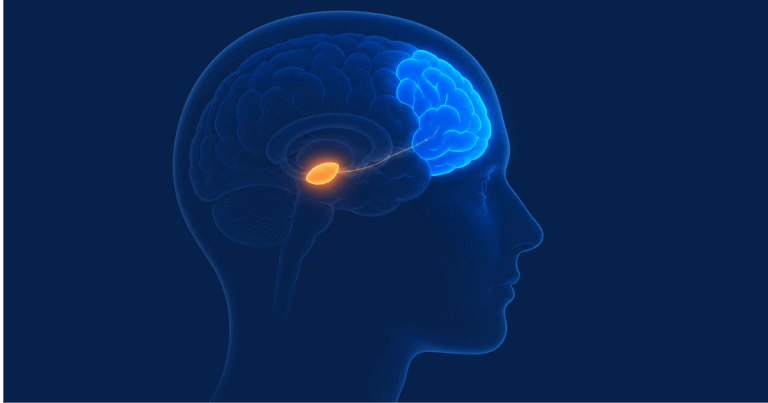
There’s also a plausible link to thinking. The prefrontal cortex, which supports focused, goal-directed thought, is highly sensitive to stress, and stress signalling can rapidly impair its function (Arnsten, 2009). If a breathing technique lowers acute arousal, it could help protect clear thinking under pressure. That step hasn’t been tested directly for the physiological sigh, so treat it as reasoning, not a result. For heart rate variability itself, see HRV training and stress optimisation.
What do the physiological sigh trials show?
The main study randomised 108 adults, mostly young and many recruited from a Stanford undergraduate class, to five minutes a day for a month of one of four practices. These were cyclic sighing (repeated physiological sighs with long exhales), box breathing (equal inhale, hold, exhale and hold), cyclic hyperventilation with breath retention, or mindfulness meditation (Balban et al., 2023).
All groups improved in daily mood and anxiety. Breathwork as a whole raised positive mood more than mindfulness, and cyclic sighing was the only single technique whose improvement was significantly greater than mindfulness. It was also the only one that significantly reduced resting breathing rate compared with mindfulness, and the mood benefit grew with more days of practice. The three breathing techniques weren’t tested against one another, and their day-to-day mood gains were similar. No group showed significant changes in heart rate variability or resting heart rate.
So cyclic sighing did best against mindfulness, but the trial doesn’t show it beats box breathing. It was also one month, delivered remotely, in healthy young adults without psychiatric conditions. A wider meta-analysis of randomised trials found breathwork reduced self-reported stress with a small-to-medium effect (g = −0.35 across 12 trials and 785 adults), with similar effects for anxiety and depression, and most studies at moderate risk of bias. The authors warned of a “mismatch between hype and evidence” (Fincham et al., 2023). Breathwork is a useful tool, not a treatment for chronic stress or anxiety, or a substitute for professional help.
Which breathing techniques are worth using?
The single physiological sigh is the in-the-moment option: two inhales through the nose, one long exhale through the mouth, once or twice. Use it before a difficult conversation or when you notice tension building. Its acute effect hasn’t been measured in the trial, which tested daily practice, but it’s free and low-risk.
Five minutes of cyclic sighing is the daily version tested in the trial: the same pattern repeated for five minutes, ideally at a consistent time. Box breathing (four counts in, hold, out, hold) is a steadier rhythm some people prefer, for example before a block of deep work; its mood gains in the trial were similar to cyclic sighing’s, though not significantly greater than mindfulness. For bedtime, slow breathing with long exhales is one of the options in how to fall asleep faster.
Is breathwork safe?
Gentle slow breathing is low-risk for most people. The real hazard comes from hyperventilating and then holding your breath. Over-breathing lowers carbon dioxide, which delays the urge to breathe, so oxygen can fall far enough to cause a sudden blackout without warning. In water this can be fatal: a CDC report on dangerous underwater breath-holding in New York State between 1988 and 2011 described 16 cases, four of them fatal, and all four deaths involved deliberate hyperventilation (Boyd et al., 2015).
Hyperventilation-with-retention methods were one of the arms in the trial and did improve mood, but not significantly more than mindfulness, and data on adverse effects across breathwork studies are limited. If you use them, do so seated or lying down, never in or near water, while driving or while standing, and stop if you feel lightheaded. People with heart or lung conditions, those who are pregnant and anyone prone to panic attacks should check with a clinician first. For another popular stressor, see cold exposure, which has its own risks.
Physiological sigh and breathwork claims ranked by evidence
🟢 Stronger or replicated evidence · 🟡 Limited, mixed or preliminary evidence · 🔴 Not established or not supported
Worked example — a five-minute cyclic sighing session
Based on the practice tested in the trial; a method illustration, not a prescription.
Set up. Sit comfortably, feet on the floor, and set a five-minute timer. Never in water or while driving.
Breathe in twice. A slow, full inhale through the nose, then a short second inhale on top to fill the lungs.
Breathe out slowly. Exhale gently through the mouth until the lungs feel empty, making the exhale clearly longer than the two inhales together.
Repeat. Keep the pace slow and comfortable for the full five minutes. If you feel lightheaded, return to normal breathing.
Review after two weeks. Note your mood before and after each session on a simple 1–10 scale. In the trial, the benefit grew with more days of practice, so judge consistency rather than any single session.
Worked examples — applying the evidence to four situations
If you want something for a stressful moment: one or two physiological sighs before a meeting or a hard conversation. It’s quick and discreet; just don’t expect it to fix the underlying stress.
If you want a daily practice: five minutes of cyclic sighing at a fixed time is the best-studied option. Box breathing is a reasonable alternative if you prefer its rhythm.
If you’re drawn to intense hyperventilation methods: they weren’t better for mood in the trial and carry blackout risk. If you try them, only seated or lying down, and never near water.
If you have panic attacks or a heart or lung condition: speak to a clinician first. Focusing on breathing can make some people more anxious at first, and breathwork isn’t a substitute for treatment.
The NeuroEdge Formula Breath Reset Self-Testing Framework
Gentle techniques first, judged over weeks. A practical routine, not a tested programme.
1. In the moment
One or two physiological sighs when tension builds: two inhales through the nose, one long exhale.
2. Daily practice
Five minutes of cyclic sighing at a consistent time, the pattern tested in the trial.
3. Before focused work
About a minute of slow breathing or box breathing as a settling routine, if you find it helps.
4. Stay safe, review honestly
No breath-holding in water, driving or standing. Rate mood before and after for two weeks; an informal log can’t prove cause.
Peter’s Testing Notes
A personal impression, not tracked data
Of the things I’ve tried over the years, the physiological sigh has one of the best ratios of effect to effort. I use it before difficult conversations and when I notice my jaw or shoulders tightening at the desk, and I usually feel the tension drop within a couple of breaths.
I’ve done the five-minute daily practice in stretches rather than consistently, so for the cumulative effect I’m relying on the trial rather than my own experience. Years ago I also tried intense hyperventilation-style breathing. It felt fine, but I didn’t notice a benefit worth the time, so I stopped.
None of this was measured, and a quick sense of relief is exactly the kind of impression that’s hard to separate from expectation. An earlier version of this page referred to wearable-tracker data; that has been removed.
Key takeaways
| → | The physiological sigh is two inhales and a long exhale, a deliberate version of a reflex your lungs already use. |
| → | Slow breathing generally shifts the body towards calm, though the supporting studies are small. |
| → | Five minutes of daily cyclic sighing beat mindfulness for mood in one month-long trial, but wasn’t shown to beat box breathing. |
| → | Effects are modest: a small-to-medium reduction in stress across trials, with moderate bias risk. |
| → | Skip breath-holding near water, and keep intense methods seated or lying down, if you use them at all. |
Frequently asked questions
How do you do a physiological sigh?
Take a full breath in through your nose, add a second shorter inhale on top, then breathe out slowly through your mouth, making the exhale longer than both inhales together. Once or twice is enough in the moment.
Does breathwork actually reduce stress?
Yes, modestly. A meta-analysis of randomised trials found a small-to-medium reduction in self-reported stress, but most studies had a moderate risk of bias. It’s a useful tool, not a treatment for chronic stress or anxiety.
Is cyclic sighing better than box breathing?
Not proven. In the main trial, cyclic sighing was the only technique that improved mood significantly more than mindfulness, but the breathing techniques weren’t compared directly and their mood gains were similar.
How long does it take to work?
The trial used five minutes a day for a month, and the mood benefit grew with more days of practice. A single sigh may feel calming within seconds, but that acute effect hasn’t been measured in trials.
Is breathwork safe?
Gentle slow breathing is low-risk for most people. Hyperventilating and then holding your breath can cause sudden blackouts, so never do it in or near water, while driving or while standing. Check with a clinician first if you have a heart or lung condition, are pregnant or have panic attacks.
Get “7 Days to a Sharper Brain” — Free
Peter Benson’s evidence-first starting framework
The habits with the strongest evidence first — sleep, movement, stress and learning — then how to add a single supplement and test whether it actually works for you.
No spam. Unsubscribe anytime.
⚕️ Educational Information, Not Medical Advice
This article is educational and is not medical advice. I’m a cognitive enhancement researcher, not a medical doctor. The guide covers lifestyle habits as well as supplements. Supplements can interact with medicines; consult a qualified healthcare provider before use, particularly if you take prescription medicines or are pregnant or breastfeeding.
Scientific references
1. Balban, M. Y., Neri, E., Kogon, M. M., Weed, L., Nouriani, B., Jo, B., Holl, G., Zeitzer, J. M., Spiegel, D., & Huberman, A. D. (2023). Brief structured respiration practices enhance mood and reduce physiological arousal. Cell Reports Medicine, 4(1), 100895. PMID: 36630953
2. Fincham, G. W., Strauss, C., Montero-Marin, J., & Cavanagh, K. (2023). Effect of breathwork on stress and mental health: a meta-analysis of randomised-controlled trials. Scientific Reports, 13, 432. PMID: 36624160
3. Zaccaro, A., Piarulli, A., Laurino, M., Garbella, E., Menicucci, D., Neri, B., & Gemignani, A. (2018). How breath-control can change your life: a systematic review on psycho-physiological correlates of slow breathing. Frontiers in Human Neuroscience, 12, 353. DOI: 10.3389/fnhum.2018.00353
4. Arnsten, A. F. T. (2009). Stress signalling pathways that impair prefrontal cortex structure and function. Nature Reviews Neuroscience, 10(6), 410–422. PMID: 19455173
5. Li, P., Janczewski, W. A., Yackle, K., Kam, K., Pagliardini, S., Krasnow, M. A., & Feldman, J. L. (2016). The peptidergic control circuit for sighing. Nature, 530, 293–297. Reported in: Live Science
6. Boyd, C., Levy, A., McProud, T., Huang, L., Raneses, E., & Olson, C. (2015). Fatal and nonfatal drowning outcomes related to dangerous underwater breath-holding behaviors — New York State, 1988–2011. MMWR, 64(19), 518. cdc.gov
Cognitive Enhancement Researcher | 18+ Years Independent Research
Peter is not a clinician; this guide is educational, not medical advice. It was rewritten in October 2026 to correct how the main breathwork trial was described, add its null heart rate variability result and the meta-analysis caveats, and remove personal claims that were not accurate. Read about how NeuroEdge Formula evaluates research.
Last reviewed: October 2026 | Educational content only. Not medical advice.