Hyperbaric Oxygen Therapy Brain
Educational information, not medical advice. Hyperbaric oxygen therapy is a genuine medical treatment with real risks and contraindications — it isn’t a casual wellness gadget. Its use for brain and anti-aging purposes is experimental. Nothing here recommends it for any condition; those are decisions to make with a qualified doctor.
| What it is | Breathing 100% oxygen at raised pressure inside a chamber. It’s an established, evidence-based medical therapy — for specific conditions like decompression sickness, carbon-monoxide poisoning and non-healing wounds. None of those are brain enhancement. |
| The brain claims | Its use for cognition, brain injury and anti-aging is experimental. The mechanism is plausible and early trials are intriguing — but small, largely from one research group, and often tied to commercial HBOT clinics. |
| The “reverse aging” hype | The famous telomere study had 35 people, no control group, and measured blood-cell biomarkers — not real-world aging. “Reverses aging” wildly overstates it. |
| Consumer chambers | The low-pressure “mild” soft chambers sold for wellness are weaker still than the medical-grade units used in studies — likely under-dosed for any of the claimed effects. |
| Bottom line | Real medicine for specific conditions; genuinely interesting early brain research to watch; not a proven brain-optimisation tool — and expensive, time-heavy and not risk-free. |
Hyperbaric Oxygen Therapy and the Brain: Hype vs Evidence
By Peter Benson, Cognitive Enhancement Researcher | 18+ Years Independent Research · Last Updated: September 2026
Hyperbaric oxygen therapy has had a remarkable image change. For decades it was a specialised hospital treatment for divers with decompression sickness and patients with stubborn wounds. Today it’s a fixture of the longevity scene — celebrities and biohackers climbing into pressure chambers, and headlines announcing that it “reverses aging.” Somewhere between those two worlds lies the truth, and it’s more interesting than either: a genuine medical therapy with a plausible brain mechanism, some intriguing early research, and a consumer hype machine running well ahead of the evidence.
This guide sorts the three apart — the established medicine, the promising-but-early brain science, and the overblown anti-aging marketing. It’s a biohacking topic that rewards the same sceptical read we brought to red light therapy: real mechanism, thin human evidence, and a big gap between the lab and the sales pitch.
What HBOT Is — and Its Real Medical Uses
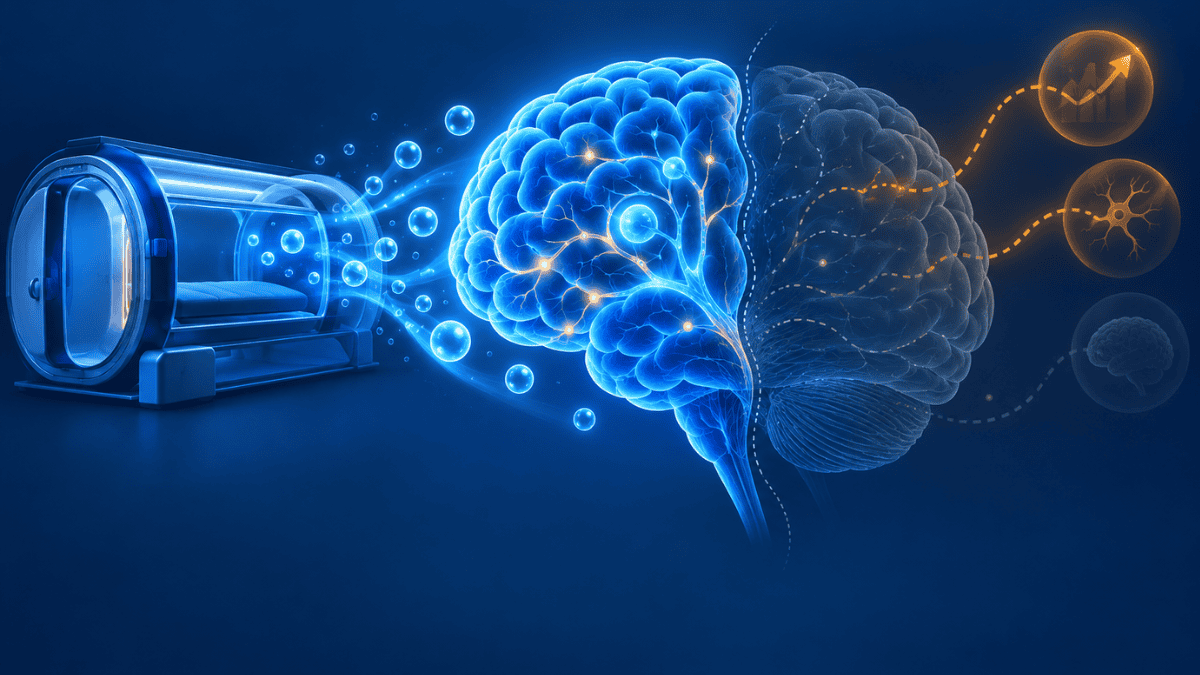
Hyperbaric oxygen therapy (HBOT) means breathing pure, 100% oxygen while inside a chamber pressurised above normal atmospheric pressure. The combination — more oxygen, at higher pressure — dramatically increases the amount of oxygen dissolved in your blood and delivered to tissues. This isn’t fringe science; it’s well-established physiology with a legitimate, decades-long place in medicine.
Crucially, though, its approved uses are specific and mostly unrelated to the brain: treating decompression sickness in divers, carbon-monoxide poisoning, non-healing wounds (especially in diabetes), certain serious infections, radiation tissue damage, and a handful of others. For these, the evidence is solid and HBOT is genuine, valuable medicine. But notice what’s not on that list: memory, focus, “brain optimisation” or anti-aging. The established credibility of HBOT for wounds and diving injuries is often borrowed, in marketing, to lend authority to brain and longevity claims that rest on far shakier ground. Keeping those two categories separate is the first and most important step to reading this honestly.
The Mechanism: Why It Might Help the Brain
There is a genuinely intriguing rationale for why HBOT could affect the brain, and it’s worth understanding because it’s the strongest part of the case. The leading idea is called the hyperoxic-hypoxic paradox (Hadanny & Efrati, 2020). Counter-intuitively, repeatedly flooding the body with oxygen and then returning to normal levels can trick cells into responding as if they’d been briefly starved of oxygen — activating the same regenerative signals that low-oxygen states trigger, without the harm.
In theory, this cascade switches on processes the aging brain could use: new blood-vessel growth, mitochondrial activity, stem-cell mobilisation and support for neuroplasticity. It’s a coherent, biologically plausible story — which is exactly why it’s persuasive. But as with every intervention on this site, a plausible mechanism is a reason to investigate, not a proof of benefit. Plenty of mechanisms that look elegant on a slide fail to translate into real cognitive gains in actual people. The question is always what happens when you test it — and here the answer is genuinely mixed.
The Brain Evidence: Early, Promising, and Conflicted
There genuinely is human research on HBOT and the brain, and some of it is encouraging. Trials have reported benefits in chronic post-concussion syndrome years after mild traumatic brain injury (Boussi-Gross et al., 2013), in stroke recovery, in cognitive function in aging adults, and more recently in post-COVID cognitive symptoms. Taken at face value, that’s a promising spread of findings for a hard-to-treat set of conditions.
But two caveats sit heavily on all of it. First, these studies are generally small, and a striking proportion come from a single research group in Israel — impressive productivity, but a long way from the broad, independent replication that turns promising findings into established ones. Second, and impossible to ignore, is a conflict of interest: the leading researchers are associated with commercial hyperbaric clinics that sell the very treatment they study. That doesn’t make their work wrong — it’s published, peer-reviewed and often carefully done — but it’s a textbook reason to weigh the results soberly rather than take the enthusiastic conclusions at face value. Encouraging early evidence from interested parties is exactly the situation that calls for waiting on larger, independent trials.
The “Reverse Aging” Headlines, Examined
No HBOT result has travelled further than the claim that it “reverses aging.” It comes from a 2020 study by Hachmo and colleagues, which reported that after 60 HBOT sessions, participants’ immune-cell telomeres lengthened by over 20% and their senescent (“zombie”) cells decreased — two changes associated with biological aging. Splashed across headlines, it became proof that a pressure chamber could turn back the clock.
Look at the actual study and the enthusiasm deflates fast. It enrolled just 35 people and had no control group — a single-arm trial in which everyone received HBOT, so there’s nothing to compare against and no way to rule out other explanations. It measured surrogate biomarkers in isolated blood cells, not any real-world outcome: no one was shown to think better, live longer or age more slowly in any way you’d notice. Telomere length in blood cells is a marker that can move for many reasons, and its link to actual aging is far from simple. Add the commercial conflict of interest, and this is a small, uncontrolled, biomarker study — genuinely interesting as a signal to investigate further, but nowhere near the “clinically proven age reversal” the marketing implies. It’s a hypothesis dressed up as a breakthrough.
Consumer Chambers, Cost and Real Risks
If the studied version is unproven for the brain, the consumer version is on even shakier ground. The trials use medical-grade “hard” chambers at meaningful pressures. What’s often sold and rented for home wellness are soft “mild HBOT” chambers operating at much lower pressure — and there’s little reason to think they deliver the same physiological dose, if any of the claimed effect is real at all. Buying into anti-aging promises with a low-pressure home chamber is stacking an unproven claim on top of an under-powered device.
And this is not a zero-cost, zero-risk experiment. The studied protocols involve dozens of sessions — 60 in the telomere study — each lasting around an hour, which is an enormous investment of time and money. HBOT also carries genuine risks: pressure changes can injure the ears and sinuses (barotrauma), high-pressure oxygen can, rarely, trigger seizures (oxygen toxicity), temporary short-sightedness is common, and the oxygen-rich environment is a fire hazard. There are real medical contraindications, too. This is a serious medical procedure, not a spa treatment — which is all the more reason not to undertake it on the strength of overhyped anti-aging claims.
So Where Does This Leave You?
In a clear, three-part position. HBOT is real medicine for its established indications — if you have one of those conditions, it’s a legitimate, doctor-directed treatment. The brain and aging research is genuinely interesting but early and conflicted — worth following as it develops, especially for conditions like brain injury where options are limited, but not yet the kind of evidence you’d build a health strategy on. And the consumer anti-aging pitch is largely hype — a small, uncontrolled biomarker study and a plausible mechanism, inflated into promises the data doesn’t support and sold with expensive, under-powered home devices.
For a healthy person hoping to sharpen or preserve their brain, the honest verdict is: not yet, and probably not with a home chamber. The time and money it demands are better spent on the interventions with strong, independent evidence — exercise, sleep, and the rest of a real plan to protect cognition as you age. Keep HBOT in the “promising, watch this space” column alongside other longevity ideas — not the “proven, act now” one the marketing wants you to believe.
Say you’ve seen a slick clinic offering hyperbaric “age reversal” and you’re tempted. Run it through the same four questions we use for vetting any exciting-but-unproven biohack — the exact filter that keeps you from overpaying for a hypothesis.
1. Is the mechanism plausible? Yes — the hyperoxic-hypoxic paradox is a coherent story with real cellular effects. It clears the first bar, which is why the pitch feels convincing.
2. What’s the quality of the human evidence? Small trials, heavily concentrated in one research group, with commercial conflicts of interest, and headline “aging” claims resting on a 35-person study with no control group measuring blood-cell biomarkers. That’s a weak, promising-at-best base — not proof.
3. Does the product match the studies? If they’re offering a low-pressure soft chamber, no — that’s not the medical-grade protocol the research used. Even the weak evidence doesn’t transfer to it.
4. What’s the cost and risk? Very high on both — dozens of hour-long sessions, significant expense, and real physical risks. When a large cost meets weak, conflicted evidence, the answer writes itself: not now. Applied honestly, the framework lands you exactly where the science does — worth watching, not worth buying.
HBOT for the Brain — Evidence Ranked
🟢 Well supported | 🟡 Real but qualified | 🔴 Commonly claimed, not supported
| Claim | Evidence | Basis |
|---|---|---|
| HBOT is effective for its approved medical uses | 🟢 Well established | Decompression sickness, CO poisoning, non-healing wounds, etc. — not brain enhancement |
| Plausible brain mechanism (hyperoxic-hypoxic paradox) | 🟡 Plausible | Coherent cellular rationale (Hadanny & Efrati 2020); mechanism ≠ proof |
| Helps brain injury / cognitive aging | 🟡 Early & conflicted | Small trials, mostly one group, commercial COI (Boussi-Gross 2013); needs independent replication |
| “Reverses aging” / proven anti-aging therapy | 🔴 Overstated | 35 people, no control, blood-cell biomarkers only, COI (Hachmo 2020) |
| Consumer “mild” soft chambers deliver the studied benefits | 🔴 Not supported | Lower pressure than medical-grade study protocols; likely under-dosed |
| A safe, casual wellness gadget for healthy people | 🔴 Not accurate | Real risks (barotrauma, oxygen toxicity), high cost/time, contraindications |
The NeuroEdge HBOT Reality Check
How to think about a real medical therapy that’s been oversold as a brain hack. Updated September 2026.
HBOT is proven for specific conditions — but that credibility doesn’t transfer to brain and anti-aging claims. Don’t let one borrow the other’s authority.
It rests on a small, uncontrolled, biomarker study with commercial conflicts of interest. Interesting signal, not proven age reversal.
Low-pressure home units aren’t the medical-grade devices used in studies. Even the weak evidence doesn’t apply to them.
The time and money HBOT demands go further on exercise, sleep and diet. Watch the research; don’t build a routine on it yet.
Peter’s Notes — Hyperbaric Oxygen
First-person, n=1 — impressions, not measurements · Updated September 2026
Hyperbaric oxygen is a topic where I have to be honest that I can’t be an n-of-1 testimonial — and I think that’s telling. The studied protocols mean dozens of hour-long sessions in a medical-grade chamber, at real cost and with real risks. That’s not something I’d casually self-experiment with, and I’d be wary of anyone who treats it as a light lifestyle add-on rather than the serious procedure it is.
What I’ve mostly done, then, is watch the research — and watch the conflicts of interest, which are unusually blatant here. When the most eye-catching “reverse aging” findings come from small, uncontrolled studies run by people who also sell the treatment, my scepticism dial goes all the way up. It doesn’t mean the work is worthless; it means I want to see independent groups replicate it before I take the headlines seriously, let alone act on them.
So my stance is genuine curiosity held at arm’s length. The mechanism is elegant and the brain-injury research in particular is worth following. But for a healthy person chasing sharper cognition or a longer life, I don’t think the evidence is remotely there yet — and the soft-chamber home versions least of all. Interesting to track; nowhere near something I’d recommend acting on. (These notes are direction-only impressions, not measured results.)
Key Takeaways — HBOT and the Brain
| ✓ | It’s real medicine — for specific conditions. HBOT is well-established for decompression sickness, carbon-monoxide poisoning, non-healing wounds and similar. None of those are brain enhancement, and that credibility doesn’t transfer to cognitive claims. |
| ✓ | The brain mechanism is plausible. The hyperoxic-hypoxic paradox (Hadanny & Efrati 2020) is a coherent rationale for regenerative effects — but a plausible mechanism is a reason to investigate, not proof of benefit. |
| ✓ | The brain evidence is early and conflicted. Trials in TBI, stroke and cognitive aging are encouraging but small, largely from one research group, and tied to commercial hyperbaric clinics — a clear signal to await independent replication. |
| ✓ | “Reverses aging” is badly overstated. The famous telomere study had 35 people, no control group, and measured blood-cell biomarkers, not real-world aging — with commercial conflicts of interest. It’s a signal to study, not a proven therapy. |
| ✓ | Not for healthy brains yet — and mind the risks. It’s expensive, time-heavy and carries real risks; soft home chambers are weaker still. Spend on proven levers (exercise, sleep, diet) and keep HBOT in the “watch this space” column. |
Hyperbaric Oxygen Therapy & the Brain — FAQ
Does hyperbaric oxygen therapy improve brain function?
Possibly, in certain conditions, but it’s far from proven for healthy people. There’s a plausible mechanism (the hyperoxic-hypoxic paradox) and some encouraging early trials in brain injury, stroke recovery and cognitive aging — but these are small, largely from a single research group, and often tied to commercial hyperbaric clinics, so they need independent replication. For a healthy person seeking sharper cognition, the evidence isn’t there yet, and the treatment is expensive, time-consuming and carries real risks.
Can HBOT really reverse aging?
That claim is dramatically overstated. It comes from a 2020 study reporting that HBOT lengthened telomeres and reduced senescent cells in participants’ blood cells — but the study had just 35 people, no control group, and measured surrogate biomarkers rather than any real-world sign of slower aging. Add the researchers’ commercial conflicts of interest, and it’s a small, uncontrolled, hypothesis-generating study, not proof of “age reversal.” It’s a signal worth investigating, nothing you should treat as established.
Are the home “mild HBOT” soft chambers worth it?
For brain or anti-aging purposes, there’s little basis to recommend them. The research uses medical-grade hard chambers at meaningful pressures, whereas soft “mild HBOT” chambers operate at much lower pressure and likely don’t deliver a comparable physiological dose. So you’d be spending significant money on a device that doesn’t match the studied protocol, to chase benefits that even the medical-grade version hasn’t proven for healthy people. That’s stacking one weak assumption on another.
Is hyperbaric oxygen therapy safe?
In proper medical settings for approved uses, it’s used safely every day — but it isn’t risk-free, and it’s a genuine medical procedure rather than a spa treatment. Pressure changes can injure the ears and sinuses (barotrauma), high-pressure oxygen can rarely trigger seizures (oxygen toxicity), temporary short-sightedness is common, and the oxygen-rich environment is a fire hazard. There are also medical contraindications. These risks are manageable under supervision, but they’re a strong reason not to pursue HBOT casually on the basis of overhyped brain or anti-aging claims.
Should I try HBOT for brain health or longevity?
For a healthy person, the honest answer is not yet. The brain and aging evidence is early, conflicted and reliant on surrogate markers, the treatment is expensive and time-intensive, and it carries real risks — a poor trade for unproven benefit. The exception is genuine medical conditions (for instance, some cases of brain injury) where a doctor might consider it; that’s a supervised medical decision, not a wellness purchase. Otherwise, your time and money go much further on the interventions with strong, independent evidence: exercise, sleep, and a good overall health strategy. Watch the HBOT research; don’t build your routine around it.
Get “7 Days to a Sharper Brain” — Free
Peter Benson’s personal daily protocol, rebuilt from 18 years of testing
Seven evidence-based interventions, in the exact order that makes each one more effective — from sleep foundation to neuroplasticity and Lion’s Mane.
Join 2,000+ readers optimising their cognitive performance. Unsubscribe anytime.
Scientific References
- Hachmo Y, Hadanny A, Abu Hamed R, et al. (2020). Hyperbaric oxygen therapy increases telomere length and decreases immunosenescence in isolated blood cells: a prospective trial. Aging (Albany NY), 12(22):22445–22456. DOI: 10.18632/aging.202188
- Hadanny A, Efrati S. (2020). The hyperoxic-hypoxic paradox. Biomolecules, 10(6):958. DOI: 10.3390/biom10060958
- Boussi-Gross R, Golan H, Fishlev G, et al. (2013). Hyperbaric oxygen therapy can improve post concussion syndrome years after mild traumatic brain injury — randomized prospective trial. PLoS ONE, 8(11):e79995. DOI: 10.1371/journal.pone.0079995

Peter Benson
Cognitive Enhancement Researcher | 18+ Years Independent Research
Peter has spent 18+ years separating genuine cognitive science from wellness marketing. He treats hyperbaric oxygen the way the evidence warrants — real medicine for specific conditions, a plausible but early and conflict-laden brain story, and an anti-aging pitch to watch, not to buy.
Last reviewed: September 2026 | Educational content only. Not medical advice.