Interleaving
Educational information. This article explains a learning technique and the research behind it. It reflects independent research, not medical advice. Study techniques are skills — how well interleaving works depends on the material and on how you apply it, and results vary.
| What it is | Interleaving means mixing different but related problem types or topics within a practice session, instead of doing all of one kind before moving on (which is called blocking). You shuffle the deck rather than sorting it. |
| Why it beats repetition | On delayed tests — the ones that mimic real recall — interleaving reliably outperforms blocking. In maths studies it has roughly doubled scores versus blocked practice (Rohrer 2015), and it improves your ability to tell categories apart (Kornell & Bjork 2008). |
| The catch | It feels worse while you do it. Blocking feels smooth and productive; interleaving feels harder and slower — so learners consistently, and wrongly, judge blocking to be more effective. That illusion is why most people avoid the better method. |
| Where it shines | Learning to distinguish confusable categories or choose the right method — maths problem types, artists’ styles, bird species, diagnoses. Weaker or inconsistent for some maths procedures and near-useless for mixing unrelated topics. |
| Bottom line | A genuinely powerful technique for the right material — but not a universal “mix everything” rule. Similarity matters, and you have to push through it feeling harder than blocking. |
Interleaving: Why Mixing Up Practice Beats Repetition
By Peter Benson, Cognitive Enhancement Researcher | 18+ Years Independent Research · Last Updated: August 2026
Almost everyone studies the same way: pick a topic, drill it until it feels solid, then move to the next one and drill that. It feels organised and productive, and by the end of the session you feel fluent. That approach — called blocking — is intuitive, common, and, for a lot of material, the weaker way to learn. The counter-intuitive alternative, interleaving, is one of the most reliable findings in the science of learning: mix related problem types up, and you remember more and transfer it better — even though it feels worse the whole time you’re doing it.
This guide explains what interleaving is, what the evidence actually shows, why it feels harder than it should, the mechanism behind it, and — the part most articles skip — exactly where it works and where it doesn’t. It’s a core tool in the broader memory and learning toolkit, and it pairs naturally with the other evidence-based techniques.
Blocking vs Interleaving: What They Actually Are
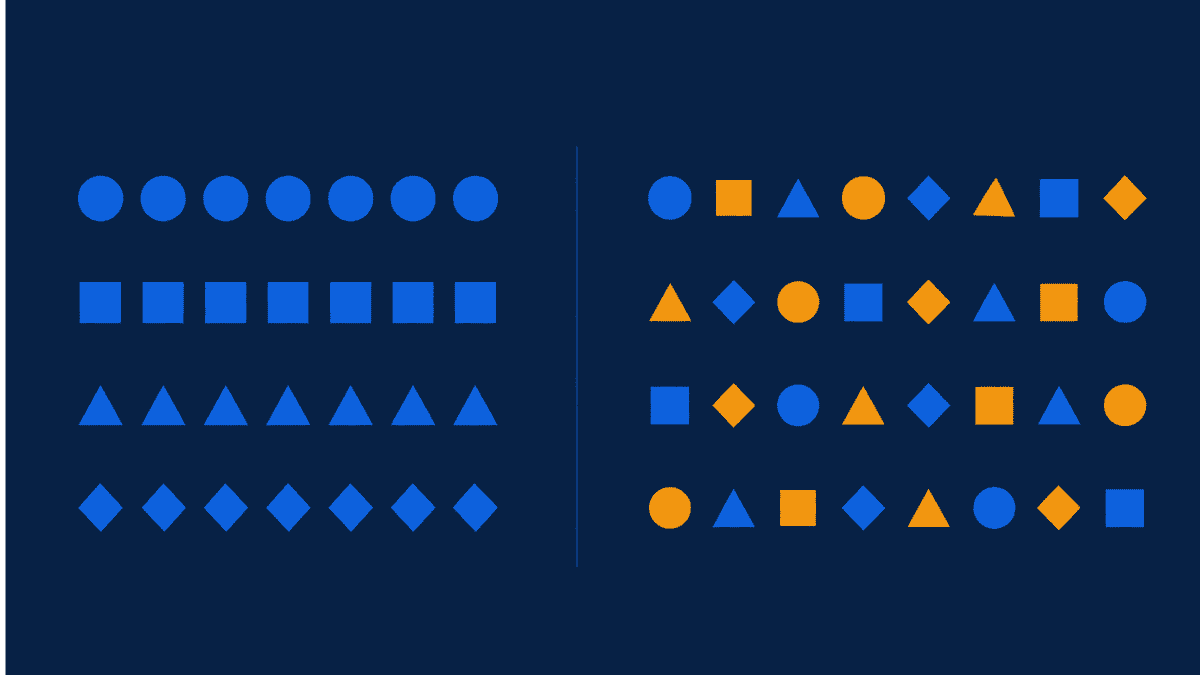
Imagine you’re learning to solve four kinds of maths problem — call them A, B, C and D. Blocked practice does them in runs: AAAA, BBBB, CCCC, DDDD. Interleaved practice mixes them: A, C, B, D, C, A, D, B. Same problems, same amount of practice — only the order differs. The same distinction applies far beyond maths: studying one artist’s paintings all together versus mixing several artists; drilling one Spanish tense before the next versus alternating them; learning bird families one at a time versus side by side.
Blocking feels good because each run lets you settle into a groove — by the third or fourth problem of a type, you barely have to think. Interleaving denies you that groove: every item is a fresh decision. That discomfort is not a bug. It’s very close to the whole point, and it’s why the technique works. The effect was first noticed decades ago in motor-skill training (where it’s called the “contextual interference” effect) and has since been confirmed across classroom and laboratory learning.
The Evidence: Interleaving Wins on the Test That Matters
The key is when you measure. During practice, blocking often looks better — people get faster and more accurate within a run. But on a delayed test, days later, the picture flips. In a well-known series of maths studies, Rohrer, Dedrick and Stershic (2015) had students practise problems either blocked or interleaved, then tested them later. The interleaved groups dramatically outperformed the blocked groups on the delayed test — in this line of research, interleaving has roughly doubled scores compared with blocked practice. Same problems; a large difference in what stuck.
The benefit isn’t limited to maths. In a classic study, Kornell and Bjork (2008) had people learn to recognise the styles of different painters. One group saw each artist’s paintings blocked together; the other saw them interleaved with other artists’. When later shown new paintings and asked to name the artist, the interleaved group was markedly better at identifying who painted what — even for artists they’d never seen those particular works from. Mixing the artists up taught people the thing that actually mattered: how to tell one style from another.
That points to interleaving’s real strength: it doesn’t just help you memorise, it helps you transfer — to apply what you learned to something new. Blocking can build a fragile fluency that fades quickly once the problems stop coming in tidy, predictable runs, decaying along the usual forgetting curve. Interleaving builds the more durable skill of recognising what you’re looking at and choosing the right response.
The Catch: It Feels Worse While You Do It
Here is the single most important — and most human — fact about interleaving: it feels less effective than it is, and blocking feels more effective than it is. In Kornell and Bjork’s painting study, most participants were convinced that blocking had taught them better, even though the test showed the opposite. This is a metacognitive illusion: blocking produces a comfortable sense of fluency in the moment, and we mistake that fluency for learning. Interleaving produces effort and hesitation, and we mistake that difficulty for failure.
The illusion is stubborn. Yan, Bjork and Bjork (2016) found that even after people experienced interleaving working better for them, and were shown that it had, many still believed blocking was superior and reverted to it. The feeling is that persuasive. This is the classic profile of what researchers call a desirable difficulty — a technique that makes learning feel harder in the moment precisely because it’s doing more work, and that pays off later. The practical lesson is blunt: with interleaving, you cannot trust the in-the-moment feeling of how well it’s going. You have to judge it by the delayed test, not by how fluent you feel today.
This is the same reason active recall feels harder than re-reading yet works far better: the effort is the mechanism, not a sign it’s going wrong.
Why It Works
Two mechanisms do most of the work. The first is discriminative contrast. When different types sit side by side, your brain is forced to notice what distinguishes them — the features that make an A problem an A and not a C. Blocking hides those contrasts, because when every item is the same type there’s nothing to tell apart. Research using photographs of birds and butterflies showed that when spacing was arranged so it broke up the direct juxtaposition of categories, the benefit shrank — supporting the idea that it’s the side-by-side comparison, not just the gap in time, that drives the effect (Birnbaum et al., 2013).
The second is retrieval and reloading. Every time you switch types, you have to let go of one approach and reconstruct another from memory — pulling it back into working memory through effortful retrieval, the same engine that powers spaced repetition. In fact interleaving automatically spaces your practice on each type, so part of its power overlaps with the spacing effect. There’s more on these encoding processes in the neuroscience of learning. Crucially, interleaving also trains a step blocking skips entirely: choosing which method a problem needs. In a blocked set you already know it’s an A problem — you never practise the decision. On a real test, half the challenge is recognising what kind of problem you’re even looking at.
Where It Works — and Where It Doesn’t
This is where honesty matters, because interleaving is often oversold as a universal rule. The largest synthesis to date — Brunmair and Richter’s (2019) meta-analysis of 59 papers and over 200 effect sizes — found that the benefit is real but strongly moderated. Its title says it all: similarity matters. Interleaving delivered its largest, most consistent gains for inductive category learning — telling confusable things apart, like painting styles or species. For mathematics, the average effect was positive but small and inconsistent across studies. And for expository text — mixing up reading passages — there was essentially no benefit at all.
The pattern makes sense once you see the mechanism. Interleaving helps most when the things you’re mixing are similar enough to be confused, so that contrasting them teaches you something. Mix items that are already obviously different and there’s no confusion to resolve — which is why Hausman and Kornell (2014) found that simply mixing unrelated study topics together did not improve learning. Interleaving is not “jumble everything”; it’s “deliberately juxtapose the things you need to learn to distinguish.”
So the honest summary is: strong and well worth using for learning to categorise, diagnose, or pick the right method among confusable options; helpful but less dramatic for procedural maths; and not worth forcing on unrelated material. Used in the right place, it’s one of the best tools you have. Used indiscriminately, it just makes studying feel harder for no gain.
Say you’re learning to choose the right statistical test — t-test, chi-square, correlation, ANOVA. These are exactly the kind of confusable categories interleaving is built for, because on the real exam the hard part isn’t running the test, it’s recognising which one a scenario calls for.
The blocked way (feels good, works less): do ten t-test problems in a row, then ten chi-squares, then ten correlations. Within each block you quickly stop reading the scenario — you already know it’s a t-test, so you just crank the procedure. It feels smooth and you leave confident. Come exam day, faced with an unlabelled question, you freeze: you never practised the decision.
The interleaved way (feels harder, works better): shuffle all four types together, so each problem starts with the real question — “what kind of problem is this?” You’ll get more wrong at first, and it’ll feel less fluent than the blocked session. But you’re rehearsing exactly the skill the test demands: reading a scenario cold and choosing the right tool. Keep the types genuinely mixed, judge your progress by a delayed self-test a few days later rather than by how smooth today felt, and you’ll walk into the exam having practised the thing that actually counts.
Interleaving — Evidence Ranked
🟢 Well supported | 🟡 Real but qualified | 🔴 Commonly claimed, not supported
| Claim | Evidence | Basis |
|---|---|---|
| Beats blocking for telling confusable categories apart | 🟢 Well supported | Induction studies + meta-analysis; largest, most consistent effect (Kornell & Bjork 2008; Brunmair & Richter 2019) |
| Improves delayed-test performance & transfer | 🟢 Well supported | Interleaved maths practice roughly doubled delayed scores (Rohrer 2015) |
| Feels worse than it is (metacognitive illusion) | 🟢 Well supported | Learners misjudge it even after seeing it work (Kornell & Bjork 2008; Yan et al. 2016) |
| Helps procedural maths | 🟡 Small & inconsistent | Meta-analysis: positive but small average, varies by design (Brunmair & Richter 2019) |
| Mixing any topics together improves learning | 🔴 Not supported | Mixing unrelated topics gave no benefit (Hausman & Kornell 2014); needs confusable material |
| Works for mixing unrelated reading passages | 🔴 Not supported | Essentially no effect for expository text (Brunmair & Richter 2019) |
The NeuroEdge Interleaving Protocol
How to interleave so it actually helps — targeted at confusable material, judged by delayed recall. Updated August 2026.
Choose related items you tend to mix up — problem types, categories, cases. The more confusable they are, the more interleaving pays off. Don’t mix unrelated subjects.
Mix the types within the session so each item starts with “which kind is this?” That decision — not the procedure — is what you’re training.
You’ll feel slower and less fluent than blocking. That’s the desirable difficulty working — don’t let the discomfort talk you back into blocking.
Measure success with a self-test days later, not by how the session felt. That delayed check is the only honest readout of whether it worked.
Peter’s Testing Notes — Interleaving
First-person, n=1 — impressions, not measurements · Updated August 2026
The thing I had to get over with interleaving was emotional, not technical. Every instinct I have says a study session should feel like it’s going well — smooth, fluent, accumulating. Interleaving feels like the opposite: choppy, error-prone, faintly frustrating. For a long time I read that feeling as “this isn’t working” and drifted back to blocking, which is exactly the illusion the research describes. Naming it as an illusion was what finally let me push through it.
The place it’s earned its keep for me is anything that involves choosing between confusable options rather than executing a known procedure — telling similar concepts apart, picking the right approach to an unfamiliar problem. Whenever the real challenge is “which type is this?”, interleaving is clearly the better rehearsal. Where I don’t bother is genuinely unrelated material — mixing subjects that have nothing to confuse just makes a session harder with no obvious return, which matches what the meta-analysis found.
My rule of thumb now: interleave things I’m likely to mix up, block things I just need reps on, and never judge either by how the session felt in the moment — only by what I can still do a few days later. (These notes are direction-only impressions, not measured results.)
Key Takeaways — Interleaving
| ✓ | Mix, don’t block. Interleaving related problem types within a session beats drilling them one type at a time — on delayed tests it has roughly doubled maths scores and sharply improved the ability to tell categories apart (Rohrer 2015; Kornell & Bjork 2008). |
| ✓ | Don’t trust the feeling. Interleaving feels harder and blocking feels smoother, so we consistently misjudge which is working — a metacognitive illusion that persists even after seeing the results (Yan et al. 2016). Judge by delayed recall, not fluency. |
| ✓ | It trains discrimination and choice. Juxtaposing types teaches you to tell them apart and to pick the right method — the exact skill a real test demands and that blocking never rehearses. |
| ✓ | Similarity matters. The benefit is largest for confusable categories, smaller and inconsistent for procedural maths, and absent for unrelated topics or reading passages (Brunmair & Richter 2019). It’s not “mix everything.” |
| ✓ | Pair it with the family. Interleaving builds in spacing and retrieval, so it works hand in hand with spaced repetition and active recall — the same desirable-difficulty logic across all three. |
Interleaving — FAQ
What is interleaving in studying?
Interleaving means mixing different but related problem types or topics within a single practice session, rather than practising one type to completion before starting the next (which is called blocking). For example, instead of doing all your division problems, then all your fraction problems, you alternate between them. The same amount of practice, in a mixed order — a change that reliably improves how much you retain and how well you can apply it later.
Why does interleaving work better than blocked practice?
Two reasons. First, putting different types side by side forces your brain to notice what distinguishes them, so you get better at telling them apart and choosing the right approach — a skill blocking never trains, because in a block you already know which type you’re doing. Second, every switch makes you retrieve a different method from memory, and that effortful retrieval strengthens learning (it also spaces your practice automatically). The trade-off is that it feels harder in the moment.
If interleaving is better, why does blocking feel more effective?
Because blocking produces a smooth sense of fluency — by the third problem of a type you barely have to think — and we mistake that fluency for durable learning. Interleaving produces effort and hesitation, which we mistake for failing. Studies show learners judge blocking to be more effective even when a test proves interleaving taught them more, and even after they’re shown that result (Kornell & Bjork 2008; Yan et al. 2016). The lesson: don’t judge a study method by how easy it feels while you do it.
Does interleaving work for everything?
No — and this is where it’s often oversold. The largest meta-analysis found the benefit depends heavily on the material: it’s strongest for learning to tell confusable categories apart (styles, species, problem types), smaller and inconsistent for procedural maths, and essentially absent for mixing unrelated reading passages (Brunmair & Richter 2019). Simply jumbling unrelated topics together doesn’t help. Interleaving works when the things you mix are similar enough to be confused — so contrasting them actually teaches you something.
How is interleaving different from spaced repetition?
They overlap but aren’t the same. Spaced repetition is about when you review — spreading practice over time so you retrieve material after a gap. Interleaving is about order — mixing types within a session so you switch between them. Because mixing types automatically spaces your practice on each one, interleaving delivers some of the spacing benefit for free, and the two are often used together. Both belong to the same family of “desirable difficulties” that feel harder but produce more durable learning.
Get “7 Days to a Sharper Brain” — Free
Peter Benson’s personal daily protocol, rebuilt from 18 years of testing
Seven evidence-based interventions, in the exact order that makes each one more effective — from sleep foundation to neuroplasticity and Lion’s Mane.
Join 2,000+ readers optimising their cognitive performance. Unsubscribe anytime.
Scientific References
- Kornell N, Bjork RA. (2008). Learning Concepts and Categories: Is Spacing the “Enemy of Induction”? Psychological Science, 19(6):585–592. DOI: 10.1111/j.1467-9280.2008.02127.x
- Rohrer D, Dedrick RF, Stershic S. (2015). Interleaved practice improves mathematics learning. Journal of Educational Psychology, 107(3):900–908. DOI: 10.1037/edu0000001
- Brunmair M, Richter T. (2019). Similarity matters: A meta-analysis of interleaved learning and its moderators. Psychological Bulletin, 145(11):1029–1052. DOI: 10.1037/bul0000209
- Birnbaum MS, Kornell N, Bjork EL, Bjork RA. (2013). Why interleaving enhances inductive learning: The roles of discrimination and retrieval. Memory & Cognition, 41(3):392–402. DOI: 10.3758/s13421-012-0272-7
- Yan VX, Bjork EL, Bjork RA. (2016). On the difficulty of mending metacognitive illusions: A priori theories, fluency effects, and misattributions of the interleaving benefit. Journal of Experimental Psychology: General, 145(7):918–933. DOI: 10.1037/xge0000177
- Hausman H, Kornell N. (2014). Mixing topics while studying does not enhance learning. Journal of Applied Research in Memory and Cognition, 3(3):153–160. DOI: 10.1016/j.jarmac.2014.02.003

Peter Benson
Cognitive Enhancement Researcher | 18+ Years Independent Research
Peter has spent 18+ years testing learning techniques through systematic self-experimentation. He writes about interleaving the way he uses it — a powerful tool for confusable material, applied deliberately rather than universally, and judged by delayed recall rather than how a session feels.
Last reviewed: August 2026 | Educational content only. Not medical advice.