Hearing Loss and Cognitive Decline
Educational information, not medical advice. Hearing and cognitive concerns should be assessed by a qualified professional — an audiologist for hearing, and a doctor for memory or cognitive worries. This article explains the research link; it isn’t a diagnosis or a treatment plan.
| The headline | The Lancet Commission on dementia ranks hearing loss as the single largest modifiable risk factor for dementia from mid-life — yet it’s rarely part of the brain-health conversation. |
| How strong is the link? | Robust and dose-dependent: greater and longer-lasting hearing loss tracks with higher dementia risk. The association is one of the most consistent in the field. |
| Does treating it help? | The first big trial (ACHIEVE, 2023) found no overall effect on cognition — but a 48% slower decline in older adults who were already at higher risk. Treating hearing loss looks most valuable for those who need it most. |
| Why it matters | Hearing loss is treatable, and addressing it is low-risk. That makes it one of the few brain-protective levers genuinely within your control. |
| What to do | Get your hearing tested, treat any loss (hearing aids don’t restore hearing, but they manage it), and protect your ears from loud noise. Simple, overlooked, and worth doing. |
Hearing Loss and Cognitive Decline: The Overlooked Risk Factor
By Peter Benson, Cognitive Enhancement Researcher | 18+ Years Independent Research · Last Updated: August 2026
Ask most people what protects the brain as it ages and you’ll hear the usual list: exercise, sleep, diet, staying mentally active. What you almost never hear is the one factor that expert consensus now ranks at the very top of the modifiable list — your hearing. It’s a strange blind spot, because the evidence tying hearing loss to cognitive decline is some of the strongest and most consistent in the whole field, and hearing loss is both common and treatable. This is arguably the most under-appreciated brain-health lever there is.
This guide lays out what the research actually shows — how strong the link is, whether treating hearing loss helps, why the connection might exist, and what to do about it — with the honest caveats intact. It sits within the wider Brain Health & Longevity picture, and it’s one of the clearest examples of a risk you can genuinely act on.
The Overlooked Headline: Hearing Loss Ranks First
The Lancet Commission on dementia prevention is the closest thing this field has to an authoritative scorecard — an expert panel that periodically weighs the evidence and estimates how much of the world’s dementia could, in principle, be prevented by addressing modifiable risks. In its 2024 update, the Commission identified hearing loss as the largest single modifiable risk factor for dementia from mid-life, estimating it accounts for around 7% of dementia cases at a population level — more than physical inactivity, smoking, or diabetes on their model.
One honest note on that number: these population-attributable fractions are model estimates, not precise measurements, and they carry real uncertainty — the exact percentage shifts as data and methods improve. But the headline is stable and striking: of all the things we could change to reduce dementia risk across a population, treating hearing loss sits at or near the top. That it barely features in mainstream brain-health advice — dwarfed by supplements and brain-training apps with far weaker evidence — is exactly the blind spot worth correcting. It belongs in any serious plan to prevent cognitive decline.
The Evidence: A Strong, Dose-Dependent Link
What earns hearing loss that top ranking is the consistency and shape of the evidence. In foundational work following older adults over many years, Lin and colleagues (2011) found that people with hearing loss had a higher risk of developing dementia — and crucially, the risk rose with the severity of the loss. Mild hearing loss was associated with a modest increase, moderate with more, and severe with more still. That kind of dose-response relationship is one of the classic fingerprints that an association might be causal rather than coincidental.
The pattern has since been reinforced by the observation that longer exposure to hearing loss carries higher risk, with the greatest risk in people who had lived with it for decades. More severe, longer-lasting hearing loss, more risk — repeated across many cohorts. It’s this reliability, not a single dramatic study, that puts hearing loss where it sits. But an association, however consistent, still can’t by itself prove that the hearing loss is causing the decline — which is the question the next piece of evidence was built to test.
Does Treating It Help? What the First Big Trial Found
This is where the story gets genuinely interesting — and where honesty matters most. The ACHIEVE trial (2023) was the first large randomised controlled trial to test whether treating hearing loss with hearing aids actually slows cognitive decline. It followed nearly a thousand older adults with hearing loss for three years, giving half a hearing intervention and half a health-education control. And the headline result was, at first glance, disappointing: across the whole group, there was no significant difference in cognitive decline.
But the detail is where it matters. The trial included two populations: a large group of healthy volunteers, and a smaller group drawn from an existing study who were older and had more dementia risk factors. In that higher-risk group, hearing aids reduced three-year cognitive decline by about 48% compared with controls — a large effect. The most likely explanation is that the healthy volunteers were declining so slowly to begin with that there was little room to show a benefit over three years, whereas the higher-risk group had the decline — and so the room to slow it.
The honest reading, then, is neither “hearing aids prevent dementia” nor “treating hearing loss does nothing.” It’s more precise and more useful: treating hearing loss appears to slow cognitive decline most in the people at higher risk — and it’s a low-risk intervention with real quality-of-life benefits regardless. That’s a genuinely strong result for a modifiable factor, stated without overclaiming.
Why Would Hearing Loss Affect the Brain?
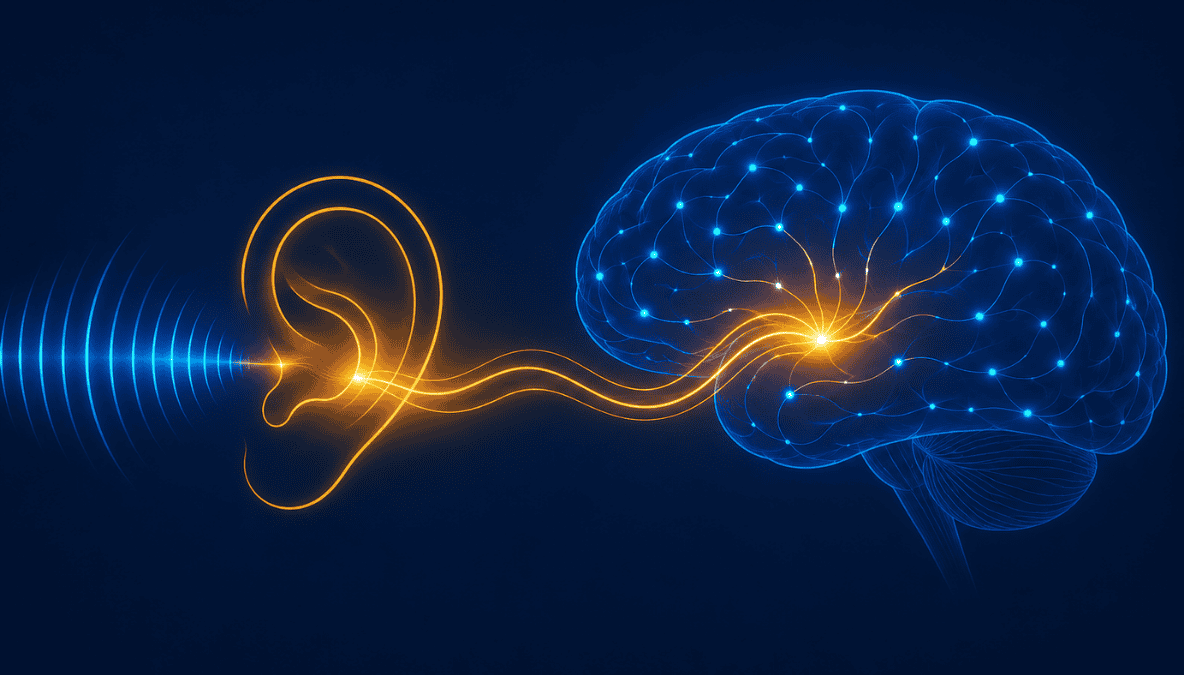
Researchers don’t think there’s a single explanation — more likely several working together, and the balance between them isn’t fully settled. Three mechanisms are most discussed. The first is cognitive load: when the ear sends a degraded signal, the brain has to work harder to decode speech, diverting resources that would otherwise support memory and thinking — a constant “effortful listening” tax. The second is structural change: reduced input to the brain over years may contribute to faster atrophy in regions involved in hearing and memory. The third is social isolation: hearing loss makes conversation exhausting, people withdraw, and social disengagement is itself a recognised dementia risk factor.
There’s also a genuine open question of direction, sometimes framed as “cause, catalyst, or consequence.” Hearing loss might directly promote decline, or amplify an existing process, or in some cases partly reflect very early brain changes affecting how sound is processed centrally. The ACHIEVE result strengthens the case that at least part of the link is causal — because intervening changed the trajectory in higher-risk people — but the full picture is still being worked out. That uncertainty is worth stating plainly; it doesn’t undercut the practical takeaway, which is remarkably robust regardless of which mechanism dominates.
What This Means for You
The practical upshot is unusually clear-cut for this field, because the action is cheap, low-risk and independently worthwhile. First, get your hearing tested — many people have gradual, unnoticed loss, and you can’t act on what you haven’t measured. Second, treat any loss you find. Hearing aids don’t restore hearing, but they manage it well, and the evidence suggests the cognitive upside is greatest precisely for those who already carry other risk factors — while the quality-of-life and social benefits apply to everyone. Third, protect the hearing you have from loud noise, since prevention beats correction.
None of this is a magic shield — hearing is one modifiable factor among several, and it works best alongside the other proven levers like regular exercise, a good dietary pattern, staying socially and mentally engaged to keep your brain adaptable, and looking after the broader body systems — including the gut-brain axis — that shape long-term cognition. But few of those levers are as overlooked, as measurable, or as straightforward to act on as this one. If you take a single new thing from this article, let it be to book a hearing test.
Consider how this plays out for someone in their fifties who’s started turning the TV up and asking people to repeat themselves — the point at which acting matters most, because mid-life is the window the Commission emphasises.
The common path (do nothing): they assume it’s a normal part of ageing and put off doing anything for a decade or more — which is exactly the “longer exposure, higher risk” scenario the data warns about. The loss quietly compounds: more effortful listening, gradually less socialising because conversation is tiring, and years of reduced input to the brain.
The evidence-guided path (act early): they book a hearing test, discover mild-to-moderate loss, and treat it. They won’t feel a cognitive boost — that’s not how this works, and expecting one is the wrong test. What they’ve done is remove a compounding risk factor during the window it matters most, keep themselves in conversations rather than withdrawing from them, and, if they carry other risk factors, plausibly bend their long-term trajectory.
The lesson mirrors the evidence exactly: the value isn’t a felt improvement today, it’s the quiet removal of a leading modifiable risk over years — and the single decisive action was the one most people skip, getting tested instead of assuming.
Hearing Loss and Cognition — Evidence Ranked
🟢 Well supported | 🟡 Real but qualified | 🔴 Commonly claimed, not supported
| Claim | Evidence | Basis |
|---|---|---|
| Hearing loss is linked to higher dementia risk, dose-dependently | 🟢 Well supported | Consistent cohorts; risk rises with severity & duration (Lin 2011) |
| It’s the largest single modifiable dementia risk factor | 🟢 Expert consensus | Lancet Commission 2024 (~7% population attributable fraction) |
| Treating hearing loss slows decline in higher-risk older adults | 🟢 RCT-supported | 48% slower 3-yr decline in the higher-risk subgroup (ACHIEVE 2023) |
| The exact “7%” figure is precise | 🟡 Model estimate | Population-attributable fractions carry real uncertainty; the ranking is firmer than the number |
| Hearing aids prevent dementia for everyone | 🔴 Overstated | No overall trial effect; benefit concentrated in higher-risk people (ACHIEVE) |
| One mechanism fully explains the link | 🟡 Unsettled | Likely several (cognitive load, atrophy, isolation); “cause, catalyst, or consequence” still debated |
The NeuroEdge Hearing Protocol
Test, treat, protect — the three actions that turn a top-ranked risk factor into a lever you actually control. Updated August 2026.
Loss is usually gradual and easy to miss. A simple audiology test tells you where you stand — the one thing you can’t act on without.
If you have loss, treat it. Hearing aids manage rather than restore, but the cognitive upside is greatest for higher-risk people — and social benefits apply to all.
Guard against loud noise — concerts, power tools, earbuds turned up. Prevention is easier than correction, and it starts young.
Don’t wait. The risk grows with duration, and mid-life is the window the evidence emphasises. Earlier action means less accumulated exposure.
Peter’s Notes — Hearing
First-person, n=1 — impressions, not measurements · Updated August 2026
Of everything I’ve researched for this site, hearing is the topic that most changed how I think about brain-health priorities. I’d spent years deep in nootropics and protocols with modest evidence, while a factor sitting at the very top of the expert list — with far stronger data — barely registered with me. That mismatch was humbling, and it’s exactly why I wanted to write this piece.
What makes hearing unusual in my mental filing system is that it’s not something to optimise for a felt effect — there’s no acute sharpening to notice, which is precisely why it gets ignored. It’s a background risk you remove, more like fixing a slow leak than taking a stimulant. That framing helped me take it seriously despite the absence of any day-to-day payoff to chase.
So my honest takeaway is less a protocol than a reprioritisation: the highest-evidence brain-health moves are often the least exciting ones, and a hearing test is a unglamorous, high-value example. It’s the kind of thing I’d rather nudge people toward than another supplement. (These notes are direction-only impressions, not measured results.)
Key Takeaways — Hearing Loss and Cognitive Decline
| ✓ | Hearing loss ranks first among modifiable dementia risks. The Lancet Commission 2024 puts it at the top, ~7% of dementia at a population level — yet it’s largely absent from mainstream brain-health advice. |
| ✓ | The link is strong and dose-dependent. Greater and longer-lasting hearing loss tracks with higher dementia risk across many cohorts (Lin 2011) — a pattern consistent with a causal role. |
| ✓ | Treating it helps most in higher-risk people. The ACHIEVE trial found no overall effect, but a 48% slower 3-year decline in older adults already at higher risk — precise, not overstated. |
| ✓ | The mechanism is plural and unsettled. Cognitive load, brain atrophy and social isolation likely all contribute; the exact causal picture is still being worked out — but the practical advice holds regardless. |
| ✓ | Test, treat, protect — and act in mid-life. It’s low-risk, measurable and independently worthwhile. If you do one new thing for your brain this year, book a hearing test. |
Hearing Loss and Cognition — FAQ
Does hearing loss really increase dementia risk?
Yes — this is one of the more robust findings in the field. Across many long-term studies, people with hearing loss have a higher risk of developing dementia, and the risk rises with the severity and duration of the loss (Lin et al. 2011). The Lancet Commission on dementia ranks hearing loss as the single largest modifiable risk factor from mid-life. An association alone can’t prove cause, but the dose-dependent pattern, plus trial evidence that treating hearing loss slows decline in higher-risk people, makes the link compelling.
Do hearing aids prevent dementia?
Not for everyone, and it’s important to be precise here. The first large randomised trial (ACHIEVE, 2023) found no overall effect of hearing aids on cognitive decline across its full group — but a substantial benefit, about a 48% slower three-year decline, in the subgroup of older adults who were already at higher dementia risk. So hearing aids don’t “prevent dementia” as a blanket claim, but treating hearing loss appears to meaningfully slow decline in those who need it most — and it improves hearing and social life regardless.
Why would hearing loss affect thinking and memory?
Probably through several routes at once. A degraded signal from the ear forces the brain to work harder to understand speech, taxing resources that would otherwise support memory (cognitive load). Years of reduced input may contribute to faster atrophy in hearing- and memory-related regions. And hearing loss often leads to social withdrawal, which is itself a dementia risk factor. Researchers debate the balance between these — and whether hearing loss is a cause, an amplifier, or partly an early marker of brain changes — but the practical advice holds regardless of which dominates.
At what age should I start caring about this?
Mid-life is the window the evidence emphasises, so caring in your forties and fifties is sensible rather than waiting for obvious problems. Because risk grows with how long you live with untreated hearing loss, earlier testing and treatment mean less accumulated exposure. It’s also worth protecting your hearing from loud noise throughout life — prevention is easier than correction. If you’ve noticed turning up the volume, struggling in noisy rooms, or asking people to repeat themselves, that’s a cue to get tested now rather than later.
Should I get a hearing test even if my hearing seems fine?
It’s a reasonable idea, because hearing loss is typically gradual and easy to miss — you adapt to it without realising. A baseline hearing test is quick, low-cost and gives you information you can act on, and it’s the one step everything else depends on. Given that hearing loss is the top-ranked modifiable dementia risk factor and treating it is low-risk, a periodic hearing check is one of the higher-value, lower-effort things you can do for your long-term brain health — far more evidence-backed than most supplements marketed for the same goal.
Get “7 Days to a Sharper Brain” — Free
Peter Benson’s personal daily protocol, rebuilt from 18 years of testing
Seven evidence-based interventions, in the exact order that makes each one more effective — from sleep foundation to neuroplasticity and Lion’s Mane.
Join 2,000+ readers optimising their cognitive performance. Unsubscribe anytime.
Scientific References
- Livingston G, Huntley J, Liu KY, et al. (2024). Dementia prevention, intervention, and care: 2024 report of the Lancet standing Commission. The Lancet, 404(10452):572–628. DOI: 10.1016/S0140-6736(24)01296-0
- Lin FR, Metter EJ, O’Brien RJ, Resnick SM, Zonderman AB, Ferrucci L. (2011). Hearing loss and incident dementia. Archives of Neurology, 68(2):214–220. DOI: 10.1001/archneurol.2010.362
- Lin FR, Pike JR, Albert MS, et al. (2023). Hearing intervention versus health education control to reduce cognitive decline in older adults with hearing loss in the USA (ACHIEVE): a multicentre, randomised controlled trial. The Lancet, 402(10404):786–797. DOI: 10.1016/S0140-6736(23)01406-X

Peter Benson
Cognitive Enhancement Researcher | 18+ Years Independent Research
Peter has spent 18+ years separating high-evidence cognitive strategies from low-evidence hype. He writes about hearing the way the data demands — a top-ranked, treatable, badly overlooked brain-health lever — and favours a hearing test over almost any supplement for long-term protection.
Last reviewed: August 2026 | Educational content only. Not medical advice.