
The Complete Guide to Laser Focus: Evidence-Based Strategies for Sustained Concentration
Medical Disclaimer: The information in this article is for educational purposes only and does not constitute medical advice. Always consult a qualified healthcare provider before beginning any supplement regimen or making significant changes to your health protocols. Individual responses vary. This guide reflects published research and 18+ years of personal experience and does not substitute for professional medical evaluation.
Focus is not a character trait. It is not something you either have or do not have. It is a biological capacity — a product of specific brain networks, neurotransmitter systems, and neurological conditions that can be understood, optimized, and trained with the same precision you would apply to any other performance variable.
The reason most focus advice fails is that it addresses the symptom — the inability to concentrate — without addressing the biology underneath it. Productivity systems tell you to turn off notifications. Time management frameworks tell you to schedule deep work blocks. These interventions are not wrong, but they are incomplete. They work with behavior while ignoring the neurological substrate that determines whether the behavior is even possible. A person whose prefrontal cortex is undermined by chronic stress, sleep debt, and neurochemical depletion cannot simply decide to focus harder — the biological machinery required for sustained attention is not operating at the capacity that behavioral interventions assume.
The approach that actually works addresses focus at every level simultaneously: the neuroscience of how attention works in the brain, the behavioral and mindfulness protocols that train attentional networks directly, and the supplementation strategies that optimize the neurochemical environment in which focus is biologically possible. After 18+ years of researching cognitive enhancement and personally coaching hundreds of individuals through focus optimization protocols, I have found that these three layers are not competing approaches — they are complementary pillars. Each one makes the others more effective.
This is the complete guide to that integrated approach. It is the foundation for everything in the Focus and Productivity section of NeuroEdge Formula — connecting to the detailed compound guides in the Nootropics hub, particularly the caffeine and L-theanine guide, the Rhodiola guide, and the Lion’s Mane guide — and to the behavioral protocols covered in depth throughout this hub.
Part 1: The Neuroscience of Focus — How Attention Actually Works
Before optimizing focus, it is worth understanding what focus actually is at the neurological level — because the mechanisms that produce sustained attention are the same mechanisms that supplementation and mindfulness training target. Understanding the biology makes every intervention more intelligently applied.
The Prefrontal Cortex and Executive Control
Sustained, goal-directed attention is primarily a function of the prefrontal cortex (PFC) — the brain region most associated with executive function, working memory, and voluntary cognitive control. The PFC acts as the brain’s director of attention: it selects relevant stimuli for conscious processing, suppresses irrelevant or distracting stimuli, and maintains task-relevant information in working memory across time. Research on prefrontal cortex function and executive attention has established that PFC activity is the primary neurological correlate of sustained concentration — and that PFC function is exquisitely sensitive to stress, sleep deprivation, and the neurochemical conditions that supplementation and mindfulness protocols directly target.
The PFC operates primarily through dopamine and norepinephrine neurotransmission — the two catecholamines most directly responsible for the alertness, motivation, and working memory that focus requires. Dopamine in the PFC governs the signal-to-noise ratio of attentional processing — adequate dopamine means relevant information gets through clearly while distractions are suppressed. Norepinephrine governs the arousal and urgency signals that determine how much cognitive resources are allocated to a task. Both systems are directly modulated by stress hormones, sleep quality, and several of the compounds covered in the Nootropics hub.
The Default Mode Network: The Biological Source of Mind-Wandering
The single most important neurological concept for understanding why focus is difficult in practice is the default mode network (DMN) — a set of brain regions including the medial prefrontal cortex, posterior cingulate cortex, and angular gyrus that activate during mind-wandering, self-referential thought, and the absence of focused external attention. Research on the default mode network found that the DMN is not simply inactive during rest — it is the brain’s default state, consuming substantial metabolic energy during undirected thought and activating spontaneously whenever the task-positive attention network disengages.
Focused attention and DMN activation are neurologically antagonistic: when the task-positive attention network is active during focused work, the DMN is suppressed. When focus lapses, the DMN activates, producing the mind-wandering and self-referential thought that characterizes distraction. Research on mind-wandering frequency found that people spend approximately 47% of their waking hours with their minds not focused on what they are doing — and that mind-wandering is consistently associated with lower subjective wellbeing and lower task performance. Improving focus, at the neurological level, is fundamentally about strengthening the task-positive network’s ability to suppress DMN activation and maintain that suppression under cognitive demand.
This is precisely where mindfulness meditation produces its most important neurological effects — and why it is the most evidence-supported behavioral intervention for focus improvement.
The Attentional Networks: Alerting, Orienting, and Executive Control
Research by Posner and Petersen established that attention is not a single cognitive function but three separable neurological networks: the alerting network (maintaining a state of readiness for incoming stimuli), the orienting network (directing attention to specific locations or features), and the executive control network (resolving conflict between competing stimuli and maintaining goal-directed behavior). Each network relies on distinct neurochemical systems and brain regions — and each is differentially affected by stress, sleep, supplementation, and mindfulness training. The complete focus optimization protocol addresses all three networks rather than treating focus as a single undifferentiated capacity.
The Stress-Focus Relationship: Why Cortisol Undermines Attention
Chronic psychological stress is the most common biological obstacle to sustained focus — not because stress is merely unpleasant, but because cortisol directly impairs prefrontal cortex function through documented neurobiological mechanisms. Research on cortisol and prefrontal cortex function found that elevated cortisol reduces PFC activity and impairs working memory — precisely the cognitive functions that focused attention requires. Cortisol achieves this through glucocorticoid receptor activation in the PFC, which reduces the dopamine and norepinephrine signaling that supports executive attention. The practical implication is direct: no amount of behavioral focus technique compensates for a prefrontal cortex that is being neurochemically undermined by chronic stress. Stress management is not separate from focus optimization — it is a prerequisite for it.
Part 2: Mindfulness and Behavioral Protocols — Training the Attentional Networks
Mindfulness meditation has accumulated the most rigorous evidence base of any behavioral intervention for focus improvement — not through the mechanism of relaxation or stress reduction alone, but through documented structural and functional changes to the specific brain networks that produce sustained attention. Understanding why mindfulness works at the neurological level is what allows it to be applied most effectively.
What Mindfulness Actually Does to the Brain
Mindfulness meditation — at its core, the deliberate practice of noticing where attention is and returning it to a chosen focus when it wanders — is essentially direct training of the attention regulation circuit. Every time a practitioner notices that attention has wandered to the DMN and returns it to the breath or chosen anchor, they are exercising exactly the neural pathway — from DMN to task-positive network — that focused work requires. Research by Lazar and colleagues found that experienced meditators showed significantly greater cortical thickness in the prefrontal cortex and right anterior insula compared to non-meditators — structural brain changes consistent with the attentional training hypothesis. The PFC changes are particularly relevant: the same region responsible for executive attention shows structural growth with sustained mindfulness practice.
Research on mindfulness training and DMN activity found that meditators showed significantly reduced DMN activation during focused tasks compared to non-meditators — and that the degree of DMN suppression correlated directly with meditation experience. This is the neurological mechanism through which mindfulness improves focus: not by eliminating mind-wandering impulses, but by strengthening the PFC’s capacity to detect and suppress DMN activation more rapidly and more efficiently. Each meditation session is a training session for the attention regulation circuit.
The Evidence for Mindfulness and Cognitive Performance
A randomized controlled trial by Zeidan and colleagues found that just four days of mindfulness meditation training (20 minutes daily) produced significant improvements in sustained attention, working memory, and cognitive flexibility compared to a control group — with effect sizes comparable to those achieved by pharmaceutical cognitive enhancement agents. The rapidity of the improvements — measurable at four days — reflects the efficiency of the attention regulation circuit’s responsiveness to direct training.
Research examining mindfulness and mind-wandering found that mindfulness training significantly reduced mind-wandering frequency during focused tasks — the direct behavioral correlate of improved DMN suppression — and that reductions in mind-wandering were the primary mediator of improvements in reading comprehension and working memory scores. This mediator analysis is important: it confirms that the cognitive performance improvements from mindfulness work specifically through the attention regulation mechanism rather than through general stress reduction or mood improvement.
The Practical Mindfulness Protocol for Focus
Based on the research and 18+ years of personally coaching focus optimization, the most effective mindfulness protocol for attention training is deceptively simple — but its simplicity should not be mistaken for insufficiency. The protocol that produces the neurological changes documented in the research is:
Foundational attention training (daily, 10–20 minutes): Sit comfortably with eyes closed or softly downcast. Choose a primary anchor for attention — the physical sensations of breathing at the nostrils or the rise and fall of the chest are standard. When you notice attention has moved away from the anchor to thought, sound, physical sensation, or anything else, gently return it to the anchor without judgment or frustration. The moment of noticing — not the duration of unbroken attention — is the training event. Each return is a repetition of the attention regulation circuit. Sessions of 10–20 minutes daily produce measurable neurological changes within 4–8 weeks of consistent practice.
Transition practices (2–5 minutes before demanding cognitive work): A brief attention-settling practice before beginning focused work sessions produces measurable improvements in subsequent task performance. Two to five minutes of deliberate breath-anchored attention before sitting down to write, analyze, or create primes the task-positive network and reduces the DMN activation that would otherwise compete for attentional resources at session start. This is the 2-minute cognitive activation protocol referenced throughout this site.
Single-tasking as mindfulness in action: The behavioral corollary of mindfulness training is deliberate single-tasking — choosing one task, removing competing stimuli, and returning attention to the chosen task whenever it wanders. Research on task-switching costs found that switching between tasks produces significant cognitive costs — measurable decrements in performance quality and processing speed — that accumulate across a work session. Single-tasking is not merely a productivity preference; it is the behavioral protocol that respects the neurological reality of attentional switching costs.
The Focus Environment: Neurological Considerations
The environment in which focused work occurs either supports or undermines the neurological conditions for sustained attention through mechanisms that are more direct than most productivity advice acknowledges.
Notification architecture: Every notification — visual or auditory — triggers an orienting response in the alerting network that is involuntary and neurologically obligatory. Research on smartphone notifications and attention found that the mere presence of a smartphone on a desk — even face down and silent — reduces available working memory capacity, as cognitive resources are partially allocated to suppressing the habitual checking impulse. The implication is not merely that notifications interrupt focus — it is that the potential for notifications competes for prefrontal resources even when no notification occurs. Physical removal of devices from the work environment, not silencing, is the neurologically appropriate intervention.
Cognitive load management: The PFC has a finite working memory capacity — typically estimated at 4 ± 1 distinct items simultaneously. Tasks that generate open loops — unresolved decisions, undocumented commitments, unanswered questions — occupy working memory slots that are then unavailable for focused task processing. The capture systems of GTD-style productivity frameworks have neurological justification: externalizing open loops to a trusted system frees PFC working memory for the current task. Before beginning a focused work session, a 2-minute brain dump of open loops to paper or a task manager measurably increases available attentional capacity for the session.
Free Download
Get the 7-Day Brain Optimization Protocol
The evidence-based diet, sleep, and supplement framework for your first week of cognitive enhancement — completely free.
Join 2,000+ readers optimizing their cognitive performance. Unsubscribe anytime.
Part 3: The Supplementation Layer — Optimizing the Neurochemical Environment for Focus
Behavioral and mindfulness protocols train the attentional networks. Supplementation optimizes the neurochemical environment in which those networks operate. The two approaches are not alternatives — they are complementary layers, and the research suggests each amplifies the effectiveness of the other. A brain with optimized dopamine, norepinephrine, and acetylcholine signaling responds more efficiently to attentional training. Conversely, attentional training amplifies the cognitive benefits of supplementation by strengthening the neural architecture that supplementation supports.
The Acute Focus Layer: Caffeine and L-Theanine
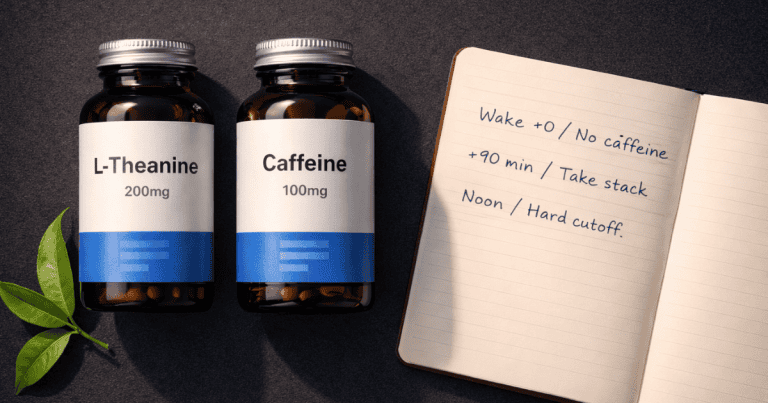
The most evidence-supported acute focus intervention available is the caffeine and L-theanine combination — covered comprehensively in the complete caffeine and L-theanine guide. Caffeine’s adenosine antagonism removes the neurochemical signal of mental fatigue, increasing dopamine and norepinephrine availability in the PFC. L-theanine’s alpha wave promotion produces the alert-but-relaxed cognitive state that is neurologically optimal for focused work — the same state that experienced meditators access through practice. The combination at the 1:2 ratio (100–200mg caffeine with 200–400mg L-theanine) produces the alpha wave signature of focused relaxation through a pharmacological mechanism that is neurologically congruent with the state mindfulness training develops through behavioral means. The two approaches address the same target state through complementary pathways.
The Stress Resilience Layer: Rhodiola Rosea
For sustained focus across long work sessions — particularly under conditions of stress or fatigue — Rhodiola Rosea addresses the HPA axis and monoamine preservation mechanisms that determine whether PFC function is maintained as session duration extends. Rhodiola’s salidroside and rosavin compounds preserve dopamine and serotonin from stress-induced depletion, directly protecting the neurochemical substrate of PFC executive attention. The 300–600mg SHR-5 extract dose taken before demanding cognitive sessions provides the stress resilience layer that prevents the cortisol-mediated PFC impairment that undermines focus under pressure — the neurochemical complement to the cortisol management that mindfulness practice provides through behavioral means.
The Structural Foundation: Lion’s Mane, Bacopa, and Alpha-GPC
The acute focus compounds — caffeine, L-theanine, Rhodiola — optimize neurochemical conditions on a session-by-session basis. The structural compounds build the neurological architecture that determines the ceiling for those acute optimizations. Lion’s Mane drives NGF production and myelination of the neural pathways that rapid attentional processing requires. Bacopa Monnieri enhances cholinergic transmission and dendritic branching in the attention-relevant cortical regions. Alpha-GPC provides acetylcholine precursor for the neurotransmitter most directly responsible for the signal clarity of attentional processing.
These structural compounds require 8–12 weeks of consistent supplementation to produce their cognitive effects — and their focus benefits are most accurately described as raising the ceiling of attentional capacity rather than providing immediate session-specific enhancement. They are the investment compounds in a complete focus protocol, building the neurological infrastructure that the acute compounds and mindfulness training operate within.
The Brain Energy Layer: Creatine and Magnesium L-Threonate
Two compounds from the Nootropics hub deserve specific mention for their focus applications. Creatine‘s phosphocreatine ATP buffering mechanism maintains neural energy availability during cognitively demanding focus sessions — preventing the energy depletion that produces mental fatigue as session duration extends. Magnesium L-Threonate‘s NMDA receptor optimization ensures the synaptic density and plasticity that rapid attentional processing requires. Both compounds address focus from the energy and structural substrate dimensions that no behavioral protocol can substitute for.
Part 4: The Integrated Focus Protocol — Putting It All Together
The complete focus optimization protocol integrates behavioral, mindfulness, and supplementation layers into a coherent daily structure. Each layer addresses a distinct biological variable; together they create the conditions in which sustained attention becomes not just possible but natural.
Morning Protocol (Before the First Focus Session)
Upon waking — delay caffeine 60–90 minutes. The cortisol awakening response provides endogenous arousal for the first 60–90 minutes after waking. Taking caffeine during this window blunts its effectiveness and accelerates tolerance development. Use this window for the foundational attention training practice instead — 10–20 minutes of breath-anchored mindfulness meditation that primes the task-positive network before the first cognitive demands of the day arrive.
60–90 minutes after waking — caffeine and L-theanine. Take 100–200mg caffeine with 200–400mg L-theanine alongside any morning structural supplements (Lion’s Mane, Bacopa, Alpha-GPC, creatine, MgT). The 2-minute transition practice before the first deep work block — a brief breath-anchored attention settling — bridges the morning supplementation timing with the start of focused work.
Before the first focus session — environment preparation. Phone in another room or in a drawer. Browser tabs closed except those directly relevant to the current task. Open loops captured to paper or task manager. These 3 minutes of environmental preparation remove the attentional competition that would otherwise consume PFC resources during the session.
During Focus Sessions
Session architecture: The research on sustained attention suggests that unbroken focus sessions of 90 minutes align with the ultradian rhythm — the 90-minute biological cycle that governs alternating periods of high and lower neural arousal. Sessions of 25–50 minutes (Pomodoro-adjacent) are appropriate during the protocol’s early weeks when attentional stamina is being built; progress toward 90-minute blocks as mindfulness training strengthens the attention regulation circuit over weeks.
During the session — the return practice. When attention wanders — and it will, regardless of supplementation or experience — the protocol is identical to the meditation practice: notice, without judgment, and return to the task anchor. Each return is a training repetition. The goal is not unbroken attention but increasingly efficient detection and return. This reframe — from “I failed to concentrate” to “I successfully noticed and returned” — is functionally important because it removes the frustration response that itself generates cortisol and further impairs PFC function.
Stress Management as a Non-Negotiable Focus Variable
No focus protocol produces its full benefit in the context of unmanaged chronic stress — because cortisol’s direct impairment of PFC function creates a neurochemical ceiling that behavioral and supplementation interventions cannot overcome. The stress management layer of the complete protocol includes: the Ashwagandha and Rhodiola supplementation covered in the Nootropics hub, the mindfulness practice that produces HPA axis recalibration through behavioral means, and the sleep optimization protocols covered in the Sleep hub — since sleep deprivation is the single most impactful acute impairment of PFC function available.
The 30-Day Focus Development Timeline
Week 1: Establish the morning mindfulness practice (10 minutes daily) and the pre-session 2-minute transition practice. Introduce caffeine and L-theanine with proper timing. Begin creatine and MgT as the brain energy and synaptic foundation. Focus session length 25–35 minutes with deliberate single-tasking.
Week 2: Extend morning mindfulness to 15 minutes. Add Rhodiola before demanding afternoon sessions. Begin noticing the quality of the return — how quickly attention is detected as wandered and how smoothly it returns. Extend focus sessions to 35–45 minutes as attentional stamina builds.
Week 3–4: Extend morning mindfulness to 20 minutes. Introduce Lion’s Mane, Bacopa, and Alpha-GPC as the structural foundation (these require 8–12 weeks for full effect but begin their neuroplasticity work immediately). Extend focus sessions toward 50–60 minutes. The combination of mindfulness-trained attention regulation and the neurochemical optimization of the full supplementation stack begins producing qualitatively different focus — not just longer but cleaner, with less subjective effort.
Week 5–12: The structural compounds reach their full neuroplasticity effects. Mindfulness practice produces measurable PFC structural changes documented in the research at 8 weeks of consistent practice. The complete integrated protocol — behavioral, mindfulness, and supplementation — is now operating at full capacity. Focus sessions of 90 minutes become achievable and sustainable without the cognitive fatigue that characterized the pre-protocol baseline.
Frequently Asked Questions About Focus Improvement
What is the fastest way to improve focus?
The fastest evidence-based focus improvement combines two interventions that produce measurable effects within the same session: the caffeine and L-theanine combination at the 1:2 ratio (100–200mg caffeine with 200–400mg L-theanine) and a 2–5 minute breath-anchored mindfulness practice immediately before beginning focused work. The caffeine and L-theanine combination optimizes the neurochemical environment for focused attention within 30–60 minutes of ingestion. The pre-session mindfulness practice primes the task-positive network and reduces default mode network activation — producing measurable improvements in subsequent attention quality that have been documented at as little as 4 days of consistent practice. For sustainable long-term focus improvement, these acute interventions should be embedded within the complete protocol covering structural supplementation, stress management, and consistent mindfulness training.
Does mindfulness meditation actually improve focus?
Yes — mindfulness meditation has one of the strongest evidence bases of any behavioral intervention for attention improvement. Randomized controlled trials have demonstrated significant improvements in sustained attention, working memory, and cognitive flexibility after as few as four days of 20-minute daily practice. Neuroimaging research shows that mindfulness training produces measurable reductions in default mode network activation during focused tasks — directly addressing the mind-wandering mechanism that most commonly disrupts concentration. Structural MRI research documents greater prefrontal cortex thickness in experienced meditators compared to non-meditators — consistent with the hypothesis that mindfulness practice produces lasting structural changes to the brain regions responsible for executive attention. The mechanism is direct attentional training: every time a practitioner notices attention has wandered and returns it to the chosen focus, they are exercising the precise neural pathway that focused cognitive work requires.
What supplements help with focus?
The supplements with the strongest evidence for focus improvement divide into acute and structural categories. For acute session-specific focus enhancement: caffeine and L-theanine at the 1:2 ratio (most thoroughly researched nootropic combination, with documented improvements in attention switching accuracy and alpha wave production in multiple RCTs) and Rhodiola Rosea SHR-5 extract (for stress-resilient focus during demanding sessions, with documented anti-fatigue and cognitive performance maintenance effects). For structural long-term focus improvement: Lion’s Mane mushroom (NGF-driven neuroplasticity supporting attentional processing speed), Bacopa Monnieri (cholinergic enhancement and dendritic branching supporting sustained attention), Alpha-GPC (acetylcholine precursor directly supporting the neurotransmitter of attentional processing), Creatine monohydrate (brain energy buffering preventing attentional fatigue under high cognitive demand), and Magnesium L-Threonate (synaptic density and NMDA receptor optimization). These categories are complementary rather than competing — the complete protocol uses both layers.
Why can’t I focus even when I try hard?
Difficulty focusing despite effort is almost always a biological signal rather than a motivation or willpower problem. The most common biological causes are: chronic stress and elevated cortisol (which directly impairs prefrontal cortex function through glucocorticoid receptor mechanisms — no amount of effort compensates for a neurochemically undermined PFC), sleep deprivation (even mild chronic sleep restriction produces measurable impairments in sustained attention and working memory), magnesium deficiency (affecting nearly half of Western adults and directly impairing the NMDA receptor function that synaptic attention processes depend upon), inadequate dietary creatine (vegetarians and vegans particularly susceptible, producing brain energy deficits that limit attentional stamina), and inadequate attentional training (the PFC’s capacity for sustained attention is trainable through mindfulness practice — without deliberate training, the default mode network’s mind-wandering tendency dominates). Addressing these biological foundations is more effective than trying to force focus through effort or willpower.
How long does it take to improve focus?
The timeline for focus improvement depends on which interventions are used and which biological variables are being addressed. Acute improvements are available within the same session: caffeine and L-theanine produce measurable attention improvements within 30–60 minutes of ingestion, and a 2–5 minute pre-session mindfulness practice produces measurable improvements in subsequent task performance. Short-term improvements become noticeable within 1–4 weeks of consistent mindfulness practice and Rhodiola supplementation. Medium-term improvements from Ashwagandha’s cortisol reduction and sleep quality optimization typically manifest within 4–8 weeks. Structural neuroplasticity improvements from Lion’s Mane, Bacopa, and Alpha-GPC require 8–12 weeks of consistent supplementation. The complete integrated protocol — behavioral, mindfulness, and supplementation — reaches full effectiveness at approximately the 12-week mark, which is why the 90-day timeline is the assessment framework used throughout NeuroEdge Formula.
The Complete Focus Protocol: Where to Go From Here
Focus is not a fixed trait — it is a trainable biological capacity determined by the neurological architecture, neurochemical conditions, and attentional habits that your daily protocols either build or undermine. The integrated approach covered in this guide addresses all three dimensions: the neuroscience that explains why attention behaves the way it does, the behavioral and mindfulness protocols that directly train the attentional networks, and the supplementation strategies that optimize the neurochemical environment in which focused work becomes sustainable.
The most important insight from 18+ years of personally researching and coaching focus optimization is that these three layers are not competing approaches requiring a choice between them. They are complementary pillars — each one making the others more effective. Mindfulness training amplifies the cognitive benefits of supplementation by strengthening the neural architecture that supplements support. Supplementation creates the neurochemical conditions in which mindfulness training produces its structural brain changes most efficiently. And both operate within the stress management and sleep foundation that determines the ceiling for every other focus intervention.
The articles throughout this Focus hub address each component of this integrated protocol in depth. For the acute focus supplementation protocol, see the caffeine and L-theanine guide and the Rhodiola guide. For the structural neuroplasticity foundation, see the Lion’s Mane, Bacopa, and Alpha-GPC guides. For the brain energy foundation, see the creatine and Magnesium L-Threonate guides. For the realistic timeline of when the complete protocol produces its full effects, see the 90-day cognitive enhancement timeline.
References
- Miller, E.K., & Cohen, J.D. (2001). An integrative theory of prefrontal cortex function. Annual Review of Neuroscience, 24, 167–202. PubMed
- Buckner, R.L., Andrews-Hanna, J.R., & Schacter, D.L. (2008). The brain’s default network. Annals of the New York Academy of Sciences, 1124, 1–38. PubMed
- Killingsworth, M.A., & Gilbert, D.T. (2010). A wandering mind is an unhappy mind. Science, 330(6006), 932. PubMed
- Posner, M.I., & Petersen, S.E. (1990). The attention system of the human brain. Annual Review of Neuroscience, 13, 25–42. PubMed
- Arnsten, A.F. (2009). Stress signalling pathways that impair prefrontal cortex structure and function. Nature Reviews Neuroscience, 10(6), 410–422. PubMed
- Lazar, S.W., et al. (2005). Meditation experience is associated with increased cortical thickness. NeuroReport, 16(17), 1893–1897. PubMed
- Brewer, J.A., et al. (2011). Meditation experience is associated with differences in default mode network activity and connectivity. Proceedings of the National Academy of Sciences, 108(50), 20254–20259. PubMed
- Zeidan, F., et al. (2010). Mindfulness meditation improves cognition: Evidence of brief mental training. Consciousness and Cognition, 19(2), 597–605. PubMed
- Mrazek, M.D., et al. (2013). Mindfulness training improves working memory capacity and GRE performance while reducing mind wandering. Psychological Science, 24(5), 776–781. PubMed
- Ward, A.F., et al. (2017). Brain drain: The mere presence of one’s own smartphone reduces available cognitive capacity. Journal of the Association for Consumer Research, 2(2), 140–154. PubMed
Tags: how to improve focus, focus and concentration, mindfulness for focus, default mode network, prefrontal cortex attention, caffeine L-theanine focus, nootropics for focus, deep work neuroscience, mind-wandering default mode, attention training, Rhodiola focus, Lion’s Mane focus, alpha wave focus, sustained concentration protocol, cognitive enhancement focus
About Peter Benson
Peter Benson is a cognitive enhancement researcher and mindfulness coach with 18+ years of personal and professional experience in nootropics, neuroplasticity, and attention optimization protocols. He has personally coached hundreds of individuals through integrated focus improvement programs combining evidence-based mindfulness training with targeted supplementation strategies. NeuroEdge Formula is his platform for sharing rigorous, safety-first cognitive enhancement guidance.